
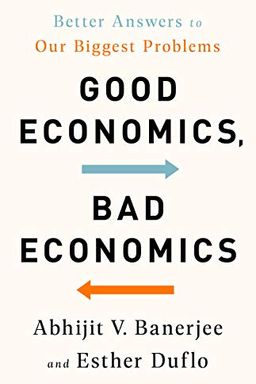
Good Economics for Hard Times cover

Good Economics for Hard Times

by Abhijit V Banerjee and Esther Duflo

Good Economics for Hard Times explores how economic insights can address pressing global challenges like climate change, inequality, and immigration. Nobel laureates Banerjee and Duflo offer fresh perspectives and practical solutions to create a more equitable and sustainable world.

Rethinking Economics for a Real World

Do economists really understand the world you live in? The book argues they often do not — at least not in the way the public expects. The opening claim is bold but humble: economics loses trust when it promises certainty instead of understanding. You see economists debate tariffs on TV or predict growth numbers that quickly prove wrong, and you conclude they are detached from daily life. Yet the point the authors make is that this is not a problem of data, but of method — economics works best when it behaves like medicine: start from facts, test small interventions, revise the model when the evidence changes, and act cautiously when uncertainty is large.

Trust and the economist's burden

Surveys reveal a trust deficit: only about a quarter of Americans say they trust economists on their own topics. Expert panels such as the IGM Booth economists often disagree with public opinion about tariffs, trade, or immigration, giving the impression of aloof technocracy. The IMF’s forecasting record—errors averaging nearly three percentage points in GDP projections—deepens the skepticism. What the book calls “good economics” isn’t about predicting GDP growth precisely; it’s about reasoning transparently, admitting what we don't know, and letting evidence—not ideology—guide our policy conclusions.

From theory to human reality

The authors take classical ideas about efficiency and welfare and translate them into human consequences. You move through migration, trade, innovation, and growth not as abstract formulas but as lived experiences. For example, the Bangladesh migration experiment shows that a mere $11.50 incentive transforms lives—proof that simple constraints like liquidity and fear matter more than textbook wage gaps. Similarly, the “China shock” reveals why trade’s winners and losers fall along geography rather than national averages; people in Bruceton, Tennessee didn’t lose prosperity because trade theory failed—they lost because adjustment policy ignored local realities.

Identity, dignity, and the politics of belief

Economics cannot avoid psychology. People's identities shape preferences and their votes. Stereotypes, media echo chambers, and caste or class norms mold economic behavior as strongly as incentives. The book brings Elinor Ostrom’s work on local enforcement into modern polarization: when communities punish deviation from group norms, discrimination and division persist even when individuals disagree privately. Good economics, therefore, refuses the illusion that rational choice operates in a vacuum—it admits that social ties, pride, and moral worth determine economic outcomes.

Measurement and the myth of growth

When you hear economists debate productivity or GDP, you might imagine these metrics capture welfare directly. But growth is far more elusive. Since the Trente Glorieuses (1950–1973), productivity has slowed, and even Paul Romer’s endogenous models cannot fully explain why. Abhijit Banerjee and Esther Duflo urge a redefinition: well-being isn't GDP alone. A family’s time together or a child’s play has value invisible to national accounts. If GDP barely measures digital goods, unpaid care, or social trust, then chasing growth numbers risks missing the real question: what improves lives sustainably?

Policy humility and pragmatic design

Good economics ends where good policy begins—with humility. Whether helping displaced American workers, easing rural migrants into city life, or fostering innovation, the answer is not grand theory but small, evidence-guided design. The authors celebrate experiments and transparency over ideology: pilot programs for training, migration insurance, local reallocation funds, and reputation networks for small entrepreneurs (like Hamis Carpets in Egypt) matter more than slogans about protection or deregulation. The message is clear: economics earns trust only when it works experimentally, restores dignity, and translates insight into compassionate action.


Migration and Myths of Movement

If you listen to political debates about migration, you will hear fears of floods and job loss. The book dismantles those myths with data and human stories. Migration has remained roughly 3 percent of global population for decades, not a deluge. Misperception drives anxiety: Italians think immigrants are nearly triple their true share, and similar misunderstandings appear elsewhere. The real constraints on movement are psychological and financial, not ignorance of wage gaps. Poor people often stay put unless catastrophe strikes, and when they do move—under programs like Tonga’s visa lottery—the income and welfare gains are immense.

Why people hesitate to migrate

From Nepal to Bangladesh, experiments reveal that uncertainty and liquidity lock people in place. In Bangladesh, an NGO’s modest financial and informational nudge led 22 percent of households to send out a migrant, improving calories and consumption dramatically. Maheshwor Shrestha’s passport study shows that far-fetched fears—like overestimated migrant mortality—reduce migration decisions. These experiments highlight how micro-level barriers matter much more than macro narratives.

How migrants reshape destination economies

Once migrants arrive, they don’t just compete—they create demand, fill essential roles, and complement local labor. David Card’s study of Miami after the Mariel boatlift found no major fall in native wages. Israel’s Soviet influx and Denmark’s randomized refugee assignments show similar results. What looks like pressure often becomes dynamism. The authors propose practical integration policies: job-matching, relocation insurance, and social links that ease isolation.

Policy takeaway

The solution is not walls but bridges — economic and social. Migration works best when governments lower mobility costs, help migrants settle with dignity, and fund local communities to absorb newcomers successfully. This turns fear into possibility, showing that empathy and data can coexist in modern policy.


Trade and the Uneven Geography of Pain

Trade theory promises mutual benefit, but in practice, gains arrive unevenly. From Ricardo’s comparative advantage to Stolper-Samuelson’s distributive warnings, the logic holds only when labor and capital move freely. Real economies, however, are sticky. In India’s 1991 liberalization, Petia Topalova found that poor districts facing heavy import competition had slower poverty reduction—a reality that contradicts simple theory. Likewise, America’s 'China shock' exposed regions where globalization erased manufacturing clusters and social cohesion.

How concentrated harm unfolds

Autor, Dorn, and Hanson’s 'China shock' index revealed striking concentration. Commuting zones that once produced furniture or textiles found unemployment soaring and few replacements emerging. The adjustment failures were compounded by weak assistance. For every $549 lost in income, affected areas received only about $58 in federal transfers—a tragic mismatch. Disability rolls expanded as displaced workers sought survival. This gap exemplifies why efficient aggregate trade can coexist with local devastation.

Beyond tariffs and slogans

Tariffs may soothe political anger but rarely solve structural pain. Cutting trade with China would hurt U.S. farmers and exporters far from the factory belt. What works better are transition supports—funds for retraining, mobility, community restoration, and targeted place-based aid. Expanding Trade Adjustment Assistance into a GI Bill–style program could help regions reinvent purpose rather than erode trust in globalization. The point: trade’s total gains remain real; policy must ensure those gains are fairly shared.

Lesson for policy design

When you think about trade shocks, think locality before ideology. The book teaches that adjustment failure—not trade itself—drives backlash. The humane fix lies not in walls but in cushions that let people land safely and rebuild dignity when markets shift.


Identity, Beliefs, and Political Polarization

Economic behavior, the authors argue, stands on social foundations. Preferences change when identity changes. Experiments such as Claude Steele’s stereotype threat studies and banker coin-flip frames show that merely reminding people of who they are alters their honesty and performance. Political economy must therefore recognize multiple selves: professional, ethnic, gendered, civic. Ignoring identity leads to misread incentives and misdesigned policies.

Social enforcement and persistent norms

Elinor Ostrom’s research on collective governance explains why harmful norms endure: violators face punishment, and even non-punishers are punished for tolerance. This recursive enforcement preserves caste systems or exclusionary customs long after individuals reject them personally. The book connects these mechanisms to modern polarization: conformity pressures remain, just reframed through partisan loyalty.

Digital echo chambers

Social media amplifies tribalism. Algorithms reward echoing rather than bridging. Studies of Twitter and Facebook show clustered retweet networks, producing feedback loops that intensify division. In such environments, political entrepreneurs weaponize micro-targeting, as seen in the Cambridge Analytica controversy. Rational persuasion collapses when identity defense drives belief propagation.

Restoring contact and dignity

The remedy draws from Allport’s contact hypothesis: equal status, shared goals, cooperation, and institutional backing are vital for trust building. School integration programs, roommate assignments, or team-based cooperation create durable cross-group empathy. Superficial exposure doesn't help; meaningful cooperation does. Economics can’t fix polarization alone, but it can design spaces—schools, workplaces, policies—that reward collaboration over segregation.


Growth Beyond GDP

Growth appears as the simplest goal: more GDP means more welfare. The book reminds you that the link is partial at best. The postwar boom from 1950–1973 was historically unique, not a baseline. Since then, productivity slowed, and economists disagree whether it’s structural or cyclical. Solow’s exogenous model suggests technical progress drives growth independently of policy, while Romer reimagines it as policy-guided innovation. Both underestimate measurement challenges and social constraints.

Why GDP misleads

GDP counts money flows, not well-being. It ignores free digital services, leisure, family time, environmental quality, and social trust. Experiments disabling Facebook showed users valued connection but felt happier without constant use. The paradox reveals that value and utility diverge, making welfare measurement trickier than output accounting.

The real growth question

Instead of asking how to restore the “Trente Glorieuses,” the authors urge a focus on sustaining dignity and opportunity. Some low-hanging growth derives from misallocation correction—reallocating workers or capital from inefficient firms—but eventually, mature economies must prioritize humane outcomes over headline numbers. Costinot and Rodriguez-Clare’s estimate of trade gains (roughly 2.5 percent of GDP) shows how modest most macro victories really are.

Rethinking success

Growth in this book means energies directed toward real prosperity—health, dignity, inclusion—not numerical acceleration. You come away asking not “How fast is GDP rising?” but “Whose lives are improving, by how much, and at what cost?”


Innovation, Misallocation, and Structural Reform

You might think innovation always spurts from brilliant individuals or big startups. The book argues otherwise: most societies fail not from lack of ideas but from barriers that block diffusion. Poor credit markets, weak land rights, and distrust sever the link between potential and scale. Aghion and Howitt’s creative destruction model shows progress via firm replacement, yet many small firms in India or Egypt simply never grow enough to destroy incumbents. The culprit is misallocation — talent and capital trapped far from their best use.

Real-world bottlenecks

Misallocation reflects institutional friction, not laziness. Banks avoid risky innovators, land procedures lag, and management quality declines. In India, randomized management training boosted firms’ profits dramatically, revealing how basic organizational fixes transform performance. The Hamis Carpets case in Egypt adds a social layer: foreign buyers needed a trusted intermediary to unlock global trade, proving that reputation and coordination matter as much as production capacity.

Political and cluster fragility

Clusters like Tirupur can collapse 40 percent in exports in a bad year, showing fragility without adaptive institutions. Big subsidies or flagship projects (like TVA or headquarters hunts) often misfire nationally despite local boosts. Even Romer’s charter city experiment in Honduras failed due to political backlash—demonstrating that innovation needs legitimacy as much as design.

Unlocking the next wave

Innovation rises where trust circulates: credible contracts, transparent governance, and fair finance. That combination—alongside education and openness—feeds continuous catch-up. The book ends by arguing that freeing misallocated resources may generate decades of growth, but sustaining it demands resilience, experimentation, and equal opportunity to participate in change.


Designing Policy with Dignity

All the analytical chapters lead here: policy isn’t charity or engineering alone—it’s design with dignity. Whether facing migration pressures, trade shocks, or automation, the humane goal is helping people adapt while preserving meaning and social standing. Cash transfers help survival; dignity programs restore belonging.

Mobility and protection

Migration succeeds when movers have insurance and community support. The Bangladesh cash experiment becomes a template: modest grants, job placement, and counseling lower uncertainty. Similarly, trade-affected towns need structured retraining and local regeneration grants, not blanket tariffs. Help should ease emotional and social costs, not merely economic ones.

Restoring pride and agency

The authors emphasize dignity-building—skills programs that empower adults to feel capable again, apprenticeships that lead to genuine employment, and public investments that renew cultural and civic pride. Money helps, but belonging heals. Economic transitions fail chiefly when people lose identity as productive participants.

Humility as method

Good economics means piloting, measuring, and revising. Policies deserve iteration like experiments. When governments commit to learning, not imposing, outcomes align with human needs. The book’s closing message wraps empathy and empiricism together: good policy is neither populist nor technocratic—it is adaptive, evidence-based, and dignified.

Dig Deeper

Get personalized prompts to apply these lessons to your life and deepen your understanding.

Go Deeper

Get the Full Experience

Download Insight Books for AI-powered reflections, quizzes, and more.