
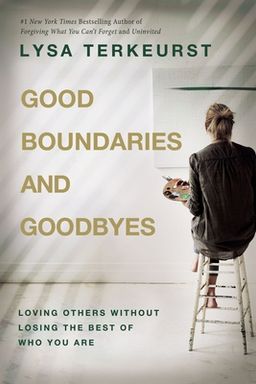
Good Boundaries and Goodbyes cover

Good Boundaries and Goodbyes

by Lysa TerKeurst

Good Boundaries and Goodbyes provides a Christian guide to setting healthy boundaries, protecting your identity, and knowing when to walk away. Lysa TerKeurst offers insights to avoid losing yourself while loving others genuinely and effectively.

Loving Without Losing Yourself

When was the last time you gave so much of yourself to someone that you began to lose sight of who you were? In Good Boundaries and Goodbyes: Loving Others Without Losing the Best of Who You Are, Lysa TerKeurst asks this exact question, confronting the tension between loving deeply and protecting your peace. Having endured betrayal, emotional devastation, and the destruction of her marriage, TerKeurst writes with raw honesty about how easily we can call dysfunction love, and how sacred boundaries rooted in God’s design can help us love better without losing ourselves.

TerKeurst contends that boundaries are not barriers to love—they are the structures that protect healthy love. Drawing on Scripture, counseling wisdom, and personal experience, she redefines what forgiveness, reconciliation, and personal responsibility look like in relationships that have grown unhealthy or even destructive. The book makes a bold claim: you can love others well and still say no.

Why Boundaries Are Sacred, Not Selfish

At the heart of TerKeurst’s argument is a biblical understanding of love and holiness. God Himself sets boundaries—between light and darkness, life and death, heaven and hell—to preserve what is good. In Genesis, when Adam and Eve crossed a divine boundary, God enforced consequences, not because He ceased loving them, but because love without holiness cannot survive. TerKeurst argues that when you tolerate chaos, dishonesty, or manipulation in the name of love, you aren’t being godly—you’re enabling sin. Boundaries, then, are an imitation of God’s holiness in human relationships: they are the way love remains safe.

Love, Responsibility, and Access

One of the most practical insights in the book is TerKeurst’s framework around access, responsibility, and consequences. You can give someone access to your time, emotions, or home, but that access must match their level of responsibility. When people show irresponsibility—through deception, addiction, or emotional volatility—your responsibility is not to fix them but to limit their access until they demonstrate change. This is the biblical model God Himself follows when human sin lessens access to divine presence (a theme echoed in 1 Peter 1:16 and Romans 8).

Grace Without Enabling

TerKeurst reminds readers that forgiveness and reconciliation are two different things. God commands forgiveness; reconciliation, however, is conditional and must include safety and honesty. She weaves in her own story of forgiving her husband’s addiction and deception, despite realizing that reconciliation had become impossible. The message is powerful: God doesn’t call you to die within what is killing your spirit. Boundaries are not exits from love—they are doorways to healthier connections and often, necessary goodbyes.

The Heart Behind Hard Goodbyes

Throughout the book, TerKeurst juxtaposes “good boundaries” with “good goodbyes.” Both require courage. A good boundary may salvage a relationship; a good goodbye may save your life. Yet, neither has to be hateful. She cites the biblical example of Abraham and Lot parting ways in peace, Paul and Barnabas separating over disagreement, and even God removing Adam and Eve from Eden not in spite but because of His love. These stories reveal a divine pattern: when a relationship becomes unsustainable, separation can be an act of mercy.

Why It Matters

In an era where self-sacrifice is often confused with holiness—especially for women—this book offers a liberation that is still deeply faithful. TerKeurst challenges “people-pleasing Christianity,” the kind that equates constant giving with Christlikeness, and instead calls readers to emulate Jesus’ own example: He loved deeply, served humbly, but also withdrew, confronted sin, and walked away from unrepentant people (Mark 1:35–38, John 6:66). The takeaway? To follow Jesus well, you must know when to stay and when to walk away.

“Boundaries protect the right kind of love and help prevent dysfunction from destroying that love.”—Lysa TerKeurst

By blending theology, psychology, and storytelling, TerKeurst creates not just a guidebook for emotional health, but a manifesto for sustainable love. Her central insight—that we cannot love well without limits—echoes through every chapter. Whether you are a chronic caregiver, a people-pleaser desperate to keep the peace, or a believer tangled in toxic relationships, TerKeurst offers both a roadmap and permission to choose holiness over chaos. The outcome isn’t isolation. It’s restoration—the ability to love others deeply while finally staying true to yourself.


When Love Becomes Chaos

Lysa TerKeurst begins with the moment most readers know too well—the unraveling of a relationship that once felt safe. In her own story, lies, addiction, and betrayal brought her marriage to the brink of devastation. But instead of focusing only on the external events, she invites readers to consider what happens internally when we confuse loyalty with love. When trust is broken repeatedly, she writes, we cannot rebuild it by pretending the damage isn’t real.

Her striking declaration, “You cannot build trust that keeps getting broken,” serves as the emotional thesis of her first chapter. The truth may be painful, but it is sacred. Denying it only deepens despair.

Health Cannot Bond With Unhealth

TerKeurst describes relationships as ecosystems—dynamic, interconnected, and fragile. When one person is mired in addiction, dishonesty, or emotional volatility, the other starts living in reaction mode. “Health cannot bond with unhealth,” she insists. Staying bound to dysfunction in the name of grace often becomes self-destruction. The Christian call to love others cannot override the God-given responsibility to protect one’s own mind and spirit (a reminder also explored by Henry Cloud in Boundaries).

The Lie of Endless Endurance

Many of us grew up believing that “good Christians” never give up, never say no, and always forgive without consequence. TerKeurst dismantles that false teaching. Love without accountability, she argues, is not biblical—it is idolatry. It turns another person’s comfort into a god. While Scripture calls for unconditional love, it never commands unconditional access. Love is holy only when it aligns with truth and justice (1 Corinthians 13:6). As God Himself withdrew intimacy when sin entered the world, humans must likewise discern when safety requires separation.

Finding Compassion Without Enabling

TerKeurst’s reflections are not devoid of empathy. She acknowledges that those who hurt others are often driven by shame or unhealed trauma. Yet compassion must not become permission. As counselor Jim Cress notes, “Adults inform. Children explain.” The adult act of setting limits includes informing others of what will no longer be tolerated, instead of endlessly explaining or rescuing.

Triggers, Trauma, and Boundaries as Healing

Throughout this early section, TerKeurst redefines boundaries as a form of trauma recovery. She explains how triggers—those physical waves of panic or dread—are the body’s alarms that something unsafe is recurring, not just remembered. You may think you’re reliving old pain when in reality, new trauma is taking place. Establishing boundaries helps your body and mind reclaim stability, signaling that you are finally safe to feel again. Boundaries are not only relational tools—they are instruments of healing.

“It’s not unchristian to require people to treat you in healthy ways.”

Ultimately, TerKeurst reframes leaving as not abandonment but acknowledgment of reality. Sometimes, staying becomes the greater betrayal—of yourself, your values, and the God who calls His children to peace (Romans 12:18). Love that undermines your safety is not love at all. Recognizing this truth marks the beginning of freedom from chaos.


Access Requires Responsibility

One of the most transformative ideas in TerKeurst’s framework is her concept of access, responsibility, and consequence. She likens it to managing a home or bank account—you wouldn’t hand over your front door key or PIN to just anyone. Yet relationally, many of us do exactly that. We allow people full access to our hearts, emotions, and energy regardless of their ability—or willingness—to handle that responsibility well.

The Boundary Between Love and Chaos

Building from Proverbs 4:23—“Above all else, guard your heart, for everything you do flows from it”—TerKeurst reveals that love can be unconditional, but access should never be. That distinction protects intimacy instead of erasing it. When people misuse your trust, you aren’t being hateful by limiting access; you’re mirroring God’s wisdom. In Genesis, Adam and Eve lost access to Eden not because God ceased to love them but because they violated the holiness of their shared relationship. Likewise, reducing access in a relationship isn’t punishment—it’s stewardship.

Recognizing Misuse and Abuse

TerKeurst walks readers through how misuse of access turns into abuse. When sin and “iniquity” (intentional wrongdoing) go unchecked, patterns of harm become normalized. Abuse, she argues, often evolves from subtle violations we tolerate for too long. Instead of labeling every difficult person as toxic, she invites you to observe patterns: is this person perpetually irresponsible with the access you’ve granted? If so, you have biblical authority to realign the relationship.

Reducing Access With Love

The key question becomes: what level of access matches someone’s demonstrated level of responsibility? This helps you navigate relationships that can’t easily be cut off—such as with family, coworkers, or church members. Reducing access might mean limiting emotional disclosure to a critical friend, adjusting household responsibilities with an unreliable spouse, or setting communication boundaries with a manipulative parent. These limits aren’t rejection—they are strategic recalibrations that make peace and clarity possible.

(TerKeurst’s model echoes psychologist Henry Cloud’s stages of “trust and truth” in Boundaries: every relationship must balance love with structure. Without structure, love corrodes.)

God’s Blueprint for Healthy Access

God Himself models access with responsibility throughout Scripture: the temple’s Holy of Holies was accessible only to priests who purified themselves; Jesus allowed multitudes to listen, twelve to walk with him, and only three to witness his deepest sorrow. Even God, TerKeurst notes, has tiers of relationship. If holiness requires boundaries, so does human love. Creating peace therefore isn’t about more tolerance—it’s about more truth. When you match responsibility with access, chaos no longer reigns; order and safety return.


The High Cost of Boundary Violations

In Chapter 4, TerKeurst dismantles the myth that “turning the other cheek” means allowing mistreatment. She traces the pattern of God’s own boundaries—from the Garden of Eden to the Ten Commandments—to show that divine love always comes paired with limits. When humans broke God’s rules, He didn’t negotiate; He set consequences. Similarly, when we overlook violations in our relationships, we validate unhealthy behavior and perpetuate chaos.

Why Good People Struggle With Boundaries

TerKeurst confesses that most of her failed boundaries resulted from good intentions gone awry: she wanted peace, not conflict. Many readers relate—especially women socialized to equate kindness with compliance. The problem is that temporary peacekeeping often leads to long-term resentment. Emotional exhaustion, hypervigilance, and even physical breakdowns are common results when boundaries collapse repeatedly. TerKeurst admits that her own boundary failures during her marriage nearly cost her life, leading to stress-related medical crises including hospitalization and surgery.

The Cycle of Dysfunction

She outlines a recognizable pattern: you set a boundary; it’s violated; you second-guess yourself; you give in; resentment builds; chaos returns stronger. Eventually, the relationship becomes defined not by love but by your tolerance for dysfunction. Breaking that cycle requires consistent consequences. As her counselor Jim Cress says, “Adults inform. Children explain.” Boundaries should be statements of fact, not negotiations. Failure to enforce consequences guarantees repeat violations—and self-betrayal.

Consequences Protect, Not Punish

Drawing from Genesis again, TerKeurst reminds readers that when Adam and Eve were expelled from Eden, God stationed angels to prevent their return—not to shame them but to protect them from perpetuating harm. Just as God used barriers for safety, we must establish firm limits to protect our wellbeing and integrity. Good boundaries are acts of stewardship, not vengeance. They preserve love’s potential instead of fueling bitterness.

(Parallels can be drawn to Brené Brown’s concept of “clear is kind.” Clarity, even when uncomfortable, nurtures authenticity.)

Faithful Love, Fierce Limits

Jesus, TerKeurst reminds readers, embodied this paradox. He forgave freely but never enabled sin. He told the adulterous woman to “go and sin no more,” rebuked the Pharisees for hypocrisy, and frequently retreated to solitude. His boundaries with people enabled His ministry to flourish. We honor Christ most faithfully not when we let others wound us endlessly, but when we protect the humanity God entrusted to us.

“When we allow a boundary to be violated, bad behavior will be validated.”


When People Resist Your Boundaries

In one of the most relatable sections of the book, TerKeurst confronts the moment when your boundary is met with backlash. Whether you’re accused of being “un-Christian,” “selfish,” or “controlling,” the discomfort from pushback is inevitable. She reframes these reactions as confirmation that your boundaries are working—the tension signals disequilibrium for those accustomed to benefitting from your lack of limits.

Emotional Maturity vs. Emotional Immaturity

Using 1 Peter 5:8’s call to be “sober-minded,” TerKeurst describes emotional maturity as sobriety of spirit—the ability to self-regulate instead of lashing out. Emotionally immature people, she explains, express emotions “without restraint or disproportionately to the situation,” often reverting to childlike defensiveness. When you establish healthy boundaries, you reveal their immaturity, which feels to them like rejection. The result? Manipulation, guilt-tripping, or rage. Recognize these not as moral failures on your part but as indicators of their unhealed wounds.

The Tension of Healing

“Your healing will bring out the emotional immaturity in those unwilling to pursue health themselves,” writes TerKeurst’s friend Candace. This insight reframes relational friction. The more you grow, the more your environment resists change. Instead of returning to dysfunction to maintain peace, she urges readers to hold steady. The other person’s irritation is not proof of your cruelty—it’s evidence of their discomfort with your health.

Sobriety as Spiritual Discipline

Spiritually, TerKeurst equates emotional maturity with vigilance against the enemy’s schemes. To be “sober-minded and watchful,” she argues, means guarding against emotional hijacking. Like a watchman in a biblical city tower, you must stay alert to danger—be it manipulation, anger, or self-doubt. This isn’t spiritual paranoia; it’s discernment in action. Boundaries are your sentinels, keeping chaos at bay.

Refusing to Trade Dignity for Drama

For readers who equate kindness with compliance, TerKeurst offers a corrective: “Mature people can disagree but still respect the sanity of the other person.” Choosing calm over chaos doesn’t make you cold—it makes you healthy. Stability is not indifference; it’s spiritual strength. If the sky feels like it’s falling after you set a boundary, remind yourself: peace isn’t the absence of conflict, it’s the presence of clarity.


Guarding Your Identity

Many people confuse self-forgetfulness with godliness. TerKeurst challenges this distortion in her chapters on identity, teaching that knowing who you are in Christ is essential to maintaining boundaries. Without this grounding, you’ll endlessly chase external validation and crumble under criticism. She confesses she spent years being driven by others’ opinions, tracing this back to her childhood fear of “getting the red card” in class—symbolizing being seen as ‘bad.’ Adults, she explains, still chase those green cards of approval through people-pleasing.

Who Are You, Really?

TerKeurst encourages readers to answer the question “Who am I?” outside of others’ narratives. She recalls a friend rediscovering a childhood photo and realizing, “That’s the purest version of me—before life wrote on me.” She invites you to look at a baby photo of yourself and speak truth over it: your worth isn’t determined by how well you manage others’ emotions. When God created you, He already called you good. Boundaries help you live as that person again.

From Fracture to Wholeness

Drawing on theological terms—orthodoxy (right belief), orthopathy (right feelings), and orthopraxy (right actions)—TerKeurst defines wholeness as the alignment of what you know, feel, and do with God’s truth. When any one of these breaks—your beliefs, emotions, or behavior—fracture sets in. Boundaries restore that alignment. They’re how you protect your spiritual wholeness against others' fractured realities. This concept echoes Peter Scazzero’s Emotionally Healthy Spirituality, which also links emotional maturity to spiritual maturity.

Staying Whole When Others Break

A man’s addiction, a friend’s betrayal, a family member’s manipulation—none of these define who you are. You are responsible for yourself, not for fixing their brokenness. “Whole people attract whole people,” she reminds readers. Without identity-based boundaries, fractured people fracture us. The way back is aligning your self-concept with Scripture, particularly Paul’s image in Colossians 3: believers as “God’s chosen, holy, and dearly loved.” Wholeness is not found in perfection but in secure belonging. Boundaries protect that sacred belonging space.


Saying Goodbye Without Bitterness

Can a goodbye ever be good? TerKeurst admits she once doubted it. But through her grief—especially over her divorce—she discovered that endings can be holy. Derived from the phrase “God be with ye,” goodbye was never meant as rejection but as benediction. Processing loss this way transforms bitterness into blessing.

God Be With You: The Theology of Release

TerKeurst compares her journey to biblical separations: Abraham and Lot parting peacefully, Paul and Barnabas disagreeing but staying faithful. Even Jesus said painful goodbyes—to Judas, to the rich young ruler, to His betrayers. In each case, love remained intact though relationship changed. Ending connection doesn’t end compassion. The goal is to honor God both in love and in letting go.

Grieving the Loss

Goodbyes demand grief. In her metaphor of “a million little funerals,” she explains that each lost expectation—a parent who’ll never apologize, a friend who drifts away, a spouse who won’t heal—deserves acknowledgment. Pretending you’re fine is not faith; it’s denial. Healthy mourning invites God into the space between what was and what will be. As she prays in Isaiah 43’s language, “Forget the former things; I am doing a new thing.”

Releasing Without Retaliation

TerKeurst anchors this practice in Ephesians 4:26–32: you can walk away without anger or malice, forgive without enabling, and move on without bitterness. The act of goodbye, when done prayerfully, removes both parties from cycles of harm. She describes visualizing memories placed into Jesus’ nail-scarred hands—an act of surrender that transforms pain into peace. Letting go no longer means loss; it becomes worship. This sacred reframe allows healing to follow.

“Even when people turned on Jesus, He didn’t let a goodbye turn Him into someone He was never meant to be.”

Dig Deeper

Get personalized prompts to apply these lessons to your life and deepen your understanding.

Go Deeper

Get the Full Experience

Download Insight Books for AI-powered reflections, quizzes, and more.