
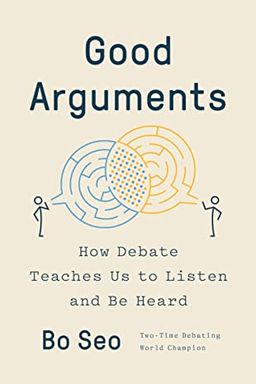
Good Arguments cover

Good Arguments

by Bo Seo

Good Arguments by Bo Seo offers a captivating blend of memoir and practical guide, drawing on the world of competitive debate to teach readers how to communicate effectively. By learning to disagree with skill and respect, you can transform conflicts into opportunities for connection and understanding.

The Craft of Good Arguments

What makes disagreement productive rather than poisonous? Bo Seo’s Good Arguments answers that question through an elegant thesis: arguing well is not about aggression or dominance—it is a craft you can learn. Drawing from his journey as a shy South Korean immigrant who became a two-time world debate champion, Seo argues that the skills of competitive debating can transform everyday conflict into tools for understanding, persuasion, and cooperation.

The book’s message is quietly radical: disagreement is not failure. It is the mechanism by which we test truth, refine beliefs, and maintain relationships. A good argument is one whose outcome is better than either silence or escalation. Seo structures the book around five essential abilities—naming the debate, constructing arguments, rebutting thoughtfully, using rhetoric well, and knowing when to stay quiet—then expands them into broader lessons about education, relationships, technology, and democracy.

From Competition to Everyday Life

Seo begins in the debating classrooms of Barker College and Harvard, where the discipline of structured disagreement turns chaos into clarity. In those rooms, every quarrel begins with a named topic and moves through reasoning, rebuttal, and reflection. But when Seo leaves competition, he finds that real life—families, workplaces, politics—lacks those structures. Conversations drift, tempers flare, or people retreat into silence. His project becomes to bridge the two worlds: to translate discipline into empathy without losing rigor.

The Anatomy of a Good Argument

A good argument begins with clarity. You name what’s being debated, craft a reasoned case, challenge the other side’s claims, and express your reasoning in language that others can hear. You also decide when to hold back. These five actions—naming, constructing, rebutting, speaking, and choosing silence—compose Seo’s practical grammar of disagreement. Each carries its own methods and moral discipline: logic without empathy alienates; empathy without reasoning concedes truth.

Seo’s own story anchors this framework. From Miss Wright’s primary school drills (“every argument requires a response”) to Coach Bruce’s admonitions (“think ‘Bullshit’ when you hear new claims”), he learns that argument is an act of respect: you take another’s ideas seriously enough to answer them. That respect extends to opponents, teammates, and even yourself. (In this sense, Seo’s method resembles the Socratic and Millian traditions of dialectic: the clash of ideas as moral exercise.)

Why Disagreement Matters

The book’s deeper claim is civic: argument keeps democracies and relationships alive. When we stop arguing—out of fear, fatigue, or polarization—we lose the ability to negotiate differences. Debate becomes for Seo a model of both education and coexistence. It doesn’t produce automatic harmony, but it builds the capacities that make harmony possible: curiosity, the courage to listen, and the habit of reasoning in public.

Seo warns, however, against importing the win-at-all-costs mentality of tournaments into life. In personal relationships, “spreading” (firing off too many points) or redefining terms (“squirreling”) breeds manipulation, not clarity. His version of debate is less about victory than repair. Arguing well means resisting both the brawler’s chaos and the silence of apathy.

From Speech to Action

Beyond individual skill, Seo links debate to education and public life. He shows how youth debate programs—from Malcolm X’s prison debates to the Chicago Urban Debate League—transform learning by combining information, skills, and motivation. He explores how civic platforms and technologies (Polis in Taiwan, Reddit’s Change My View) can institutionalize good debate at scale if designed with empathy and transparency. And he reminds readers that even in intimate or polarized spaces, argument remains the only honest route to mutual understanding.

Core message

A good argument is not about defeating others—it’s about building shared clarity in the presence of difference. To master disagreement is to learn how to live together without fear of our differences, one conversation at a time.

By the end, Seo brings debate full circle: from stage to home, from competition to community, from theory to technology. The craft that once made him a champion, he now presents as a worldly ethic—a habit of reason backed by empathy, practiced in relationships, classrooms, and democracies that depend on our ability to speak—and to listen—well.


Naming What We Argue About

Clarity begins with definition. When you and another person argue without naming what you’re arguing about, you end up fighting ghosts. Seo’s first rule of productive disagreement is to name the debate: identify the precise question at issue and the kind of disagreement you’re having. Is it factual (what’s true), judgemental (what’s good), or prescriptive (what should be done)? When you name the type, you calibrate your reasoning to the right evidence and moral frame.

Three Kinds of Dispute

Seo borrows from classroom experience: Miss Wright had her third-graders draw six columns to list each speaker’s points and their rebuttals. You cannot reply unless the debate has a clear topic. Likewise, Barker College debaters learned to circle contentious words in the motion, ask what they meant, and decide which disagreements mattered most. This technique—topic analysis—translates perfectly to life. It is the difference between hurling opinions and resolving an actual issue.

Everyday Example: Family Conflict

Seo shares a family story: an argument about his missed calls with his parents. At first it seemed factual (“How many times did you call?”). But when he paused and asked, “What are we really arguing about?”, they discovered the issue was moral—whether he was neglecting his cultural obligations. Naming that reframed the conflict from accusation to understanding. It’s a miniature model of diplomacy: precision turns blame into curiosity.

Guarding Definition: Beware the Squirrel

Once you’ve named your debate, protect it. Competitors who “squirrel” subtly redefine terms midfight to gain advantage (“recreational drugs” becomes “coffee”). In life, the squirrel appears as loaded labels (“woke,” “politically correct”) or shifting claims (“that’s not what I meant”). The antidote is vigilance: check definitions early, keep asking “are we still talking about the same thing?”, and pull the conversation back when it drifts.

Practical tip

Write down the topic, circle ambiguous words, and list the factual, value-based, and prescriptive threads. Even in a heated moment, this simple mapping can rescue an argument from chaos.

The act of naming the debate is small but powerful. It stops conversational drift, reveals hidden assumptions, and restores fairness. It turns conflict into a deliberate inquiry rather than a soundtrack of defensiveness—and gives both sides a real chance to win something more important than a point: mutual understanding.


Building Persuasive Arguments

Once you know what dispute you’re in, your job is to build arguments that carry weight. Seo calls this moving from assertion to persuasion—a leap many people never make. The structure that makes persuasion work is deceptively simple: conclusion, claim, reasons, evidence, and link. You state what you believe, explain why, support it, and then show why those supports matter to your conclusion.

Truth and Importance

Coaches like Bruce drilled two burdens of proof into teams: truth (is the argument believable?) and importance (does it matter?). Convince on one without the other and you only inform; achieve both and you persuade. For instance, evidence that factory farming causes suffering may be true, but if your listener doesn’t see moral weight in that fact, they won’t change behavior. Relevance completes persuasion.

A Toolkit: The Four Ws

To practice, Seo promotes a modern drill derived from classical rhetoric: What, Why, When, Who cares? State your point, give reasons, provide examples, and identify the stakeholder. If you can answer those questions clearly, you already have the skeleton of a solid argument. This pattern builds muscle memory; it’s how debaters learn to think in structured sentences rather than reactive ones.

Avoiding Common Traps

  • Avoid assertion without reasons—back boldness with proof.
  • Avoid evidence without linking—explain why data matters for your claim.
  • Avoid over-qualification—say it plainly first, then refine.

Insight

Arguments persuade when they balance logic and significance. People don’t just need to think you’re right—they need to care that you’re right.

For Seo, crafting an argument is less about flair and more about method. Writing a hundred short arguments trained his reflexes; with practice, he found that persuasion becomes habitual. Repetition, not genius, is what turns opinion into influence.


Rebutting Without Rage

To disagree usefully, you must also know how to push back. Rebuttal, Seo explains, isn’t contradiction; it’s diagnosis. When someone argues, you test their claim for truth and importance, exposing where it fails or why it matters less than an alternative. Done right, rebuttal sharpens both sides; done badly, it corrodes trust. Good debaters don’t aim to humiliate—they aim to clarify.

Two Rebuttal Paths

Truth rebuttal shows the opponent’s claim is false or unsupported; importance rebuttal shows even if true, it’s irrelevant or outweighed. Bruce’s famous coaching prompt—“think ‘Bullshit’ whenever the opposition speaks”—was less rudeness than an antidote to passivity. If you don’t test ideas, they calcify. In debate and politics alike, rebuttal keeps reasoning alive.

The Courtesy of Disagreement

Seo insists rebuttal is a courtesy. By engaging directly, you honor the other side’s effort and help audiences see what’s at stake. That courtesy requires listening: rather than interrupting or caricaturing, you “flow” (note) their case and answer the strongest version of it. Point-scoring interruptions might thrill a crowd, but they shrink insight. Think of the Obama–Romney debates, where interruptions became theater rather than substance.

Progress Through Counterclaim

Seo learned through painful rounds that rebuttal must end with an alternative—otherwise, it’s demolition without vision. After dismantling an argument, offer a better proposition. In personal and civic arenas, this moves disagreement from destruction to progress.

Practical mantra

Listen first, challenge second, propose third. That sequence makes rebuttal a public service rather than a power play.

When you rebut well, you help the truth emerge through friction. The skill lies not in volume but in restraint—the art of testing claims with precision and finishing with a vision others can adopt.


Speaking That Moves People

Rhetoric, Seo writes, is how you make your reasoning matter to real listeners. Argument answers the question “what’s true?”; rhetoric answers “why should we care?” The best speakers combine both. They make listeners see, feel, and act without distorting the facts. Drawing lessons from Mrs. Gilchrist’s speech class, John Quincy Adams’s lectures, and finals stages at Harvard, Seo portrays rhetoric as design—words shaped to serve truth.

Clarity Over Ornament

Seo prefers simplicity to flourish: short sentences, concrete nouns, and crisp metaphors. He repeats classical advice—begin paragraphs with the lede, then prove it. Rhetoric should reveal, not distract. The goal is service: if listeners carry your idea beyond the room, you’ve succeeded. (Note: this echoes Orwell’s and Cicero’s principles—clarity as ethics.)

Personality, Proportion, Panache

Three ingredients animate powerful delivery. Personality reveals your stake in the story. Proportion matches emotion to the argument’s scale—don’t shout a nuance or whisper a crisis. Panache gives the final touch: an original, repeatable line that lingers. From Nick’s witty zingers to W. E. B. Du Bois’s moral crescendos, Seo sees great rhetoric as disciplined empathy.

Lesson

Style should carry substance. When rhetoric enlightens instead of overwhelms, you give ideas wings.

Through drills like Count, Restart, and Penalty, Seo teaches that eloquence is practice, not talent. Done responsibly, rhetoric connects logic to humanity—making persuasion possible where mere data would fail.


Dealing with Bullies and Bad Faith

Not every disagreement involves goodwill. Seo categorizes predictable bad-faith tactics—the bullies of argument—and offers calm countermeasures. When someone hijacks the rules, your aim isn’t domination; it’s restoration of structure. Bullies exploit confusion; order disarms them.

Five Personas of the Bully

  • Dodger: deflects from the topic (ad hominem, tu quoque).
  • Twister: misrepresents your stance (the straw man).
  • Wrangler: attacks endlessly without proposing a position.
  • Liar: floods discourse with falsehoods to exhaust fact-checks.
  • Brawler: destroys format itself—interrupts, shouts, dominates.

Restoring the Rules

Seo prescribes responses: stay focused on the real issue, restate your precise claim, force reciprocity (“what would you have me prove?”), and correct with brevity. Against lies, use the “plug-and-replace” technique—plug the falsehood, then replace it with truth and reasoning. When brawlers explode norms (as Trump did in 2016), pretend the debate continues under rules, then name the behavior: “This is interruption” or “That’s heckling.” Naming restores expectations for fairness.

Crucial habit

Bullies rely on momentum. Pause, name the tactic, and restart the conversation on rules you both can inhabit.

The insight is empowering: once you recognize manipulation as pattern, not personality, you can plan defenses. Treat bullies not as monsters, but as malfunctions in the culture of argument—and fix the malfunction by restoring structure, not matching aggression.


When Silence Is Strength

Not every battle deserves your voice. Seo’s discipline of restraint, summarized in the RISA checklist—Real, Important, Specific, Aligned—teaches when to engage and when to step back. Arguing well includes knowing when to walk away.

The RISA Test

Real: Is there substantive disagreement or just irritation? Important: Is it worth your emotional time? Specific: Is it narrow enough to resolve? Aligned: Are your reasons for engaging compatible with theirs? Fail any test and the argument is likely noise.

Strategic Silence

In his quarrel with a friend over lateness, Seo learned that even if a debate passes RISA, you can still drop nonessential skirmishes. Choose only the claims that move understanding forward. Silence, in this sense, is strategic—a decision to preserve relationships and redirect energy.

Moral

Silence is not cowardice when it protects the possibility of future discourse.

In public life, this restraint becomes duty: before weighing in on controversies—deplatforming, censorship, protests—ask what your voice aims to accomplish. Silence can be a form of care, ensuring you argue where your words can do real work.


Debate as Education and Practice

Seo widens his focus from individuals to education. Debate, he argues, works because it combines information, skills, and motivation—each reinforcing the others. In classrooms, prisons, and leagues, this trifecta makes debate one of the most effective tools for civic learning.

Information, Skills, Motivation

Just as the Greeks trained orators through daily progymnasmata (drills), modern debate programs train quick logic, empathy, and research habits. Mr. Gregory’s “Count” and “Restart” drills feel tedious but produce fluency. Malcolm X’s self-education in prison—copying the dictionary, joining the Norfolk Prison Colony debate society—shows how structured speech ignites learning where schooling failed. Wiley College under Melvin Tolson turned the same craft into civic courage, preparing civil-rights leaders like James Farmer.

Modern Scale and Evidence

Empirical data support Seo’s belief. A study of the Chicago Urban Debate League found participants over three times likelier to graduate than peers. Florida’s Broward County made debate a district-wide program. For Seo, these are not extracurricular luxuries—they are civic necessities that build literate citizens capable of reasoning together.

Principle

Deliberation is learned by doing. Practice turns curiosity into competence, competence into confidence, and confidence into civic participation.

To master arguing is to master learning itself: you research, listen, build, and refine. The process makes citizens who can think critically and express conviction without violence—a skill democracies urgently need.


Fighting Fair in Relationships

Love doesn’t exempt you from conflict—it amplifies it. Seo explores how arguments within families, friendships, and communities slip into hurt because trust tempts carelessness. The same rules that rescue public debate can rescue intimacy, but adapted for emotion rather than adjudication.

The Four Un‑s

Personal arguments often spiral because they are Unreal (you assume mind-reading), Unimportant (trivial triggers mask deeper fears), Unspecific (every grievance bleeds into the next), and Unaligned (you want repair, they want revenge). Recognizing these “Un‑s” in time can short-circuit escalation.

Side Switch

Seo adapts a debating drill—Side Switch—to repair relationships. Before continuing an argument, switch sides: list the four best reasons for their view, and even write a “loss ballot” explaining how they could win. This ritual, like couples therapy’s perspective-taking, forces empathy through logic.

From Church Hall to Home

He illustrates this with a story from a Uniting Church meeting about same‑sex marriage, where confusion nearly split the congregation. The minister’s instruction—“go home and think from your fellow congregant’s perspective”—became an institutional Side Switch. Seo later used it with his parents; progress was hard but real. The lesson: structure heals chaos.

Guiding idea

Fighting fair means creating limits, rituals, and pauses so the fight becomes a tool of repair rather than destruction.

Inserting deliberate structure into intimate conflict may feel artificial, but Seo shows it liberates empathy. The goal isn’t to avoid conflict—it’s to argue without losing each other.


Debate in an Age of Machines

As technology enters argument, Seo extends his craft into the digital and AI frontier. At the IBM demonstration of Project Debater in San Francisco, he watches a machine challenge world finalist Harish Natarajan. The contest tests what argument means when machines can marshal millions of facts but still lack human resonance.

What Machines Do Well—and Poorly

Project Debater excelled in breadth: it cited OECD, CDC, and research meta‑studies in seconds, earning the audience’s vote for “most informative.” Yet Harish won the judging vote by connecting emotionally, articulating trade-offs, and framing policy realism. Machines can recall data; humans can frame meaning. Seo concludes persuasion requires both.

Civic Design and Digital Debate

Seo links AI debate to wider civic design. Taiwan’s digital minister Audrey Tang uses platforms like Polis to cultivate consensus through structured crowd input. Reddit’s Change My View is another model: rules and incentives (the “delta” system) reward respectful mind-change. Such examples prove that the future of argument depends less on technology itself than on how humans design its incentives.

Takeaway

Tools can amplify deliberation or erode it. The difference lies in transparency, empathy, and ownership of meaning.

Seo’s lesson for a digital era: as algorithms get better at evidence retrieval, humans must get better at sincerity and moral reasoning. Reason still needs a heartbeat.


Scaling Argument for Democracy

In his final chapters, Seo asks how to scale good argument beyond individuals to whole societies. His answer pairs realism with hope. Debate grows through institutions—citizens’ assemblies, classrooms, online forums—but it also grows locally, one conversation at a time. Scaling deliberation means building both structure and culture.

Institutions That Enable Argument

Seo points to recent experiments: Ireland and Canada’s citizens’ assemblies, France’s Grand Débat National, and Japan’s jury reforms that used public education campaigns (even a justice minister in a parrot suit). These show governments can formalize citizen reasoning. The key is sincerity—consultations must connect to real policy, not serve as fig leaves for decisions already made.

Moral Constraints and 'Clogging'

Scaling also demands ethical guardrails. Seo adapts Elaine Scarry’s idea of “clogging”—procedural pauses that require consent before harm. In debate, this means vetting topics to ensure they don’t deny anyone’s humanity or weaponize vulnerable groups. The Harvard debate council’s refusal to host motions like “legalize Holocaust denial” is not censorship; it’s maintenance of moral terrain that debate itself needs to survive.

Small Scale, Big Impact

For Seo, systemic change begins microscopically: one argument, one class, one restored conversation. Social transformation isn’t grand but cumulative. What matters is the commitment to rules, reason, and respect—repeated often enough to become habit.

Final message

If disagreement built Seo’s life, he argues, it can rebuild our public life too—provided we teach and protect the art of arguing well.

Seo leaves readers with optimism tempered by discipline: argument, properly understood, is both personal skill and social infrastructure. To defend democracy, we must each become better debaters—not louder, but clearer, fairer, and kinder.

Dig Deeper

Get personalized prompts to apply these lessons to your life and deepen your understanding.

Go Deeper

Get the Full Experience

Download Insight Books for AI-powered reflections, quizzes, and more.