
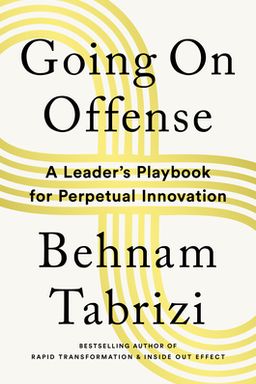
Going on Offense cover

Going on Offense

by Behnam Tabrizi

Going on Offense by Behnam Tabrizi equips leaders with the tools to drive perpetual innovation. Through stories of industry giants, the book reveals how to implement bold strategies that unleash potential, redefine success, and lead companies towards sustainable growth. Discover how to cultivate a visionary mindset and foster a culture of excellence.

Going on Offense: The Mindset for Perpetual Innovation

Can an established organization ever innovate as freely and fearlessly as a start-up? In Going on Offense: A Leader’s Playbook for Perpetual Innovation, Stanford professor Behnam Tabrizi argues that while perpetual innovation is rare, it is achievable if leaders build a culture that combines emotional energy, disciplined execution, and existential purpose. He contends that the secret isn’t another management fad but a complete shift in mindset: companies must learn not just to defend their current markets but to go on offense—to seek new opportunities and lead change before they’re forced to react to it.

Over twenty-five years of teaching and consulting, Tabrizi has studied more than a thousand organizational transformations. Yet a 2014 conversation with Hans Vestberg, then-CEO of Ericsson, pushed him to reimagine what lasting innovation truly looks like. Vestberg wanted his executives to learn from the world’s most innovative companies, not just to transform Ericsson once but to stay agile indefinitely. That challenge inspired Tabrizi’s in-depth study of twenty-six firms—ranging from Apple, Amazon, Microsoft, Tesla, and Starbucks to DBS Bank and Haier—to uncover the deeper patterns that sustain innovation across decades, industries, and leadership changes.

A Playbook for Going on Offense

Tabrizi’s research suggests that companies capable of perpetual innovation share eight core elements, organized across three qualities: they are Generous in purpose and empathy, Ferocious in focus and speed, and Courageous in risk-taking and collaboration. Together, these create an organization that can continually reinvent itself while preserving a clear sense of identity.

In the Generous dimension, leaders anchor transformation in existential purpose, foster a deep obsession with customers, and create cultures where individuals rise to expectations through what Tabrizi calls the “Pygmalion effect.” These firms operate from conviction, not compliance: they pursue meaning that resonates with employees' personal values and inspires adventurous commitment. The result is motivation that transcends profit.

In the Ferocious section, Tabrizi introduces the operational mechanics of innovation: embracing the start-up mindset, mastering the tempo of change, and learning to operate “bimodally”—driving incremental improvement while simultaneously experimenting radically. He likens this to a lion pacing before a hunt, conserving energy for bursts of speed. Great organizations, he argues, know when to stalk, sprint, and rest, and always stay alert enough to sense new opportunities.

Finally, the Courageous dimension examines what bold leadership really looks like: companies must be willing to go boldly into risk, make unpopular choices, and practice radical collaboration across silos and even competitors. Courage, in Tabrizi’s research, isn’t just the will to innovate—it’s the humility to eliminate bureaucratic drag and the trust to share ideas freely, even when it threatens comfort or hierarchy.

Why This Matters Now

In an age of relentless disruption, from artificial intelligence to remote work, Tabrizi warns that most firms operate on defense—obsessing over cost efficiency and legacy processes while losing their creative edge. The giants of yesterday, like Nokia, Kodak, and Blockbuster, serve as cautionary tales of organizations that clung to past success and failed to renew themselves when the world changed. In contrast, Amazon, Tesla, Apple, Microsoft, and Starbucks exemplify companies that “stay on offense” by continually reinventing their culture, purpose, and products, often defying industry norms.

Tabrizi’s framework blends psychology, strategy, and organizational design. Drawing on thinkers from Viktor Frankl to Amy Edmondson, he weaves existential meaning (the “why”) with operational rigor (the “how”). The book’s blend of case studies—from Microsoft’s rediscovery of purpose under Satya Nadella to Haier’s radical decentralization into entrepreneurial microenterprises—demonstrates that perpetual innovation is both deeply human and profoundly structured.

“Whether you lead a team or an entire enterprise, the goal isn’t to copy Apple or Amazon, but to pursue a 10 to 20 percent improvement in agility—that’s enough to transform your culture and your results.” —Behnam Tabrizi

Across its ten chapters, Going on Offense shifts leadership from passive management to energized transformation. It’s a manifesto for rekindling human creativity inside organizations—where purpose gives meaning to work, discipline sustains momentum, and courage turns ideas into enduring advantage.


Setting an Existential Purpose

Why does your company exist beyond profit? Tabrizi begins the “Generous” section with this central question, arguing that an existential purpose—a deeper reason for being—is the indispensable foundation for sustained innovation. Purpose, he writes, isn’t marketing fluff; it’s the North Star that directs decisions, energizes employees, and justifies the hard work of transformation.

Finding a Reason that Matters

Drawing on Viktor Frankl and Friedrich Nietzsche, Tabrizi notes that humans can endure almost any challenge if they have a strong “why.” The same applies to organizations. Existential purpose is the corporate equivalent of calling—it evokes emotion and commitment. Microsoft, for example, rediscovered its soul when CEO Satya Nadella replaced the dated motto “a PC on every desk” with “empowering every person and every organization on the planet to achieve more.” That simple shift reframed Microsoft’s identity from product-centric to people-centric—sparking new collaboration, empathy, and agility across the company.

Defining Vision, Goals, and Core Values

An authentic purpose must cascade down into practical objectives. Tabrizi distinguishes between three tiers: existential vision (the ultimate aspiration), existential goals (what makes that vision real), and core values (the enduring principles that guide trade-offs). Apple’s vision—“making powerful technology accessible to ordinary people”—translated into products like the iPhone and the Macintosh, while its core values of simplicity and humanity shaped every design choice. These layers make purpose operational, not ornamental.

Haier, the Chinese appliance giant, exemplifies this adaptability. Under Zhang Ruimin, Haier evolved its existential goal five times, each phase marking a bold transformation—from making reliable refrigerators to fostering microenterprises that empower employees as entrepreneurs. Yet the existential vision—premium, modern quality—remained constant. Tabrizi calls this the art of changing the goals without betraying the soul.

From Corporate Slogans to Living Beliefs

Superficial mission statements, or what Tabrizi calls “purpose washing,” drain meaning from strategy. A genuine existential purpose demands trade-offs and inspires fierce discipline. Nadella’s choice to end Microsoft’s toxic “us vs. them” culture required letting go of influential executives who didn’t believe in his collaborative vision. Purpose only works when it changes behavior. As Tabrizi puts it, “It should make some people leave.”

Tesla’s purpose—to accelerate the world’s transition to sustainable energy—likewise guides every product decision, from high-end Roadsters to solar power systems. Elon Musk’s first principles thinking forces his teams to continually invent beyond competition’s boundaries. The moral audacity of this mission taps into employees’ and customers’ emotions; it feels like participating in history, not just commerce.

Aligning Personal Calling to Company Vision

Purpose becomes unbreakable when employees see their own aspirations reflected in it. Tabrizi highlights the Santa Clara Valley Medical Center, a public hospital that reinvented its culture by discovering a unifying purpose: “to build a world-class patient flow process that patients and families love and makes staff proud.” This wasn’t invented by consultants but co-created with staff through reflection exercises using his SEE (Strengths–Evokes–Elates) framework. Frontline workers rediscovered moments when they felt most alive and meaningful at work, linking their own “flow states” to the hospital’s broader mission. The result: faster care, fewer delays, and record employee engagement despite budget cuts.

When personal and organizational North Stars align, the energy released can power an entire transformation. As Tabrizi warns, though, when a company drifts from purpose—as Facebook did when it favored ads over integrity—innovation turns toxic. The lesson is clear: existential purpose isn’t just philosophical; it’s a competitive advantage.


The Power of Customer Obsession

If existential purpose provides the emotional energy for transformation, customer obsession supplies its direction. Tabrizi argues that organizations stay agile only when they let customer dissatisfaction pull them forward. “Customers,” Jeff Bezos observes, “are always dissatisfied—they always want more. If you let them lead, you’ll never stagnate.”

Two Faces of Obsession: Cocreation and Empathetic Imagination

Tabrizi distinguishes between two complementary modes. The first, cocreation, involves listening closely, gathering real-time feedback, and inviting users to shape what you build. Haier exemplifies this, involving hundreds of thousands of customers before a product even launches. Its “zero-distance” model—where any employee is accessible to customers—transforms feedback into daily strategy. Zara’s “fast fashion” approach works similarly: stores track selling patterns and customer comments, relaying this data directly to designers to produce on-trend apparel in weeks, not months.

The second mode, empathetic imagination, arises when customers don’t yet know what they want. Steve Jobs famously dismissed focus groups, insisting that Apple’s job was to “read things that are not yet on the page.” The iPhone wasn’t a response to demand but an act of foresight powered by empathy—imagining users’ untapped desires for simplicity and elegance. Tesla’s sleek, software-rich cars operate on the same principle.

Beyond Service: Obsession as Infrastructure

True customer obsession ripples through every layer of infrastructure. Amazon doesn’t just serve customers—it predicts and resolves their problems before they occur. When a delivery delay happens, the company automatically refunds or upgrades shipping, often before customers notice. Its massive investment in data systems allows it to refine friction points invisibly. This “silent service” builds trust that sustains long-term loyalty. (Bezos’s mantra: “We make money when we help customers make purchase decisions.”)

Apple applies this same philosophy in its in-store APPLE service model: Approach, Probe, Present, Listen, End. Every interaction, down to the store layout, turns retail into a ritual of empathy. Employees are trained not to fix gadgets but to enrich human experiences, reinforcing Apple’s existential promise of “tools for the mind that advance humankind.”

Embedding Obsession in Culture

To institutionalize customer obsession, leaders must bake it into behavior and metrics. At Amazon’s warehouses, real-time dashboards measure how every process contributes to delighting the customer. At Apple, new recruits undergo immersive rituals designed to internalize the belief that their work changes lives. These soft and hard systems converge on a single question: Is what we’re building truly improving our customers’ lives?

Customer obsession, Tabrizi concludes, is not about constantly asking customers what they want—it’s about caring enough to anticipate what’s next. The companies that thrive turn that caring into habit: a relentless, almost irrational devotion to the people they serve.


The Pygmalion Effect in Corporate Transformation

Borrowing from Ovid’s myth of Pygmalion—the sculptor who brought his ideal creation to life—Tabrizi reframes leadership as the art of shaping culture through belief and expectation. Leaders who expect greatness from their teams cultivate it not through slogans but through structure, trust, and discipline. The Pygmalion effect, when applied to organizations, can multiply innovation far beyond any single leader’s reach.

From Sculptor to Culture Maker

Steve Jobs was notorious for being abrasive, yet his intensity forged a culture of innovation at Apple by setting impossibly high expectations. When recruiting, he told one potential hire that heaven would be having “more amazing talent than I knew what to do with.” That conviction spread: hiring extraordinary people became the company’s central ritual. Even after Jobs’s death, Apple’s expert-led culture—where “experts lead experts”—preserves this ethos. Engineers don’t report to general managers but to other world-class engineers, creating a system of peer inspiration rather than bureaucratic supervision.

Recruiting for Culture, Not Comfort

Modern Pygmalion leaders hire for potential and cultural resonance, not convenience. Elon Musk personally approved every Tesla hire up to a staff of twelve thousand, demanding evidence of “exceptional ability” and resilience under pressure. AMD’s CEO Lisa Su rebuilt the company by poaching brilliant risk-takers who wanted “to learn a ton and make a big impact.” Each saw joining AMD as a calling, not a career move. These leaders sculpt organizations in their own visionary image—but the sculpture grows stronger than the sculptor.

Trust, Autonomy, and Courageous Coaching

A true Pygmalion culture balances expectation with freedom. Haier’s transformation into thousands of self-managed microenterprises shows this at scale. Employees are not mere workers; they’re entrepreneurs operating their own units responsible for profit and loss. Trust transforms accountability into self-motivation. Netflix captures the same spirit through its “keeper test” and radical transparency. Leaders give real-time feedback rather than annual reviews and compensate generously but fire quickly if fit fades. In these environments, performance culture is high-trust, not high-control.

Mentorship completes the sculpture. Jobs groomed Tim Cook to see potential in people; Bezos personally mentors “technical advisors” who shadow him to absorb leadership habits. Even KPMG’s internal storytelling campaign, where employees created tens of thousands of posters answering “What do you do at KPMG?”, spread pride from the top down. The point, Tabrizi argues, is not supervision but shaping self-belief—the quiet alchemy that turns talent into transformation.


The Start-Up Mindset

To stay agile, companies must rediscover the intensity of their early days. Tabrizi’s start-up mindset is the foundation of the “Ferocious” section—a mentality that combines hunger, speed, and missionary zeal. It’s not about size but spirit: even the biggest organizations can move like start-ups if they choose urgency over comfort and purpose over process.

Breaking Out of Day 2

Jeff Bezos describes “Day 1” as a company’s start-up phase—energetic, experimental, and paranoid about complacency. “Day 2,” by contrast, means stagnation: managers chase metrics, protect silos, and value efficiency over innovation. Blockbuster’s downfall epitomized Day 2 thinking; it optimized existing processes long after the world shifted to streaming. DBS Bank in Singapore, by contrast, deliberately re-coded itself into a technology company, adopting the mantra “becoming the D in GANDALF” (Google, Apple, Netflix, and others). It reimagined its banking operations as digital ecosystems powered by experimentation.

Lessons from Heroes, Founders, and Intrapreneurs

Tabrizi parallels the start-up journey with Joseph Campbell’s The Hero with a Thousand Faces: founders and innovators all step out of comfort, confront chaos, and return transformed. His examples include Amancio Ortega of Zara, whose childhood poverty fueled an obsession with serving customers affordably, and Jeff Bezos, whose humble household made him value self-reliance and reinvention. Both built empires by channeling adversity into entrepreneurial drive. For the rest of us, embracing this mindset means remembering our own origin stories—what hardship set our ambition aflame?

Inside large organizations, intrapreneurs replicate this spirit. IBM’s David Grossman and John Patrick quietly revolutionized the corporation by building its first internet presence in 1994, working from a closet server. They didn’t wait for permission—they acted like rebels with a cause. Similarly, 3M’s Richard Drew invented masking tape by defying orders to stick with sandpaper. These stories remind you that going on offense doesn’t depend on hierarchy, only conviction.

The Mechanics of Missionary Thinking

Start-up thinkers behave like missionaries, not mercenaries. They believe in something bigger than profits, interpret constraints as creative fuel, and simplify aggressively. Ortega’s Zara compresses fashion cycles to weeks by giving decision power to frontline store staff. Bezos decentralizes decision-making into “two-pizza” or “single-threaded” teams that move autonomously. Tesla tears down hierarchy by letting engineers go directly to whoever can solve a problem. Across all cases, the pattern is clear: radical clarity, small empowered teams, and relentless reduction of bureaucracy unleash innovation faster than capital alone ever could.

Adopting a start-up mindset isn’t a one-time event—it’s a cultural reset. Every team must ask: If we were founding this company today, what would we do differently? That single question, Tabrizi insists, is the antidote to Day 2 complacency and the heartbeat of perpetual innovation.


Managing the Tempo of Change

Even the most inspired organizations falter without rhythm. In his chapter on tempo, Tabrizi compares great companies to lion prides and elite athletes: neither sprint constantly, but both know when to stalk, when to rest, and when to strike. Tempo, he writes, is not about speed but about control of speed—the ability to vary pace strategically across projects and people.

Type-One vs. Type-Two Decisions

Quoting Jeff Bezos, Tabrizi distinguishes between “one-way door” decisions (irreversible, requiring deliberation) and “two-way door” decisions (reversible, demanding speed). Agile innovators calibrate tempo by knowing which is which. Linger too long on a reversible decision and you miss the moment; rush an irreversible one and you risk catastrophe. Amazon institutionalized this thinking, accelerating small iterative choices while moving deliberately on strategic bets like AWS.

The Lion’s Lesson: Energy Management as Strategy

Lions doze most of the day—not out of laziness but conservation. When opportunity appears, they explode into coordinated action. Likewise, elite organizations use planned pauses to recharge teams and sharpen focus. Bumble, for example, gives employees paid “wellness weeks” to prevent burnout, fueling long-term performance. In contrast, Peloton’s pandemic collapse showed what happens when companies sprint endlessly without rest or adaptability.

Tabrizi uses analogies from sports to illustrate deliberate tempo shifts. Virginia’s championship basketball team learned to alternate between patience and aggression, mastering both defensive discipline and fast-break execution. Businesses that master tempo do the same: they prepare slowly, act swiftly, and review methodically.

Practical Levers for Tempo Control

To manage tempo effectively, leaders can establish recurring “heartbeat” meetings for synchronized check-ins, limit team size (Amazon’s two-pizza rule), and purge unnecessary decision layers. Netflix’s stripped-down bureaucracy lets top talent run freely, while Microsoft’s simplification under Satya Nadella sped coordination. The takeaway: decide fewer things, but make them faster.

Tempo isn’t tempo for its own sake—it’s a moral stance against inertia and chaos. The goal isn’t to run harder, but to move deliberately with clarity, energy, and paranoia before change forces you to.


Operating Bimodally: Efficiency and Experimentation

How do you innovate radically without losing control? Tabrizi’s concept of bimodal operation solves this paradox by teaching companies to run on two rhythms at once: one mode focused on compression (streamlining, standardizing, cutting cost) and another dedicated to experiential exploration (testing, prototyping, learning fast). The genius lies in knowing when—and how—to switch between them.

Compression: Excellence in the Known

Compression is the disciplined pursuit of efficiency. Think Apple’s annual iPhone updates or Nike’s iterative Air Jordan releases—products that require precision, not reinvention. Amazon’s fulfillment centers embody compression: every movement is measured, every second analyzed. Managers run “critical pull times” by the minute, and constant feedback loops drive both productivity and safety improvements. In this mode, systems hum like engines; innovation is incremental but dependable.

Experiential Development: Surfing the Unknown

In contrast, experiential mode is messy, creative, and uncertain. It values learning over predictability. Apple’s original iPhone project captures this spirit: competing teams prototyped rival designs, argued fiercely, and iterated until breakthrough emerged. Amazon’s failed Fire Phone followed similar laws of exploration—yielding insights that later powered Alexa. Facebook’s constant A/B testing across thousands of micro-versions of its interface exemplifies experimentation as ongoing discovery. Failure isn’t wasteful; it’s tuition.

Integrating Both Worlds

Elite performers orchestrate both modes simultaneously. SpaceX builds pioneering reusable rockets (experiential) while tightening manufacturing costs (compression). Haier’s microenterprises combine rigorous execution with creative autonomy. Tabrizi warns that applying the wrong mode can be fatal: using rigid controls for innovation suffocates it, while treating stable processes as experiments breeds chaos. The leader’s role is to discern when to plan and when to play.

Ultimately, bimodal management reflects an agile truth: true innovation demands both precision and play, order and improvisation. As Tabrizi’s research from Apple to AMD shows, perpetual innovators don’t choose between efficiency and creativity—they synchronize them.


Go Boldly: The Courage to Defy Conformity

Tabrizi defines courage not as fearlessness but as disciplined defiance—the willingness to act boldly when success has made action uncomfortable. Great leaders aren’t content with “good enough.” They dismantle structures that once worked and build anew, guided by vision rather than vanity.

From Defensive to Offensive Leadership

Citing Amazon’s creation of AWS, Tabrizi shows how boldness transforms companies into category-creators. What began as an internal fix for server inefficiency became a multi-billion-dollar industry because Bezos wasn’t confined by “core competency” dogma. He saw constraints as invitations—and cultivated leaders like Andy Jassy who did the same. Similarly, Satya Nadella’s Microsoft proved that courage often means subtraction: he gave away Windows for free, killed failing hardware ventures, and reinvested in cloud and gaming—rebuilding the company’s soul and market dominance.

Scaling Back to Move Forward

Boldness also means knowing when to pause. Steve Jobs pulled Apple back to a handful of products upon his return, sacrificing short-term sales for design excellence. AMD’s Lisa Su pruned her company’s scattered divisions to focus solely on high-performance chips—a move that revived it from bankruptcy. In each case, courage was less about expansion than focus. (Notably, this echoes Jim Collins’s hedgehog concept in Good to Great—clarity over complexity.)

Yet boldness can’t exist without trust and safety. Companies like Netflix and Bumble make bravery possible by encouraging experimentation and forgiving failure. “Adequate performance gets a generous severance package,” Netflix proclaims—not to intimidate but to keep excellence alive. Bumble’s Whitney Wolfe Herd boldly redesigned both her app and workplace to empower women, proving that courage and compassion can coexist.

In the end, Tabrizi reframes boldness as collective clarity: when leaders act with purpose and employees feel safe to challenge norms, organizations unlock what he calls “the genius of offense”—the power to act before the market demands it.


Radical Collaboration and Trust

In a world obsessed with silos, Tabrizi contends that the most daring act may be collaboration. Radical collaboration replaces hierarchy and hoarding with connection and trust. It’s “radical” because it crosses boundaries—between teams, businesses, and even competitors—to create something no one could achieve alone.

Breaking Down the Silos

Big companies fail to collaborate because security breeds isolation. Myspace’s engineers stopped communicating with customer teams, and the site’s stagnation opened the door to Facebook. Tesla’s antidote is to flatten communication entirely: anyone can contact anyone to fix a problem. Musk insists that hierarchy is less important than expertise. This rule forces mastery and transparency, not politics.

Structural freedom alone isn’t enough; companies must also nurture emotional trust. AMD’s Lisa Su maintains an open-door policy, while Microsoft’s Satya Nadella fosters shared purpose through empathy. His replacement of internal rivalry with global hackathons—where thousands of employees worldwide cocreate tools for accessibility and education—turned collaboration into ritual, not rhetoric.

Collaboration Inside and Out

Radical collaboration extends beyond corporate walls. Microsoft’s partnership with once-rival Apple and its acquisition of open-source platform GitHub exemplify external cooperation for shared benefit. Haier’s networks of microenterprises collaborate dynamically, aligning profit with user satisfaction through mutual support. These ecosystems of trust fuel enduring agility.

Radical collaboration, Tabrizi emphasizes, is not chaos—it’s orchestrated openness. It requires psychological safety, mutual accountability, and an ethos that prizes progress over pride. As he warns, “You cannot collaborate from fear.” At its best, collaboration transforms institutions into networks of human creativity, making innovation a shared responsibility rather than an executive privilege.


Putting It All Together: The Path to Perpetual Innovation

Tabrizi closes his playbook with a sweeping synthesis: practical steps any leader can take to make perpetual innovation reality. Drawing from his Brightline Transformation Compass, he identifies five building blocks that transform theory into a living system: defining a North Star, gathering customer insights and trend awareness, fostering inside-out personal transformation, creating a transformation operating system, and mobilizing volunteer champions.

Building Block 1: The North Star

Transformation begins with listening. Leaders like Satya Nadella and Howard Schultz revived their companies by grounding vision in real conversations with employees and customers. The North Star articulates both purpose and priorities. Schultz’s revival of Starbucks centered on seven principles—reigniting emotional connection and operational excellence—while simultaneously closing underperforming stores. A clear North Star provides the conviction to say no as much as yes.

Building Block 2: Customer Insights and Megatrends

Perpetual innovators embed empathy into analytics. They don’t just chase satisfaction surveys—they study underlying human behaviors, industry megatrends, and unmet needs. Techniques like ethnography, behavioral diaries, and direct co-creation ensure constant attunement to evolving realities. This approach made Zara and Amazon masters of anticipation rather than reaction.

Building Block 3: Inside-Out Employee Transformation

To sustain change, people must grow alongside the company. Using his SEE framework, Tabrizi encourages employees to discover what strengthens, evokes, and elates them, aligning this self-knowledge with organizational purpose. Transformation becomes personal, turning fear of change into opportunity for meaning. Leaders must become coaches who connect aspiration with execution.

Building Block 4: The Transformation Operating System

Structural agility replaces bureaucracy with “rapid response teams”—cross-functional units led by pilots who make fast, data-driven decisions without waiting for permission. These teams work like internal start-ups, combining venture-capital budgeting (funding in stages) with disciplined governance. They embody the virtues of both speed and accountability.

Building Block 5: Volunteer Champions

Finally, transformation spreads through influence, not enforcement. By identifying passionate, credible individuals at every level and empowering them as “champions,” companies create peer-driven momentum. These volunteers evangelize new values, mentor others, and sustain motivation long after the formal initiative ends. Done well, they become the next generation of authentic leaders.

Together, these five building blocks operationalize the eight elements of constant innovation. As Tabrizi concludes through Starbucks’s story, sustaining agility isn’t about tech or size—it’s about people animated by purpose, disciplined by systems, and united by courage. When those forces converge, innovation stops being a project and becomes a way of life.

Dig Deeper

Get personalized prompts to apply these lessons to your life and deepen your understanding.

Go Deeper

Get the Full Experience

Download Insight Books for AI-powered reflections, quizzes, and more.