
Idea 1
The Calculated Rise and Fall of Sam Bankman-Fried
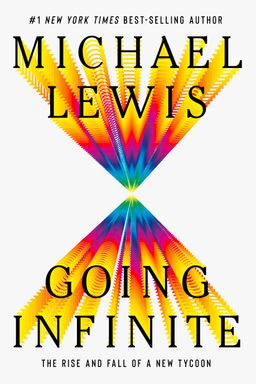
What happens when a brilliant mind trained to maximize expected value finds himself building an empire based on human trust—something he never really understood? In Going Infinite, Michael Lewis delivers a riveting, close-up portrait of Sam Bankman-Fried (SBF), the MIT-trained quant trader turned crypto czar, whose stated mission was to earn as much money as possible for moral ends, but whose rational world collapsed into chaos. Lewis argues that SBF’s story is not just about the biggest financial scandal of its time—it’s about what happens when logic, math, and utilitarian ideals hit the messy world of human emotion and regulation.
Lewis, known for The Big Short and Moneyball, crafts this book as both biography and social x-ray. He contends that SBF wasn’t motivated by greed but by miscalculation: a man trained by math and the culture of high-frequency trading to quantify risk and utility, and who ultimately applied those skills to moral philosophy and, disastrously, to crypto finance. Yet beneath the rational surface lies a tragic blindness—one common to many modern techno-idealists—that numbers can trump relationships, empathy, and accountability.
A Man of Logic in a World of Emotion
The heart of Lewis’s argument is that Sam Bankman-Fried’s mind was optimized for systems, not people. Raised by Stanford law professors steeped in utilitarian ethics, SBF saw life as an optimization problem. As a child, he couldn’t comprehend why his peers believed in Santa Claus—or, later, in God. These early disillusionments with mass delusion led him to see humanity as irrational at scale, a tendency that would define his later business choices. When he discovered effective altruism—a movement encouraging people to make and give money according to measurable utilitarian values—it formed the backbone of his identity. He would make billions not to enjoy them, but to save the world.
But this moral clarity also became a trap. Lewis paints a picture of a man so consumed by maximizing outcomes that he ignored their human costs. At Jane Street Capital, the trading firm where SBF cut his teeth, he learned to reduce complex gambles into probabilities—a skill that served him well in markets but disastrously in public life. Every decision became a math problem. Should he move to the Bahamas? Yes—if the expected value of lower regulation and higher profits outweighed the risk of reputational damage. Should he date a subordinate, Caroline Ellison, who ran his hedge fund Alameda Research? Yes—if their alignment was “high EV.” Should he risk billions in customer deposits to fill a liquidity gap? The math might suggest yes, but reality didn’t follow his models.
From Quant Genius to Crypto King
Lewis traces SBF’s meteoric rise from MIT physics graduate to founder of digital-asset giant FTX. In a few short years, SBF became the world’s youngest multibillionaire and the “golden child” of crypto. His exchange promised the safety and precision of Wall Street trading combined with the speed and freedom of the blockchain. FTX grew by exploiting inefficiencies that larger institutions ignored, until venture capitalists and celebrities—Tom Brady, Larry David, and even regulators—lined up to anoint him the “JP Morgan of crypto.” To outsiders, he was a nerdy savior in cargo shorts promising to fix finance.
But behind the scenes, SBF’s empire was structurally flawed. His hedge fund, Alameda Research, secretly borrowed billions in customer deposits from FTX—money meant to be untouchable. Instead of a firewall, there was a backdoor code (written by his trusted partner Gary Wang) that let Alameda take infinity credit. SBF’s world began to unravel in 2022 when Binance's CEO, Changpeng Zhao (CZ), publicly questioned FTX’s solvency. A liquidity panic ensued, customers demanded withdrawals, and FTX didn’t have the funds. In days, the empire collapsed, revealing that its foundation—built on trust in an untrusting man—was hollow.
Effective Altruism and the Ethics of Scale
Lewis uses the lens of effective altruism to explore how well-meaning rationalism curdled into moral hazard. SBF sincerely believed in earning to give: ascend the money ladder not for pleasure, but to redistribute wealth more efficiently than governments or charities could. Yet, when your metric of success is “maximizing humanity’s utility,” it becomes easy to justify shortcuts. FTX wasn’t designed for crime; it was optimized for speed and control. But the logic of aggressive risk-taking—so natural in trading and in philosophy—met a financial system that runs on something SBF never understood: trust.
By weaving personal portraiture with systemic critique, Lewis turns the fall of FTX into a cautionary tale about the limits of rationalism in a world governed by human emotion, perception, and narrative. If the financial crises of the past were about greed, Going Infinite is about intelligence untethered from empathy. As you follow SBF’s rise, crash, and rationalization, you’re left asking: Can numbers capture the cost of trust betrayed—or the irrational beauty of human restraint?