
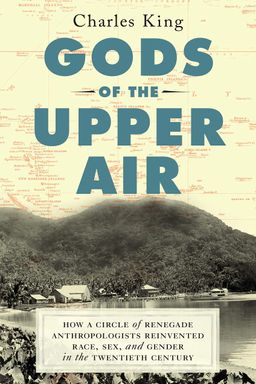
Gods of the Upper Air cover

Gods of the Upper Air

by Charles King

Gods of the Upper Air explores how Franz Boas and his circle of renegade anthropologists revolutionized our understanding of race, sex, and gender in the twentieth century. Through personal stories and groundbreaking research, this book reveals the transformative impact of cultural anthropology on shaping modern views on equality and diversity.

The Birth and Ethic of Cultural Relativism

What does it mean to understand another way of life on its own terms? This question anchors the entire narrative tracing Franz Boas and the movement that became modern anthropology. The book shows how Boas—born in Prussia, trained in physics, and later transformed on the ice fields of Baffin Island—revolutionized ideas about human difference. You follow his journey from measuring skulls and observing Arctic weather to realizing that classification, not curiosity, was the real limitation of nineteenth‑century science.

From measurement to meaning

Boas begins among museum men who divide people into evolutionary ladders: savage, barbarian, civilized. He watches natural history displays turn living cultures into things and sees how instruments like calipers and craniographs promise certainty but deliver prejudice. His early anthropometric work at the 1893 Chicago World’s Fair, intended to demonstrate scientific rigor, becomes his apprenticeship in skepticism. The same tools designed to prove racial hierarchy instead reveal inconsistency. People’s measurements shift with nutrition, environment, and experience. In later immigrant studies, he proves that head size—the icon of racial permanence—changes within a single generation, undermining the foundations of race science.

A new method: cultural relativism

From these lessons Boas builds the method that anchors the discipline: culture, not biology, shapes human behavior. What you take for natural—manners, kinship rules, gender expectations—is produced within social environments. The anthropologist’s duty is to observe before categorizing, to live among the people studied, and to treat one’s own society as an object of analysis. Boas’s ethnographic practice in the Arctic, the Northwest Coast, and among European immigrants establishes the principle that knowledge emerges inductively from life, not deductively from theory.

Ethics and the cost of knowledge

The narrative also insists that this intellectual shift carries moral weight. Museum collecting and racial spectacle exacted human costs: Inuit remains exhibited in Manhattan, the skull of Ishi stored for study, and entire peoples misrepresented in anthropological displays. Boas himself becomes uneasily aware that scientific curiosity can reproduce exploitation. His later career and letters reveal an increasing emphasis on consent, restitution, and humility—principles that anticipate today’s research ethics.

The Boas Circle and legacy

From Columbia University, Boas trains a remarkable circle—Ruth Benedict, Margaret Mead, Edward Sapir, Alfred Kroeber, Ella Deloria, and Zora Neale Hurston—who expand his insight in unique directions. They learn to study language with phonetic precision, record oral traditions, and treat daily activity as the key to culture. Through them, cultural relativism becomes not just a theory but a moral orientation: withhold judgment until you grasp a culture’s internal logic. Under Boas’s guidance, anthropology evolves from the measurement of skulls to the interpretation of stories.

Science and public life

Boas’s fight against eugenics and racist policy shows how anthropology enters politics. His Dillingham immigrant study reveals the plasticity of human form and challenges the racial quotas driving immigration law. Even as the commission ignores his conclusions, Boas becomes a public intellectual defending empirical truth against ideology. Later, his students carry these ideas into wartime intelligence, education reform, and civil rights. Cultural relativism, viewed in this broader arc, is not moral indifference but moral courage—a method for grounding equality in scientific humility.

Core message

The story of Boas and his circle teaches you to see humanity as a mosaic of adaptive, creative, and meaningful worlds. True knowledge requires empathy, evidence gathered in context, and the willingness to recognize that your own categories are local inventions.

This opening framework sets the stage for the rest of the book: the confrontation between science and myth, the evolution of fieldwork, the struggle of women and marginalized scholars for recognition, and the persistent question Boas left us—how to know others without diminishing them.


Science, Measurement, and Its Illusions

You begin in the age of instruments. The late nineteenth century makes numbers its new faith: skull indices, brain weights, and color charts promise certainty about human worth. Scientists like Galton, Broca, and Putnam treat the body as a ledger of racial truth. Boas enters this world fluent in measurement but curious about meaning. At the 1893 Chicago World’s Fair, he directs an anthropometric laboratory that draws crowds eager to see 'race science' in action. Yet what he observes is not confirmation but confusion—data that refuse to behave.

Boas’s critique from within

By turning the tools of anthropometry on their presuppositions, Boas begins to dismantle them. He finds environmental effects in head form and demonstrates observer bias—what he calls apperception—the tendency to see through one’s own habits of thought. Numbers are not self‑interpreting; context and culture shape both what you record and how you read it. His later immigrant studies amplify this discovery: within a single generation, cranial shape shifts with diet and social condition, proving that physical type is not racial destiny.

The spectacle of public science

The Chicago fair embodies the double edge of popular science: it dazzles the public and reinforces myth. Visitors see skulls and calipers as instruments of truth but miss the methodological caution they require. The anthropologist here learns a permanent lesson—display and interpretation are political acts. To measure without reflection is to moralize with numbers.

Boas’s enduring lesson

Quantification can clarify patterns, but only contextual observation reveals meaning. Measurement without humility becomes mythology in numeric form.

By transforming the very tools of racial science into instruments of critique, Boas shifts anthropology from spectacle to scholarship and inaugurates its empirical conscience.


Cultural Relativity in Action

Once you accept that culture explains behavior more than biology, you must learn how to study culture itself. Boas’s fieldwork model—live where people live, master the language, record the small and ordinary—sets the template his students refine. Ruth Benedict reads symbolic patterns; Margaret Mead studies social regulation through daily tasks; Zora Neale Hurston records folklore from within her own black community. Together they transform observation into empathy.

Mead’s ethnology of activity

In Samoa, Mead tests whether adolescence is biologically stormy or socially shaped. Her answer—that emotional turbulence is cultural, not universal—shocks readers and demonstrates the power of controlled comparison. She watches young Samoan women cooking, flirting, and facing few taboos about sexuality, showing how freedom from repression alters development. The method—structured question plus immersive residence—becomes a Boasian hallmark.

Benedict’s culture patterns

Ruth Benedict widens the focus from social stage to cultural design. In Patterns of Culture, she contrasts the self‑restrained Zuni, the aggressive Dobu, and the flamboyant Kwakiutl to show that each culture selects traits into coherent Gestalts. What looks like moral difference is aesthetic patterning: each society creates a particular rhythm of emotion and control. Her analysis transforms cultural relativity into an ethical principle—difference as coherence, not deficiency.

Mead’s study of temperament

Later, in Sex and Temperament, Mead extends this view to gender. Among the Arapesh, both sexes are gentle; among the Mundugumor, both are fierce; the Tchambuli reverse Western gender roles. From this variety she concludes that personality and gender behavior are products of cultural choice, not universal instinct. (Note: these studies foreshadow feminist and psychological debates that continue today.)

Through these case studies you learn to practice cultural relativism not as abstract tolerance but as disciplined comparison. You suspend judgment until you see the world through another’s logic—and in that act you discover how flexible human nature really is.


Voice, Story, and Insider Ethnography

Zora Neale Hurston brings Boas’s ethics to life through language. Trained at Barnard under his supervision, she returns to the communities of her own upbringing in Florida to record folktales and oral histories. Her method, unlike the detached museum catalog, is participatory and narrative. She writes in dialect, stages the porch conversations of Mules and Men, and treats storytelling itself as cultural performance. For Hurston, folklore is not residue but living theory—a proof of creativity among those labeled primitive.

From folklore to field theater

Hurston’s storytelling ethnography dissolves the line between literature and science. She introduces herself as a character, engages in verbal play, and refuses to mute the vernacular voice. Boas understands the importance of her contribution and writes the preface that frames it as ethnographic data. Yet the literary quality—its musical rhythm and humor—signals a deeper argument: that representation can itself reproduce hierarchy unless reclaimed by insiders.

Fieldwork across the Atlantic

Her later Caribbean work in Tell My Horse extends this claim. In Jamaica and Haiti, Hurston documents vodou ceremonies and the case of Felicia Felix‑Mentor, exploring zombies as metaphors for social dispossession. She neither romanticizes nor mocks; she interprets belief as social text. Through her you see how fieldwork becomes moral witnessing—an art of presence that challenges colonial ways of seeing.

Hurston’s principle

To grasp a community, you must imagine the world as its members do and let their voices carry the analysis. Writing, then, becomes a shared performance of understanding.

By merging art and ethnography, Hurston ensures that cultural relativism speaks in many tongues, not just the academic one.


Ethics, Museums, and the Human Cost of Science

Behind every display case lies a moral story. The discipline’s early triumphs relied on collecting bodies, objects, and songs, often without consent. The book confronts you with chilling examples: Qisuk’s dissected body and the staged funeral for his son Minik; Ishi’s life in a museum; Ota Benga exhibited in the Bronx Zoo. These episodes expose the imbalance of curiosity and power in early anthropology.

From collection to conscience

Boas’s growing discomfort with such practices embodies anthropology’s conscience shift. He begins as caretaker of museum specimens and ends as critic of museum imperialism. When he insists on documenting living culture rather than accumulating artifacts, he indirectly inaugurates debates about repatriation and the ethics of representation. His regret over the Minik affair shows that even reformers are entangled in the structures they critique.

Scientific racism and display logic

Museums organized skulls by race, constructing visual taxonomies that lent physical reality to prejudice. Such displays fed both pseudoscience in America and race policy abroad. The text traces how Nazi racial ideology borrowed American eugenic models, closing the circle between exhibition and extermination. Anthropology could no longer pretend neutrality.

Lesson for researchers

Knowledge gathered without consent or care corrodes the very ethics that make it credible. Every observation carries responsibility for what—and whom—it exposes.

By connecting scientific practice to its human cost, the book transforms ethics from appendix to foundation: anthropology must be accountable to those it studies.


Women, Barriers, and the Discipline’s Hidden Labor

Much of anthropology’s progress rests on women who rarely received equal credit. Ruth Benedict, Margaret Mead, Zora Neale Hurston, and Ella Deloria illustrate how gender and race shaped access to intellect and authority. Benedict managed Columbia’s programs and edited its journals but earned less than male peers. Mead became the public face of anthropology but was simultaneously dismissed as sensational. Hurston navigated both racial and academic marginality. Deloria, a Native linguist and coauthor of Dakota Grammar, compiled immense data while juggling unpaid labor.

Intellectual collaboration

These women not only executed Boas’s projects—they expanded them. Benedict’s concept of cultural configuration refined cultural relativism into moral philosophy. Mead’s comparative studies of childhood and gender popularized anthropology for the public. Hurston’s narrative ethnography defended black culture from exoticism, while Deloria’s linguistic precision established benchmarks for indigenous scholarship.

Hidden foundation

Anthropology’s credibility as an inclusive, empathetic science was built through their persistence in systems that often excluded them. Recognizing their labor is itself an act of disciplinary repair.

Learning their stories reveals that the struggle for scientific integrity is inseparable from the struggle for equity within the sciences themselves.


Applied Anthropology and the Uses of Culture

World wars push anthropology from the field into the policy room. During World War II, Ruth Benedict, Margaret Mead, and Gregory Bateson transform ethnographic analysis into cultural advice for the U.S. government. Benedict’s The Chrysanthemum and the Sword analyzes Japan through literature and interviews with Japanese Americans, producing the influential distinction between shame cultures and guilt cultures. Her conclusion—that policy must adapt to cultural logic rather than ignore it—embodies Boas’s principle of context‑sensitive understanding.

Culture at a distance

Unable to enter enemy territory, wartime anthropologists practice 'culture cracking' from afar, using films, diaries, and interpreters. This adaptation reaffirms that anthropology’s value lies in interpretation, not mere proximity. Yet it also reveals risk: when scholarship serves state power, ethical lines blur. Japanese American informants like Robert Hashima move from internment to intelligence work, exposing the moral ambiguity of applied science.

The double legacy

Applied anthropology humanizes foreign policy but entangles scholars with authority. Mead and Benedict use culture to advocate restraint, yet their analyses also become tools of occupation. The book presents this as a test case for the discipline’s moral compass: how to connect understanding with responsibility.

Through wartime work you see anthropology’s reach—and its ethical limits. Cultural knowledge can mitigate harm or deepen control depending on how it is wielded.


The Moral Purpose of Relativity

In its final turn the book reframes cultural relativism as moral practice. Boas and his successors do not urge value‑neutrality; they advocate empathy disciplined by evidence. By dismantling myths of innate inferiority, they broaden the circle of moral concern. Benedict argues that understanding alternative moral worlds enlarges our own; Mead insists that rigid gender norms waste human potential; Hurston proves that narrative voice is itself a form of dignity. Together they turn relativism into a defense of shared humanity.

From science to conscience

Boas warns that bad science justifies cruelty—from segregation in America to racial purity laws in Germany. Confronting those links, he declares objectivity impossible without ethical vigilance. His circle carries that warning into the mid‑century campaign for civil rights, cultural pluralism, and democratic reform. The book ends by arguing that anthropology’s most radical claim is moral: facts about variation are also commitments to equality.

Final lesson

To understand another’s culture is not to suspend judgment forever but to judge with broader sympathy and better evidence. Empirical humility becomes the foundation of moral imagination.

Cultural relativism thus emerges not as retreat from truth but as its ethical refinement—an insistence that knowledge about others should make the world more just.

Dig Deeper

Get personalized prompts to apply these lessons to your life and deepen your understanding.

Go Deeper

Get the Full Experience

Download Insight Books for AI-powered reflections, quizzes, and more.