
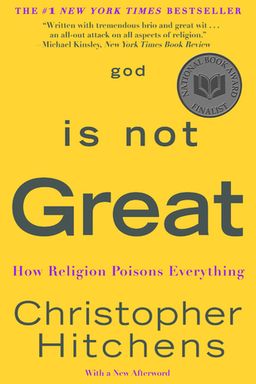
God Is Not Great cover

God Is Not Great

by Christopher Hitchens

In ''God Is Not Great,'' Christopher Hitchens explores the evolution of religious belief and its implications. He challenges the reconciliation of science and faith, shedding light on religion''s historical inaccuracies, moral contradictions, and its totalitarian nature. Hitchens advocates for reason and critical thinking as tools for societal progress.

Reason Against Faith: The Core Argument

What happens when you measure human morality and truth claims against evidence rather than authority? Christopher Hitchens takes you through that question with a consistent thesis: religion is man-made, false in its descriptions of origin, and harmful when it claims special moral or political authority. Yet he also insists that life need not be desolate without it—art, literature, and reason offer richer consolation and clearer ethics than divine command ever did.

Across continents and centuries, Hitchens traces how belief systems evolve from tribal superstition to organized dogma, often entrenching servility, violence, and taboo. His purpose is not just to mock faith but to defend inquiry itself—the idea that awe and wonder are compatible with truth rather than submission. You begin with his childhood classroom where a teacher tells the children that plants are green because God made them pleasing to the human eye; that small logical reversal (“the eye evolved for the world, not the world for the eye”) becomes the germ of skepticism.

From Doubt to Secular Ethics

Hitchens identifies four abiding objections: religion distorts origins, mingles self-abasement with narcissism, demands sexual repression, and thrives on consoling illusion. His response is a secular ethic—built on free inquiry, literature, and empathy without divine command. He finds moral example in Shakespeare and Tolstoy rather than scripture, because they confront cruelty and love without pretending infallibility. This blend of curiosity and compassion becomes the backbone of his Enlightenment stance: you mourn and find meaning without surrendering your reason.

Faith’s Material Consequences

The book then expands from idea to world history: religion’s pursuit of power often yields bloodshed. In Belfast, Beirut, and Baghdad, sectarian identity replaces civic identity and people die for holy claims. Whether Catholic vs. Protestant, Hindu vs. Muslim, or Sunni vs. Shia, Hitchens sees a single template—religion sanctifies tribe and vengeance. He contrasts such confessional politics with secular institutions like the U.S. Constitution or Enlightenment republicanism, which deliberately separate church and state to reduce cruelty. When religion drives governance, death follows; when reason governs, pluralism survives.

From Mythmaking to Human Invention

As the argument progresses, Hitchens tests revelation, miracles, and taboo to show how human imagination creates gods and rules. He explores the pig prohibition as an example of religion’s arbitrary fetishes—what began as cultural identity became moralized superstition. Likewise, he exposes how faith wounds health, sexuality, and children: vaccine refusals, ritual mutilations, and indoctrinated terror are not fringe but systemic. These cases reveal faith’s institutional immunity from evidence—a danger to bodies as well as minds.

Reason as Liberation

To replace myth, Hitchens formalizes reason’s principles: Ockham’s razor, Laplace’s mechanistic astronomy, and Hume’s test of miracles. Each asks you to prefer what can be tested over what is merely asserted. Modern science and democratic inquiry inherit those values. When Laplace said he had “no need of that hypothesis,” he was rejecting metaphysical decoration—not wonder itself, but its unfounded explanations. By that logic, evolution refutes design arguments, textual criticism refutes revelation, and cosmology refutes creation myths.

Toward a New Enlightenment

Hitchens ends with a rallying appeal: reason must again become moral courage. Study Socrates’ defiance, Spinoza’s independence, and Darwin’s risk; they illuminate how skepticism builds civilization. Knowledge and compassion are not opposites—they thrive together when freed from priestly authority. His book is both diagnosis and prescription: expose religion’s human origins, confront its harms, and revitalize an ethic of doubt and humanism that rests on evidence, empathy, and freedom instead of revelation and fear.

Core Idea

Religion is a human fabrication that misuses awe and authority; reason, properly applied, offers both truth and humane consolation. To live well, you do not need faith in gods—only faith in the inquiry that makes you free.


Faith and Violence

Hitchens’ surveys of Belfast, Beirut, Bombay, Belgrade, Bethlehem, and Baghdad form a global indictment: confessional identity consistently produces organized cruelty. What appears as piety often conceals political ambition. Protestant and Catholic militias divide Belfast, Hindu nationalism reshapes Bombay, and Islamist rule turns Bethlehem into a war zone for its own believers. Each case shows how belief claims to transcend politics yet constantly fuels it.

Sacred Language, Secular Power

When religion asserts divine sanction, it gives rulers moral immunity. Saddam Hussein’s “Anfal” campaign invoked Koranic rhetoric while exterminating Kurds; Serbian clerics blessed massacres in Bosnia. The phrase “religion kills” is not metaphorical—it describes faith used as state charter for murder. Even acts of charity can conceal power—Mother Teresa’s alliances with dictatorships reveal how sanctity can silence dissent.

The Political Alternative

Hitchens pleads for secular republicanism: no church-run parliaments, no confessional borders. His insight is simple—once belief wields coercive power, violence follows. The separation of church and state is the necessary firewall against divine totalitarianism. The lesson from history is clear: prefer constitutions that derive legitimacy from reason, not revelation.


Taboos and Social Control

To understand how religion sanctifies the arbitrary, Hitchens dissects the pig taboo—a small case with immense sociological reach. In Judaea and later Islam, pig avoidance became a badge of identity, reinforced by moral horror. This taboo spread not for hygiene but for differentiation; its survival into modern times shows how ritual transforms minor customs into tools of authority.

Psychology of Repulsion and Attraction

Frazer’s and Ibn Warraq’s studies reveal that taboo often hides fascination. The pig, intelligent and similar to humans, provoked discomfort; by denouncing it, believers externalized their ambivalence. Such mechanisms illustrate how religion codifies instinct into prohibition. Over time, even harmless symbols—Miss Piggy, children’s book characters—become contested territory for divine purity.

Political Use of Ritual

Hitchens recounts how in Spain, inquisitors used pork consumption as a test for sincerity. The familiar jamón transformed into an instrument of persecution. The broader insight applies widely: when belief requires visible loyalty, trivial items become moral tests, and ordinary acts (eating, dressing, speaking) become surveillance tools. The pig taboo thus stands for the larger machinery of religious policing—from dietary codes to blasphemy laws.


Faith Versus Health and Childhood

Many harms of religion are bodily and generational. Hitchens shows how piety interferes with medicine and how doctrines terrorize or injure children. He recalls fatwas against polio vaccination in Nigeria, bishops denying condom efficacy, and ritual circumcisions that spread disease. Each case demonstrates faith’s claim to moral exemption from evidence—a claim that kills.

Health Policy Sabotaged

When clerical authority overrules science, epidemics return. The Nigerian vaccine ban revived polio; Catholic sex teaching worsened AIDS mortality. Religious leaders prefer purity myths to prevention. Hitchens contrasts this with secular ethics rooted in consent and empirical review, arguing that moral sincerity must never excuse factual negligence.

Children and Fear

Doctrines of hell and sin, preached to children, shape minds through terror. Ritual mutilation—male or female—is justified as obedience to divine law. The Catholic Church’s sexual abuse scandals reveal structural causes: enforced celibacy, hierarchical secrecy, and immunity from external law. Hitchens’ conclusion is civic, not just moral—protect the vulnerable by bringing all institutions under public accountability, no matter how sacred their name.


Reason and Science Replace Metaphysics

In the transition from theology to science, Hitchens places rationalists like Ockham, Laplace, and Hume as torchbearers. Their principle is economical: accept no supernatural cause when natural ones suffice. Laplace’s absence of God from celestial mechanics becomes emblematic—he “had no need of that hypothesis.” Hitchens sees that attitude as civilization’s pivot.

Taking Nature on Its Own Terms

Evolution undermines design arguments by revealing gradual complexity rather than divine manufacture. Paley’s watchmaker analogy fails because life evolves through trial and error, not blueprint perfection. The eye’s flawed wiring and the Burgess shale’s random outcomes exemplify contingency; complexity does not prove intention but history.

Modern Astronomy and Awe

Where religion demanded worship, science offers astonishment. Hubble images or Einstein’s cosmology reveal wonder without doctrine. Hitchens argues that the real spiritual impulse lies in curiosity, not submission. Once nature explains itself, metaphysics recedes. Faith’s leap becomes a repetitive denial of progress; reason’s humility becomes the mature form of awe.


Scripture as Human Literature

Religion claims revelation as evidence, but textual scrutiny exposes authorship as human collage. Hitchens examines the Old Testament’s genocidal and servile laws, the New Testament’s internal contradictions, and the Koran’s political compilation—all examples of editing masquerading as eternity.

Old Testament: Moral Narrowness

The Ten Commandments omit compassion for children or slaves while condoning ethnic massacre. Archaeology finds no Exodus; the Pentateuch reads as later nationalist propaganda. Revelation proves to be a consolidation of tribal law, not divine telegrams.

New Testament: Contradicted Testimony

Gospel chronologies clash, prophecies are retrofitted, and interpolations multiply. Bart Ehrman’s textual criticism undercuts claims of consistency. Once you treat scripture as historical literature, divine infallibility disappears and ethical reflection becomes free from dogma.

Koran and Hadith: Borrowing and Codification

Hitchens notes Islam’s compilation centuries after Muhammad, with editions burned to enforce uniformity. Hadith stories borrow freely from earlier Jewish-Christian lore. The insistence on Arabic purity ensures clerical control while blocking critical translation. Across all traditions, the pattern repeats: religious texts preserve human ambition draped in supposed divine authority.


Manufacturing the Miraculous

When Hitchens examines modern miracle stories, he reveals a sociological machinery—error rebranded as holiness. From Malcolm Muggeridge’s 'divine light' in Mother Teresa’s film to claims of medical cures in India, every case follows the same pattern: ambiguous evidence plus institutional hunger equals instant sanctity.

How a Miracle Is Made

The BBC footage was simply shot with experimental Kodak film that enhanced brightness. Yet journalists proclaimed divine illumination. Likewise, a routine tuberculosis recovery becomes the miracle for beatification. Hitchens uses these events to expose the marketing of faith: miracles sell certainty; medicine and physics sell complexity. Media incentives amplify the extraordinary and silence the mundane.

Applying Rational Tests

Hume’s principle applies: extraordinary claims require extraordinary evidence. Once skepticism filters through, most miracles fade as misinterpretations or fraud. The ethical problem persists because institutional religion rewards credulity for influence and profit. Hitchens’ remedy is civic discipline—demand proof as public duty, not merely intellectual style.


Religion, Tyranny, and Reform

One common defense of religion is that it restrains tyranny; Hitchens shows instead that it often enables it. From Mussolini’s Vatican Pact to Catholic accommodation with Hitler and Japanese Buddhist nationalism, sacred authority has repeatedly sided with power. The reason is structural: institutions protect influence before conscience.

Faith as Ideology of Rule

Totalitarianism operates as secular religion—Stalin or Kim Il-sung fulfill the priest’s role in the worship of infallibility. Hitchens draws on Orwell and The God That Failed to illustrate this crossover: even atheist tyrannies mimic church ritual to control minds. Where theocracy or monolith reign, truth dies.

Faith and Reformers

Yet individuals like Martin Luther King Jr. use religious metaphor for moral rebellion rather than obedience. King’s genius was rhetorical, turning biblical imagery into civic argument. Hitchens invites you to distinguish between courageous individuals who borrow faith’s language for justice and institutions that oppose it. Reformers succeed by conscience, not creed.


Eastern Mysticism and Human Fabrication

Hitchens dismantles the romantic notion that Eastern spirituality transcends dogma. From Bhagwan Rajneesh’s cult economics to Zen’s collaboration with Japanese militarism, he shows identical patterns of manipulation, hierarchy, and repression. The promise of detachment can mask coercion just as effectively as Western theology.

Cults and Opportunism

Rajneesh transformed meditation into business empires, then weaponized loyalty. The parallels to revivalist frauds like Marjoe or Mormonism’s textual entrepreneurship are obvious—religion emerges from human needs and leaders who monetize them. Cargo cults literalize the yearning for material rescue, revealing religion as economic wish disguised as revelation.

Shared Structural Traits

Whether guru communes or theocratic states, the traits persist: obedience, charisma, and taboo. Eastern and Western distinctions blur once you look at power relations. Hitchens concludes that human invention—not geography—shapes faith systems. You can admire meditation or poetry but must reject any institution that burdens liberty in mystical language.


The New Enlightenment

In the final movement, Hitchens urges renewal—a modern Enlightenment where reason again defeats fear. He evokes Socrates, Spinoza, and Darwin as moral ancestors of scientific democracy. Their courage to question authority made both knowledge and ethics possible. You inherit that task now: replace superstition with literacy and compassion grounded in fact.

Intellectual Courage

Socrates died for inquiry; Spinoza lived excommunicated yet serene; Darwin and Einstein redefined awe through discovery. These figures embody the conscious refusal of comfortable myth. Hitchens insists that this refusal is not cold but humane—it delivers freedom from terror and invites genuine admiration for existence itself.

Building Civic Reason

He calls for policies based on evidence, sex education free from clerical interference, and art that teaches empathy instead of submission. Seen this way, the 'new Enlightenment' is not academic but practical: universal education, free speech, and ethics of consent. The book closes by linking personal doubt to collective progress. Rational thought becomes not mere critique of religion but blueprint for a more decent world.

Dig Deeper

Get personalized prompts to apply these lessons to your life and deepen your understanding.

Go Deeper

Get the Full Experience

Download Insight Books for AI-powered reflections, quizzes, and more.