
Idea 1
The Art and Science of One-on-One Meetings
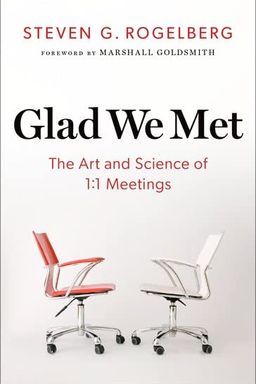
When was the last time you truly connected with someone at work—listened fully, felt understood, and came away more energized than before? In Glad We Met: The Art and Science of 1:1 Meetings, organizational psychologist Steven G. Rogelberg asks this deceptively simple question to expose what might be the most undervalued tool in leadership: the one-on-one meeting.
Rogelberg argues that while most managers dread meetings, they unknowingly miss the most powerful type—the regular, purposeful conversation with individual team members. His research confirms that one-on-ones are not an administrative task or an add-on; they are the work of leadership itself. Drawing on extensive organizational studies, interviews with top executives, and decades of meeting science, he reveals how high-quality 1:1s dramatically shape engagement, trust, performance, and even life satisfaction.
Why One-on-Ones Matter
The book opens with a staggering observation: billions of meetings occur daily worldwide, with at least 200–500 million being one-on-ones. Yet nearly half are rated as subpar by participants. The gap isn’t in quantity—it’s in quality. Rogelberg’s data show that while managers think their 1:1s are going well, direct reports often disagree. This blind spot costs organizations billions of dollars and erodes connection. The author sets out to bridge this gap through an evidence-based playbook.
His case rests on seven outcomes linked to effective 1:1s: stronger engagement, team success, manager effectiveness, trust, diversity and inclusion, career growth, and even personal well-being. One-on-ones, he explains, are the single most efficient way to combine structure with humanity—meeting both the practical needs (alignment, clarity, coaching) and personal needs (respect, trust, support) of employees. When done right, they make work feel meaningful rather than mechanical.
Meetings as an Investment, Not a Chore
Many leaders resist scheduling more meetings, but Rogelberg reframes them as strategic investments. He calculates that global one-on-ones represent over $1.25 billion in daily labor costs—yet this figure reflects the potential return as much as the expense. Effective meetings reduce turnover, improve communication, and increase alignment, saving time in the long run. Poor meetings, by contrast, waste resources and disengage employees.
To help leaders see one-on-ones as high-value interactions, Rogelberg positions them as engines for organizational culture. A 1:1 is a microcosm of leadership philosophy: if a manager listens, builds trust, and fosters growth here, those behaviors reinforce across the team. He notes that skipping 1:1s doesn’t just delay progress—it sends a message that employees are not worth a manager’s time. Absence communicates apathy.
The Balance of Structure and Flexibility
The heart of Rogelberg’s model is balance. An effective 1:1 blends rigor and empathy, short-term action and long-term vision, consistency and personalization. He urges managers to approach these conversations as both science and art—guided by behavioral research but tailored to human nuance. The 1:1 becomes a leadership micro-skill where preparation, psychological safety, curiosity, and feedback interlock.
The author breaks down the spectrum managers must navigate: structure without rigidity, cadence without monotony, and agenda without domination. These meetings, he insists, should belong to the team member, not the manager. The leader’s role is to orchestrate—not dictate. It means asking questions like “What’s on your mind?” or “How can I help?” and listening more than speaking—a ratio Rogelberg quantifies as 50–90% of airtime belonging to the employee.
The Science Behind the Practice
Rogelberg brings credibility from his prior bestsellers and empirical research. His studies span thousands of knowledge workers and executives across organizations like Google, Deloitte, Marriott, and Facebook. He synthesizes findings from psychology, coaching, and communication theory. For instance, he cites the Pygmalion Effect—our expectations shape outcomes—to remind managers that entering a meeting believing in someone’s potential directly influences their performance.
He also weaves in the concept of meeting flow, based on Mihaly Csikszentmihalyi’s work on “flow states.” Scheduling 1:1s thoughtfully (clustered together, not scattered) boosts productivity by minimizing task-switching. Even environmental details—lighting, noise, color, or air quality—can affect emotional tone and cognitive engagement. Rogelberg’s scientific lens turns workplace routine into behavioral design.
Human Connection in a Hybrid World
Beyond logistics and frameworks, the book’s emotional core is human connection. Rogelberg echoes thinkers like Adam Grant and Carol Dweck (both featured in the book’s endorsements): people thrive not just from tasks completed but from relationships nurtured. Even remote employees crave visibility and empathy. One-on-one meetings give voice to those who might otherwise remain unseen.
Whether in a traditional office, over a video platform, or on a walking meeting, Rogelberg argues that space matters. A quiet, comfortable, private environment promotes psychological safety and openness. Leaders must “meet people where they are”—literally and figuratively. A coffee shop chat or an outdoor stroll can dissolve hierarchy and unlock candid conversation.
A Practical Blueprint for Better Leadership
Throughout Glad We Met, Rogelberg offers tools—templates, quizzes, and checklists—for scheduling, agenda creation, and feedback. But the deeper message isn’t mechanical; it’s moral. He concludes that effective 1:1s are an expression of leadership values: respect, inclusion, curiosity, and service. They embody empathy in action. As Jane Austen’s quote reminds us, “It isn’t what we say or think that defines us, but what we do.” Holding meaningful conversations isn’t optional—it’s how leaders live their values.
In short, Rogelberg shows that the heartbeat of great leadership is conversation. A 1:1 isn’t a meeting—it’s a moment of stewardship, where time becomes a gift, trust becomes currency, and growth becomes inevitable. Done well, these encounters transform teams, cultures, and lives. The measure of an executive, Rogelberg suggests, is simple: you are as good as your last one-on-one.