
Idea 1
Mining for Purpose in a Throwaway Age
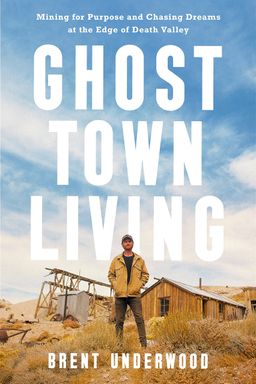
What would you attempt if the timeline for success stretched beyond your own lifetime—and the point wasn’t the payoff, but the person you became in the doing? In Ghost Town Living, Brent Underwood argues that an extraordinary life is more likely to be built than found. He contends that meaning arises when you commit to a hard, long-term undertaking that resists efficiency, survives catastrophe, and binds you to a community and a place. But to do that, you have to unlearn our culture’s shortcut mindset and relearn what miners, mules, and desert elders already knew: pick your spot, swing, and endure.
Underwood’s experiment is audacious. In 2018 he spent everything he had (and a lot he didn’t) to buy Cerro Gordo, a 19th-century silver camp perched above Death Valley. The town built Los Angeles, then died when the ore ran out. He moves in alone at 8,500 feet without running water, amid decrepit buildings and 30 miles of mines. Soon the pandemic hits, a blizzard strands him, floods erase the only road, and a 3 a.m. fire incinerates the American Hotel—the heart of his vision. Still, he doubles down. He rappels into collapsed shafts, learns heavy machinery, raises a global volunteer corps via YouTube, and—famously—airlifts nothing, instead hauling and hand-mixing 80 cubic yards of concrete with Heavy D’s crew to resurrect the hotel’s foundation. The book is a memoir of grit, a field guide to meaning, and a love letter to a ravaged landscape.
What This Book Claims
The core argument: Purpose isn’t discovered; it’s mined—layer by stubborn layer—through a long, absorbing project that stretches your skills, deepens your sense of history, and roots you in a place and people. Underwood echoes Albert Camus’s “happy Sisyphus,” insisting that the struggle is not a bug of a meaningful life; it is the meaning (Camus; also see Viktor Frankl’s Man’s Search for Meaning). Against our culture’s “move fast and break things,” he proposes “move deliberately and build things,” accepting nature’s veto power, the pain of setbacks, and the time horizons of masonry and mountains, not apps and quarters.
How the Book Proves It
You’ll see four recurring moves:
- Pick a mountain and swing. Inspired by prospector “Burro” Schmidt, who hammered a half-mile tunnel through granite over 38 years, Underwood shows how choosing a worthy, resistant project creates a rhythm of daily progress and a resilient identity.
- Start small, then go deep. He rebuilds a porch plank-by-plank in a blizzard, then rappels into Cerro Gordo’s truly subterranean city to grasp the mine’s logic—and himself.
- Walk the wash and find elders. With Tip—an austere desert sage—he learns to see terrain, history, and danger, turning the land into a teacher (compare to Barry Lopez’s Arctic Dreams on landscape literacy).
- Build community, not ego. After fire reduces the hotel to ash, he posts a raw video—crying on camera, then inviting help. Thousands respond. The project becomes a commons.
Why It Matters Now
We live in a snatch-and-grab era—strip-mined attention spans, growth hacks, exit plans. Underwood’s countercultural thesis lands with force: short-term thinking has long-term costs. He retells the draining of Owens Lake by William Mulholland’s aqueduct—the crime behind LA’s rise—to reveal that how we build matters as much as what we build (see also Marc Reisner’s Cadillac Desert). Whether you’re making software, schools, or a life, your methods write your legacy on the landscape and in other people’s lungs.
What You’ll Take Away
This summary tracks eight ideas: choosing hard commitments; the power of starting tiny; learning to see and finding mentors; going deep into history; respecting water, fire, and flood while thinking longer-term; building with community; managing burnout through rotation, awe, and gratitude; and leaving a mark worthy of memory. You’ll get vivid stories—Burro Schmidt’s tunnel; the 2020 fire; rappelling the Jefferson Chimney; the Buckets-and-Bobcats concrete pour; Tip’s final lessons—and practical ways to turn your own work into a mine for meaning.
Key Idea
“There it is, take it” built a metropolis but killed a lake. “Here I am, build it” can build a life—and maybe a better future.
If you feel a tug toward a life less ordinary, this isn’t a manifesto to burn the ships so much as a blueprint to sink footings. Underwood shows you how to trade speed for stewardship, spectacle for substance, and audience for community. The work will wound you. It will also make you whole.