
Idea 1
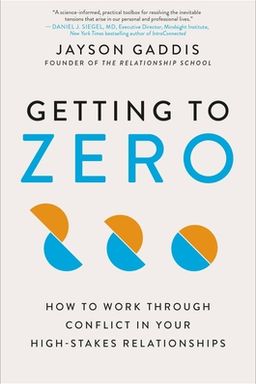
Getting to Zero: The Art of Repairing Relationships Through Conflict
Have you ever wondered why even your closest relationships can swing from deep connection to painful disconnection in a heartbeat? In Getting to Zero: How to Work Through Conflict in Your High-Stakes Relationships, therapist and relationship coach Jayson Gaddis argues that the quality of our most important relationships isn’t determined by how little we fight, but by how well we repair after conflict. He contends that learning to navigate disconnection—the arguments, misunderstandings, and emotional ruptures that accompany intimacy—is the gateway to deeper connection and personal growth.
Gaddis redefines what we think conflict means. Instead of seeing it as something destructive or shameful to avoid, he views conflict as unavoidable—and even crucial—for the evolution of any meaningful relationship. Through what he calls the Conflict Repair Cycle, he introduces a new way to measure intimacy: not by harmony but by how quickly and skillfully you can move from disconnection back to what he calls Zero, that sweet spot of mutual connection, understanding, and peace.
Reframing Conflict as Connection
The central idea of Gaddis’s work is that conflict is not a sign of relational failure—it’s actually the fuel for relational maturity. Drawing on neuroscience, Buddhist psychology, and attachment theory (not unlike works by Dan Siegel and Stan Tatkin), Gaddis reminds us that our nervous systems are wired both to protect and to connect. When we feel threatened, our instinct is to defend or withdraw. But doing so cuts off communication and emotional safety, which he calls the realm of the “Scared Animal”—the reactive self that hijacks understanding and fuels distance.
To navigate this tension, the author urges readers to replace avoidance with awareness. He illustrates this through his personal story: a gifted athlete turned conflict avoider, whose early experiences taught him that fighting was bad. Only after a painful breakup did he realize the truth—he was the common denominator in his failed relationships. From that point, he committed to learning how to face conflict rather than run from it. This journey led him to develop the Getting to Zero method, which blends therapeutic and communication tools for anyone willing to confront their pain honestly.
The Road to “Zero”
“Zero,” in Gaddis’s language, isn’t about perfection or perpetual calm; it’s the moment after repair—when both people feel safe, seen, and soothed. Using a scale from 0 to 10, he suggests measuring your level of disconnection: 10 means emotional chaos, and 0 means peaceful attunement. The goal isn’t to avoid reaching a 10, but to shorten the time it takes to return to zero. You’ll keep cycling through these ruptures for as long as you’re human, but getting back to zero faster ensures relationships will deepen instead of deteriorating.
Through this process, Gaddis reminds you that high-stakes relationships—partners, family, close friends—always carry more emotional volatility because they touch our most vulnerable selves. You fear being rejected or abandoned, so you adapt by hiding your truth, pleasing others, or withdrawing. Ironically, these strategies create even more conflict. The author’s prescription is to stop playing the victim and become what he calls a Relational Leader—someone who takes radical responsibility for their reactions and who learns to face, not flee, discomfort.
A Structured Path to Repair
Across thirty chapters, Gaddis maps a comprehensive process for getting to zero, divided into three stages: Before Conflict (understanding your blueprint and triggers), During Conflict (practical communication and emotional regulation tools), and After Conflict (repair, forgiveness, and reconnection). He integrates tools like LUFU—“Listen Until They Feel Understood”—and SHORE—“Speak Honestly with Ownership to Repair Empathetically.” Each supports the same principle: that empathy and responsibility dissolve tension faster than defense or blame.
Throughout, he offers vivid stories: Monika and her avoidant husband, Sarah choosing “Choice C” by embracing conflict rather than avoiding it, and Jared, an extreme athlete who could face death on a mountain but not a disagreement at home. These illustrate how our avoidance mechanisms—what Gaddis calls the Four Disconnectors (posture, collapse, seek, avoid)—block intimacy until we confront them. Personality meets biology in every fight, but by slowing down and seeing the threat for what it is (a perceived danger, not an actual one), you reclaim your adult self from your scared animal.
Conflict as a Mirror for Self-Understanding
Conflict, in Gaddis’s vision, is a mirror showing what still needs integrating within you. It exposes your relational blueprint—patterns inherited from childhood—and invites you to rewrite it. You learn to move from victimhood (blame) to authorship (empowered choice). This transformation is not a quick fix; it’s an ongoing movement from reaction to reflection. You practice taking ownership, pausing when triggered, and shifting from “What’s wrong with you?” to “What am I learning about me?” Each confrontation becomes an opportunity for both parties to grow, not a threat to survival.
Why This Matters Now
In an age of disconnection—digital relationships, ghosting, political divisions—Getting to Zero offers a relational antidote. Gaddis builds on decades of psychological research (including Dan Siegel’s studies on attachment and Gabor Maté’s insights on emotional suppression) to show that unresolved conflict undermines not only relationships but health, longevity, and joy. Emotional distance, he warns, is as lethal as smoking fifteen cigarettes a day. The capacity to repair is therefore not just emotional intelligence—it’s survival skill.
Ultimately, Gaddis’s message is both humbling and hopeful: great relationships are earned through the practice of repair. You can't avoid conflict, but you can learn to dance with it—using curiosity, vulnerability, and courage as your partners. In doing so, you don’t just mend your relationships; you heal the scared animal within, one conversation at a time.