
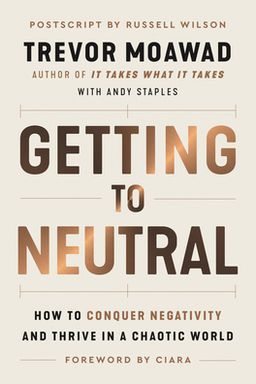
Getting to Neutral cover

Getting to Neutral

by Trevor Moawad

Getting to Neutral provides a roadmap to conquer negativity through neutral thinking. Embrace a balanced mindset by learning from past experiences without emotional bias, and lead a life aligned with your values. Discover how to make informed decisions and find calm amidst chaos.

The Power of Neutral Thinking: Rejecting Extremes to Thrive

Have you ever been told to “just stay positive” when everything seemed to fall apart—and felt that advice was impossible to follow? In Getting to Neutral, Trevor Moawad delivers a radically practical alternative: when positivity feels fake and negativity pulls you under, there’s a better state of mind—neutral thinking. Moawad argues that neutrality, not positivity, is what empowers you to act effectively amid chaos, fear, or uncertainty. Neutral thinking means focusing on the truth in front of you, stripping away emotional judgment, and asking, “What’s the next step?”

The book expands on Moawad’s first work, It Takes What It Takes, but shifts from the performance arenas of sports to a broader audience—people facing adversity, illness, or global crises. Moawad, who coached elite athletes like Russell Wilson and worked with military units, uses his personal battle with cancer and the pandemic as case studies of what it truly means to think neutrally when life is unpredictable. Rather than trying to be positive, you learn to manage reality, make factual decisions, and take one practical next step—even when optimism feels unsuitable.

From Positive Thinking to Neutral Reality

Moawad begins by dismantling the cult of positivity that dominated self-help since Norman Vincent Peale’s The Power of Positive Thinking. He shows how unearned positivity can be damaging. During the COVID-19 pandemic, for example, people who believed positivity alone would make everything fine were crushed when reality refused to cooperate. Neutral thinkers, by contrast, recognize that neither optimism nor pessimism guarantees results—facts do. The mind must shift gears to neutral, as a car idling but ready to move in any direction depending on the terrain. Neutrality accepts what happened, understands it doesn’t dictate the future, and focuses solely on actionable truth.

Building the Mindset of Ownership

Neutral thinking demands discipline over emotion. Moawad’s central framework teaches you to own your current reality without judgment, shift your words away from negativity, and control your inputs. Every thought, he warns, has consequences: the more negative messages you say, hear, or consume, the more your behavior degrades. (He proved this with a personal “negativity diet” experiment that made him miserable within weeks.) Neutrality doesn’t suppress emotion—it simply prevents emotion from hijacking decision-making. Russell Wilson’s mantra captures it: “It’s okay to have emotion, but don’t be emotional.” In this way, neutral thinking becomes a management system for your brain.

Living Neutral One Step at a Time

Throughout the book, Moawad unfolds practical models for turning this mindset into daily behavior. You learn to downshift to neutral when facing crises, take the next right step after stabilizing, align your values with your goals, build habits that sustain success, and define yourself not by results but by continued growth. Whether recovering from illness, leading a team, or simply navigating an overwhelming news cycle, neutrality means thriving by acting on controllable truths. Moawad’s storytelling—from Nick Saban’s football program to Navy SEAL training—illustrates that the most consistent performers strip away panic and bias to focus on execution, moment by moment.

Why It Matters Now

In an era of anxiety, information overload, and constant judgment online, Moawad’s lessons are an antidote. Neutral thinking helps you face adversity without denial or delusion, equipped with clarity and self-control. His message transcends sport or motivation—it’s survival psychology for modern life. Whether you’re navigating a divorce, career uncertainty, or a global pandemic, neutrality reminds you: you can’t predict the future, but you always control your next action. That’s how you conquer negativity and thrive in a chaotic world.


Downshifting Under Pressure

Moawad’s personal story of discovering cancer creates the most vivid demonstration of downshifting to neutral. When he woke with jaundiced eyes in 2019 and received a diagnosis of cholangiocarcinoma—a rare bile duct cancer—his response was deliberate: rather than panic or feign positivity, he asked his surgeon Dr. Nicholas Nissen, “What do you need from me to execute?” This single question reveals the mindset: move from emotion to action. Downshifting means slowing your mental engine, grounding in truth, and controlling decisions in uncertain times.

Facing Fear Without Collapse

The process starts when crisis hits—be it illness, loss, or global chaos like the pandemic. Moawad explains how fear naturally spikes but doesn’t have to dominate. He practiced focusing only on data he needed, ignoring distractions such as online survival statistics. Accepting what he couldn’t control allowed him to redirect toward realistic steps: surgery prep, chemo, walking for exercise. This mirrors sports psychology’s “process over outcome” model used by Nick Saban and SEAL commanders—emotion is acknowledged but the next step prevails.

Pandemic Lessons in Real Time

Through the chaos of March 2020, the world faced collective panic. Moawad parallels his cancer journey with the pandemic’s uncertainty: both demanded neutral decisions amid limited data. Optimistic slogans (“It’ll pass soon”) and despair (“We’re doomed”) were equally harmful. Neutral thinking instead asked, “What is true today?”—wash your hands, limit exposure, stay connected, manage one controllable variable at a time. These microsteps reflect Admiral William McRaven’s military principle: small wins build momentum and discipline.

Executing the Next Best Move

Neutral thinkers replace questions of why (which only breed judgment) with what now. Moawad’s approach echoes Cori Close’s basketball motto at UCLA: “What does this situation require of me?” It reframes adversity from victimhood to agency. When facing surgery complications, Moawad repeated it aloud, staying mentally in the moment. The discipline of downshifting built emotional resilience, proving that peace and performance arise not from avoidance but from mastery of perspective.

Ultimately, the skill of downshifting to neutral transforms panic into process. You learn to audit emotions, identify facts, and phase forward step by step. Whether you face a diagnosis, a business failure, or an overwhelming challenge, neutrality ensures your decisions—made without bias—keep you alive and moving forward.


Taking the Next Right Step

After downshifting, what you do next determines everything. Moawad reveals that living neutrally isn’t static—it’s forward-moving. His mantra, take the next right step, helps individuals act rationally in the midst of crisis. Real stories illustrate this principle: Si France pivoting health-care operations during Covid; Coach Cori Close steering UCLA’s women’s team through loss; Coach Mel Tucker building Michigan State football amid chaos. Their success came from executing one step guided by truth, not fear.

Fact-Based Decisions

Si France’s company, Welbe Health, served seniors when the pandemic hit. Positivity was impossible—his clients were at highest risk. France adopted Moawad’s neutral philosophy: focus only on controllable variables, ignore news noise, protect employees. Within weeks, his business completely adapted from facility-based care to home-based operations using tablets and rapid testing. The mantra became “Do the best we can today.” Because they took precise steps daily, Welbe saved fifty people’s lives beyond expected outcomes. Neutrality, here, was humanity’s most pragmatic hope.

Athletic Proof of Process

Moawad pairs this with UCLA’s Cori Close, who taught players to ask, “What does this situation require of me?” Down 10 at Oregon, her team practiced responding neutrally; they recalculated their next play, rebounded harder, switched defense calmly. The result—a disciplined victory—proved that emotional control leads to competitive greatness. (John Wooden’s “Pyramid of Success” emphasized identical behavior-based mastery.) Positivity didn’t win championships; process did.

Neutral in Leadership

Coach Mel Tucker’s case at Michigan State expands this idea to leadership. Unable to hold practices due to COVID rules, Tucker quieted judgment and asked factual questions: “Can players gather? No? Then train from home.” Later, when permitted to play, his team faced heavy losses but improved focus. Using neutral evaluations and reinforcing what worked—the second half defense versus Indiana—he led a rebound win over Northwestern. Truth-based step taking built culture. This mirrors military strategy; every SEAL evolution demands clarity, facts, and incremental action.

Takeaway: Neutrality isn’t passive acceptance—it’s active execution. One decision at a time guided by “What does this situation require of me?” builds success greater than blind belief.


Values as Your Navigation System

You can’t get to neutral if your inner compass malfunctions. Chapter 4 dives into how defining values keeps thinking aligned and emotion balanced. Moawad shows that knowing what truly matters—health, family, growth, faith, honesty—anchors you under pressure. Without this clarity, your behaviors drift and anxiety takes control. Using stories from Russell Wilson, young Trevor, and corporate leaders, Moawad teaches that values form the foundation of neutral living.

Values Bring Congruence

Russell Wilson’s decision to speak publicly after George Floyd’s death demonstrated alignment between values and action. Normally silent on nonfootball issues, he realized that authenticity demanded honesty about racial injustice because he valued his children’s safety and equality more than reputation. Moawad argues that living neutrally means acting consistently with values without letting emotion distort behavior.

Discovering Values Through Adversity

Moawad narrates his own college spiritual search—from basketball camps to studying religion—highlighting how trauma reveals priorities. His youth minister’s advice, “Life is in the questions,” led him to understand that uncertainty shows what we truly treasure. Once defined, values operate like a stabilizing GPS guiding neutral behavior even when identity shifts through illness or success. He connects this to neuroscience (Joe Dispenza’s work on subconscious decision loops) showing how awareness breaks repetitive self-sabotage.

Organizational and Habit Alignment

Teams and companies also require values to stay neutral. Nick Saban’s Alabama football manual listed perseverance, teamwork, and sleep hygiene—seemingly mundane but essential for discipline. Moawad illustrates how when individual values match team values, cohesion arises naturally. Similarly, entrepreneur Christian Nowakowski integrated personal goals (growth, family, potential) into his company’s expansion plan—reconciling ambition with family time. Values shape achievable habits and banish confusion between desire and reality.

Ultimately, values are the neutral thinker’s compass—you make calmer, fact-based choices because you know what matters most.


Behaving Your Way to Success

Values point direction, but habits move your feet. Moawad’s lesson in behaving your way to success reframes daily discipline as the engine of progress. The smallest task—like making your bed—launches momentum. Drawing from Admiral William McRaven’s commencement speech, Moawad illuminates why trivial acts compound into resilience: one completed behavior leads to another until success becomes automatic. Habits are how you practice neutrality.

Small Wins, Big Transformation

The SEAL’s daily bed-making taught how micro-actions anchor performance. Each success drives identity—you become someone who finishes tasks and controls outcomes. Moawad expands this to all fields: athletes rehearse drills, entrepreneurs refine processes, writers draft daily. Once habits align with values (e.g., health equals exercise; growth equals reading), your behavior builds consistency instead of relying on emotion. As Lawrence Frank aptly puts it, “Behaviors must supersede feelings.”

Mastery Through Repetition

Moawad’s sports examples demonstrate habitual excellence. Ichiro Suzuki’s six-year-old essay outlining his dream to be world-class became reality through daily repetition—five hundred swings, glove oiling, strict rituals. Stephen Curry’s training at Kobe Bryant’s Skills Academy showed identical principle: perfect form, self-correcting errors, sticking to fundamentals. These athletes didn’t depend on motivation but on process—their habits carried them when emotions fluctuated.

Living Neutral in Action

Neutral thinking transforms “trying” into “doing.” When your habits reflect consistent action—make bed, eat healthy, finish priorities—you turn discipline into self-worth. Moawad connects this to his father Bob’s acrostic: “Have A Ball All The Time.” Joy arises from reliable self-leadership. Success, then, isn’t luck or talent; it’s cumulative neutrality practiced until excellence feels normal.

In a world obsessed with outcomes, Moawad reminds you: execution beats expectation. You behave your way into better feelings, and your life becomes a reflection of your daily choices.


Managing Distraction and Focus

Another pillar of neutral living is controlling attention. In Locking On and Locking Out, Moawad explores how distractions deplete mental energy. Borrowing from neuroscience and leadership psychology, he shows that what enters your mind competes against your goals. Like a phone’s battery, constant social media and gossip drain charge required for peak moments. Neutral thinkers deliberately starve distractions and feed focus.

Starve Distraction, Feed Focus

Georgia’s 2017 SEC champion team used this mantra before facing Auburn. Coach Kirby Smart knew hype and public noise could derail performance. Moawad taught players to conserve “mental battery”—ignore media, focus on controllables, preserve bandwidth for game time. This principle applies universally: fewer open tabs in your mind means stronger execution in business, sports, or personal life.

Attention Is Currency

Moawad cites theorist Michael Goldhaber’s foresight of the “attention economy.” Every glance and click costs cognitive bandwidth. Paying attention isn’t free—it’s investment. Redirect this investment toward health, family, creativity. Like Serena Williams reviewing notes during tennis matches, consciously lock onto your checklist; lock out noise. She used handwritten reminders—sometimes just her sister’s name—as triggers for purposeful focus. Her behavior model proves control is learnable.

Practical Tools for Focus

Moawad offers techniques: make checklists, control digital input, and separate emotional from task energy. He references UCLA’s phone-in-bag policy: when players park, no devices until they reach locker rooms—forcing brief moments of in-person engagement. Neutral living thrives on such boundaries. Also, in work life, he suggests success lists and focus audits similar to Navy SEAL “evolution” drills—one mission at a time.

By mastering attention, you reclaim mental real estate. Every focused minute becomes a statement: I control my mind before it controls me.


You Are Your Own General Manager

Teams succeed because of rosters. So do lives. In this chapter, Moawad reframes personal relationships through the lens of a sports general manager: select, support, and sometimes release people strategically. Your mental health depends on the people you surround yourself with. Moawad’s own journey battling illness reveals how choosing the right “team” saves your life.

Building a Support Team

When diagnosed, Moawad assembled doctors, mentors, and friends like Clippers president Lawrence Frank, coach Mel Tucker, and athlete Mark Herzlich—all experts at focus under pressure. He limited who knew about his diagnosis to conserve emotional energy, just as a coach limits players on the field. The right teammates asked “How can I help?” instead of “How does this affect me?” This team dynamic created resilience comparable to championship culture.

Managing Energy, Not Just People

Moawad warns against energy drainers—the emotional “bad trades.” Like elite sports franchises, your life must develop chemistry between people who reinforce values and neutral thinking. He recalls Pete Alonso’s compassion during a game after surgery prep, proving genuine teammates elevate performance even in hardship. Selecting people who share your principles—discipline, faith, truth—creates alignment under stress.

Be Your Own Coach

Ultimately, you serve as GM and head coach of yourself. Self-evaluation, honesty, and accountability—standard for elite teams—become life tools. Neutral living means leading yourself first, setting your behavioral roster, and cutting toxic inputs. Whether choosing coworkers, friends, or mentors, neutrality ensures each relationship contributes to your clarity and courage.

Your team determines your future. Build it consciously, manage it wisely, and you’ll thrive even through adversity.


There Is No Finish Line

The finale reminds us that neutrality is not an achievement—it’s a lifestyle. In There Is No Finish Line, Moawad explores continuous growth through stories of Florida Gators coach Billy Donovan and his father Bob. Success, he writes, is temporary; neutrality keeps you evolving rather than stagnating after a win or collapsing after a loss. Billy’s back-to-back national titles showed that fulfillment comes from journey, not trophies.

Success and Renewal

Donovan realized after his first championship that elation faded quickly. Guided by mentors like Pat Riley and Bill Belichick, he learned to treat each new season as an entirely new climb. Sociologist Harry Edwards symbolized this mindset by drawing a mountain: after victory, players weren’t at the summit—they were at the mountain’s base again. The second championship emerged from this understanding: celebrate, then move forward. Neutrality makes growth infinite.

Human Becomings

Moawad’s father described people not as human beings but as “human becomings.” We evolve through each next step. In Trevor’s cancer journey, this became literal—every action was the next becoming. His father's humor (“Any day on this side of the asphalt is terrific”) symbolized neutrality as gratitude for existence. By accepting there’s no ultimate finish line, life transforms into continuous discovery rather than a checklist.

Perseverance in Fear

Even facing surgery and the fear mirrored in skid marks on a highway, Moawad learned to drive forward one mile at a time. He embodies the book’s final truth: success, failure, fear—they’re all transient. What endures is your next right step. Neutrality doesn’t promise serenity; it promises motion.

If you live neutrally, life stops revolving around outcomes and starts flowing through progress. Every moment is another opportunity to reengage, evolve, and own the next mile ahead.

Dig Deeper

Get personalized prompts to apply these lessons to your life and deepen your understanding.

Go Deeper

Get the Full Experience

Download Insight Books for AI-powered reflections, quizzes, and more.