
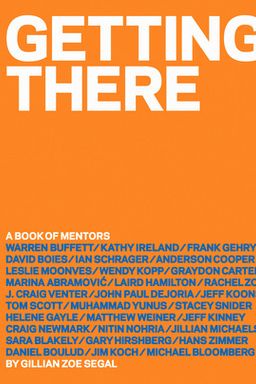
Getting There cover

Getting There

by Gillian Zoe Segal

Getting There by Gillian Zoe Segal provides captivating stories of leading entrepreneurs and creatives who overcame obstacles and followed their passions. Through their first-person narratives, discover the power of perseverance and creativity to reach your dreams.

Lessons from the Paths of Extraordinary Achievers

How do people actually get where they want to go—especially when life rarely follows a straight, predictable path? Getting There: A Book of Mentors by Gillian Zoe Segal asks this deceptively simple question and finds that success, in all its forms, emerges from a rich blend of persistence, curiosity, failure, and reinvention. Through candid interviews and personal stories from forty accomplished figures—from Warren Buffett to Marina Abramović—Segal reveals that every road to success is winding, filled with setbacks, surprises, and redefinitions of what ambition really means.

Segal’s central argument is that most people imagine success as a linear ascent, but in reality, careers grow by trial and error, tough lessons, and an evolving understanding of what “getting there” truly entails. The book contends that every person can build their own version of success by following passion, staying open to new opportunities, learning from failure, and seeking meaning in work—even when the odds look impossible.

Finding Meaning in Work, Not Just Titles

One of Segal’s primary goals is to redefine success away from prestige, wealth, and accolades and toward resilience, curiosity, and purpose. Her own journey mirrors this shift—from being a law school graduate pressured to follow a lucrative path to discovering her passion for photography and interviewing inspiring people despite rejection. As she puts it, no one sails through life untouched by failure, but those who keep going often discover their authentic direction in the process.

This philosophy echoes thinkers like Viktor Frankl (Man’s Search for Meaning), who argued that fulfillment arises from meaning, not comfort or status. Segal’s interviews reveal that purpose often trumps profession—many of her mentors radically changed fields after discovering what truly drove them. Frank Gehry abandoned stable corporate architectural work to design radical, imaginative buildings; Warren Buffett emphasized living by an inner scorecard rather than the world’s approval; and Sara Blakely transitioned from selling fax machines to building a billion-dollar brand born from personal frustration and creativity.

The Gift of Trial and Error

Segal structures the book around the idea that failure is not a detour—it’s the road itself. Every featured person reveals how mistakes shaped their path. For instance, Vanity Fair editor Graydon Carter was expelled from two universities but found his calling through student magazines. Instead of shame, these failures gave him clarity. Similarly, Warren Buffett’s rejection from Harvard Business School led him to Columbia, where he met Benjamin Graham—the mentor who defined his investment philosophy. What felt catastrophic became pivotal.

Key insight:

Things that seem disastrous at the moment often turn out to be blessings. Success unfolds through adaptation, not avoidance of struggle.

Reimagining Mentorship for a Modern World

Segal’s book also reframes the idea of mentorship. Each subject offers hard-earned wisdom—sometimes contradictory, always personal. The takeaway isn’t that you must emulate their paths but that you should study their perseverance and self-discovery. Some mentors, like John Paul DeJoria, emphasize unrelenting optimism (“Success unshared is failure”), while others, like Marina Abramović, focus on spiritual discipline and daring performance as a means of transformation. Together they demonstrate that mentorship doesn’t guarantee answers—it illuminates possibilities.

Segal’s approach reminds readers of Robert Greene’s Mastery, where every apprentice learns by humility, endurance, and passionate curiosity. The common habit across these mentors wasn’t genius—it was commitment to continual learning and courage to deviate from expectation. Whether it’s Buffett studying communication to overcome fear or composer Hans Zimmer transforming rebellion into creativity, each story reveals how persistence and personal reinvention lead to mastery.

Why These Lessons Matter

In an era obsessed with speed and instant results, Getting There stands as a reminder that success—real, durable success—requires patience and evolution. Segal’s interviews dismantle the idea that anyone “has it all figured out.” The most accomplished people often describe themselves as uncertain learners. As Warren Buffett candidly says, “Nobody knows what they’re doing at first.” This humility about growth makes the book deeply human and profoundly useful.

Taken together, these narratives form a “composite mentor,” teaching you that there isn’t one formula to success but many small, consistent acts of courage and curiosity. The book’s thesis is clear: by embracing mistakes, staying curious, and following your passion with honesty and grit, you will eventually get there—wherever there happens to be.

The chapters that follow in this summary explore the main themes of perseverance, curiosity, creativity, failure, mentorship, and authenticity—through vivid examples and lessons from these extraordinary lives. Whether you’re starting your career, reinventing yourself, or seeking meaning beyond success, Segal’s mentors remind you that the journey itself is the destination.


The Power of Passion over Perfection

One of the strongest threads running through Getting There is that passion—not perfection—is the fuel that drives every great career. Segal’s subjects repeatedly describe how following intuition and enthusiasm, even into messy beginnings, led them farther than calculated plans ever could. Passion transforms ordinary effort into endurance, and endurance into mastery.

Living with Curiosity, Not a Script

Segal’s own story sets the stage. She left law to pursue photography despite having “no track record” and constant rejection. She succeeded only because she couldn’t stop thinking about the project. Similarly, Sara Blakely—a failed test taker and door-to-door fax machine salesperson—found her passion through a personal idea: cutting the feet off pantyhose. That spark of necessity became Spanx. Her lesson: ideas are most fragile when new, so protect them until you’ve built momentum. (This echoes Steven Pressfield’s advice in The War of Art about shielding creative work from early criticism.)

Turning Fear into Drive

Instead of asking “Is this safe?” passionate people ask “What if it works?” Frank Gehry risked his reputation and faced bankruptcy multiple times by rejecting convention in architecture. Maria Abramović endured misunderstanding and ridicule to pioneer performance art. These mentors show that fear and passion coexist: fear signals importance. Warren Buffett put this into practice by confronting his anxiety about public speaking through a Dale Carnegie course—later calling it the most valuable investment he made.

Key insight:

Passion doesn’t remove fear—it repurposes it into energy. Each setback clarifies what truly matters and builds resilience for future challenges.

Why Perfection Gets in the Way

Segal’s subjects remind you that perfection is the enemy of progress. Composer Hans Zimmer spent years fearing imperfection and overworking himself to the point of collapse, only to learn that agony is part of creative growth. Similarly, Jillian Michaels learned from her disordered teenage years that the path to strength begins at your weakest moments. She channels failure—not precision—into motivation. The imperfect starting point becomes the foundation for transformation.

If you wait for perfect timing or certainty, you’ll never begin. Passion reveals itself through action, mistakes, and persistence—not through flawless plans. As every mentor in Segal’s book demonstrates, the difference between staying stuck and getting there is simply the decision to start, fueled by enthusiasm that outweighs fear.


Failure as the Hidden Mentor

Most of Segal’s subjects faced significant failure before success—and in some cases, failure was the catalyst that redirected their lives. This theme runs through nearly every story. In fact, several mentors explicitly say that failure taught them everything they know. It’s almost as if failure is their truest teacher.

Turning Rejection into Opportunity

Graydon Carter was expelled from two universities and bankrupted his first magazine, The Canadian Review, before launching Spy and eventually taking the helm at Vanity Fair. His lesson: “You learn more from mistakes than successes.” Similarly, Warren Buffett’s rejection from Harvard directly led him to study under Benjamin Graham at Columbia—an event he calls “the best thing that ever happened.” Failures narrow focus and illuminate purpose.

Learning to Love the Long Road

Many of Segal’s mentors describe lengthy hardships as character laboratories. John Paul DeJoria was fired multiple times and lived in his car before cofounding Patrón tequila and John Paul Mitchell Systems. Instead of collapsing under rejection, he saw each job loss as education: “The difference between successful people and unsuccessful people is that successful people do all the things unsuccessful people don’t want to do.” For him, adversity was proof that persistence matters more than circumstance.

Redefining Failure as Research

Segal’s book treats failure like experimentation. When Marina Abramović’s performances flopped or were ridiculed, she viewed them as opportunities to test boundaries. Hans Zimmer used discarded compositions as stepping stones to his next masterpiece. Daniel Boulud’s failed restaurant openings taught him which partnerships to avoid. Failure isn’t fatal—it’s data about what works.

Key insight:

The mentors in Getting There don’t fear failure because they redefine it: not as defeat, but as correction.

Viewed through this lens, failure becomes the silent partner of mastery. Like Thomas Edison’s famous refrain about finding “10,000 ways that won’t work,” Segal’s subjects show that the willingness to keep refining turns every setback into guidance. If you treat each disappointment as a step closer to insight, you’ll eventually find your own version of getting there.


Mentorship and the Art of Learning

Segal’s collection is more than inspirational biography—it’s an exploration of how mentorship shapes success. Each chapter distills the wisdom mentors once offered to others, but also how these figures became mentors themselves. Their advice centers on curiosity, humility, and generosity.

Learning from the Best

For Warren Buffett, success began with choosing “the right heroes.” He surrounded himself with people of integrity—his father, Benjamin Graham, and later Tom Murphy—and became like those he admired. Buffett’s principle of the “inner scorecard” teaches that true success means living by your own values, not external validation. This mindset mirrors Carol Dweck’s concept of the growth mindset: focus on learning, not proving.

Similarly, Daniel Boulud’s culinary evolution emerged from working under Paul Bocuse and other masters in France. He emphasized learning by immersion: “If you want to be a chef, get your foot in the door of the best restaurant you can.” He saw apprenticeship not as servitude but as strategic exposure to excellence.

Becoming a Mentor Yourself

Many of Segal’s subjects, like Marina Abramović and Helene Gayle, pay mentorship forward by teaching others. Abramović stresses generosity as a duty of success: “When artists reach a certain status, it is important for them to open themselves up and help the younger generation.” Gayle echoes this by mentoring women and minorities navigating leadership roles. Both women reimagine mentorship as empowerment—a web of shared growth.

Key insight:

Who you choose to learn from defines who you become. Mentorship isn’t imitation—it’s inspiration that teaches you how to think for yourself.

Ultimately, Segal redefines mentorship as conversation—a set of evolving exchanges across generations and disciplines. You don’t need direct access to great figures to learn from them. Their stories, writings, and examples can serve as invisible mentors. Whether through a boss, a teacher, or even the pages of a book, the act of learning from others and sharing what you’ve learned forms the true architecture of success.


Resilience and Reinvention through Hardship

Resilience—the capacity to adapt and reimagine yourself after adversity—is a defining theme in Getting There. Across industries, from architecture to surfing to cuisine, Segal’s subjects repeatedly rebuild from loss, rejection, or reinvention. Their stories prove that hard times are not detours but the crucibles of transformation.

Turning Adversity into Opportunity

Laird Hamilton, the big-wave surfer, grew up poor and discriminated against in Hawaii. His stepfather’s cruelty and local ostracism could have broken him. Instead, it forged defiance and confidence. “The ocean was the one place I found equality,” he says. What was emotional pain became physical mastery. Similarly, Kathy Ireland faced business collapse after Kmart’s bankruptcy. Instead of folding, she diversified her brand into home furnishings and apparel, building a resilient, billion-dollar empire.

The Creative Rebirth

Marina Abramović transformed trauma—including isolation and abuse during childhood—into powerful art. Her performances that pushed physical and emotional limits represent catharsis as creation. Hans Zimmer, the composer, channelled personal rebellion and obsessive perfectionism into music that revolutionized film scoring. Both remind you that resilience is about channeling pain, not suppressing it.

Redefining Survival as Innovation

Some mentors faced existential professional threats. When Jim Koch could not get investors for his craft brewery, he started selling beer door-to-door himself. When banks refused loans, John Paul DeJoria lived in his car, selling hair products with relentless optimism. They illustrate Segal’s point that resiliency is less a mindset than an active practice—each rejection a cue to pivot. As Buffett might say, “You can tell someone to go to hell tomorrow”; the composure to wait turns loss into leverage.

Key insight:

Resilience starts by accepting imperfection. Reinvention begins by asking not “Why me?” but “What now?”

By chronicling these reinventions, Segal offers a universal lesson: hardship strips away illusion, revealing what’s essential. If you meet obstacles with adaptability rather than despair, you eventually uncover not just survival, but originality—the ability to make something new out of what broke you.


Integrity, Character, and the Inner Scorecard

Among all the lessons in Getting There, none appears more central than the idea of integrity. Warren Buffett’s distinction between the inner and outer scorecard—living according to your own ethical standards instead of others’ approval—summarizes the moral backbone of Segal’s mentors. Whether artists or entrepreneurs, each strives to stay true to themselves amidst ambition and temptation.

Choosing the Inner Scorecard

Buffett learned this mindset from his father, whom he calls his “first hero.” The outer scorecard measures success by appearances—money, fame, and recognition. The inner scorecard measures fulfillment by integrity, character, and doing what feels right. Buffett lives this philosophy daily, advising managers to apply the “newspaper test”: would you be comfortable if your action were printed tomorrow for everyone to see? This principle parallels moral frameworks found in classics like Stephen Covey’s The Seven Habits of Highly Effective People, where self-management begins with character, not charisma.

Cultivating Authentic Leadership

Helene Gayle and Nitin Nohria provide modern applications. Gayle insists that leadership depends on “standing for something” rather than simply being against wrongs. Her shift from medicine to humanitarian work at CARE demonstrates values-driven leadership. Nohria, dean of Harvard Business School, champions generosity as a guiding principle learned from his grandfather’s humility. He calls self-awareness and intellectual honesty the bedrock of effective leadership. Both suggest that ethical clarity—not ambition—is what sustains success through change.

The Rewards of Integrity

Integrity also brings peace. Buffett observes that wealth without respect or affection equals emptiness. “You have lived a successful life if, as you grow older, the people who you hope love you actually do.” This insight resonates throughout the book: longevity in both personal and professional realms depends on trust, kindness, and authenticity.

Key insight:

In the end, success judged by one’s own conscience endures longer than success judged by applause. Your inner scorecard is your compass in every storm.

Segal’s mentors ultimately teach that integrity isn’t static—it’s lived through daily choices. Whether rejecting shortcuts, fostering collaboration, or simply treating others with decency, character defines how far—and how peacefully—you get there.


Curiosity, Creativity, and Lifelong Learning

Throughout Getting There, curiosity emerges as the common denominator of great lives. Every mentor featured in the book thrives on asking questions, staying open-minded, and learning continuously. Segal shows that curiosity, rather than talent, often maintains success long after technical mastery fades.

Curiosity as the Engine of Creativity

Frank Gehry’s creative process exemplifies curiosity at work. He questions every architectural convention, asking, “Why do we have to do it that way?” Hans Zimmer’s musical innovations stem from endless experimentation—he literally learned composition by daydreaming and modifying piano parts against the rules. For them, curiosity isn’t passive wonder; it’s deliberate inquiry driving originality.

Staying a Lifelong Learner

Nitin Nohria embodies this principle personally and professionally. His journey—from narrowly failing to enter India’s elite engineering college to becoming dean at Harvard—taught him that rediscovery and adaptation fuel growth. He reminds readers: “You can’t give up at first blush. If you give up, you’ll never succeed.” Similarly, Warren Buffett, despite his billions, reads for hours daily, treating learning like sustenance. Segal uses these examples to stress that education never ends at diplomas—it lives in curiosity.

Creativity through Connection

Connecting with others also expands curiosity. Rachel Zoe turned her fascination with fashion into an empire by listening to clients and understanding risk. Gary Hirshberg combined environmental concern with business insight to build Stonyfield Farm, proving curiosity can transform industries as much as individuals. Creative discovery arises when you question norms and link ideas across disciplines.

Key insight:

To stay successful, stay curious. The most powerful skill isn’t knowing—it’s asking.

Segal’s mentors reveal that curiosity builds adaptability. It keeps you young, inventive, and resilient in a changing world. Whether questioning old rules, exploring new technology, or simply learning from those around you, lifelong curiosity ensures you’ll not only get there—you’ll keep moving forward.


Redefining Success and Happiness

The final and perhaps most profound lesson of Getting There is that success without happiness is hollow. Many of Segal’s mentors realized that external triumphs don’t guarantee satisfaction. They redefined success as living in alignment with values, passion, and meaningful relationships.

Beyond Money and Fame

Graydon Carter discovered fulfillment through editing work that mattered, not just prestige. Buffett, despite immense wealth, measures success by relationships: “You have lived a successful life if, as you grow older, the people who you hope love you actually do.” Jim Koch’s metaphor about Monday—the day that might never come—encourages seizing meaningful experiences now. Each mentor frames success as the harmony between effort and joy.

Happiness through Contribution

John Paul DeJoria insists that “Success unshared is failure.” His philanthropy arises from his mother’s belief that no matter how little you have, someone always has less. Helene Gayle transformed her medical training into global development leadership to help vulnerable populations. Marina Abramović finds love through audience connection. Their happiness stems from contribution and community, not accumulation.

Balancing Ambition with Peace

Segal’s reflection on these stories leads to a timeless truth: ambition should elevate, not exhaust you. Each person eventually learns balance—between striving and savoring, ambition and gratitude. As Marina Abramović says, “Life is temporary. Make every day meaningful and don’t spend time on bullshit.”

Key insight:

True success isn’t reaching a peak—it’s building a life where the climb itself feels worth it.

As you absorb the stories in Getting There, you realize that happiness and authenticity are inseparable from achievement. You can’t shortcut fulfillment—it’s crafted through meaningful work, deep relationships, and integrity. In redefining what “getting there” really means, Segal reminds you that the greatest victories aren’t measured in wealth or fame, but in contentment, contribution, and purpose.

Dig Deeper

Get personalized prompts to apply these lessons to your life and deepen your understanding.

Go Deeper

Get the Full Experience

Download Insight Books for AI-powered reflections, quizzes, and more.