
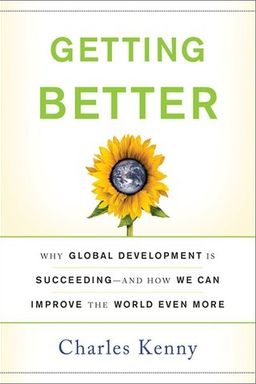
Getting Better cover

Getting Better

by Charles Kenny

In ''Getting Better,'' Charles Kenny explores how global development is making strides in improving quality of life. By showcasing the role of technology and ideas, he encourages optimism and provides actionable strategies for sustaining progress, challenging the traditional focus on income as the sole measure of success.

Why the World Is Getting Better Than You Think

When you think about global development, do you picture endless suffering, poverty traps, and broken aid promises? Charles Kenny’s Getting Better: Why Global Development Is Succeeding—and How We Can Improve the World Even More invites you to radically reimagine that narrative. He poses a provocative challenge: what if, despite all the gloomy headlines, the world has been making extraordinary, measurable progress—especially for the poorest?

Kenny, a development economist at the World Bank, argues against the pervasive idea that global development has failed. Instead, he presents a mountain of evidence showing that humanity’s quality of life—our health, education, rights, and freedoms—has been improving faster and more broadly than at any other point in history. The catch, he says, is that we’ve been too fixated on money as the single measure of success. When viewed through the more meaningful lens of well-being, the story of development isn’t about stagnation—it’s about staggering progress.

The Problem With the Growth Obsession

At almost every global summit since World War II, leaders have declared that the goal of international cooperation is to help poor countries “catch up” economically with rich ones. Yet, as Kenny points out, after trillions in aid and decades of effort, many African and South American nations still have roughly the same per capita incomes they had forty or fifty years ago. Critics on both the right and left have used this to declare the failure of foreign aid. But Kenny dismantles this simplistic picture by showing that income is a narrow, misleading lens. If we look beyond GDP, a very different world comes into view—one where infant mortality has halved, literacy has risen exponentially, and even in the poorest countries, life expectancy has shot upward.

He opens the book with the 2009 G20 Summit in London: leaders lament stagnation, protestors chant about inequality, and pundits bemoan “Africa’s failure to develop.” But Kenny observes that these laments depend on one flawed assumption: that being richer is the only sign of progress. Economists like Paul Collier and Dambisa Moyo have described Africa as a tragedy of stagnation, calling for either more aid or a complete halt to it. Yet, Kenny reminds us, this view ignores extraordinary improvements in child survival, literacy, and access to vaccines—achievements that money alone can’t explain.

A Different Way to Measure Progress

Instead of asking, “Is the world richer?” Kenny asks, “Are people living better lives?” From that perspective, almost every region has seen unparalleled progress. Life expectancy worldwide has more than doubled since 1900. Literacy rates have quadrupled. The share of humanity living under oppressive regimes has fallen. Even sub-Saharan Africa—often painted as a basket case—has improved its average literacy from 30% to 60% in just three decades. As he illustrates with vivid data, a child born today in Niger or Bangladesh, while still poor, is far more likely to attend school, get vaccinated, and survive to adulthood than someone in their grandparents’ generation ever could.

In one striking example, he compares the early-20th-century United States—then one of the world’s richest countries—with present-day Sierra Leone—one of the poorest. The U.S. infant mortality rate in 1900 was about 15%, nearly the same as Sierra Leone’s today, even though Sierra Leone’s income is one-tenth of what America’s was. This, he argues, tells a powerful story: health and longevity have become accessible even without wealth. Progress in knowledge and technology has made the best parts of life—clean water, vaccines, schooling—cheaper than ever.

How the Good News Happened

What explains this transformation? Kenny credits the spread of technology and ideas more than any economic miracle. Simple tools and concepts—vaccinations, oral rehydration therapy, handwashing campaigns, and schooling for girls—have proven more powerful at saving lives than billion-dollar infrastructure projects. Governments, civil society groups, and foreign aid organizations have all contributed, often imperfectly, to making these essential advances widespread. Even in places rife with corruption, such as late-1990s Zimbabwe or 2000s Nigeria, the “beautiful banality” of progress persisted: clinics vaccinating babies, schools teaching literacy, families demanding better services.

Kenny’s radical optimism doesn’t deny hardship. He knows that millions still suffer deprivation, wars still rage, and corruption persists. But his point is that progress is real—and it’s contagious. The same ideas that enabled Western Europe’s breakthroughs are now available on mobile phones across Africa. The knowledge of how to keep babies healthy or how to prevent cholera can circle the globe nearly instantaneously. As he puts it, “Life is far from perfect—but it is better.”

Why This Matters for You

For Kenny, this isn’t just about optimism—it’s about agency. If you believe the world is doomed, you stop trying to improve it. But if you see development as a story of success, it becomes easier to imagine how much more can be done. He closes with a call for “realistic optimism”: we must acknowledge both the struggles and the achievements of the past century. By celebrating the quiet revolutions—clean water, schools, medicines—we remind ourselves that progress is not only possible but ongoing. And if history shows us anything, it’s that when ideas and innovations spread, the best of humanity spreads with them.

In short, Kenny’s message is profoundly hopeful yet pragmatic: we don’t need to make everyone rich to make the world better. Small, affordable, proven changes—like vaccines, education, and rights—have already lifted billions. The challenge isn’t knowing what works; it’s scaling what already does. That’s how the world has been getting better—and how you can help it keep getting better still.


Beyond GDP: Redefining What It Means to Develop

Charles Kenny argues that our obsession with economic growth—measured by GDP per capita—has distorted the way we think about progress. For decades, world leaders judged success solely by how fast incomes grew. But GDP, he explains, is a limited yardstick: it values money flows, not well-being. It counts weapons but not safety, hospitals but not health, and ignores unpaid care, freedom, or happiness. His message echoes Amartya Sen’s insight in Development as Freedom: development should be measured by human capabilities, not just wealth.

The Traps of Income Thinking

GDP makes intuitive sense—who doesn’t prefer to be richer than poorer? But Kenny shows that tying development to GDP alone leads to paralysis. If you believe poor countries can’t “catch up,” you might call the entire project of aid a waste. Yet the world’s poor are healthier, better educated, and more connected than ever. Income does affect well-being, especially at very low levels. But once people can meet basic needs, improvements in health and education depend less on money and more on choices, institutions, and technology.

Consider health care. Between 1960 and 2000, Africa’s GDP per capita barely budged, yet life expectancy rose by 13 years. The continent’s average literacy doubled. These aren’t anomalies; they’re proof that quality of life can advance even without fast income growth. Technologies like vaccines or oral rehydration therapy are cheap but transformative. Once discovered, they spread widely, benefiting people who remain poor by monetary standards but not by historical ones.

The Broader Canvas of Development

Kenny proposes a multidimensional view of progress, aligning with the UN’s Millennium Development Goals. These encompass health, education, gender equality, and sustainability—values no less important than income. In this view, “development” is the expansion of people’s real freedoms to lead the lives they value. It’s about mobility, dignity, security, and opportunity. And by this measure, he insists, the human story over the past century is profoundly positive.

For example, between 1950 and 2000, global literacy rose from about 50% to 80%. Primary education became nearly universal. Women’s literacy narrowed the gender gap from 59% to 80% of men’s levels. In the same half-century, global life expectancy rose from 48 to 66 years—an unprecedented leap. These changes transformed daily life for billions more dramatically than any spike in GDP could capture. The world, in Kenny’s words, has “escaped Malthus’s nightmare” and replaced it with the “beautiful banality” of normal, safe, literate lives.

A Case Study: The Middle East’s “Other Miracle”

One of Kenny’s most revealing examples comes from the Middle East. While economists obsessed over East Asia’s “growth miracle,” the Middle East experienced something arguably more important: a “miracle of life.” Between 1962 and 2002, life expectancy in the region rose from 48 to 69 years. GDP growth remained sluggish, but improvements in basic medical care, urban sanitation, and education transformed societies. This uncoupling of health from income redefined what “progress” could mean.

By reframing success beyond GDP, Kenny helps readers see that the greatest human achievements aren’t captured by bank statements. Progress means fewer funerals for children, more girls in classrooms, and greater safety under the rule of law. While economists still chase the elusive formula for prosperity, Kenny contends that “we may already have found the simpler formula for a better life.”


Escaping Malthus: How Innovation Outran Scarcity

Kenny devotes a vivid section to dismantling the apocalyptic predictions of Reverend Malthus and his modern heirs like Paul Ehrlich. For centuries, thinkers feared that population growth would outstrip food and resources, leaving humanity condemned to famine and disease. Yet from the Industrial Revolution onward, the opposite happened: innovation outran scarcity. Humanity multiplied, but production multiplied faster.

A World Freed from the Trap

From 1800 onward, GDP and population grew together, but technology ensured rising living standards, not decline. Between 1950 and 2000, global GDP increased sevenfold, agricultural output tripled, while population only doubled. Everywhere, people ate more and lived longer. Even Africa, the region still portrayed as “Malthusian,” expanded its total GDP at 3.5% annually. Despite droughts and political turmoil, famine became rare—a tragic exception, not the rule.

Kenny highlights the “Green Revolution” as a defining counterexample. Between the 1960s and 1990s, improved seed varieties and fertilizers doubled grain yields across Asia. India, once the focus of doomsday predictions, became a net food exporter. Meanwhile, global calorie availability rose by 25%. Malthus’s prophecy—that food supplies grow arithmetically while populations grow geometrically—collapsed under the weight of human ingenuity.

Ideas as the New Fertile Ground

What made this possible wasn’t just machinery or chemicals—it was the spread of ideas. Farmers learned better irrigation, governments invested in research, and information flowed across borders. Modern analogs abound: mobile weather forecasts help African farmers plan crops, and open-source biotech spreads new crop strains worldwide. The cycle of innovation and adoption never stops. As Kenny puts it, “It wasn’t more land—it was better knowledge.”

The lesson carries moral weight: scarcity is not destiny. Where pessimists once saw looming famine, the real story is empowerment through information. By beating Malthus, humanity proved that poverty is not inevitable—it’s solvable when technology and ideas spread fast enough.


The Great Convergence in Quality of Life

Though incomes have diverged, Kenny calls attention to an astonishing global convergence in well-being. Poor countries have been catching up with rich ones in health, education, civil rights, and safety—just not in their bank accounts. It’s an inversion of expectations: while dollars concentrate, lives converge.

Health: The Global Equalizer

Global life expectancy jumped from 31 years in 1900 to 66 by 2000. Infant mortality fell by three-quarters. Africa, despite HIV/AIDS, gained 13 years of life since 1960. Even the poorest countries now achieve health outcomes that the richest once considered miraculous. In Niger, about 800 more children survive each week thanks to improved vaccines and health access since 1960—a statistic that captures Kenny’s theme that quiet progress saves lives daily.

Education: Literacy for All

The world also witnessed a literacy revolution. In 1870, only a quarter of adults could read; by 2000, four in five could. The greatest strides came from lagging regions: Africa’s literacy more than doubled in three decades. Even with low incomes, countries like Malawi and Bangladesh achieved near-universal primary schooling. This, Kenny argues, shows that education is one of the cheapest and most crosscutting tools of development.

Rights, Safety, and Peace

Progress isn’t just about calories and books—it’s also about dignity. The spread of democracy and human rights has been dramatic. In the 1820s, most of the world lived under autocracy; today, the average global democracy score is the highest in recorded history. Slavery, once systemic, is legally extinct. Even war and crime rates have declined: the number of major wars fell from 26 in 1991 to 4 by 2005. Humanity, Kenny writes, “has never lived longer, freer, or safer.”

This convergence of outcomes, he explains, results from the diffusion of knowledge and ideas more than wealth. As thresholds of basic health, schooling, and peace are crossed, the human experience grows more equal—even if fortunes do not.


Innovation and Ideas: Engines of Everyday Progress

If income doesn’t explain most global gains, what does? Kenny’s answer is simple but profound: innovation and the spread of ideas. He likens it to water seeking its level—technological and social improvement seeps across borders more easily than policies or wealth. These innovations are often small and cheap, but their ripple effects are huge.

The Power of Simple Tools

Consider the humble mosquito net, bar soap, or pit latrine. These tools epitomize progress that costs almost nothing yet saves millions. Vaccination campaigns offer another example: since 1974, global immunization rates for key childhood diseases soared from 5% to 80%, thanks to cheap, durable vaccines that could survive without expensive refrigeration. Similarly, oral rehydration therapy—a mix of salt, sugar, and water—has saved tens of millions of lives without needing hospitals or doctors.

Smallpox Eradication: The Ultimate Bargain

Kenny highlights the eradication of smallpox as the best $300 million the world ever spent. That sum—about 32 cents per at-risk person—eliminated a disease that once killed millions yearly. The same spirit now drives polio and measles eradication efforts. He calls this paradigm “the cheap revolution”: technologies that make the essentials of life steadily more affordable.

The Demand Side of Change

Equally important is how ideas spread. Education, media, and communication foster demand for better living. Mothers who understand hygiene or recognize disease symptoms can save their children even when systems fail them. Communities that demand schooling compel governments to provide it. In other words, progress happens not only when innovations appear but when people know to ask for them.

This democratization of knowledge—the ability of ideas to leap without borders—explains why quality of life has converged even where income has not. For Kenny, it proves that innovation is the true equalizer of our age.


Making the Best Things in Life Cheap

In one of his most hopeful arguments, Kenny shows that development’s biggest triumph is not in making people richer, but in making life’s essentials cheaper. Health, education, and freedom—the true goods—now cost a fraction of what they once did. He calls it a miracle of diminishing prices: “We no longer need a nineteenth-century fortune to buy a twenty-first-century life.”

Health at a Discount

Using Samuel Preston’s famous analysis, Kenny notes that in 1900, a country with $1,000 per capita income could expect an infant mortality rate of 20%. By 2000, countries with the same income averaged only 7%. The “price” of an extra year of life expectancy has fallen by over 90% in a century. Even stagnant economies like Haiti saw life expectancy rise by more than ten years between 1950 and 2000, simply because lifesaving knowledge became global public goods.

Education for Pennies

The cost of learning also plummeted. Fifty years ago, a country needed moderate wealth to provide primary schooling; today, even impoverished nations reach universal enrollment. Innovations like same-language subtitling of popular TV shows in India teach literacy at almost zero cost. In short, the barrier to knowledge is no longer money but access and engagement.

Freedom as a Free Good

Unlike the expensive infrastructure of industrialization, rights come cheap once people demand them. The global wave of democratization since the 1980s—spurred by communication, activism, and example—cost far less than any aid program but transformed billions of lives. This reinforces Kenny’s claim: technological and moral progress are becoming “low-cost, high-return” investments.

If the 20th century was about expanding wealth, the 21st should focus on spreading access. Kenny urges rich nations to redirect aid toward scaling proven, low-cost interventions rather than chasing grand economic miracles. The world doesn’t need to be richer to be better—it needs to make the good life affordable for all.


Realistic Optimism: How to Keep Getting Better

Kenny ends with a call for “realistic optimism.” Yes, inequality persists, and some nations still struggle. But despair is not realism—it’s resignation. The past century’s record proves that progress is possible when we focus on what works: spreading ideas, empowering governments, and scaling technologies that make life better and cheaper.

What Works in Practice

Kenny champions concrete actions such as conditional cash transfers for schooling, vaccination drives, and public health campaigns. Programs like Mexico’s PROGRESA or Bangladesh’s sanitation initiatives show how small incentives can transform behavior at scale. Rather than “planning” countries into prosperity, he argues, we should reward measurable improvements—the “payments for progress” approach.

He also calls for a “global innovation bank” to focus aid on developing and distributing technologies that improve quality of life—off-grid solar power, new vaccines, or robust learning tools. This approach, he argues, would make global aid both more effective and politically defensible.

The Moral Case for Optimism

Optimism, for Kenny, isn’t naïve—it’s strategic. Believing that development is working strengthens the moral argument for continuing it. If we constantly declare crisis, we undermine the very institutions that deliver progress. “We have not failed,” he writes. “We have succeeded—and can succeed further.” Recognizing this truth is motivation, not complacency.

Kenny concludes where he began: the four horsemen of the apocalypse—famine, war, disease, and ignorance—are in retreat. Life today is longer, freer, and more equal than ever before. The task ahead isn’t to lament what remains undone but to expand what already works. That’s not a utopian dream—it’s a blueprint drawn from a century of proof.

Dig Deeper

Get personalized prompts to apply these lessons to your life and deepen your understanding.

Go Deeper

Get the Full Experience

Download Insight Books for AI-powered reflections, quizzes, and more.