
Idea 1
Getting What’s Yours: Mastering Social Security
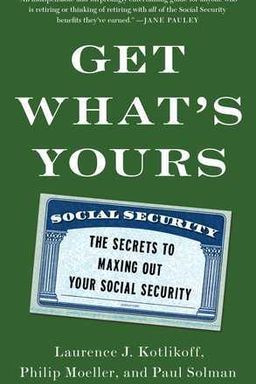
How can you be sure you're not leaving thousands of dollars on the table when it comes to Social Security? In Get What’s Yours: The Secrets to Maxing Out Your Social Security, Laurence Kotlikoff, Philip Moeller, and Paul Solman argue that Social Security, while designed to secure Americans' futures, has become so bewilderingly complex that millions fail to collect what they’ve earned. The authors contend that understanding the rules—rather than trusting the system’s advice—is the only way to ensure you get every penny you’re entitled to.
Across nearly 300 pages, Kotlikoff and his co-authors mix humor, policy analysis, and real-life stories to decode Social Security’s 2,700 rules and tens of thousands of sub-rules. They show you how decisions about timing, marital status, disability, and government pensions can alter lifetime benefits by tens or even hundreds of thousands of dollars. The book’s witty tone hides a serious warning: Social Security’s rules are a maze. You must play this game shrewdly to win.
The Core Idea: Social Security as Insurance, Not Investment
The authors emphasize that Social Security isn’t simply an investment account—it’s the best old-age insurance available. Taking benefits early, much like cashing in insurance before a disaster, defeats the purpose: protection against living so long that you outlive your savings. The book reframes Social Security as a hedge against longevity risk—a concept echoed by economists like Peter Diamond and Alicia Munnell. Your goal isn’t to “break even” by comparing early versus delayed payouts. It’s to “not go broke.”
Why This Matters
Most retirees assume Social Security is simple: you reach a certain age and collect your check. But the authors reveal a stunning truth: hundreds of claiming combinations exist based on your marital status, earning history, health, and age. And Social Security itself often gives incorrect or incomplete advice. Larry Kotlikoff’s tennis-court revelation—that journalist Paul Solman could earn nearly $50,000 extra through a “file-and-suspend” spousal strategy—illustrates how just one conversation can reframe your financial future.
The Framework of Fairness and Complexity
The Social Security system was born out of fairness—helping widows, low-income workers, and families. Yet its progressive formulas often produce paradoxes. The authors highlight two haunting examples: the Windfall Elimination Provision (WEP) and the Government Pension Offset (GPO). These rules, created to prevent double-dipping for workers in non-covered jobs, often penalize teachers, police officers, and low-earning public employees. In chasing fairness, the system becomes riddled with unintended inequities.
Why Most People Get It Wrong
Human psychology sabotages retirement planning. Behavioral economists call it “loss aversion”—our fear of waiting and missing out on immediate cash. The authors dissect this phenomenon in “Life’s Biggest Danger Isn’t Dying, It’s Living.” Our rational self wars with our short-term self: the part that fears death more than poverty. The book urges you to side with your long-term “adult” self—the one protecting your future you’s from destitution. Waiting until age 70 can increase benefits by 76%, providing lifelong inflation-protected income.
The Broader Conversation
At its heart, Get What’s Yours is both personal guide and public critique. Kotlikoff and his colleagues expose how bureaucratic opacity erodes trust in government, while offering citizens the tools to fight back through knowledge. In tone, it channels the practical ethos of Charles Ellis (Winning the Loser’s Game) and Richard Thaler (Nudge): systems are flawed, but informed individuals can still prevail. By understanding the rules, you empower yourself—and your family—to win a game millions lose simply because they didn’t know how to play.
In the pages ahead, the book explores seven interwoven themes: the dangers of claiming too early; the “three golden rules” for maximizing lifetime benefits; traps like deeming and windfall penalties; the nuances of marital and divorce advantages; hidden payoffs for disabled or government workers; and overarching reforms to make Social Security sustainable. Each chapter builds toward one promise: if you understand the system, you’ll never again feel powerless facing bureaucracy’s labyrinth. You’ll get what’s yours—and more.