
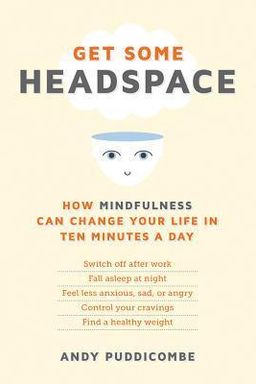
Get Some Headspace cover

Get Some Headspace

by Andy Puddicombe

Get Some Headspace by Andy Puddicombe offers a practical guide to meditation, drawing from his experience as a Buddhist monk. Discover how ten minutes of mindfulness daily can transform your mental landscape, improve relationships, and enhance your quality of life-no incense required.

Training the Mind for a Spacious Life

How can you find calm and clarity in a noisy world? In his work on meditation, Andy Puddicombe argues that meditation is not about escaping reality but about transforming your relationship to it. His central claim is that meditation is a technique, while mindfulness is the quality of mind it cultivates. Once you see this distinction clearly, you can use meditation as a realistic, flexible way to cultivate presence throughout the day — not a saintly ritual requiring solitude and incense, but a practical path to mental stability and contentment.

In the chapters that follow, you learn how meditation functions as training, mindfulness as its daily expression, and how both serve to develop what Andy calls a “space of mind” — that stable clarity that remains even through difficulty. You also explore how this training unfolds in three parts (approach, practice and integration), how to apply mindfulness to thoughts, emotions, sleep and action, and why consistency rather than duration determines success. Ultimately, the book is about learning to live with attention — how the mind can stop being your enemy and become your ally.

The Practical Difference Between Meditation and Mindfulness

Andy begins with a common confusion: many people think meditation and mindfulness are the same. He explains that meditation is a structured exercise designed to train attention — much like lifting weights builds strength — whereas mindfulness is the ongoing mental state that results from that training. When you meditate, you deliberately step back and observe thoughts, feelings and sensations without trying to eliminate them. When you are mindful, that attitude of presence extends naturally into daily activities: cooking, commuting, parenting, or working.

He illustrates this with a humorous story from Moscow: he once hid $500 in his underwear, forgot, and flushed it down a toilet. That moment of distraction captures the opposite of mindfulness — being physically present but mentally absent. Through meditation, you begin to develop the attention that prevents such “toilet moments” in life — not by becoming rigidly focused, but by learning to be fully here.

From Sitting to Living: The Three-Part Training

Meditation belongs to a larger system Andy calls the Three-Part Training: approach, practice, and integration. The approach sets your attitude — you understand meditation as training the mind, not suppressing thought. The practice is the set of techniques, such as his “Ten,” a structured ten-minute breathing exercise that anyone can do. The integration is what gives the practice meaning: you take the skills off the cushion and into ordinary life. Neglect any one part, and meditation becomes either mechanical or detached from reality.

This scaffolding keeps meditation practical and secular. It also prevents the “aspirin” approach — meditating only when stressed — which, though common, limits impact. The integrated approach turns mindfulness into a baseline habit that steadies you amid uncertainty.

Metaphors That Reshape Your Relationship With Thought

Two memorable images anchor Andy’s teaching: the busy road and the wild horse. Thoughts are like cars rushing by or a horse galloping freely. When you meditate, you learn to sit on the roadside, watching the traffic, rather than blindfolded in its midst. You stop chasing or resisting thoughts and simply see them pass. Similarly, you don’t try to force the horse still; you let it settle gradually by giving it space. These metaphors redefine meditation as a practice of observation without interference — a radically different stance than the usual attempt to control or silence the mind.

The Blue Sky Beneath the Clouds

When emotions arise, the same principle applies. Andy’s teachers taught him to visualize the mind as an open sky and emotions as clouds. The blue sky — clarity and steadiness — never disappears; we just stop seeing it. Meditation trains you to remember that wider perspective, even in grief. This theme becomes deeply moving in his story of Joshi, a man who lost his family but still found inner space through meditation. The point isn’t to suppress pain but to see that beyond sadness lies awareness itself: undamaged, always present.

Mindfulness as Everyday Curiosity

A major message is that mindfulness needs to occur in real moments — not just special ones. Andy describes this as cultivating noble curiosity, a willingness to see each moment anew. When you’re curious, even washing dishes becomes a chance to observe sensations and reactions. His “sharp soup” story — mistaking chili for curry when rushing — reminds you how lack of attention breeds unnecessary suffering. Through curiosity, you slow down enough to experience life as it unfolds, improving accuracy, calm, and connection.

Science Confirms the Ancient Practice

Andy integrates modern science to support ancient insight. Neuroplastic research shows that meditation reshapes attention and emotion networks in the brain. Clinical studies at Wisconsin and Massachusetts demonstrate reduced anxiety, stronger immune responses, and lower relapse into depression after regular mindfulness practice. He emphasizes that science doesn’t replace experience — it validates it. The data is clear: short, regular sessions create lasting neural change.

From Cushion to Life Platform

Ultimately, meditation evolves from exercise to life platform — a foundation for wiser responses. The monk who “had no time” to meditate learned that sweeping and firewood collection could be mindfulness in motion. Everyday tasks become the real field of awakening. Whether brushing your teeth, walking, or speaking to a child, attention transforms ordinary experience into practice. Meditation stops being something you do and becomes something you are.

That’s the book’s real promise: through ten minutes a day — anchored in curiosity, honesty and repetition — you cultivate a mind that’s steady enough to see clearly in chaos and kind enough to stay open through sorrow. You no longer seek to control life; you learn to meet it fully awake.


The Three-Part Training

To make mindfulness habitual, Andy teaches that effective meditation depends on three interconnected elements: approach, practice, and integration. These reflect the natural arc of learning — how you think about the exercise, how you perform it, and how you embody its lessons beyond the exercise itself.

Approach: How You View Meditation

Approach means understanding what you’re doing and why. Many beginners arrive with myths — that meditation requires emptying the mind or achieving mystical peace. Andy’s early experience in a 1960s-style class where teachers said “just relax” for forty minutes did more harm than good. The real approach is pragmatic: you are training attention with curiosity, not erasing thoughts.

Practice: The Ten and Daily Techniques

Practice is where intention becomes method. Andy’s signature format, the Ten, uses a structured sequence of ten minutes: find a comfortable seat, take five deep breaths, perform a body scan, count breaths up to ten, and finish with twenty seconds of open awareness. The counting anchors attention gently; losing track and returning is itself the training. Practice shouldn’t strain — it’s repetition with ease that produces stability.

Integration: Extending Awareness into Life

Integration moves the insight off the cushion. It’s about being mindful while brushing teeth, talking, commuting or exercising. Examples abound: noticing breath while sitting in traffic or truly listening during dinner. Without integration, meditation stays an “aspirin” for stress; with it, attention becomes a constant companion. Andy likens it to “cross-training” for consciousness — you rehearse awareness in practice, then deploy it in life.

Skip one element and your development weakens. Approach gives mindset, practice builds skill, integration makes it real.

When all three parts align, meditation stops being therapy or philosophy and becomes a lived training system — one designed to produce clarity, compassion, and centeredness that last far beyond the ten-minute practice.


Working with Thoughts and Emotions

Your relationship to thoughts and feelings defines your relationship to life. Andy’s teaching revolves around learning to observe thoughts and emotions instead of obeying them. Through vivid metaphors — the busy road, the wild horse, and the blue sky — he demonstrates how to train awareness to stay spacious, not reactive.

The Busy Road: Observing Without Chasing

In the busy-road analogy, thoughts are cars speeding by. Meditation is not standing in traffic or trying to stop cars — it’s sitting at the roadside and watching them come and go. Sometimes you’ll chase one; just notice and return to safety. This moment of observation weakens identification: you are not your thoughts, you are the awareness that sees them pass.

The Wild Horse: Patience Over Control

A different teacher called the mind a wild horse. Tug the rope too tight and it rebels; loosen it too much and it runs away. The aim is gentle steadiness. Translating this into practice: give wandering thoughts space, name the distraction (“thinking”), and return to breath. The mind learns balance through patient repetition, not suppression.

Emotions: Seeing the Sky Beneath the Clouds

For emotions, Andy introduces the blue-sky metaphor. Emotions — anger, joy, sorrow — are clouds that cover but never destroy the sky. Noticing them as transient sensations prevents you from confusing weather for climate. He distinguishes states (transient moods) from traits (persistent tendencies) and teaches body mapping: finding where emotion sits in the body until it dissolves. Recognizing this shifting quality creates space for choice.

These practices converge on one insight: awareness changes everything. When you treat inner experiences as guests, not dictators, you gain emotional freedom and compassion — for yourself and for others struggling under the same sky.


Mindfulness Across Postures and Actions

Meditation is not locked to one posture or time of day. Andy reveals that mindfulness must flow through all positions — sitting, standing, walking, and lying down — and into all kinds of activity. This understanding turns the entire day into training space.

Four Positions of Mindfulness

In monasteries, monks meditate eighteen hours a day by alternating postures. Sitting cultivates still focus; standing trains balance and poise; walking develops moving awareness; lying meditation teaches presence at the threshold of sleep. Each complements the others, ensuring mindfulness does not become posture-dependent. You can adapt this rhythm in modern life by linking short mindful sessions to ordinary transitions — a few breaths before unlocking your phone, or a five-minute standing awareness while waiting for a bus.

Mindfulness in Everyday Routines

Andy’s practical examples are delightfully mundane: brushing teeth, eating, walking to work. When you focus on bodily sensations — taste, weight, sound — intrusive thoughts lose strength. The “ice cream and curry” story from the monastery, where monks had to watch dessert melt before eating, underlines mindfulness as training in patience and non-attachment. The lesson: bring awareness even to craving and aversion; watch how they arise and pass.

The Power of Noble Curiosity

Andy calls the bridge between formal and informal mindfulness “noble curiosity” — the habit of meeting moments with openness. Whether cutting grass with scissors or tasting soup, curiosity converts routine into meditation. By replacing autopilot with investigation, you nourish joy and resilience. This playful approach also helps integrate mindfulness into work, parenting, and even technology use: staying aware of when to connect and when to switch off.

With practice, attention flows through body and task seamlessly, turning each day into a moving meditation.


Mindfulness in Movement, Sleep, and Recovery

Andy extends mindfulness into movement, rest, and healing. Whether you’re running, juggling, or trying to fall asleep, the same skill applies: noticing sensations without resistance. When you train this balance, performance, rest, and recovery all improve.

In Movement and Sport

In one story, Andy describes juggling five balls: when he stopped trying too hard and simply watched, flow emerged. This mirrors how athletes perform best — they blend relaxed ease with sharp focus. For runners or swimmers, anchoring attention to breathing or stride prevents mental fatigue. Pain becomes information, not threat. The lesson: sustainable effort equals awareness plus softness. Beyond athletics, this applies to any high-demand activity where tension undermines efficiency.

For Sleep and Insomnia

Mindfulness helps calm the “midnight mind” that keeps so many people awake. Andy’s evening routine — pre-sleep breathwork, body scan, review of the day, and progressive relaxation — replaces struggle with witnessing. Studies show mindfulness halves average sleep-onset time and reduces medication dependence. The secret is counterintuitive: stop fighting thoughts, and rest follows naturally.

For Emotional and Behavioral Recovery

Working clinically, Andy witnessed how mindfulness supports anxiety, depression, and addiction recovery. In one example, James, a stressed father, stopped shouting at his children after a week of ten-minute sessions. Pam, tapering antidepressants, learned to see depressive thoughts as mental weather. Tom faced his addictions by meeting cravings mindfully instead of indulging or repressing them. The consistent principle: observe emotion as process, not identity. When you meet suffering with gentle attention, its power diminishes.

Mindfulness, movement, and rest are not separate. They form a single circle of awareness — learning to stay present whether sprinting, grieving, or drifting into sleep.


Building a Sustainable Practice

Meditation changes your life only if you repeat it. Andy ends with the essential guidance of sustainability: how to create a habit so durable that mindfulness becomes a reflex rather than a resolution.

Ten Minutes a Day

“Ten minutes daily beats a weekend retreat,” Andy insists. Consistency rewires the brain through neuroplastic repetition. The morning is ideal — fewer distractions, fresher mind, and less chance to skip. Create a predictable ritual: sit on a chair, use a soft timer, wear comfortable clothes, and make the place inviting. If you forget a session, note why without guilt — awareness of the lapse itself is practice.

Dealing with Discomfort and Setbacks

Tightness, restlessness, or sleepiness are inevitable. Andy reframes them as feedback, not failure. Treat discomfort as a teacher: what does it reveal about your relationship to control or resistance? In longer view, patience transforms frustration into insight. Progress is subtle, but cumulative — like eroding stone by dripping water.

Reflection and Growth

Andy encourages keeping a light journal — short observations of mood before and after meditation. Patterns will surface: calmer mornings, clearer conversations, less reactivity. Such reflection strengthens motivation. Eventually the boundary between “practice” and “life” dissolves — meditation becomes both the first act of your day and the foundation of how you live it.

Practice honestly, gently, daily. Let small repetitions become great transformations.

This is how mindfulness endures — not as an abstract goal but as an ordinary rhythm that steadily shapes a more compassionate, awake, and balanced life.

Dig Deeper

Get personalized prompts to apply these lessons to your life and deepen your understanding.

Go Deeper

Get the Full Experience

Download Insight Books for AI-powered reflections, quizzes, and more.