
Idea 1
Winning the Battle for Your Mind
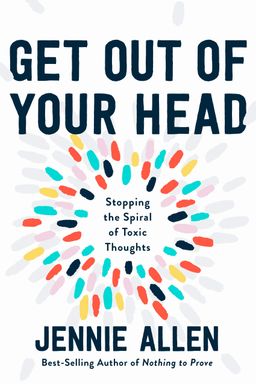
Have you ever found yourself trapped inside your own head—stuck in patterns of fear, doubt, or anxious overthinking? In Get Out of Your Head: Stopping the Spiral of Toxic Thoughts, Jennie Allen argues that the greatest spiritual battle of our generation isn’t external—it’s in the mind. Drawing from scripture, neuroscience, and her own journey through anxiety and disbelief, Allen contends that we can harness the power of God and the renewal of our minds to end toxic thought spirals and experience freedom. The book combines Christian faith with practical mental and emotional strategies, showing how spiritual truths overlap with the latest findings in brain science.
Allen’s thesis is simple but profound: you have a choice. Every thought you entertain either leads you closer to God’s peace or traps you in fear and defeat. As she explains through her own struggles—18 months of doubt and anxiety—she realized that her breakdown in faith was not an absence of belief but a battle for her thought life. Once she recognized the destructive lies she was believing and how those lies contradicted God’s truth, she found a way forward: take every thought captive, as the Apostle Paul urged in 2 Corinthians 10:5.
Faith Meets Brain Science
The book opens by explaining that neuroscience and scripture agree on a critical fact: your thoughts shape your life. We now know that the brain is plastic, constantly changing based on the thoughts we think (a field known as neuroplasticity). This mirrors Paul’s call in Romans 12:2 to be “transformed by the renewal of your mind.” Allen reinforces this by referencing research (and authors like Dr. Caroline Leaf) showing that up to 98% of mental and physical illness is linked to one’s thought life. The more you think an anxious or self-critical thought, the deeper it engrains a neural pathway. Conversely, when you dwell on truth—hope, gratitude, community—those pathways strengthen, making optimism and resilience easier to sustain.
Allen uses a personal example to show how vicious thought spirals can become. One morning, after reading a mildly critical email and scrolling Instagram, she declared herself a failure. That sequence of thoughts led to feelings of inadequacy, which led to snapping at her husband, Zac. In an hour, she descended from confidence to despair. This is how toxic cycles propagate, she explains: emotions spawn destructive thoughts, those thoughts produce actions, and actions reinforce emotional turmoil—a loop she calls “the downward spiral.”
The Spiritual War Within
Allen emphasizes that this war in our heads is not just psychological—it’s deeply spiritual. Early chapters explore Eve’s temptation in Genesis, David’s lust for Bathsheba, and even Jesus in Gethsemane to illustrate that every action begins with a thought. The enemy, she writes, exploits our mental vulnerabilities, feeding lies that mirror three primal deceptions: “I’m helpless,” “I’m worthless,” or “I’m unlovable.” These are not mere insecurities—they are distortions of divine truth. Believing them distorts how we see God Himself, turning us into victims of our own minds.
For Allen, freedom begins when you recognize that thoughts are not facts—they are choices. We can replace the false narrative with the truth of Scripture: that we are loved, chosen, and equipped with divine power to destroy strongholds. Her personal story of recovery after an 18-month spiral of doubt in Uganda powerfully brings this to life. When her friend Ann declared, “Jennie, this isn’t who you are,” it was as if “scales fell from her eyes.” By naming the lies, fasting, praying, and replacing them with truth, Allen seized control of her thought life and reclaimed her peace. (This echoes the transformation in Viktor Frankl’s Man’s Search for Meaning, where the choice of attitude amid suffering defines freedom.)
Living Transformed
By the end of the book, Allen builds a roadmap for living like Christ through renewed thinking. She urges readers to shift focus away from distractions and busyness and toward stillness with God (“I choose to be still”), to let themselves be known in community (“I choose to be known”), to replace fear with trust (“I choose to surrender my fears to God”), to fight cynicism through worship (“I choose to delight in God”), to replace pride with service (“I choose humility”), to overcome victimhood with gratitude, and to defeat complacency by running their race for others’ good. Ultimately, she argues, a mind fixed on Christ leads to supernatural joy and purpose—a life where, as she writes, “thoughts no longer hold us captive; we are the captors.”