
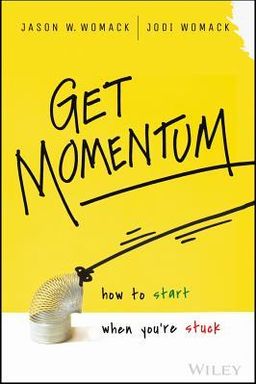
Get Momentum cover

Get Momentum

by Jason W Womack & Jodi Womack

Get Momentum provides vital strategies to break free from stagnation and pursue your goals with sustained motivation. Learn to manage time, track progress, and celebrate victories while adapting your approach to overcome setbacks. Perfect for anyone seeking to enhance personal and professional growth.

Getting Unstuck and Creating Momentum

Have you ever felt trapped in a loop of busyness—working hard, yet not moving forward on what truly matters? In Get Momentum: How to Start When You're Stuck, Jason and Jodi Womack argue that being stuck isn’t a permanent condition—it’s a signal that the strategies, systems, or mindsets that once worked are no longer serving you. Their core idea is that momentum—consistent, meaningful progress—can be created intentionally through a handful of manageable practices rather than by waiting for motivation to strike. They offer a structured, five-stage methodology to help readers refocus, act, and sustain energy on their most important projects.

Drawing from two decades of executive coaching, leadership training, and personal experimentation, the Womacks position this book as both a philosophy and a practical framework for progress. Each of the five stages—Motivation, Mentors, Milestones, Monitor, and Modify—works like a gear that powers the next. Momentum starts by clarifying purpose, expands through learning from others, gains traction with tangible goals, builds confidence through regular tracking, and maintains speed through deliberate adjustments. Together, these stages help you design the conditions for success, rather than waiting for them to appear.

Why Getting Stuck Happens

The book begins with a simple but arresting truth: being stuck is part of being human. It’s not about failure or procrastination but about reaching the limits of what once worked. Many professionals, the authors observed through their coaching clients, are trapped in what they call the WUTW trap—What Used To Work. Like the executive who keeps adding hours rather than changing strategies, we often respond to new challenges with old habits. The first step toward momentum is acknowledging that what got you here might not get you there (echoing Marshall Goldsmith’s famous principle).

Momentum, the Womacks argue, requires awareness and choice. You must first recognize the patterns keeping you stuck—overcommitment, perfectionism, or fear—and then consciously choose where you’ll direct your focus next. The central question isn’t what you can do, but rather what you want to be known for. Using this as a compass, you start differentiating between activity and progress.

The Architecture of Momentum: Five Stages

The book’s structure mirrors its philosophy: movement emerges from structure. In Stage 1, Motivation, you ask, “What do I want to be known for?” This redefines motivation not as an emotion, but as clarity of purpose. In Stage 2, Mentors, you explore who can teach or guide you—and how to learn even from those you’ve never met. Stage 3, Milestones, applies project management thinking to personal growth by breaking big goals into achievable ninety-day cycles. In Stage 4, Monitor, you track progress objectively and celebrate small wins to sustain energy. Finally, Stage 5, Modify, encourages adaptation—refining what works, letting go of what doesn’t, and embracing 2x productivity instead of endless exertion (+1 productivity).

Each stage builds upon the previous one, integrating psychology (intrinsic vs. extrinsic motivation), practical tools (journaling, milestones), and mindset shifts (focus on progress, not perfection). The book’s design encourages readers to reflect and act simultaneously. Each chapter includes Get Momentum Activities—guided journaling, questions, and real-world experiments—so that theory connects directly with lived experience.

Real People, Real Momentum

The Womacks animate their framework with vivid stories of clients and community members. Stephen, a senior executive offered a high-status promotion, rethinks his choice after Jason asks, “Is this what you want to be known for?” The question reframes his dilemma from logistics to legacy. Another story follows Jodi’s Women’s Business Social project, born from her frustration with uninspiring networking events. By acting on her own complaint—hosting the kind of gathering she wanted to attend—she shifts from wishing to doing, sparking a global community of women entrepreneurs. Through these examples, momentum emerges as a self-perpetuating cycle: clarity fuels action, and action fuels more clarity.

Momentum as a Way of Life

Ultimately, Get Momentum isn’t about a single project but a way of living. The Womacks invite readers to integrate self-reflection and accountability into everyday routines. Life’s challenges—career transitions, creative ambitions, leadership growth—become laboratories for practicing the momentum process. The book closes with a reflection on legacy and impact: momentum isn’t a sprint toward achievement; it’s the steady creation of a life aligned with what matters most.

In a world saturated with quick fixes and motivational hype, Get Momentum stands out for its structure and sincerity. It offers what the Womacks themselves embody: progress rooted in practice, clarity grounded in curiosity, and motivation sustained by meaning.


Stage 1: Motivation — What Do You Want to Be Known For?

The Womacks redefine motivation not as a fleeting surge of enthusiasm, but as the steady energy that comes from aligning your daily activities with what truly matters. At its heart lies the question, “What do I want to be known for?” This isn’t about ego or reputation—it’s about purpose. When you know what legacy you’re trying to build, every decision becomes clearer, and every action more directed.

Intrinsic vs. Extrinsic Motivation

True motivation blends two forces: the inner drive to grow and the outer forces that challenge or inspire us. You’ll recognize the intrinsic kind when you feel compelled to act simply because the work resonates with your identity. Jodi’s decision to start the Women’s Business Social came from an inner spark—a desire to build authentic connection. By contrast, extrinsic motivation arises from external change: opportunity, crisis, competition, or even boredom. Jason’s career leap happened when he realized he’d never be promoted where he was; his “stuck” became his catalyst.

From Getting Motivated to Being Motivated

Many people chase motivation like caffeine—a quick fix to jumpstart action. The Womacks challenge you to reverse that dynamic. Don’t get motivated to act; act in alignment with values so that motivation naturally follows. As Zig Ziglar famously said, “motivation doesn’t last—neither does bathing—so we recommend it daily.” The “daily” version here is reflection. Writing in your Momentum Journal connects you to your why until it becomes habitual.

The Legacy Lens

Motivation becomes sustainable when tied to legacy. Inspired by Stephen Covey’s “Begin with the end in mind,” the authors prompt you to define the mark you want to leave—professionally, personally, and communally. This question transforms ordinary projects into meaningful ones: launching a product can become enabling creativity; losing weight can become modeling health for your family. One client realized his volunteering wasn’t extra— it was central to who he wanted to be known as. The book’s activities encourage you to concretize legacy goals through lists, events, and causes you want associated with your name.

Developing Focus as a Superpower

The Womacks insist that focus—not time or money—is your most valuable asset. You can’t manage every demand, but you can direct attention. They liken focus to balancing on a moving bicycle: once you’re in motion toward purpose, staying upright becomes easier. Between competing projects and distractions, focus functions as your internal compass—a daily reminder that to say yes intentionally, you must say no consciously. (Similar ideas appear in Cal Newport’s Deep Work.)

Motivation, in this sense, is clarity in motion: the more clearly you see where you want to go, the easier it becomes to move. Every Get Momentum exercise in this stage—listing what inspires you, confronting frustrations, and tracking your time—exists to make invisible motives visible. And once you name them, you can lead with them.


Stage 2: Mentors — Learning from Others’ Experience

Once you’re motivated, the next accelerant is mentorship. The Womacks define a mentor not by job title but by experience you can learn from—directly or indirectly. The question becomes: “Whom can I learn from?” You don’t have to reinvent success; stand on others’ shoulders to see farther.

The Function of Mentors

Mentors do three things: restore perspective, transfer wisdom, and expand networks. A mentor’s story often reframes struggle: hearing how someone survived a tougher challenge builds your resilience. Jason’s clients, for example, often discover that productivity isn’t just tools but behavior—an awareness that comes faster through another’s feedback than through trial and error. Great mentors show what’s possible and shrink the learning curve.

Informal Learning

Mentorship doesn’t have to be official. Jodi built a vast network organically—through conferences, coffee chats, and even book clubs. These organic encounters create safe, reciprocal environments where insight flows easily. The key is to approach potential mentors with clarity: know what you’re trying to learn before you ask for help. Mentors aren’t there to motivate you but to exchange awareness for action.

Like Attracts Like: Expanding the Circle

The Womacks urge readers to “change who you spend time with.” Influence is contagious; proximity shapes progress. In one example, a photographer named Victoria networked with thirty galleries in three months, simply showing up where the conversations she wanted to join were already happening. When her own exhibition opened, her mentors’ advice—on mistakes, contacts, and timing—made success feel inevitable.

Learning from Mentors You’ll Never Meet

You can also learn from historical or distant mentors. Jason, fascinated by Benjamin Franklin, studied multiple biographies, discovering models of autodidactic learning and community leadership. In the same spirit, readers are encouraged to treat books, videos, and TED Talks as mentoring sessions-on-demand. The goal is cumulative inspiration—the mental proof that success like Roger Bannister’s four-minute mile is possible.

Mentorship in the Get Momentum model becomes less about hierarchy and more about reciprocity. As you grow, you’ll mentor others, reinforcing your own learning. It’s not who you know; it’s how you learn. And that, the Womacks say, is the secret to continual growth.


Stage 3: Milestones — Breaking Big Goals Into Doable Steps

Large ambitions often stall because of their size. That’s why Stage 3 reframes achievement as a series of visible milestones—concrete, measurable subprojects designed to make progress believable and achievable. The guiding question: “What are three subprojects I can complete?

The Power of Small Wins

The Womacks define milestones as “significant events in the progress of a project.” Breaking work into 30, 60, and 90-day chunks counters overwhelm and sustains enthusiasm. Completing subprojects delivers momentum because you experience success repeatedly. Psychologically, as Harvard researcher Teresa Amabile observed, “the progress principle” shows that even minor victories boost motivation dramatically.

The 30/30 and 90/90 Rules

To operationalize milestones, the Womacks propose two practical laws:

  • 30/30 Rule: Spend 30 focused minutes daily on something due 30 or more days from now. This builds foresight and reduces fire drills later.
  • 90/90 Rule: Once a month, devote 90 minutes to plan work that matters 90+ days out. This converts distant goals into near-term strategy.

Jason’s anecdote about redesigning his travel schedule demonstrates this mindset: by investing just 30 minutes a week to plan smarter client groupings, he reduced fatigue, improved profits, and achieved a long-dreamed goal—five consecutive workshop days in one city. Incremental work on long-term aims builds exponential benefits.

Planning with the Future in Mind

As Peter Drucker advised, “The best way to predict the future is to create it.” Milestone planning is exactly that—structured creation. It replaces vague ambition with an actionable path. A helpful metaphor from the book recounts an Alaskan road trip where mile markers warned of hazards ahead. Foreknowledge didn’t remove difficulty, but it removed surprise. Similarly, visible milestones give form to uncertainty. Each one you pass releases energy for the next.

Setting three subprojects is the balance point between simplicity and strategy. Too few, and progress feels abstract; too many, and momentum scatters. The sweet spot is progress you can see, feel, and celebrate every month. In short, milestones turn motion into momentum.


Stage 4: Monitor — Measuring What Matters

Success doesn’t follow effort automatically; it follows observation. The fourth stage encourages you to monitor progress intentionally. Asking “What positive things are happening that I can acknowledge?” trains your attention on movement, not frustration. As Peter Drucker’s adage reminds us, “What gets measured, gets managed.”

Early Detection, Early Response

Monitoring isn’t micromanagement—it’s self-leadership. Borrowing from public health expert Larry Brilliant’s mantra “early detection, early response,” the Womacks urge readers to notice deviations before they become crises. Whether tracking time, financial health, or emotions, regular reviews act like dashboard lights—warnings to refuel before running out of energy or focus.

Jason’s story of coaching a nonprofit manager named Anne-Marie illustrates this. Her goal—“make a positive difference”—was too abstract to monitor until they translated it into measurable outcomes: number of partner libraries, student attendance, hours of engagement. Once progress became visible, motivation flourished.

The Power of Debrief and Gratitude

A second monitoring practice is the debrief. After completing projects, take time to document learning—what worked, what didn’t, what to replicate. Without this, lessons evaporate within days. The Womacks also elevate gratitude as a measurable performance indicator. Jason’s early habit as a teacher—calling students’ homes nightly to share good news—became a model of appreciative feedback. Recognition fostered more of the same good behavior, proving that gratitude, like progress, compounds with use.

Designing Your Dashboard

Effective monitoring requires a customized dashboard tracking three to five indicators that reflect real success. These could be client engagement metrics or even the number of evenings spent device-free with family. The goal isn’t numbers for their own sake but awareness. Data is information; reflection turns it into wisdom.

The stage culminates in a mindset shift: celebrate progress, however small. When you monitor what’s working, you build confidence to continue. Momentum grows from recognition as much as from effort.


Stage 5: Modify — Making Small Changes to Stay in Motion

Momentum isn’t permanent; it’s maintained through adaptation. The final stage asks, “What one change can I make to keep moving forward?” Modification is about refining, not restarting. The Womacks define it as “making small, partial improvements that yield big results.”

Knowing When and What to Change

You modify strategies when progress slows. The book recommends reviewing monitored data and asking mentors for perspective. Jason’s own modification—integrating video directly into presentations after feedback from a coach—turned distraction into seamless engagement. Change often begins with an uncomfortable truth: the current method isn’t wrong, just incomplete.

+1 vs. 2x Productivity

One of the Womacks’ smartest distinctions is between “+1 productivity” (working longer) and “2x productivity” (working smarter). +1 feels productive but leads to exhaustion; 2x rethinks systems so the same tasks require half the effort. Jodi’s example of switching from bank visits to mobile check deposit freed up 25 hours a year—time reinvested into mentoring and creativity. The math of momentum is simple: small efficiencies multiplied equal transformation.

Automate, Delegate, Eliminate

The authors provide a three-part checklist for sustainable change:

  • Automate recurring tasks—use technology to handle repetitive work.
  • Delegate what others can do, creating shared ownership.
  • Eliminate habits, meetings, and obligations misaligned with purpose.

Modification Is Not Failure

Changing course isn’t quitting—it’s refining direction. Jodi’s decision to end her successful Women’s Business Social to focus on the Get Momentum Academy demonstrates strategic modification. Letting go of “good enough” created room for great impact. Like Michael Jordan’s quote on missing 9000 shots, failure, reframed, becomes raw material for growth.

In the end, modify means maturity: you quit forcing results and start sculpting conditions for success. Momentum lives not in intensity but in adaptability.


Living a Life of Impact and No Regrets

Having mastered all five stages, the Womacks conclude by zooming out: momentum isn’t just about projects—it’s about designing a life of impact. Their closing message echoes Bronnie Ware’s observation from her book The Top Five Regrets of the Dying: you regret the chances not taken, not the mistakes made. Momentum ensures you won’t leave your best work unlived.

From Self-Improvement to Contribution

The Womacks encourage shifting attention from personal success to collective influence. Mentorship, gratitude, reflection—all cultivate the humility to ask, “Who benefits when I get momentum?” Leaders in their workshops realized that progress at work improved family life and vice versa. The same habits—clarity, reflection, acknowledgment—create harmony across domains.

The Practice of Daily Reflection

Self-reflection becomes the engine of self-confidence. By journaling, reviewing wins, and articulating gratitude, you reinforce awareness of growth. The process resembles mindfulness for achievers—a structured awareness of being “in motion.” Over time, it wires confidence not as arrogance but as trust in one’s capacity to adapt.

Teaching It Forward

Finally, the Womacks advocate for teaching momentum. Once you internalize the process, sharing it cues commitment. Leading by these principles transforms meetings, families, and communities. Imagine, they suggest, a workplace where everyone could answer, “What do I want to be known for?” That environment buzzes with purpose and cooperation.

The book ends with the Eisenhower-like reminder that planning is nothing; preparation is everything. You create meaning when intention and motion meet. Through Get Momentum, you learn to begin again—deliberately, daily, and with lasting joy.

Dig Deeper

Get personalized prompts to apply these lessons to your life and deepen your understanding.

Go Deeper

Get the Full Experience

Download Insight Books for AI-powered reflections, quizzes, and more.