
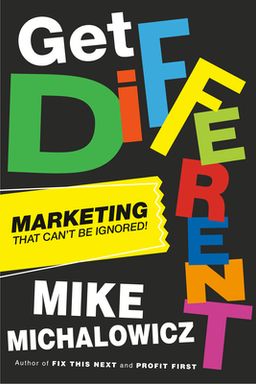
Get Different cover

Get Different

by Mike Michalowicz

Dive into ''Get Different'' by Mike Michalowicz, a groundbreaking guide for entrepreneurs ready to revolutionize their marketing approach. Learn to stand out in a crowded market with unique strategies, target the right audience, and refine your tactics for enduring success.

Different Is Better: Why Standing Out Is the Only Way to Win

When was the last time your business truly stood out? In Get Different, Mike Michalowicz argues that the only way to win customers’ attention in today’s over-saturated marketplace is by embracing what makes you uniquely different—and unapologetically marketing that difference. His central thesis is simple but revolutionary: “Better is not better. Different is better.” While most entrepreneurs chase industry best practices, polish their professionalism, and follow what’s worked for others, Michalowicz shows that this conformity kills visibility. If you're doing what everyone else does, you’re invisible. The cure is radical authenticity and creativity grounded in psychology, not gimmicks.

Building on his previous books, like Profit First and Clockwork, Michalowicz brings a fiercely practical approach to marketing. He insists that you have a responsibility to market if what you offer genuinely helps people. If inferior competitors attract customers because they market better, that’s your fault, not theirs. The world can only benefit from good solutions when the right businesses get noticed. That’s why, he says, marketing isn’t optional—it’s an entrepreneurial duty.

The Millisecond Battlefield

Michalowicz introduces the concept of “millisecond marketing,” grounded in cognitive science. Your audience’s brain decides in less than 250 milliseconds—faster than a blink—whether to pay attention or tune out. The human mind, wired for efficiency, filters out the familiar (habituation) and fixates on the unexpected. This is why copying proven marketing tactics backfires; it's just blending into background noise. The only way to win this microscopic window of attention is through difference—by activating curiosity and surprise while staying safe and inviting.

The DAD Framework: Simple, Sequential, and Powerful

To operationalize “different,” Michalowicz distills effective marketing into the DAD Framework: Differentiate, Attract, and Direct. First, you must Differentiate—stand apart visibly in your messaging, visuals, or concept. Then, you must Attract by ensuring your difference resonates with the right audience, making them feel safe and understood. Finally, you Direct by giving clear, actionable next steps. Without all three, your marketing fails—different alone may repel, attraction without direction stalls, and direction without attention never happens.

Marketing as Experimentation

The book reframes marketing not as a static plan but as a series of experiments. Michalowicz encourages entrepreneurs to test low-cost, creative ideas—what he calls “Get Different Experiments”—to find what truly gets noticed by their “Target One Hundred,” a small, defined set of prospects. Like a scientist in a lab, your job is to test, observe, and refine. Only through experimentation can you cut through noise and discover repeatable ideas worth scaling. This method releases entrepreneurs from fear of failure—each experiment, like a lab test, provides valuable data whether it succeeds or flops.

Marketing as Authentic Expression

Unlike many guides that push formulaic funnels, Michalowicz champions human creativity and authenticity. He urges you to lean into your quirks—the traits others call “unprofessional” may actually be your greatest asset. The mission isn’t to “grow up” into corporate sameness; it’s to double down on what makes you real. He draws examples from companies like the Geek Squad, whose goofy FBI-style uniforms became a billion-dollar brand, and the Savannah Bananas, a baseball team that turned fun and weirdness into global attention. These businesses succeed not because they’re better—but because they dared to be fully themselves.

Why It Matters More Than Ever

We live in a world drowning in noise—ads, posts, podcasts, products. As Get Different reminds us, invisibility is the greatest business risk. Conformity isn’t safety; it’s slow death. If your business is valuable, ethical, and genuinely helps people, you owe it to them to market boldly and proudly. Through stories, humor, and hands-on frameworks, Michalowicz transforms marketing from a dreaded chore to a creative act of service. Standing out isn’t vanity; it’s responsibility. When done differently, it’s what saves good businesses from obscurity and keeps customers from buying garbage instead of gold.


Marketing as a Responsibility, Not a Choice

In the opening chapter, Michalowicz reframes marketing as an ethical obligation rather than a self-promotion exercise. He shares how a conversation with internet marketing pioneer Yanik Silver changed his life. When Michalowicz lamented that manipulative 'infomarketers' dominated attention, Yanik told him bluntly: “If people are buying crap, it’s your fault for not outmarketing it.” That moment became Michalowicz’s moral wake-up call. If your product truly serves, you don’t just have permission to market—you have a responsibility to make it known. Otherwise, you’re condemning customers to inferior alternatives.

Mission Over Fear

This mindset flips fear-driven hesitation on its head. Most business owners hesitate because they fear standing out—what if people think it’s goofy, too bold, too risky? But Michalowicz argues that “playing it safe” is actually the riskiest path of all. In a memorable metaphor, he compares marketing sameness to wearing a gray suit in a room full of five hundred gray suits. Only the person in the bright red suit gets noticed—and even if they’re not the absolute best match, they’ll start the conversation. Invisibility, not ridicule, is the true enemy.

Better Is Not Better

One of the book’s most repeatable mantras—Better is not better. Different is better.—is grounded in behavioral psychology. Our brains ignore incremental improvements. A “slightly faster,” “somewhat cheaper,” or “better-quality” offer barely registers because it fits into existing patterns. Only what breaks expectation creates conscious attention. Hence, even 'better' businesses fail if their marketing looks like everyone else's. The goal isn’t comparison—it’s contrast.

Mission Meets Nemesis

To keep entrepreneurs focused, Michalowicz invites you to define both a mission and a nemesis. His mission is to “eradicate entrepreneurial poverty,” and his nemesis is the predatory guru culture that profits from deceit. When you personify your opposing force—whether it’s apathy, waste, or greed—you gain clarity and urgency. It’s no longer about self-promotion; it’s about defeating the enemy that hurts your customers. Marketing thus becomes a moral crusade—to rescue people from bad options with a better solution, wrapped in attention-worthy difference.


The DAD Framework: Differentiate, Attract, Direct

Michalowicz’s brilliant simplification of marketing, the DAD Framework, captures the psychology of why people notice, engage, and act. This isn’t fluff—it’s neuroscience applied to business. To get results, your marketing must always do three things, in sequence: Differentiate (get attention), Attract (hold interest), and Direct (trigger action).

Differentiate: The Blink Moment

The first D represents the instant your marketing passes—or fails—the brain’s reticular formation filter. You have milliseconds to stand out. Michalowicz’s example of Geek Squad shows why difference trumps quality. While he wore a boring suit to look 'professional,' Geek Squad techs dressed like nerdy FBI agents and drove branded Beetles—visual contrast so powerful that they owned the industry narrative. They weren’t “better computer repair technicians”—they were unmistakable. That difference turned into domination and eventually a $3 million acquisition by Best Buy.

Attract: From Curiosity to Connection

Once noticed, your message must resonate emotionally. Attraction hinges on safety, trust, and relevance. For example, Ernestina Perez, a Chicago-based therapist, used a viral video reacting to reality show 90 Day Fiancé to connect culturally with her Latinx audience. Her humor and authenticity drew clients who felt personally understood—thirty-one inquiries in one week. The attraction phase transforms “different” from a gimmick into rapport.

Direct: Make the Next Step Obvious

No matter how engaging your campaign, it fails without a simple, reasonable call to action. Street performers do this best—they entertain and then silently point to their tip jars. Clarity always beats cleverness. Michalowicz cautions that vague directives (“Learn More,” “Check it out”) waste engagement. Each campaign must say: “Do this exact thing, now.”

The DAD test becomes your go/no-go gauge: if your idea fails any of the three steps, it fails, period.

DAD turns the mystery of marketing into an accessible, repeatable formula. It empowers even “non-marketer” entrepreneurs to confidently evaluate and execute campaigns that win the blink—and the sale.


Target One Hundred: Focus Beats Volume

Forget “reach millions” mantras. Michalowicz teaches that effective marketing begins with focus: identifying your Target One Hundred—the first one hundred people most likely to benefit from and buy your offer. Based on statistical reasoning (10% of your market is enough to predict outcomes), this approach shrinks marketing from an overwhelming scale problem to an achievable experiment.

Who, What, and Win

To target effectively, you must define three components: the Who (your ideal client), the What (your core offer), and the Win (the action you want them to take). For example, accounting entrepreneur Gabriel Piña struggled with leads until he focused solely on cigar shop owners—a niche aligned with his personal passion. He mailed them business books with handwritten Post-its like “Text me, I’ll walk you through this—gratis.” That one distinctive, generous approach built six figures in new revenue.

Investment Per Prospect

Michalowicz guides you to reverse-engineer your marketing budget. Figure out a customer’s Lifetime Value (LTV) and your likelihood of closing them, then set how much you’ll invest per prospect. For the author, each book buyer nets $28 in lifetime value, so each must cost no more than $1 to acquire. This keeps creativity grounded in math, not guesswork.

Why Small Samples Scale Big

By limiting your sample to one hundred prospects, you eliminate analysis paralysis, speed up testing, and get clear feedback you can refine. Wins in small batches are statistically significant enough to roll out widely. This method gives even underfunded entrepreneurs a data-driven way to control lead flow and outlearn richer competitors.


Differentiate for Attention

If everyone around you zigs, it’s time to zag. Michalowicz’s most entertaining sections dive into how to actually get noticed—his “Differentiate” playbook filled with creativity exercises and wild real-world case studies.

Try a Different Medium

One of the easiest differentiators is using a different medium than everyone else. While competitors flood email inboxes, restaurateur Kasey Anton mailed real birthday candles to customers with an offer for a free entrée. That personal, tactile gesture earned $18,000 in business for under $200. When candles melted in summer, she pivoted to balloons—testing the same concept with new materials. Experimentation, not perfection, drives breakthroughs.

The “Est” Principle

To stand out, exaggerate a natural trait into a superlative—the “est” version of you. The Savannah Bananas branded themselves as the “funniest” team in baseball. Frank’s RedHot became the “spiciest grandma hot sauce” with its cheeky “I put that sh*t on everything” campaign. Pick one “est”—weirdest, kindest, boldest—and own it relentlessly. Extremes are memorable; moderation is invisible.

Blend and Borrow

Michalowicz recommends “R&D” not as Research & Development but as “Rip Off and Duplicate.” Borrow marketing ideas from unrelated industries: banks copied fast food’s drive-through model; you could use pharmaceutical-parody ads to sell vacuums. A pinch of novelty from outside your field equals instant difference inside it.

Authenticity Wins, Always

Throughout, Michalowicz emphasizes authenticity. Fake personas eventually collapse. In a cautionary tale, a famous author hid his whiskey collection to please his conservative audience—proof that polished façades create internal disconnect. Being “real” attracts your right tribe and repels mismatches, which is healthy. Your differentness already exists; your job is simply to amplify it.


Attract for Engagement

Attention means nothing unless you hold it. In the “Attract” stage, Michalowicz reveals how to convert curiosity into comfort by leveraging human psychology—what he calls Attraction Influencers.

Thirteen Psychological Attractors

He identifies thirteen common motivators—authority, belonging, beauty, safety, health, relief, esteem, and more. For instance, Apple’s minimalist design uses safety (trust in reliable tech) and beauty (sleek aesthetics). Lady Gaga’s “Little Monsters” community thrives on belonging and identity. Your task is to choose three that resonate most with your audience and build your campaign around them.

Avoid Gimmick Fatigue

A flashy tactic that misaligns with your offer backfires. Michalowicz recalls a tax-prep shop that hired a derelict Statue of Liberty mascot—different, yes, but hardly trust-building. In contrast, the Savannah Bananas’ silliness aligned perfectly with their “family fun” promise, not elite athleticism. Alignment between message and audience identity separates clever from cringey.

Speak to Identity

The best marketing mirrors who your customers believe they are. The Texas “Don’t Mess with Texas” anti-littering campaign reduced trash by 72% because it appealed to Texans’ pride, not guilt. When your brand affirms someone’s story about themselves, they lean in—not because they were convinced, but because they were recognized.


Direct for Results

The last step of DAD—Direct—is where engagement turns into revenue. Many marketers stumble here, either by confusing prospects or triggering the wrong behavior. Michalowicz advocates for clarity, simplicity, and immediacy.

Singular, Simple, Safe

Your call to action must be singular (“Buy this now”), not multi-choice (“Like, follow, and share”). It must also feel safe—the reward must outweigh perceived risk. Dorothy Hustead’s Wall Drug signs offering free ice water during the Great Depression illustrate this perfectly. The directive was direct, beneficial, and costless, transforming a failing shop into a global landmark.

Designing Directives by Relationship

Your audience perceives you as either superior (authority), equal (community member), or inferior (servant). Adjust your directive accordingly: experts “command” action, peers “invite” it, servers “petition” it. For example, a keynote speaker should confidently say “Join my masterclass,” while a nonprofit says, “Help us serve others.” Matching directive tone to relationship psychology maximizes compliance.

Scarcity and Exclusivity

Scarcity fuels urgency. The secret restaurant “Classified” inside Newark Airport thrives on exclusivity—you must be invited to even discover it. Ford’s limited-edition Bronco sold out twice just because of its “only 7,000 available” label. When paired with clear directives, scarcity converts curiosity into instant action.

Ultimately, every piece of marketing must direct one thing—and one thing only. Simplicity sells. Clarity converts.


Embrace the Disadvantage Advantage

What do squirrels, painted babies, and Dolly Parton have in common? They all turn perceived weaknesses into strengths. In one of the book’s most memorable chapters, Michalowicz introduces the Disadvantage Advantage: reframing your flaws and mistakes as magnets for attention and trust.

Flaws Build Trust

Painter Matt Shoup accidentally painted a baby black during a job. Horrified, he hid the story for years—until one blunt client demanded to hear his worst screw-up. When he shared it, the client hired him instantly, trusting that a guy who owned his biggest failure would make things right if something went wrong. Shoup turned “we paint babies” into a signature marketing story. His honesty tripled sales and made him famous for transparency.

Weirdness Wins

Michalowicz himself leans into his polysyllabic, hard-to-pronounce last name, joking about “My-cow-low-wits” to connect through humor. Similarly, Dolly Parton weaponized her flamboyance, transforming ridicule into legend. Her quote “I look artificial, but I’m totally real” captures Michalowicz’s ethos—lean fully into what makes you oddly you. Weird sticks.

Turn Lack into Differentiation

If you can’t afford what competitors have, spin it. The Savannah Bananas lacked a digital scoreboard, so they used a hand-cranked one—and fans adored its vintage charm. Constraints breed creativity. In Michalowicz’s words, “Not having money may be the best thing that ever happens to your marketing.”


Reimagine and Adapt Fearlessly

In the final chapters, Michalowicz shows how the same principles that power Get Different marketing can reinvent entire business models when change hits. True entrepreneurs don’t wait for circumstances—they reimagine them.

Pivot Through Listening

When the pandemic cut off sales, coffee shop owner Jacob Limmer surveyed customers instead of guessing their needs. They wanted health and comfort, so he launched immune-boosting cold brews within weeks—and achieved his most profitable year ever. The lesson: when times shift, don’t double down on old strategies; take one empathetic step back and ask, “What’s needed now?”

Sell the Tell

Test-market your ideas before building them. Announce your concept early and charge a deposit—if customers pay for the promise, you have proof of demand. This “Sell the Tell” approach ensures you develop only what buyers actually want, not what you hope they’ll want.

Do What Doesn’t Scale

Another gem from collaborator Joey Coleman: “Do what doesn’t scale.” Michalowicz personally answers every reader email—not efficient, but transformative. True differentiation often hides in unscalable personal touches others are too busy to attempt.

By the book’s end, Michalowicz leaves readers with a rallying cry: Grow, but don’t grow up. Keep your childlike curiosity, playful experimentation, and unfiltered authenticity alive. The world doesn’t need another polished grown-up brand—it needs your unapologetically different voice.

Dig Deeper

Get personalized prompts to apply these lessons to your life and deepen your understanding.

Go Deeper

Get the Full Experience

Download Insight Books for AI-powered reflections, quizzes, and more.