
Idea 1
Getting Better Begins With Building Deep Relationships
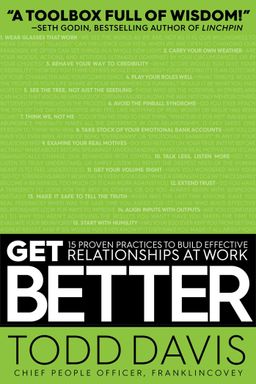
Do you ever feel that relationships at work—and even in life—are harder than they should be? In Get Better: 15 Proven Practices to Build Effective Relationships at Work, Todd Davis argues that almost every success or failure we experience stems from the quality of our relationships. Drawing on decades as FranklinCovey’s Chief People Officer, Davis contends that personal and professional growth begin when we stop trying to change others and instead focus on improving ourselves. When we do, both our influence and fulfillment expand dramatically.
This is not another leadership book filled only with principles and slogans. Davis builds the case that relationships—between colleagues, customers, teams, and leaders—form the foundation for culture, productivity, and happiness. At the heart of his thinking is the idea that “all meaningful change comes from the inside out.” You get better when you deliberately change how you see, think, and act in connection with others. As Davis uses Jean-Paul Sartre’s metaphor from the play No Exit, most of us live in rooms with people we can’t escape—coworkers, family, or friends—and when those relationships sour, life can feel like hell. Yet, the solution is rarely to flee the room; it’s to transform how we relate inside it.
Why Relationships Are the True Competitive Advantage
Every organization claims that people are its greatest asset, but Davis pushes further. He shows that it’s not just people—it’s the nature of the relationships between those people that determine whether a team thrives or implodes. Research from FranklinCovey and Harvard confirms that the best-performing business units are those with high-quality employee and customer relationships. When these relationships are rich with trust, everything moves faster; when they break down, productivity collapses, engagement plummets, and internal battles erupt. Whether you’re a leader, engineer, or parent, your outcomes depend on how well you understand, trust, and invest in the people around you.
From Sartre’s Hell to Relational Heaven
So much of human frustration at work stems from how we view others. Davis uses Sartre’s image—a room with no exit—to show that our misery often arises not from circumstances but from poor relationships. At first, when conflict arises, we point fingers and blame: our boss, our peers, our spouse. Then we seek escape—a new job, a new company, even a new marriage—convinced that a fresh setting will solve everything. But soon we discover the same patterns waiting for us in the next room. The real answer, Davis insists, is to “wear new glasses,” to shift our paradigm so we see others and ourselves more completely and compassionately.
Fifteen Practices That Rebuild Trust and Connection
The book revolves around fifteen practices that act as behavioral bridges between self-improvement and relationship growth. They range from personal habits (“Carry Your Own Weather,” “Avoid the Pinball Syndrome”) to interpersonal skills (“Talk Less, Listen More,” “Make It Safe to Tell the Truth”) and character-based disciplines (“Examine Your Real Motives,” “Start With Humility”). Each practice begins with a vivid story—often of an employee, manager, or parent facing a relational crisis—and ends with concrete steps for turning the insight into action. This structure makes the book practical, not theoretical. You don’t just learn ideas—you apply them in real conversations and daily routines.
Why This Matters Beyond Work
Although the subtitle emphasizes workplace relationships, the lessons reach far beyond the office. Davis’s practices—such as “Play Your Roles Well” and “Take Stock of Your Emotional Bank Accounts”—apply equally to friendships, families, and communities. The human need for connection, trust, and meaning transcends professions. In effect, Get Better is about cultivating emotional intelligence and personal leadership in every sphere of life. What starts as self-awareness blossoms into empathy; empathy ripples outward into influence; and influence creates collective success.
The Inside-Out Framework of Getting Better
Davis builds on Dr. Stephen R. Covey’s “inside-out” philosophy from The 7 Habits of Highly Effective People. Instead of chasing quick fixes or external validation, you begin by mastering your paradigms—your lenses of perception. How you see determines how you think, which determines how you feel, which guides what you do, and those behaviors ultimately produce your results. Changing your behavior without changing your paradigm yields only minor improvements; changing your paradigm yields radical breakthroughs. In relationships, that shift translates into patience, trust, and authentic influence.
The Ultimate Promise of “Get Better”
Davis’s message is uplifting: by practicing self-awareness, humility, and trust, you can turn any room—any relationship—from a form of hell into a space of cooperation and growth. His stories—from marathon training with his daughter to coaching leaders who rediscover balance—remind you that every transformation begins with one choice: to get better yourself. Through that choice, you become the kind of person others want to work with, follow, and love. In the end, Get Better teaches that success and happiness depend not only on what you achieve but on how you connect. The better you get, the better everyone around you becomes.