
Idea 1
The Genome as Life’s Narrative Code
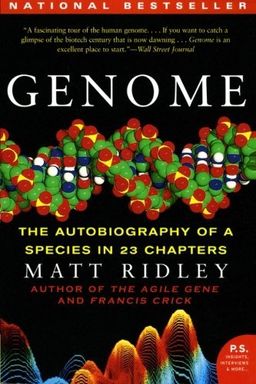
Imagine if your entire biological essence could be read like a storybook. That’s the premise guiding Matt Ridley’s The Genome: The Autobiography of a Species in 23 Chapters. He invites you to think of DNA as literal text—twenty-three chapters (chromosomes), each telling the tale of evolution, health, disease, and behavior. The genome, Ridley argues, is both archive and script: it records the past and anticipates the future through its capacity to express, mutate, and regulate.
From molecules to meaning
Each gene is a paragraph written in a four-letter alphabet (A, C, G, T) encoding instructions for proteins—the actors in your biological drama. In this scheme, replication copies the book, transcription writes temporary RNA notes, and translation turns those notes into physical structure. Information, not chemistry alone, defines DNA’s genius. Ridley echoes Erwin Schrödinger’s insight that life is an information system before it is a material one. A cell’s molecules behave like readers and editors constantly revising the text, interpreting and executing it anew with every cell division.
RNA, LUCA, and the origin of life’s story
Ridley begins his narrative not with humans but billions of years earlier, when RNA probably shouldered both roles now divided between DNA (information storage) and proteins (function). RNA can catalyze reactions and copy itself—a dual capacity that allowed it to serve as life’s primordial script. From that world emerged the Last Universal Common Ancestor (LUCA), which marked the evolutionary turning point when cells wove information from chemistry into heredity. The ribosomal RNAs you still carry today are molecular fossils—living echoes from that ancient narrative.
The genome’s structure as evolutionary memoir
The human genome carries in its chapters the story of evolution. Chromosome 2 records a fusion that distinguishes our lineage from that of other great apes, while mitochondrial DNA whispers of maternal ancestors who walked out of Africa. These genetic artifacts make the genome a biography written in molecular script—one that reveals not just kinship but also struggle, creativity, and the passage of time.
Crossing from discovery to ethics
Ridley weaves historical discovery with moral reflection. You travel from Mendel’s peas to Watson and Crick’s helix, from Garrod’s concept of inborn metabolism to the modern genetic revolution of Huntington’s disease testing, gene therapy, and forensics. Each step extends the metaphor of reading: by deciphering the text of life, you gain knowledge—but also responsibility. Knowing your genetic future may empower or burden you, depending on how society uses that knowledge.
Core insight
The genome is both history and prophecy. It tells the story of your species’ origins while drafting alternative versions of its future—and learning to read it demands a blend of biology, philosophy, and humanity.
Throughout this unfolding chronicle, Ridley’s project stays clear: to show you that the genome is not a static code but a dynamic conversation among chemistry, evolution, and culture. Every gene has a past; every chromosome carries arguments between adaptation and accident. By turning the pages of this molecular autobiography, you learn not just what humanity is made of, but what stories keep us alive.