
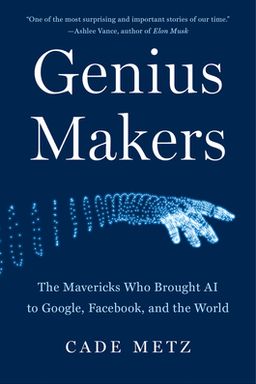
Genius Makers cover

Genius Makers

by Cade Metz

Genius Makers delves into the thrilling race to develop AI, chronicling its history and future potential. From tech giants'' investments to ethical dilemmas, this book offers a comprehensive look at AI''s profound impact on society.

The Renaissance of Deep Learning

How does an idea once abandoned as a scientific dead end become the foundation of a technological revolution? The story of deep learning — from the perceptron to AlphaGo — is a tale of rediscovery, persistence, and scale. It reminds you that breakthroughs often await the right alignment of data, computation, and human belief. This book charts that alignment, showing how neural networks, once dismissed, came roaring back to shape speech, vision, language, and even politics.

From the perceptron to the AI winter

Starting in the 1950s, Frank Rosenblatt imagined machines that could learn from examples. His perceptron was simple: it categorized marks on cards as left or right. Yet public promises outpaced reality, and by the late 1960s Marvin Minsky and Seymour Papert dissected perceptron limitations — notably that single-layer networks couldn’t solve basic problems like XOR. Funding vanished, symbolic reasoning took over, and AI entered a long winter. The setback was less about misconception than about missing resources: data, compute, and mathematical tools weren’t ready.

Persistence and revival

Geoff Hinton, David Rumelhart, Terry Sejnowski, and a small cohort never stopped believing that connectionism hadn’t failed so much as it had been premature. They refined backpropagation, enabling multi-layer networks to learn internal representations. Boltzmann Machines and convolutional networks followed, laying the technical foundation for deep learning’s later surge. Hinton’s guiding principle — “old ideas are new” — teaches you to revisit discarded concepts when constraints change.

Compute, datasets, and tipping points

By the 2000s, GPUs designed for gaming supplied unprecedented parallel computing. Massive labeled data from the internet provided the fuel. When Alex Krizhevsky, Ilya Sutskever, and Hinton trained a convolutional network on ImageNet in 2012, they halved error rates overnight. This wasn’t incremental progress; it was the field’s turning point. ImageNet proved that scale and engineering matter as much as theory. Suddenly, deep nets became industry-ready tools.

Industrial transformation and talent race

Geoff Hinton’s three-person company, DNNresearch, sparked an industry auction among Google, Baidu, Microsoft, and DeepMind. Google’s $44M acquisition symbolized more than capital; it was the start of an era in which talent dictated technological direction. Google Brain under Jeff Dean focused on product-scale systems, while DeepMind under Demis Hassabis aimed for AGI breakthroughs. Each attracted brilliant researchers, built compute infrastructure, and set cultural tones that influenced the future trajectory of AI.

From labs to societies

The renaissance didn’t stop at research labs. AlphaGo’s victories over Lee Sedol and Ke Jie symbolized the leap from pattern recognition to autonomous strategy discovery — via reinforcement learning and self-play. These matches weren’t just scientific events; they were geopolitical catalysts, inspiring China’s national AI initiative. The same period saw neural networks move into speech recognition (Hinton, Li Deng), translation (BERT, seq-to-seq), medicine (diabetic retinopathy detection), and cars (Chauffeur), proving that algorithmic ideas could become real-world products.

Ethics, bias, and governance

Powerful machinery — whether GANs generating imagery or networks guiding drones — brought new moral weight. Google’s Project Maven contract, internal protests, and DeepMind’s ethics board show that technology maturity demands moral maturity. Equally urgent were fairness crises: Joy Buolamwini, Timnit Gebru, and Deborah Raji exposed racial bias in facial recognition, reshaping how companies treat dataset diversity. The book closes where science meets power: open-source debates, sovereign data, misinformation, and the call for responsible stewardship.

Core lesson: Progress is cyclical. Ideas that fail under one set of constraints can succeed spectacularly when compute, data, and persistence converge. To understand technology, you must understand timing, people, and context — not just code.

In essence, this book isn’t just about AI’s rebirth — it’s about how human faith in ideas, combined with scale and engineering, turned abstract mathematics into a reshaping force for industry, policy, and ethics. If you follow this story, you grasp how science and society now co-evolve through algorithms trained on the world itself.


From Perceptrons to Deep Nets

The path from Rosenblatt’s perceptron to today’s deep networks reveals a core insight: technology grows by recombining old concepts with new tools. When Minsky and Papert criticized early nets for theoretical limits, they didn’t refute learning itself—only its first incarnation. Geoff Hinton, David Rumelhart, and others kept refining the math until the missing ingredient, backpropagation, arrived.

Connectionism and persistence

During the symbolic AI boom, connectionists kept working quietly. Hinton’s Boltzmann Machines and LeCun’s convolutional models linked neuroscience metaphors with practical use. They proved that layering representations—from edges to shapes to semantics—was computationally powerful. The people mattered as much as the technique; persistence kept the lineage alive until hardware could catch up.

Scaling the dream

By the late 2000s, GPUs provided thousands of parallel processors. AlexNet’s 2012 triumph showed how decades of theory became practical engineering. Once you could train deep stacks fast enough, learning genuinely deep representations became possible. The lesson is practical: every failed idea might just be waiting for technological scale.

Key takeaway: To innovate effectively, ask not only “what works?” but “what used to fail, and why?” Deep learning flourished by revisiting a discarded model once computing caught up with imagination.

If you build systems today, your creative advantage may lie in connecting historical undercurrents with modern constraints. Deep learning’s resurrection proves that science evolves less through novelty than through patience and timing.


Scale, Compute, and Hardware Revolutions

Deep learning’s success depends less on clever equations than on compute. GPUs and TPUs changed what was possible: they turned academic curiosities into systems that could train on billions of examples. You learn that hardware innovation—often invisible to outsiders—determines which ideas survive.

GPUs: from gaming to learning

Initially built for 3D graphics, GPUs parallelize the linear algebra at the heart of neural nets. Microsoft researchers used them to improve speech; Krizhevsky trained AlexNet on them in his bedroom. Jeff Dean’s $130M push for GPUs at Google showed how scale converts theory into impact: training that took months could now happen overnight.

TPUs and efficiency

Google’s Tensor Processing Units pushed further. By sacrificing precision, they sped up tensor operations, enabling instant translation. Every production system requires both training horsepower and efficient serving hardware. As compute became central, AI turned industrial—hardware budgets rivaled software talent.

If you evaluate any breakthrough today, trace its hardware lineage. The moral: progress scales with electricity and silicon as much as with equations.


Benchmarks and Turning Points

Scientific revolutions need measurable victories. ImageNet did that for computer vision. AlexNet’s stunning improvement revealed that with enough data and GPUs, convolutional networks could generalize far better than hand-built features. Benchmarks validate reality: you prove ideas not with philosophy but with numbers.

AlexNet’s engineering achievement

Krizhevsky squeezed GPU memory limits to train a massive model. His code–engineering mattered as much as theoretical insight. Error rates on ImageNet nearly halved, forcing skeptics to reconsider neural nets seriously. It was the moment the field shifted from academic theory to global adoption.

The deeper lesson

Benchmarks like ImageNet and AlphaGo’s matches reveal whether abstractions work in reality. When performance surges past expectation, industries reorganize. That is how tech transitions from curiosity to inevitability.

Ask of any AI claim: where’s the benchmark? If none exists, improvements may remain anecdotal. Once metrics exist, progress accelerates—and falsification becomes possible.

This turning point laid groundwork for deep learning in vision, speech, and text—and ultimately made AI measurable, investable, and inevitable.


Games, Reinforcement, and Strategy Learning

Games like Go or StarCraft became laboratories for intelligence. DeepMind used them to test whether a system could learn by trial and error, not imitation. AlphaGo proved it could—and generated philosophical shockwaves that reached governments and corporations alike.

From imitation to self-play

AlphaGo mixed neural networks with reinforcement learning and Monte Carlo search, playing millions of games against itself. Moves like 37 astonished observers; move 78 by Lee Sedol revived human pride. This dynamic showed creative emergence—machines developing intuition at scale, humans adapting in response.

Beyond entertainment

AlphaGo’s impact transcended Go. It triggered China’s national AI plan, justified long-term research budgets, and shifted Google’s internal politics. DeepMind’s mission for AGI contrasted with Google Brain’s product focus, revealing divergent paths within the same empire.

The broader framework

Reinforcement learning scales beyond games—to robotics, resource management, or chemistry. The conceptual leap is rewarding systems for sequences, not static classifications. It gives machines a sense of strategy rather than reactive recognition.

If you design dynamic systems—vehicles, warehouses, digital assistants—understand that reinforcement learning models action over time. What AlphaGo proved inside a game board may soon apply everywhere decisions unfold sequentially.


From Research to Product

AI matters only when it reaches reality. Speech assistants, translation systems, and medical diagnostics showed how deep learning crossed from lab demos to production. The book follows this path closely, illustrating how engineering converts innovation into utility.

Speech recognition revolution

Li Deng and Geoff Hinton rebuilt acoustic models with neural nets; George Dahl and Abdel-rahman Mohamed executed GPU training that cut error rates dramatically. That improvement enabled mobile voice assistants and transformed billions of devices.

Translation and sequence modeling

Ilya Sutskever’s sequence-to-sequence architecture let machines translate whole sentences, not just words. Combined with TPUs, it reduced latency from seconds to milliseconds. The takeaway is universal: models require infrastructure to serve millions effectively.

Cars and medicine

Deep learning began to see roads and diagnose retinas. Self-driving projects like Chauffeur automated perception; medical teams taught nets to detect disease at human parity. Drug discovery and hospital analytics followed. Research became healthcare and automotive reality.

These examples show that AI wins when theory meets domain data and engineering rigor. The bridge from paper to product defines impact.


Ethics, Bias, and Accountability

As AI entered public life, ethical pressure mounted. The book demonstrates how hype, bias, and weaponization forced new norms. You learn that ethics isn’t separate from research—it’s a continuation of engineering responsibility.

Bias and representation

Incidents like Google Photos’ mislabeling and face recognition errors exposed systemic bias. Joy Buolamwini, Timnit Gebru, and Deborah Raji’s audits forced accountability. Their message: diversity and dataset curation are engineering imperatives, not soft issues.

Misinformation and generative risks

GANs can now create convincing faces or voices. What began as creative play turned into social risk—deepfake pornography, propaganda, and misinformation. Ian Goodfellow’s insight birthed an arms race for authenticity verification.

Weaponization and revolt

Google’s Project Maven contract provoked thousands of employee protests, forcing the firm to cancel its defense partnership. The episode revealed that ethical agency can emerge inside institutions when power and conscience collide.

Governance and openness

OpenAI and DeepMind experimented with ethical boards and open-source policies. Balancing openness versus control remains unresolved, but these debates mark the maturity of a field confronting its social consequences.

Ultimately, ethical progress traces the same pattern as technical progress: iteration, conflict, and correction. The challenge now is to engineer not just smarter systems but more responsible institutions.


Language and Robotics Frontiers

Language models and robots test AI’s frontiers of understanding and embodiment. You witness both leaps and limitations—systems that write essays but lack reasoning, robots that grasp cubes yet struggle in messy realities.

Language: statistical power vs. true understanding

Google’s Duplex sounded human on the phone, while BERT generalized linguistic patterns across tasks. Gary Marcus challenged their interpretive capacity; Yann LeCun defended deep learning’s scalability. This debate matters for deploying AI responsibly—language fluency isn’t cognition.

Robotics and the physical gap

OpenAI’s Rubik’s Cube hand relied on simulation diversity to generalize, while Covariant’s warehouse robots mastered commercial tasks. Physical reality exposed brittleness, but also incremental milestones toward embodied skill.

Economic and social meaning

Robotics adoption is uneven: augmentation precedes displacement. Language automation similarly amplifies productivity before replacing human roles. Watching these trajectories helps anticipate how labor and skill evolve alongside intelligence expansion.

Together, language and robotics define the edges of AI evolution—where pattern learning meets physical and semantic complexity. You learn that progress here demands humility, interpretability, and multi-disciplinary design.

Dig Deeper

Get personalized prompts to apply these lessons to your life and deepen your understanding.

Go Deeper

Get the Full Experience

Download Insight Books for AI-powered reflections, quizzes, and more.