
Idea 1
From the Steppe to the World: The Making of an Empire
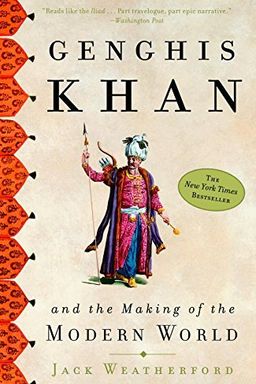
How does a boy from a persecuted clan remake half the world? This book tells the story of Genghis Khan’s transformation of the Mongol tribes into a disciplined nation and his sons’ and grandsons’ creation of a transcontinental empire. It argues that the Mongol rise was not a miracle of brutality but a calculated reinvention of governance, military organization, and culture—an early prototype of globalization. You witness how survival on the steppe became a school for adaptive leadership, and how conquest became a mechanism for trade, law, and exchange.
The Birth of a Vision from Trauma
You meet Temujin as a child of violence—kidnapped, starved, enslaved—learning not to depend on inherited privilege but to build loyalty through reciprocity. His mother Hoelun’s resilience, his brother’s murder, and his captivity by the Tayichiud forge in him an obsession with merit over blood. Early allies like Jamuka and enemies like Ong Khan shape his understanding that kinship politics must be replaced by voluntary bonds based on proven worth. By the Baljuna Covenant, where nineteen men of different faiths swear allegiance while drinking muddy water, he redefines community across lineage, tribe, and religion.
Revolution in Organization and War
From this crucible, Temujin—now Genghis Khan—creates a system where mobility, discipline, and law work together. The decimal military structure (arban, jagun, mingan, tumen) fuses civil and military life, making every man accountable to his unit rather than clan. The reorganized army defeats larger powers through speed, intelligence, and deception. Feigned retreats, encirclement (nerge), and surprise night marches reveal a mind that studies psychology as much as terrain. Siege techniques borrowed from China and Persia—catapults, mining, gunpowder bombs—show his fascination with technology and learning from conquered peoples. War becomes a laboratory for innovation.
The Law That Turns Raids into Rule
Conquest alone could not hold diverse peoples. Genghis Khan codifies a Great Law forbidding blood feuds, theft, and the capture of women, while mandating religious freedom and tax privileges for clergy and scholars. He adopts writing (the Uighur script) for administration and establishes recordkeeping through his judge Shigi-Khutukhu. Literacy becomes the connective tissue between military command and civil governance. Hostages become students at court, trained to serve rather than rot in captivity—a redefinition of coercion as statecraft.
Empire as Economic Network
Having pacified the steppe, the Mongols turn roads of conquest into arteries of trade. The same postal relay (yam) that carries military orders also moves merchants, doctors, and monks. Loot becomes regulated revenue; caravans traverse safe routes protected by law and logistic stations. Craftsmen from Germany to China are relocated as imperial resources. The once-isolated Silk Roads fuse into a single system of exchange—an early form of international supply chain. This connectivity transmits not only silk and silver but also languages, technologies, and medical knowledge.
The Politics of Fear and Faith
Fear, rumor, and mercy form a dual engine of control. Cities that yield, like Samarkand, are spared; resistors, like Nishapur, face annihilation. But terror is always theatrical—a signal more than slaughter. Genghis Khan’s selective sanctions set a policy precedent later used in Europe by Subodei and Batu, where terror preempts battle through psychological shock. Behind these actions lies a moral calculus: fewer Mongols die when cities surrender early. In parallel, his policy of religious freedom unites Buddhists, Muslims, Christians, and shamans under pragmatic tolerance.
Succession, Reforms, and Continuity
After Genghis’s death, wives and grandsons perpetuate his institutional legacy. Toregene and Sorkhokhtani rule through regency and diplomacy, proving that Mongol politics could operate as bureaucratic matriarchy. Mongke centralizes administration, imposes fiscal discipline, and introduces the sukhe silver standard—foundations for functional banking. His brothers Hulegu and Khubilai extend the empire through the Middle East and China: Hulegu destroys Baghdad; Khubilai sinicizes rule, founds Khanbalik (Beijing), and harmonizes Mongol and Chinese law. Each ruler translates conquest into civilization-building.
Integration and Collapse
Under Khubilai, the empire becomes a cosmopolitan superstate supporting trade, science, and art at unprecedented scale. Envoys like Rabban Bar Sawma reach Rome; artisans like Guillaume Boucher build marvels at Karakorum. Yet the very networks that connect Eurasia also spread plague. The Black Death (1340s) travels along Mongol caravan routes, dismantling population bases, markets, and fiscal systems. Fragmentation follows: Mongol states localize, adopt regional religions, and lose the universalism of Genghis’s vision. The Mongol achievement endures in its systems—in bureaucracy, postal architectures, and global exchange—but its political structure dissolves into the empires and ideas it inspired (Timurids, Mughals, Ming).
Core Message
The Mongol story is not simply about destruction. It is a study in how trauma turns into innovation, how mobility becomes empire, and how governance, technology, and exchange intertwine to make the first truly global century. You leave understanding that Genghis Khan’s greatest conquest was not land, but structure: he built an idea of connection that long outlasted the horsemen who rode it.