
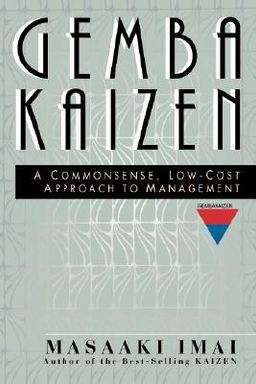
Gemba Kaizen cover

Gemba Kaizen

by Masaaki Imai

Gemba Kaizen by Masaaki Imai unveils the transformative power of the Japanese business philosophy that revolutionizes efficiency. Through practical strategies, learn how to engage employees, streamline processes, and implement continuous improvements to achieve excellence in any industry.

Gemba Kaizen: Continuous Improvement at the Actual Place

How can you build a company that improves every day, everywhere, without massive investments? Masaaki Imai’s Gemba Kaizen argues that the answer lies in developing a culture of continuous, small-scale improvement—kaizen—anchored at the actual place where value is created: the gemba. The method is deceptively simple but revolutionary: standardize processes, make problems visible, empower people to solve them, and repeat endlessly. Instead of top-down innovation, kaizen grows from daily discipline and observation in the workplace.

Imai’s central claim is that kaizen is a low-cost, people-centered strategy that transforms operating performance from the inside out. The concepts of kaizen (continuous improvement) and gemba (the actual place) form two sides of the same coin. Improvement must happen where work happens. If you want better results, you must first stabilize, standardize, and improve the process on site.

From Philosophy to Practice

Kaizen’s flow begins with fundamentals: eliminate waste (muda), maintain standards, and focus on process rather than outcome. Imai structures improvement through two complementary cycles: SDCA (standardize-do-check-act) to stabilize work and PDCA (plan-do-check-act) to improve on that standardized base. This disciplined rhythm prevents chaos and ensures that innovation follows control. Companies like Toyoda Machine Works show this rhythm superbly—documented standards led to dramatically lower defects as engineers iterated from stable processes.

Layered Systems Under One Umbrella

Imai places kaizen as an umbrella concept under which several famous systems reside: Total Quality Management (TQM), Just-In-Time (JIT), Total Productive Maintenance (TPM), and Policy Deployment (hoshin kanri). These tools support continuous improvement when built on a stable foundation of standards, visual management, and people participation. Yokogawa Hewlett-Packard’s progression—cutting defects from 4000 ppm to 3 ppm—demonstrates how incremental kaizen combined with technical rigor yields monumental results.

People First, Process Always

At the heart of gemba kaizen are people. Workers and supervisors are trained to observe, quantify, and solve problems directly at the gemba using structured approaches like the five whys and standardized formats such as the A3 problem-solving sheet. This democratizes improvement: everyone, not just engineers, becomes capable of daily analysis and experimentation. Art Byrne at Wiremold and Soichiro Honda exemplify this leadership philosophy—leaders who live in the gemba embody credibility, urgency, and learning.

Why Visuals and Standards Matter

For kaizen to work, problems must be visible and standards must be alive. The combination of 5S (Sort, Straighten, Scrub, Systematize, Self-discipline) and visual management turns workspaces into transparent learning labs. Specialty Silicone Fabricators used magnetic whiteboards and andon lights to make production progress visible; Stainless Design managed high-mix orders visually with simple sequence cards. These simple visuals synchronize teams and prevent delays through fast attention to abnormalities.

Beyond Factories: Universal Application

Although rooted in manufacturing, Imai widens kaizen to every domain—IT, healthcare, logistics, even airports. The same principles apply: see the real place, measure facts, involve staff, and remove friction. Achmea’s IT group cut wasteful cost by 30%; Oporto Hospital Centre reduced medicine stock by millions and patient waiting time by weeks; Aeroporti di Roma improved passenger flow with simple layout changes and empathy-based design. The gemba exists wherever real work and real value occur.

Leadership, Culture, and Sustainability

Ultimately, Imai’s vision is cultural. Standards, visuals, and metrics are tools—but the essence is leadership by example, training cascades, and daily routines that convert practice into habit. Art Byrne’s acquisitions proved that CEO-led kaizen can generate swift financial returns (3.5× in three years) while embedding lean behavior across companies. Sonae MC’s multinational training cascades show how kaizen scales to tens of thousands of people through audits, certification, and recognition of small wins.

Core message

Kaizen is not an event or a toolkit—it is the disciplined, daily act of seeing and improving at the gemba. When standards, people, and leadership align, continuous improvement becomes self-sustaining.


Standards, 5S, and Visible Discipline

Standards are the lifeblood of kaizen. Without them, improvement floats on opinion. Imai describes standards as the “best, safest, easiest” way to perform a job today—and the foundation for tomorrow’s better version. They capture organizational memory and make learning measurable. Yoshio Shima of Toyoda Machine Works reminds you that standards must evolve; they are not carved in stone but continuously reviewed through PDCA cycles.

The 5S Sequence

You begin kaizen with housekeeping. The five S’s—Sort, Straighten, Scrub, Systematize, and Self-discipline—build awareness and control. Sort removes the unnecessary; Straighten gives everything a place; Scrub uncovers problems while cleaning; Systematize makes those steps routine; Self-discipline (Shitsuke) transforms behavior into culture. These simple habits generate pride and ownership: a Romanian city’s volunteer 5S project and Giorgio Foods’ relocation of managers to the shop floor both demonstrated how order fosters engagement and accountability.

Visual Management and Standards

Visual management amplifies standards by making deviations unavoidable. Whiteboards, andon lights, and posted targets give instant feedback. At Specialty Silicone Fabricators, visuals made customer communication positive instead of apologetic. At Stainless Design, simple cardboard cards synced complex orders seamlessly. The rule is plain: if problems aren’t visible, they can’t be solved. Visual thinking makes gemba self-managing; the shop speaks when something is abnormal.

Standardized Problem Solving

Kaizen connects standards to problem-solving formats like Toyota’s Business Practice (TBP) and the A3 method: identify a theme, capture current conditions, analyze root cause, define countermeasures, implement, check results, and standardize improvements. Practicing this sequence repeatedly builds PDCA discipline. Document what works, observe outcomes, and raise the bar again. The standard form may seem bureaucratic, but as Toyoda’s Shima warned: “put the form first and the soul later”—meaning start with visible practice, then deepen insight through experience.

Practical takeaway

Combine 5S and visual tools to make standards tangible and living. When workers own routines and visuals highlight abnormality, your process gains stability, clarity, and momentum for improvement.


The Gemba Manager’s Discipline

At the heart of every kaizen culture stands the gemba manager—the person who ties policy to real work. Imai distills their role into five golden rules: go to the gemba, check the gembutsu (actual parts and machines), act immediately to sustain flow, find root causes, and standardize solutions. These simple principles appear in timeless stories: Taiichi Ohno’s chalk circle observation exercise trained supervisors to see wastes firsthand; Soichiro Honda modeled direct engagement at the gemba; Kristianto Jahja learned observation that replaced assumptions with data.

Root-Cause Thinking

Using the five whys, you move from symptom to source: oil on the floor isn’t “clean it up” but “why did it leak?” until the defective coupling gets redesign treatment. Temporary fixes are permitted but never final. This method embeds logical habit and discipline where others rely on firefighting. (In Toyota training, “temporary countermeasures are oxygen; root cause analysis is medicine.”)

Supervisors and Training

Training Within Industry (TWI) built the supervisor’s toolkit: Job Instruction, Job Methods, and Job Relations. You teach, improve, and lead simultaneously. Toyota Astra Motor’s structured manuals, leadership checklists, and daily audits illustrate this triad perfectly. Success demands visible routines—morning standups, hourly checks, and on-the-job coaching where leaders demonstrate problem-solving in real time.

Observation and Measurement

Going to the gemba means measuring what you observe. Akio Takahashi insists you turn dissatisfaction into nouns and numbers: “Line A runs at 65%; target is 85%.” Precision enables accountability. Nissan’s two-day kaizen encapsulates this rigor: Day 1 observation and idea selection; overnight fabrication; Day 2 implementation and check. These concentrated learning events compress improvement cycles into hours, teaching focus and speed.

Key lesson

Presence, fact-based thinking, rapid countermeasures, and disciplined follow-up define effective gemba management. Supervisors become the living link between leadership intention and daily execution.


Flow, Takt, and Pull Thinking

Just-In-Time (JIT) redefines production from the customer backward. It synchronizes work to demand rather than to forecasts. Imai explains that takt time is the rhythm of the market—available time divided by customer demand—and cycle time is how long each process actually takes. Aligning the two builds a flow responsive to customers and free of excess inventory. If each process meets takt, the entire system breathes with the market pulse.

Pull Versus Push

Push systems create stockpiles; pull systems create flow. Imai’s Aisin Seiki example—fabricating mattresses in one-piece flow for 750 variants within minimal space—shows how small-lot logic elevates flexibility and speed. Kanban signals, leveled production (heijunka), and setup-time reduction convert physically possible flow into economically viable production. The lesson: produce only what the next process or customer actually needs.

Total Flow Management

Kaizen Institute expands JIT to Total Flow Management (TFM), designing pull across the entire supply chain. Use milk-run logistics, vendor-managed inventories, and one-piece flow from supplier to customer. “Company A” achieved inventory and defect reductions while lifting schedule adherence from 50% to 92%. Wiremold under Art Byrne turned these flows into cash: freed floor space, cut lead time, improved service, and multiplied enterprise value.

Flow as Strategy

Imai warns that JIT is not technical tinkering—it’s strategic alignment. You eliminate muda to expose problems, not to chase automation. Only when flow stabilizes does technology add leverage. Byrne’s approach validated this: he tied JIT metrics directly to financial outcomes, proving that lean flow is both operational and strategic.

Action point

Design flow to takt, implement pull, and extend it across suppliers. Every cycle change should bring you closer to rhythm with the market—not more speed for its own sake.


People Development and Leadership Commitment

Kaizen’s engine is people. Your tools will fail without participation, training, and leadership. Imai defines kaizen as a strategy to develop people into problem-solvers. Learning organizations cultivate habits of observation, experimentation, and collaboration. Bill Ford’s “learning enterprise” echoes Imai: teams must learn faster than their environment changes. TWI’s triad—Job Instruction, Job Methods, Job Relations—remains the blueprint for skill-building at every level.

Participation and Suggestion Systems

Japanese suggestion systems emphasize morale and involvement rather than financial reward. Operators proposing kaizen not only enhance productivity but own their processes. This intrinsic motivation transforms self-discipline—the fifth S—into cultural strength. Examples like Marina Calcagni at Giorgio Foods illustrate that 5S changed employees’ relationships both with work and family, proving kaizen’s human dimension.

Leadership and CEO-Led Change

Leadership drives intensity. Art Byrne’s acquisitions model at Wiremold demonstrates CEO-led kaizen: first week equals first kaizen, not analysis. Hands-on presence sets norms, eliminates excuses, and delivers rapid payback. At American Safety Razor, Byrne’s team freed $65 million in working capital and lifted margins within three years. Visibility from the top signals priority and permanence—“bring your CEO to the plant, or don’t come at all.”

Training Cascades and Cultural Maturity

To sustain change, companies must cascade training from managers to operators. Sonae MC did this for 25,000 employees through its Team Development Program, backed by audits, certification, and recognition systems. “Kaizen by Harmony” at Supremia bridged organizational, operational, and individual development. Visible small wins, daily boards, and kamishibai audits make improvement habitual. Xuji Group’s Chinese experience proves local adaptation multiplies success—lead times collapsed from days to hours after internalizing kaizen training.

Encouraging insight

Kaizen’s sustainability depends on trained, motivated people and leaders who act as role models. Culture emerges when learning becomes daily work.


Measure, Innovate, and Expand Kaizen Everywhere

Long-term kaizen success depends on solid measurement, creativity, and cross-sector expansion. Art Byrne’s five forward-looking metrics—customer service, productivity, quality, inventory turns, and 5S/visual control—form a numerical backbone for lean management. By measuring outcomes visibly, Wiremold converted operational gains into predictable cash flow. Imai extends this principle: metrics make kaizen factual and move it beyond anecdote.

Visual Metrics and Transparency

Posting charts, progress boards, and scare reports transforms accountability. Heinrich's Law reminds that stopping minor incidents prevents major ones. Inoue Hospital’s daily scare reporting and Tres Cruces Cold Storage’s accident countermeasures proved this practical truth. When managers analyze even “near misses,” safety and morale grow together.

Kaizen as Innovation

Kaizen fuels innovation. Densho Engineering’s daily 30-minute monozukuri class enabled operators to build robots, prototype tools, and invent a novel chemical recycling method, earning national awards and reducing costs by 96%. Group Health used Toyota’s 3P (production preparation process) to design new insurance models and clinics via hands-on mockups. Both cases prove kaizen’s creative side: frequent, structured experimentation accelerates discovery without expensive R&D departments.

Kaizen in IT and Services

Achmea’s agile IT kaizen mapped workflow losses and restored creative time, saving 30% costs. Oporto Hospital Centre applied 5S and kanban to medical logistics, reducing inventory from €5 million to €3 million and waits from 70 to 46 days. Rome’s Archimede initiative turned airport staff empathy into customer delight. These prove kaizen’s universality: map, visualize, act, standardize—no matter your industry.

Scaling and Partnership

To scale kaizen, you institutionalize metrics and recognition. Audits and certifications anchor behavior. Showrooms, like Sonae MC’s pilot stores, teach peers through demonstration. Innovation partnerships, like Densho’s collaboration with Kansai University or Group Health’s cross-team 3P efforts, highlight trust as kaizen’s ultimate reward. When people share learning openly, improvements propagate across networks.

Final takeaway

Measure visibly, innovate continually, and apply kaizen beyond boundaries. The method’s simplicity—see, act, learn—unlocks creativity and collaboration everywhere work happens.

Dig Deeper

Get personalized prompts to apply these lessons to your life and deepen your understanding.

Go Deeper

Get the Full Experience

Download Insight Books for AI-powered reflections, quizzes, and more.