
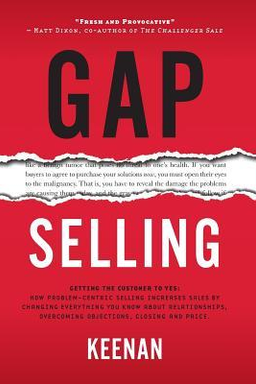
Gap Selling cover

Gap Selling

by Keenan

Gap Selling revolutionizes the sales process by advocating a problem-centric approach that dispenses with traditional tactics. By focusing on understanding and solving the buyer’s real-world issues, this book provides a framework for creating value, building influence, and achieving sales success in today’s competitive market.

Selling the Gap, Not the Product

Why do most salespeople lose deals they should have won? It’s rarely because they don’t work hard enough or don’t have a great product. In Gap Selling, Jim Keenan argues that the reason is simple: most sellers don’t actually understand what game they’re playing. They think selling is about convincing someone to buy a product, but in truth, it’s about diagnosing a problem and facilitating change. The difference between where your buyer is now (their current state) and where they want to be (their future state) is the gap—and that gap is what ultimately drives every sale.

Keenan contends that sales is broken because sellers have been trained to push features, pitch benefits, and build relationships that don’t necessarily solve problems. Instead, they should function like consultants and doctors—diagnosing before prescribing, analyzing before offering solutions. If there’s no problem, there’s no sale. If you don’t understand the size, cause, and impact of the problem, you can’t define the value of solving it. The “gap” represents that value.

The Core Philosophy of Gap Selling

Gap Selling reframes sales around change rather than persuasion. Every sale, Keenan insists, is about getting a buyer from their current state to a better future state. That means identifying and quantifying the difference—the gap between these two points. When a buyer perceives the cost of staying in their current state as higher than the pain of changing, they will buy. Your job as a salesperson is not to talk them into liking you or your product, but to help them understand the true cost of the status quo and the value of transformation.

To drive this point home, Keenan uses a story from his youth playing football. He wasn’t a bad athlete, but he lost his team the game because he didn’t understand how the game worked. He knew the rules, but not the strategy. Similarly, most salespeople know the basic mechanics of selling—qualifying leads, running demos, closing—but they don’t know the deeper game that ties human psychology, problem diagnosis, and value creation together. Without understanding that game, they can’t win consistently.

Why Gap Selling Matters in Today’s Sales World

Over the past few decades, buyers have evolved faster than sellers. The internet made information universally accessible, so modern customers often know as much or more about products than the reps selling them. What buyers don’t know—and what they desperately need help with—is understanding their own problems, quantifying their business impact, and finding the clearest path to change. Sellers who can do that become indispensable.

Keenan’s approach aligns sales with consulting frameworks like SPIN Selling (Neil Rackham) and The Challenger Sale (Matthew Dixon and Brent Adamson). However, Keenan’s emphasis is squarely on diagnosis. The gap is both the logic and the emotion behind every sale: logic because it defines business value, emotion because change is personal and unnerving. Customers resist change until they see that it will be worth it.

The Structure of the Game

Keenan divides Gap Selling into four parts: knowing the game, playing the game, prospecting with the gap in mind, and building a gap-selling culture within teams. Each section builds on the foundational belief that selling shouldn’t be manipulative—it should be investigative and collaborative. You’re not chasing quotas by pushing products; you’re solving meaningful problems and guiding people toward improvement.

  • Part I teaches the psychology and rules behind the gap, including the nine “truth bombs” of selling.
  • Part II focuses on execution—how to conduct discovery, demos, and pipeline reviews based on the gap.
  • Part III shows how to apply gap principles to prospecting so you can start relationships that matter.
  • Part IV helps leaders implement this mindset across entire teams, creating predictability and culture.

Why Understanding the Gap Changes Everything

When you sell through the gap, everything shifts. You stop talking about your product and start talking about your buyer’s world—what’s broken today and what could be better tomorrow. You no longer need to “close”; instead, the buyer naturally decides to change because you’ve helped them emotionally and logically connect the dots between their pain and the reward of fixing it. Your conversations feel consultative, your forecasts become predictable, and your close rates rise because you’re finally focused on the right thing.

Key Idea

The gap—the measurable difference between a customer’s current state and desired future state—is the true engine of every sale. When you diagnose the gap, you understand what drives urgency, value, and change. Selling isn’t about convincing customers to buy—it’s about helping them see why not changing costs more than changing.

Gap Selling teaches you to stop pitching and start diagnosing. It’s a shift not only in technique but in identity—from salesperson to trusted advisor. Once you truly understand the game, selling becomes easier, faster, and infinitely more rewarding—not just for you, but for every customer who lets you help them change.


The Nine Truth Bombs of Selling

Keenan introduces nine bold truths that blow up traditional sales myths. Each rule reframes misconceptions about buyers and teaches you how to align your approach with human psychology and the dynamics of change. Together, they form the foundation of Gap Selling.

1. No Problem, No Sale

If the buyer doesn’t have a problem worth solving, there is no sale. The pain drives change. You could have the best product on the market, but without a meaningful problem tied to business or personal impact, there’s no reason for your buyer to pay attention. Think of the buyer’s world as a doctor’s patient: symptoms lead to diagnosis, not the other way around.

2. In Every Sale, There’s a Gap

Every sales interaction involves identifying a gap—the distance between the buyer’s current reality and their desired future state. In one of the book’s best illustrations, Keenan tells the story of needing a PalmPilot charger and realizing his real problem wasn’t a dead battery—it was a case design causing premature drain. Buyers often misdiagnose their own needs, and it’s your job to reveal the actual gap, not sell their assumed fix. (This echoes consultative selling principles from SPIN Selling.)

3. All Sales Are About Change

Customers buy to change something. They’re either trying to escape pain or pursue improvement. This means your sales conversations aren’t about transactions; they’re change management discussions. When people change, emotion and logic collide. Guide them through that tension.

4 & 5. People Resist Change Because Sales Are Emotional

Humans are wired to favor stability. Keenan pulls in psychology research (including studies from the University of Arkansas) showing longevity bias: people trust familiar things over new ones. Even when new solutions are better, change triggers fear. He summarizes Harvard professor Rosabeth Moss Kanter’s ten reasons people resist: fear of loss, uncertainty, surprise, workload, risk, and more. As a seller, your role is to defuse those emotional threats by understanding where resistance arises and guiding people toward safety.

6. Customers Like Change When It’s Worth the Cost

The moment buyers perceive that the benefits of change exceed the pain of transition, they move forward. Your job is to make the value of the future state crystal clear. It’s the same mental math people do when deciding to pay for surgery—painful short-term, but life-changing long-term.

7. Asking “Why” Gets Customers to “Yes”

By asking “why” repeatedly, you dig past surface-level symptoms into intrinsic motivation—the deep reason a buyer wants change. This might transform a vague problem like “I want better productivity” into “I need time at home to care for my adopted twins.” When you understand the “why,” your solution transforms from a tool into a lifeline.

8. Sales Happen When the Future State Is Better

You sell outcomes, not features. Buyers imagine a better tomorrow with higher revenue, faster operations, happier teams, or more peace of mind. Once they believe that future state is achievable and better than today, your solution sells itself.

9. No One Gives a Shit About You

In the “show-me economy” powered by the internet, buyers can research you long before meeting you. They don’t need a self-centered pitch—they need to see how you’ll improve their life or business. Keenan’s example of the self-absorbed printer-sales rep “Mandi with an i” nails this point: customers care only about their own world, never yours.

Takeaway

These nine truths redefine every assumption you’ve held about sales. They shift your mindset from selling things to solving problems, from pitching change to facilitating it, and from ego-driven tactics to empathetic expertise. Your success begins the moment you accept that it’s never about you—it’s always about them.


Diagnosing the Customer’s Current State

Before you can sell anything, you need to become a diagnostician. Keenan teaches that great sellers think like doctors—they gather evidence about the buyer’s current state before offering a prescription. Diagnosis precedes proposal, always.

Five Layers of the Current State

The current state comprises five dimensions: factual reality, problems, impact, root cause, and emotional state. The better you understand each, the richer your insight into the customer’s world.

  • Facts: Objective data—how many projects, customers, employees, or dollars are at play.
  • Problems: Observable symptoms, like high defect rates or slow delivery times.
  • Impact: The consequences of those problems—lost revenue, poor morale, missed opportunities.
  • Root Cause: Why the problems exist—broken processes, outdated tools, misaligned incentives.
  • Emotional State: How buyers feel about it—frustrated, fearful, or ambitious.

In one vivid example, Keenan describes a project management company with cost overruns. The problem wasn’t just “we go over budget”; it was the ripple effect of reduced capital, fewer new projects, slower innovation, and declining competitiveness. By understanding that cascade, a seller can connect their product directly to big-picture outcomes.

From Problem to Impact

Most average sellers stop at identifying the problem. Keenan insists you keep going until you measure impact, because that’s what matters. Every problem is only as big as the damage it causes. High defect rates might be tolerable unless they erode customer trust or investor confidence. Digging into impact creates urgency.

Root Causes and Emotional Cues

A powerful diagnostic moment comes when you uncover the root cause—the real reason the problem exists. Like a heart surgeon identifying a blocked artery rather than prescribing antacids for chest pain, you must trace every symptom back to its source. Emotional cues also give insight into motivation. Frustration signals readiness to act; apathy signals poor fit.

Diagnosis Drives Trust

When you ask intelligent, patient, factual questions, you earn credibility. Buyers stop seeing you as a salesperson and start viewing you as a consultant. Diagnose thoroughly, and you won’t need to sell—the customer will ask for your help.


Visualizing the Future State

If the current state reveals pain, the future state reveals hope. Keenan defines the future state as the world the buyer wants to inhabit once their problems are solved. Your effectiveness depends on how vividly you help them imagine that world.

From Pain to Pleasure

People buy emotionally: they seek pleasure or relief from pain. In sales terms, pain is the problem, and pleasure is the future state. Keenan draws on neuroscience to emphasize the emotional backbone of decision-making—humans move toward what provides relief, pride, or joy.

Designing the Future State

Ask: What would solving this mean to your business? How would it affect your employees, your customers, and you? Helping buyers picture future outcomes transforms abstract value into concrete motivation. For a hotel manager struggling to book conferences, a vivid future state might include full occupancy, happy staff, rising profits, and peace of mind. Numbers matter, but stories cement belief.

Keenan advises pairing logical outcomes (profits, efficiency) with emotional ones (confidence, relief). When both are aligned, buyers stop resisting. They can see, feel, and desire the change.

Anchoring Value in Emotion

The emotional resonance of the future state anchors urgency. Once buyers emotionally experience their better future, their subconscious starts pushing them toward it. This is why you should never stop at technical descriptions—show emotional benefits.

Building the Bridge

Once both states are clear, your solution becomes the bridge. Sales then becomes problem-solving, not pitching. As Keenan says, the perceived value of your solution equals the size of the gap. Help buyers feel confident the journey is worth the cost, and they’ll lead themselves across.

Key Lesson

You sell destinations, not vehicles. Paint the picture of where buyers want to go so vividly that they can already see themselves there. Once they do, they’ll see your product as the only way to get there.


Discovery and the Art of Asking

Discovery is where most deals are won or lost. Keenan dismantles outdated frameworks like BANT (Budget, Authority, Need, Timing) and replaces them with a process centered on understanding problems and impact. You’re not qualifying prospects—you’re discovering their world.

Four Types of Questions

Gap-selling discovery relies on four kinds of questions: probing, process, provoking, and validating.

  • Probing: Open-ended inquiries that uncover facts. (“Tell me about the number of customers you serve.”)
  • Process: Questions about how they operate. (“Walk me through your ticket-selling workflow.”)
  • Provoking: Push buyers to rethink assumptions. (“What if your delays are hiding deeper inventory issues?”)
  • Validating: Confirm you’ve understood correctly. (“Did I get that right when you said this issue costs $500K annually?”)

Keenan emphasizes tone and timing. Ask too soon or too harshly, and buyers shut down. Ask empathetically and sequentially, and they open up. Mastering tone is as crucial as mastering your solution.

The CRM Challenge

To test whether you did discovery correctly, Keenan offers the CRM Challenge: could a colleague read your CRM notes without names or contexts and immediately identify which customer they came from? If not, you haven’t gone deep enough. Every opportunity should sound unique, anchored in specific, tangible data.

Discovery Is the Close

Counterintuitively, closing doesn’t happen at the end—it happens at the beginning. The more questions you ask upfront, the faster and more effectively you close later. Keenan cites Gong.io analysis showing deals with longer, richer discovery calls had dramatically higher close rates. Listening > talking.

Action Principle

Always assume you’re wrong—until discovery proves you right. Curiosity wins deals; arrogance kills them.


From Demo to Partnership

Most sellers treat demos as performances. Keenan redefines them as exercises in validation—proof that you’ve listened, diagnosed, and built a bridge to the future state. A great demo doesn’t wow; it resonates.

The Four Elements of a Kickass Demo

According to Keenan, demos succeed when four conditions are met:

  • You never demo without a prior discovery.
  • You never use the word “if.” (“If you have this problem...”) implies ignorance of their reality.
  • You stick to six features that solve actual problems.
  • You anchor every feature to measurable business impact.

Anchoring Psychology

Human brains evaluate new information relative to their first reference point, known as the “anchor” bias. Keenan uses this insight strategically. You anchor your demo by getting buyers to confirm value (“Can you see how this would reduce churn?”). Each affirmation sets your solution as the benchmark against which alternatives will be judged.

Quality Over Quantity

Buyers won’t remember a laundry list of features. They will remember one or two big ah-has that solve their core problem. Customize demos like tailored suits—fit the customer’s shape, not the manufacturer’s catalogue.

Lesson

Stop performing; start confirming. A demo isn’t theater—it’s therapy. You’re reminding buyers they’re safe to change because you understand their pain better than anyone else.


Building Predictability and Influence

Predictability in sales is a superpower. Keenan argues that gap selling’s greatest strength isn’t just higher win rates—it’s consistency. When you sell through understanding the gap, your forecasts stop feeling like guesses. They become data-driven commitments.

Pipeline Reviews That Work

Keenan contrasts traditional pipeline meetings—vague, hope-filled conversations—with gap-based reviews that demand evidence. Managers ask reps to detail current state, future state, the quantified gap, and the buyer’s next yes. If reps can’t answer these questions concisely, they’re not selling—they’re hoping.

Commit Culture

One of Keenan’s strongest leadership lessons is creating a “commit culture,” where reps accurately forecast their numbers within ±15%. Commitments aren’t quotas—they’re promises based on data and probability. When your team operates on verifiable gaps, surprise declines and trust rises.

Challenge “Hope-Based” Selling

Managers must be comfortable confronting reality early. Don’t punish low commits; use them as early-warning indicators to adjust strategy. This proactive honesty reduces panicked end-of-quarter discounting and improves organizational sanity.

Leadership Insight

The highest-performing sales cultures are built on truth and trust, not hype and hustle. Gap Selling makes predictability the new charisma.


Hiring and Leading Gap Sellers

Great gap sellers aren’t born from traditional sales molds. Keenan describes nine traits that define world-class sellers in his framework—and they differ radically from “charismatic closers” or “relationship-builders.”

The Nine Traits

  • Curiosity – They ask “why” relentlessly until problems reveal themselves.
  • Critical Thinking – They connect dots and see systems.
  • Empathy – They understand emotional resistance.
  • Problem Solving – They treat challenges as puzzles, not obstacles.
  • Leadership – They guide, not chase, buyers.
  • Creativity – They invent unique bridges between current and future states.
  • Deliberate Learning – They practice improvement intentionally.
  • Coachability – They accept feedback and evolve.
  • Business Acumen – They understand the economics behind problems.

Coaching, Not Managing

Sales leaders succeed when they act as coaches—teaching, supporting, and guiding rather than commanding. Keenan’s metaphor aligns the leader not with the player but with the coach on game day: prepare your team for execution, then get out of their way.

He references The Challenger Sale data showing that over 50% of customer loyalty stems from the sales experience itself—not product quality or support. Coaching sellers into empathy and insight affects customer retention more than anything else.

Leadership Takeaway

Hire thinkers, not talkers; coaches, not charmers. Gap sellers don’t just close deals—they change companies.

Dig Deeper

Get personalized prompts to apply these lessons to your life and deepen your understanding.

Go Deeper

Get the Full Experience

Download Insight Books for AI-powered reflections, quizzes, and more.