
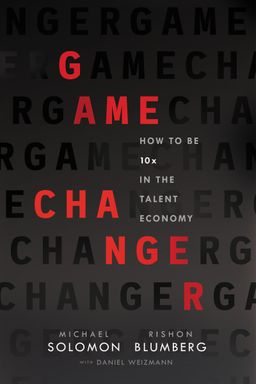
Game Changer cover

Game Changer

by Michael Solomon, Rishon Blumbe

Game Changer is your essential guide to thriving in the talent economy. Learn how to identify and manage 10xers-employees who deliver ten times the value. Gain insights into modern management strategies that attract and retain top talent, ensuring your organization stays ahead in a competitive market.

Becoming 10x in the Talent Economy

How can you thrive in a world where good is no longer good enough? In Game Changer: How to Be 10x in the Talent Economy, Michael Solomon and Rishon Blumberg argue that today’s rapidly digitized world belongs to those who can deliver exponentially more than what’s expected—those they call 10xers. The authors contend that the most valuable professionals of the 21st century combine superior technical performance with self-awareness, adaptability, and emotional intelligence. But to understand how to become or manage such talent, you must see how work, management, and trust itself have changed in today’s economy.

Drawing on decades of experience managing everyone from Grammy-winning musicians to elite software engineers, Solomon and Blumberg reveal that success now depends on more than technical superiority—it relies on empathy, collaboration, and the ability to evolve. This book offers a map to both sides of the new workplace: how companies can attract and manage world-class talent, and how individuals can rise to 10x status through constant learning and self-management.

The Rise of the 10x World

In this new “talent economy,” the gap between average performers and exceptional ones has never been wider. Solomon and Blumberg use vivid stories—from clients who replaced 33 developers with just three 10xers, to visionary tech founders who refused inflexible corporate offers—to illustrate that star talent doesn’t merely contribute to success—it redefines it. As automation replaces repetitive work, the demand for exceptional human creativity and deep problem-solving multiplies. You can no longer rely on being competent; you need to be irreplaceable.

What Makes a 10xer

10xers are distinguished by a blend of IQ and EQ. They are deeply curious, eager for feedback, constantly reinventing themselves, and motivated by purpose as much as competence. They thrive on “deep work”—hyper-focused periods of concentration where they create disproportionate value. A story of a coder named Ryan, who demanded freedom over schedule yet delivered a breakthrough for a cybersecurity firm, captures this spirit: empower a 10xer, and they’ll transform your company.

At the same time, 10xers are diverse: they can be coders in Brooklyn, remote consultants in Utah, or artists commanding stadiums. Their common thread? They treat evolution as a lifestyle. They reject bureaucratic systems and excel in companies that grant autonomy, purpose, and respect. To engage them, you must trade control for trust.

The Two Sides of the 10x Equation

The book is divided into two interconnected halves. The first part explains how companies must become 10x themselves—rethinking leadership, culture, and communication to attract elite performers. It explores the transformation from the authoritarian “Old School Boss” to the adaptive “Bespoke Boss” who manages the whole person, not just their output. It also introduces the Manageability Continuum, a psychological framework distinguishing those driven by a Success Impulse from those undermined by self-sabotage.

The second half flips perspective, guiding individuals on becoming 10xers. Here, Solomon and Blumberg show that thriving in this reality means taking responsibility for both your performance and professional growth. They reveal how to build “skin in the game” partnerships with mentors or managers, use the Third Party Effect to amplify your reputation, and master distributed leadership through 360° Management—influencing peers, bosses, and subordinates alike.

Why It Matters Now

The COVID-19 pandemic and the normalization of remote work accelerated changes that were already underway. The ability to lead dispersed teams, inspire without micromanaging, and maintain trust across digital channels are no longer futuristic—they’re basic survival skills. Companies that cling to old hierarchies are losing to agile, empathetic organizations that engage 10x talent on their own terms.

Ultimately, Solomon and Blumberg show that 10x is not just an adjective—it’s a paradigm shift. Whether you run a startup, lead teams, or work as an independent professional, success now depends on your capacity to marry excellence with insight, agility with empathy, and ambition with purpose. In a world where talent holds the cards, the rules of management—and mastery—have changed forever.


Understanding the 10xer: The New Talent Revolution

The story of the 10xer begins with the birth of Silicon Valley—a fusion of counterculture creativity, technical mastery, and risk-loving independence. Solomon and Blumberg trace the roots of this revolution back to the 1970s, when rebellious engineers rejected bureaucratic conformity and replaced it with experimentation and community. Their philosophy—do it because you love it—became the DNA of the modern digital workplace.

The Mindset of a 10xer

A true 10xer doesn’t just write code, design systems, or close deals—they solve problems that seem unsolvable. They are autonomous and crave deep intellectual engagement. They prefer “results-only” environments, where performance is measured by outcomes, not office hours. Cal Newport’s concept of deep work perfectly mirrors their world: distraction-free focus that yields long-term value. In contrast, “shallow work”—emails, meetings, bureaucracy—kills their productivity.

The authors share stories of coders who refused rigid office policies but delivered company-transforming innovations when given freedom. One developer working remotely rebuilt a nonprofit’s tech infrastructure faster and better than a team of 30 engineers. The result? A lesson for every leader: excellence emerges when talent is trusted to operate at its own rhythm.

Continuous Evolution and Learning

In the 10x ecosystem, a degree is just a starting point. The authors cite researcher Adi Gaskell’s view that lifelong learning is now inseparable from lifelong work. Each 10xer they interviewed described education as a cycle—not a phase. Sam Brotherton, a Harvard-trained engineer, admitted that he thrives not by mastering one discipline but by constantly reinventing himself across projects in AI and machine learning. He said, “Being too comfortable is a step backward.”

Success, therefore, depends on curiosity and adaptability—skills that can’t be automated. The best 10xers operate like entrepreneurs: they integrate feedback, challenge their assumptions, and evolve faster than the environments they work in.

The Generational Shift

The workplace is also being reshaped by millennials and Gen Z, generations raised in a hyperconnected, personalized world. Solomon and Blumberg argue that these young professionals share the same expectations as 10xers: flexibility, transparency, and purpose. They don’t just want a paycheck—they want to “change the world.” They question legacy systems and demand to be treated as collaborators, not cogs. The authors’ story of Julie Hershman, a once-introverted millennial who became a powerhouse manager through guided trust and autonomy, proves that empowerment beats micromanagement every time.

By understanding these shifts, you begin to see that the 10x revolution isn’t about a few exceptional talents. It’s about redefining how all of us work, learn, and lead in a world that rewards curiosity as much as competence.


From Old School to the Bespoke Boss

Once upon a time, managers barked orders and workers obeyed. Loyalty was measured by attendance, not performance, and individuality was a risk. That age is over. In the new world of 10x talent, the most successful leaders are Bespoke Bosses—adaptive managers who understand that people bring their whole selves to work. To thrive, you must stop treating employees like interchangeable parts and start managing them as complex, evolving individuals.

The Death of the Old School Boss

The “Old School Boss,” as the authors describe, ruled with authority and hierarchy. They demanded presence, conformity, and obedience. But as technology democratized work and millennials entered the scene, this top-down model collapsed. Today’s talent has options and expects flexibility. As one executive put it, “If you don’t help me grow, someone else will.”

The show Mad Men serves as their historical metaphor: Don Draper and Peggy Olson embodied a new era of creativity within rigid structures. Likewise, modern 10xers thrive when given autonomy and meaning. Leaders must therefore aim for buy-in, not control.

Managing the Whole Person

To earn this buy-in, Solomon and Blumberg urge leaders to view each employee as a “whole person.” They cite their Lifestyle Calculator—a diagnostic tool that helps managers learn what drives people beyond salary: creativity, flexibility, family, purpose. When leaders align job expectations with personal motivations, retention and innovation skyrocket. IBM veteran Marc Wangel told them, “It actually makes me a better manager—I have more time to coach, not rate.”

Bespoke bosses don’t motivate with perks but with personalization. They know which team member needs praise in public and which prefers private acknowledgment. They balance constructive feedback with compassion and adjust their strategy for every individual.

Compassion and Accountability

Real compassion is not coddling—it’s clarity with empathy. Solomon and Blumberg illustrate this through Shelley Seifert, a progressive bank CEO who challenged her industry’s hierarchy. Seifert replaced rigid systems with human-centered leadership that valued individuality but still demanded results. She taught that being kind means holding people accountable, not shielding them from truth. “You don’t give them everything they want,” she told the authors. “You help them become successful.”

This modern model—part coach, part strategist, part confidant—is now table stakes for every successful organization. The age of the Bespoke Boss signifies not just a leadership evolution but a moral one: from commanding to connecting.


Success, Sabotage, and the Manageability Continuum

Why do some talented people destroy their own success? The authors answer this with the Manageability Continuum—a spectrum that explains why certain individuals soar while others self-sabotage. Every person, they argue, operates somewhere between two psychological poles: the Success Impulse and the Sabotage Impulse. Knowing where you—and your colleagues—fit on this continuum can determine the fate of entire teams.

The Success Impulse

The Success Impulse drives people to learn, adapt, and take responsibility. It fuels growth and cooperation. When the authors managed musician John Mayer at the start of his career, they witnessed this impulse firsthand. Mayer constantly sought and applied feedback—even when it was painful. He balanced faith in his own vision with humility, converted criticism into mastery, and built a career defined by creativity and stamina. That’s the Success Impulse in action.

The Sabotage Impulse

By contrast, the Sabotage Impulse is a pattern of denial, blame, and recurring self-inflicted injury. One of their clients, a gifted singer named “Anthony,” exemplified this darker side: resistant to guidance, quick to shift blame, and ultimately the architect of his own downfall. His story underscores the authors’ warning: no amount of raw talent can compensate for low emotional intelligence. Self-awareness and humility, not genius alone, separate the sustainable stars from the burned-out comets.

Spotting Manageability in Action

In business, manageability often matters more than competence. Executive coach Jonathan Lowenhar told the authors that startups collapse when founders can’t confront reality—what he calls “Glass Jaw Syndrome.” These leaders crumble under criticism instead of using it to learn. Good managers, therefore, vet for manageability as carefully as they do for skill. They identify patterns of trust, accountability, and empathy before they hire.

Equally dangerous is the “Late Stage Sabotage Impulse,” when early success breeds arrogance. Solomon and Blumberg note how fame or power can make previously coachable people resistant to advice. The antidote? Lifelong feedback. As long as you remain open to credible outside perspective, you stay on the success side of the continuum.

Why It Matters

Understanding these impulses is not psychological trivia—it’s a strategic advantage. Teams that fill their ranks with success-driven, self-aware players outperform those with toxic divas or fearful avoiders. Whether hiring a CTO or managing yourself, the question isn’t just “Can they do the job?” It’s “Can they take feedback and grow?” For 10x performance, manageability is the ultimate metric.


Super Visionaries: Seeing Around Corners

Great managers don’t just oversee—they foresee. In the modern workplace, this ability to see around corners and inside people is called Super Vision. Solomon and Blumberg break it down into two complementary forms: Future Vision—the ability to anticipate challenges and design long-term strategies—and Inner Vision—the empathy and insight to help people recognize their blind spots and grow. Together, these create a framework for strategic and emotional intelligence.

Future Vision

Future Vision is about predicting outcomes before they arrive. Jonathan Lowenhar of Enjoy The Work exemplifies this skill: he guides startups through predictable cycles of growth and crisis by recognizing patterns in their development. His role, he says, is to be “the start-up’s crystal ball.” The authors extend this principle to every field: when you map foreseeable risks and opportunities, you become indispensable.

Music manager Ken Levitan (Kings of Leon, Emmylou Harris) applied the same foresight, rebuilding artists’ careers by spotting hidden markets and moments before others did. Being 10x in management, then, means blending intuition with preparation—knowing when to act and when to anticipate.

Inner Vision

Inner Vision turns the focus inward: how well do you understand what your people (or yourself) can’t see? Using the psychological model of the Johari Window, the authors show four quadrants of self-knowledge—what you know, what others know, what’s hidden, and what’s blind. A manager’s job is to illuminate that second quadrant. They share the story of Ahmed, a brilliant but defensive entrepreneur whose angry outbursts sabotaged his team until he was guided to recognize his emotional triggers. Once he learned to separate critique from identity, his company flourished.

Inner Vision is not about therapy—it’s about growth. As Barbara Carr (Bruce Springsteen’s longtime manager) put it, great managers “become part of the family.” They challenge you with honesty because they care about your long-term success more than your short-term comfort.

The Power of Dual Vision

A leader with both Future and Inner Vision doesn’t just react—they create. They anticipate strategic risks while nurturing emotional resilience. This blend builds trust, foresight, and loyalty. It’s how organizations stay adaptive and humane at once. Indeed, the hallmark of every 10x manager is the ability to deliver insight with empathy—to see both the path ahead and the person walking it.


Trust: The Currency of the 10x Relationship

If there’s one element that powers every 10x relationship, it’s trust. Solomon and Blumberg call it the currency of the new workplace—a mutual bond that allows managers and talent to operate at peak performance. Trust isn’t sentimental; it’s strategic. It drives innovation, reduces friction, and enables risk-taking. Without it, 10x talent walks away.

Managing Expectations

Trust begins with expectation management. The authors recount how one tech team at a medtech startup consistently hit their deadlines while another collapsed under unrealistic promises. The difference? The former set clear, honest timelines and owned their outcomes; the latter overpromised and eroded credibility. As Solomon and Blumberg warn, each missed commitment is a crack in the trust foundation. Each fulfilled one strengthens it.

The Neuroscience of Trust

They cite FBI behavioral expert Robin Dreeke, who teaches that trust-building is rooted in “suspending your ego.” Listening deeply, asking follow-up questions, and showing genuine curiosity trigger a positive neurological response. Likewise, coaches Sara Ellis Conant and Michael Counts of A-Plan Coaching build trust by creating judgment-free spaces of confidentiality where people feel safe to be honest. Listening, not talking, is their superpower. (This echoes Stephen Covey’s “seek first to understand, then to be understood.”)

Empathy, Vulnerability, and Diversity

True trust demands vulnerability from leaders. When bosses admit mistakes or take responsibility for team failures, they show humanity rather than authority. The authors link this to diversity and inclusion: people only share unique ideas when they trust that their voices matter. They recount how one female developer initially resisted joining an all-male “brogrammer” culture until guided to set firm boundaries and find her voice—transforming herself into a respected leader.

In the end, trust reshapes culture from compliance to commitment. It turns hierarchical relationships into partnerships. And for 10x talent, that’s non-negotiable.


Skin in the Game: Building Aligned Partnerships

How invested are you in the success of those you lead—or those who lead you? According to Solomon and Blumberg, great management is impossible without skin in the game—an emotional, professional, and sometimes financial stake in mutual outcomes. This isn’t about percentages on paper; it’s about belief, accountability, and shared destiny.

The Springsteen-Landau Model

To understand skin in the game, look at rock legend Bruce Springsteen and his longtime manager Jon Landau. Their partnership endured for nearly five decades because they shared vision, trust, and equal commitment to excellence. When Landau traveled through a snowstorm just to keep an appointment with Springsteen, it showed more than loyalty—it signaled alignment. “If I hadn’t gone that night,” Landau recalled, “it wouldn’t have happened.” Their story reminds you that deep commitment creates the platform for greatness.

Why Alignment Matters

Aligned interests eliminate manipulation and foster trust. When both sides benefit from success and share risk, candor replaces politics. The authors describe how advising a technologist named Aviva against a tempting but toxic engagement built long-term credibility. They lost short-term income but gained enduring trust. As they put it, “There’s nothing more powerful than guidance that runs counter to your self-interest.”

Avoiding False Alignment

Yet not every “partner” truly shares your interests. The book warns against overrelying on “momagers,” “spousagers,” or friend-managers whose emotions cloud judgment. While family support can be nurturing, it often lacks objectivity. Great guidance balances emotional investment with clear-eyed realism—what the authors call the sweet spot between skin in the game and professional distance.

When you find someone who shares your goals, challenges your blind spots, and wins when you win, you’ve discovered the essence of 10x collaboration. Skin in the game transforms management from oversight into partnership—and partnership into shared triumph.


The Third Party Effect: The Power of Advocacy

In a competitive world, who speaks for you matters as much as what you can do. Solomon and Blumberg call this the Third Party Effect—the phenomenon where validation from an external advocate carries far more weight than self-promotion ever could. As Abraham Lincoln quipped, “He who represents himself has a fool for a client.”

Why You Need Advocates

The authors discovered this when representing elite programmers who chronically undervalued themselves. One Harvard graduate with extraordinary credentials couldn’t bring himself to discuss his own achievements; he consistently asked for below-market rates. Once the authors stepped in to negotiate, positioning his expertise confidently, his earnings and opportunities skyrocketed. A credible third party removes ego, adds perspective, and amplifies your worth.

The same principle applies at every level. Inside corporations, strong managers act as third parties when they advocate for their people’s promotions and visibility. This isn’t flattery—it’s cultural currency. Employees follow leaders who go to bat for them, not those who hoard credit.

Speaking for Others—and Yourself

Third partying also makes you a better communicator. Literary agent Lucinda Halpern told the authors that her success comes from caring deeply about the authors she represents while maintaining honesty with publishers. Her “double loyalty” creates trust on both sides. Similarly, managers who advocate sincerely for their teams while acknowledging company realities build reputations as authentic translators—indispensable in any negotiation.

At its core, the Third Party Effect democratizes voice. By consciously creating networks of advocates—and acting as one yourself—you multiply collective power. Every “yes” you earn isn’t just a validation of your skill but proof of relational capital well invested.


360° Management: Leadership in All Directions

To be 10x, you must not only manage down but also sideways and up. Solomon and Blumberg’s concept of 360° Management redefines leadership as multidirectional influence. In the old hierarchy, feedback flowed only downward; now, success depends on your ability to coach your boss, collaborate with peers, and empower subordinates simultaneously.

Creating a Safe Culture

Drawing on Google’s internal research, the authors identify psychological safety—the belief that you won’t be punished for mistakes—as the root of high-performing teams. Leaders cultivate this safety by listening, sharing credit, and replacing blame with curiosity. Companies like KIND Snacks embody this ethos: founder Daniel Lubetzky built a $4 billion business around the values of empathy and accountability, proving that kindness can coexist with performance.

Practical 360° Tactics

The authors provide actionable scripts for managing in every direction—thank those who give feedback, ask for positive reinforcement, deliver bad news transparently, and advocate for peers. For instance, radio host Elvis Duran runs his show by treating every team member as an equal performer, bridging leadership with friendship. They call it “hallway management”: quick, candid conversations that build trust faster than formal meetings.

Ultimately, 360° Management restores humanity to the corporate structure. When everyone feels responsible for communication and improvement, hierarchy dissolves into collaboration. Leaders stop managing people and start managing energy—and that, the authors insist, is how organizations become 10x from the inside out.


Donning the Double Hat: The Art of Mutual Mastery

Every professional now wears two hats: manager and talent. This shift defines what Solomon and Blumberg call the Double-Hat World, where agility matters more than title. You must coach others while staying coachable yourself. You must lead while learning, critique while creating, and serve while strategizing.

Switching Perspectives

The authors illustrate this through cautionary tales and triumphs. “Billy,” a rising music star, destroyed his band’s morale because he never learned to manage peers; he believed talent exempted him from leadership. In contrast, “Gabe,” a software engineer, transformed into an effective manager by actively seeking coaching, applying feedback, and practicing empathy. The moral: success requires knowing when to lead and when to listen.

Feedback as a Superpower

Double-hat professionals master both giving and receiving feedback. Michael Counts, an artist and entrepreneur, once told the authors that their criticism felt overwhelming. His request for more balanced praise taught them that strong management requires emotional calibration. Research from Harvard Business Review confirms that the ideal praise-to-criticism ratio is about 5:1—encouragement energizes innovation more than correction does.

Why It Matters

The Double-Hat mindset turns work into constant apprenticeship. It’s especially critical in volatile industries like tech, where the line between individual contributor and leader blurs daily. When you view yourself as both coach and player, you cultivate empathy, resilience, and ownership. “Rising tides raise all boats,” the authors write. By managing up, down, and within, you elevate not just your own career but the ecosystem around you.


The Evolution of the Deal: How 10x Talent Negotiates

Negotiation, the authors argue, is no longer about winning—it’s about aligning. In the talent economy, every deal must serve as a win-win partnership that reflects the individual’s lifestyle, goals, and values. Outdated procurement systems and cookie-cutter offers fail to attract 10xers because they ignore what truly matters to them: flexibility, meaning, and growth.

From Cookie Cutter to Custom Fit

Solomon and Blumberg share real negotiation case studies. One engineer leveraged multiple offers to secure both higher pay and flexible time off. Two cybersecurity experts used benchmarking data to convince HSBC to redesign its compensation structure and better value its employees—triggering raises even for their future boss. Each case proves that informed, empathetic negotiation creates shared long-term value.

Tools for Modern Negotiation

Their proprietary tools like the Lifestyle Calculator and Employment L.E.A.P. (List of Expectations and Priorities) exemplify 10x thinking: they help candidates articulate what truly drives satisfaction beyond salary. Meanwhile, music mogul James Diener’s surprising lesson from stage magic—spectator management—demonstrates how reading the emotional energy of a room can turn a negotiation into a performance built on empathy and timing.

Above all, effective negotiation balances strategy with compassion. Diener reminds us, “The only thing that really matters is how people feel leaving the transaction.” Reputational currency compounds over time—each fair deal buys goodwill for the next.

The Win-Win Ethos

The book closes by showing that true 10x leaders measure success through mutual prosperity. Whether crafting a job offer or collaborating on a project, they understand that empathy and integrity create exponential returns. In the end, the most valuable contract is not written on paper but built through trust. You don’t just win the deal—you build the relationship that makes every future deal easier to win together.

Dig Deeper

Get personalized prompts to apply these lessons to your life and deepen your understanding.

Go Deeper

Get the Full Experience

Download Insight Books for AI-powered reflections, quizzes, and more.