
Idea 1
The Human Quest to Know the Future
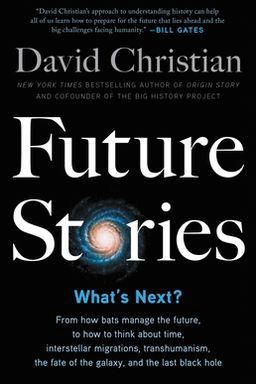
How can you anticipate what comes next when the future is inherently uncertain? Historian David Christian argues that the ability to imagine, predict, and shape the future is one of the most distinctive human traits, but it is also a biological inheritance from life itself. In Future Stories, he explores how life—from microbes to modern civilizations—has developed strategies to manage uncertainty, interpret time, and act with purpose. The book’s core claim is that all living systems are future-oriented, but humans have expanded this capacity through language, science, and collective learning.
The story unfolds in a sweeping arc: it begins with metaphysical debates about time’s nature, then moves through biological evolution and cultural history to modern scientific forecasting, planetary futures, and finally cosmic time. Across these scales, Christian’s central question remains constant: how do you think about what hasn’t happened yet in a way that improves your chances of thriving?
Time’s Dual Metaphors
Christian starts with two metaphors—time as a river (A-series) and as a map (B-series). The river picture captures human experience: you drift forward into an unknown future, where possibilities collapse into actualities as events unfold. The map perspective, by contrast, is the physicist’s: past, present, and future coexist like locations on a chart. You live in the river but sometimes need the map to understand constraints such as causality and entropy. Balancing these views protects you from either fatalism or the illusion of complete control.
Christian reminds you that prediction always operates between these two extremes—flow and fixity. Science can define causal limits (Einstein’s light cones, Judea Pearl’s causal diagrams) but can never eliminate uncertainty entirely, thanks to Gödel’s incompleteness, quantum indeterminacy, and chaos theory. This framing sets up his broader thesis: good future thinking combines metaphysical humility with practical method.
From Life to Conscious Intelligence
Christian’s next move is evolutionary. All organisms, he argues, act as imperfect prediction engines. Every cell or creature follows a three-step kit: set goals (a Utopia like food or safety), hunt trends through sensing and memory, and act while updating based on results. Even an E. coli bacterium uses this algorithm—it senses nutrient gradients, adjusts its motion ("tumble and swim"), and modifies behavior based on chemical feedback. That cellular model becomes a microcosm of all forecasting: goal‑orientation, evidence gathering, and Bayesian updating.
As complexity grows, coordination becomes vital. Plants anticipate seasonal change through chromatin ‘memories’; animals centralize forecasting in nervous systems. In brains, neurons store patterns, make predictions, and simulate futures—what Patricia Churchland calls the brain’s defining feature: anticipation. These biological stories show a deep continuity between behavior and foresight: life survives by managing uncertainty and learning from feedback loops.
Humans and Collective Futures
Human beings took future thinking to a new level. Enlarged frontal cortices support planning over long horizons, and language allows complex futures to be shared, remembered, and refined. Through cumulative culture—knowledge building on knowledge—humans became global-scale forecasters. The invention of writing, calendars, and science transformed private hunches into collective institutions of prediction. As a result, the future became a civic project as much as a personal one.
Christian situates this transformation historically: from agrarian divination and royal oracles that stabilized empires, to the scientific revolution and its mechanistic worldview, to modern probabilistic models and computational forecasting. Each step represents both a gain in predictive precision and a shift in responsibility. When you interpret omens or run data models, you are trying to make an opaque future more legible for action.
The Modern Turn: Science and Disenchantment
Modernity’s distinctive move was to replace gods and spirits with causes and probabilities. Newton’s mechanics, Boyle’s experiments, and Pascal’s mathematics turned fortune into measurable risk. Yet Christian underscores that not all processes fit deterministic molds: social and biological systems remain partly unpredictable because they involve purposeful agents. The challenge, therefore, is to mix the rigor of science with humility before contingency—a stance that underlies both statistical forecasting and moral responsibility.
Futures of Planet and Cosmos
The book’s timeline finally expands from the near future to cosmic horizons. Christian explores today’s crossroads—between collapse, downsizing, sustainability, and techno-optimistic growth—before imagining “middle futures” where renewable energy, AI, and biotechnology reshape what it means to be human. He ends with remote futures: a cooling Earth, a dying Sun, and an expanding universe. Against that vast backdrop, human action now acquires cosmic significance: tiny in scale, immense in consequence.
Key takeaway
You are a biological forecaster embedded in a cosmic story. Effective future thinking demands both the river’s urgency (act ethically in real time) and the map’s perspective (see the structural limits and large-scale patterns). From cells to civilizations, Christian reveals that the art of anticipating tomorrow is ultimately about survival, stewardship, and imagination.