
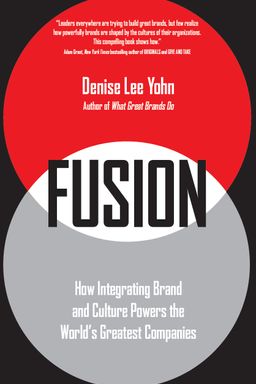
Fusion cover

Fusion

by Denise Lee Yohn

Fusion by Denise Lee Yohn reveals how integrating brand and culture can release immense business power. Discover how successful companies like Amazon and Airbnb harness this synergy to gain a competitive edge, align employee and customer experiences, and create authentic and engaging workplace environments.

Fusing Brand and Culture: The Secret Power Behind Great Companies

What if the secret to building a thriving business wasn't just better strategy or more innovation—but creating total alignment between who you are on the inside and how the world sees you on the outside? Denise Lee Yohn’s Fusion: How Integrating Brand and Culture Powers the World’s Greatest Companies makes a bold claim: the companies that dominate their industries do so because their internal culture and external brand work in complete harmony.

Yohn calls this state brand-culture fusion—the full integration of an organization’s brand identity (how customers perceive it) and its culture (how employees think and act). She argues that most companies treat brand and culture as separate silos, handled by marketing and HR respectively. But in the world’s greatest organizations—from Amazon to Nike, Airbnb to Starbucks—brand and culture are fused, forming a single, unifying force that shapes every decision, interaction, and experience.

The Two Energies That Power Performance

Yohn likens brand and culture to atomic nuclei that, when fused, release massive energy capable of fueling extraordinary growth—just as nuclear fusion powers the sun. Culture determines how people behave and make decisions on the inside; brand determines how those actions manifest externally. When these forces are misaligned, companies waste energy on confusion, bureaucracy, and inconsistency. But when they fuse, every part of the business—strategy, operations, employee experience, and customer experience—moves in one powerful direction.

Yohn opens with the surprising case of Amazon. Despite reports describing its culture as “relentless” and “bruising,” Amazon’s culture of high performance and innovation perfectly matches its external brand promise—“to be Earth’s most customer-centric company.” In contrast, companies like Uber, whose internal dynamics have clashed with their brand image, face reputational crises that erode public trust and internal cohesion.

Why Alignment Creates Authenticity

In today’s hyperconnected world, consumers demand authenticity. They can quickly detect dissonance between what a company says and how it behaves. Brand-culture fusion ensures authenticity because employees live the same values customers experience. Internally, it creates clarity and motivation; externally, it builds trust and differentiation. As Yohn notes, companies like Southwest Airlines and Starbucks don’t just have consistent messaging—they embody it.

“Culture multiplies results. Brand is culture, culture is brand.”

—Eduardo Braun and Herb Kelleher, quoted in Fusion

Yohn also positions fusion as an antidote to today’s disengaged workforce. Gallup estimates that only about 13% of global employees are engaged—a “worldwide engagement crisis.” When employees are emotionally connected to a clear purpose and experience alignment between internal culture and external image, engagement rises dramatically. Companies like Airbnb demonstrate the power of designing employee experiences (“EX”) that mirror their customer experience (“CX”), ensuring employees feel the same “belonging” they create for guests worldwide.

A Practical Blueprint for Transformation

After exploring the theory, Yohn lays out a roadmap for achieving brand-culture fusion across eight chapters. The first part establishes the foundation: setting a unifying purpose and values (as Nike did with “bringing inspiration and innovation to every athlete”), assessing the current level of fusion, and leading the cultural change from the top down. Leadership, she insists, is non-negotiable: “Culture starts with you.”

The second part introduces five strategies for aligning brand and culture in practice. These include organizing the company to operate “on-brand,” creating employee experiences that reflect core values, embedding culture into daily rituals and policies, using brand engagement programs to ignite transformation, and finally, leveraging culture itself to redefine or strengthen the brand. Through vivid examples—Adobe’s operational redesign, Zingerman’s quirky staff handbook, and Patagonia’s purpose-driven activism—she shows how fusion transforms not just companies but also their impact.

The Stakes of Fusion

For Yohn, fusion isn’t a branding exercise—it’s a survival strategy. As industries face commoditization and employees demand deeper meaning from work, the organizations that thrive will be those whose inside and outside are indistinguishable. Fusion creates a “true north”—a shared sense of purpose that guides behavior across silos, markets, and generations. It transforms culture from “soft stuff” into the hardest driver of performance and turns brand-building from marketing rhetoric into lived reality.

Ultimately, Fusion is both a manifesto and manual for leaders. It urges you to dissolve the walls between HR and marketing, between mission statements and meeting rooms, and between what you say and what you actually do. As Yohn concludes, “No organization has a culture so strong that it doesn’t need to build it continually. No brand has such power that it can afford to drift.” The journey to fusion is lifelong—but it’s the only way to build an organization powered by authenticity, trust, and purpose.


Set a Single Purpose and Core Values

Every company needs a clear answer to the fundamental question: Why do we exist? Denise Lee Yohn argues that a unifying purpose and one set of core values form the bedrock of brand-culture fusion. Without them, companies drift into contradiction—saying one thing to the market while doing another internally.

Your Overarching Purpose: The 'Why'

Yohn draws on Phil Knight’s story at Nike to illustrate how purpose sustains vision through adversity. Knight’s belief that “if people ran a few miles every day, the world would be better” became Nike’s blueprint for inspiring athletes everywhere. That purpose—to bring inspiration and innovation to every athlete*—still fuels the brand and shapes the company’s internal culture decades later. (Nike’s asterisk—“if you have a body, you are an athlete”—perfectly fuses inclusivity with brand identity.)

Too often, organizations confuse mission with purpose, producing bland statements about profits or efficiency. Yohn insists that a real purpose transcends profit. It signals how the company makes a difference in the world—like Amazon’s aim to be “Earth’s most customer-centric company” or Facebook’s mission to “bring the world closer together.” True purpose unites employees behind a shared ‘why’ that energizes both culture and brand.

Core Values: The 'How'

If purpose defines why you exist, values dictate how you behave. Yohn warns against having two sets of values—one for employees and another for marketing. The world’s best companies bridge this divide. At Zappos, “Deliver WOW Through Service” isn’t just a slogan—it’s a daily behavior guiding hiring and performance. The WD-40 Company’s value “Create positive lasting memories” echoes both internally (team relationships) and externally (customer delight). These shared codes ensure authenticity and coherence.

But values must be unique, actionable, and measurable—not generic clichés like “integrity” or “teamwork.” Yohn urges leaders to define behaviors that embody each value so that employees can “see, feel, and do” them. Banco Supervielle, for instance, turned vague terms like “simplicity” into concrete actions: “Make decisions as close as possible to the customer.” The result is a living culture where values aren’t plaques on a wall but habits in motion.

Unity Through Purpose and Values

When purpose and values are consistent across every department, they unify diverse teams. Even sprawling enterprises like FedEx discovered that a single banner—“Operate independently. Compete collectively. Manage collaboratively.”—could harmonize employees after multiple mergers. Bryant Miles of BELAY, a fully remote company, put it succinctly: “Why is the best thing to leave somebody with when you’re not around.” That’s fusion in practice: a shared moral compass guiding autonomous people.

Yohn concludes that a company’s purpose and values are its “cornerstones of culture.” Get them right, and you’ll align emotion with execution, internal pride with external promise. As Peter Drucker famously said, culture eats strategy for breakfast—but only if it’s grounded in a purpose that everyone believes and values that everyone lives.


Lead the Change from the Top

Culture doesn’t evolve by accident—it’s led with conviction. Yohn argues that leaders are the catalysts of brand-culture fusion because they model the behaviors, decisions, and communication patterns that define what’s valued inside the organization. The transformation of Ford under Alan Mulally is her guiding example.

Alan Mulally and the One Ford Revolution

When Mulally took over Ford during the 2008 financial crisis, the company was on the brink of collapse, losing $14.6 billion and drowning in infighting. His solution wasn’t just financial—it was cultural. He created the “One Ford” vision centered on Henry Ford’s original purpose: democratizing mobility. By uniting every employee around “One Team, One Plan, One Goal,” he fused brand identity (accessible, innovative cars for all) with culture (collaboration and transparency).

Through color-coded performance reviews, Mulally demanded honesty—green for healthy, red for problems—with no punishment for transparency. When an executive finally dared to show a red slide, Mulally applauded. That single gesture signaled a new era of trust. Within three years, Ford returned to profitability without government bailout—a victory powered by culture change.

Culture Failure: Volkswagen’s Scandal

By contrast, Volkswagen’s emissions scandal revealed what happens when culture and brand diverge. VW’s public image celebrated honesty and engineering precision, but internally arrogance and fear ruled. Leaders like Ferdinand Piëch fostered a culture of intimidation and superiority—“a walk-on-water” mindset, as insiders described it. The result was systemic deception that shattered customer trust and employee morale. The brand’s authenticity collapsed because its culture was built on contradiction.

Communication and Example

Yohn highlights communication as the crucial leadership skill. Leaders must overcommunicate the company’s purpose and values with consistency, simplicity, and storytelling. But as she notes, “actions speak louder than words.” Every small decision—from the clothes Marvin Ellison wore to support JCPenney’s brand, to whether a CEO attends safety training—signals what truly matters. Employees mirror what leaders model (“people follow what you do, not what you say”).

True transformation also requires engaging middle managers—the “frozen middle” that often blocks culture change. Empower them with tools, data, and stories that connect purpose to their metrics. As Yohn reminds readers, “Every leader at every level is a link in the leadership chain.” Change starts at the top but spreads through example, accountability, and empathy.

Leadership mantra:

"Culture is shaped by the worst behavior leaders tolerate."

In short, fusion begins when leaders embody the DNA they want their organization to replicate. As Yohn puts it, “You must provide the main thrust to lift your organization—and keep fueling it until it flies on its own.”


Design Your Organization to Operate On-Brand

A winning culture can’t survive if its structure and systems work against it. In Chapter 4, Yohn argues that organizations must operationalize their culture—baking purpose and values into their design, processes, and day-to-day operations. Adobe’s transformation offers a blueprint.

Adobe’s Realignment

When Adobe transitioned to cloud-based software, it merged its customer support and HR teams to create a unified "Customer and Employee Experience" unit. Leader Donna Morris put it simply: “We must be as great to work with as we are to work for.” The result was structural fusion—aligning employee and customer experiences through one organizational design. Adobe even closed redundant offices to promote collaboration and agility.

This illustrates Yohn’s principle of operationalizing culture: embedding it into structure, policies, metrics, and roles. Companies that merely talk about values, she warns, get culture drift. Those that design structures—like Southwest Airlines’ famously high manager-to-employee ratio—turn culture into competitive advantage.

Designing for Purpose

Yohn provides three levers for cultural design: structure (how teams are organized), standards (consistent rules and norms), and roles (distinct positions that embody values). Google’s “Rule of Seven” ensures autonomy by requiring each manager to oversee at least seven people—reducing unnecessary hierarchy and enabling innovation. Similarly, LinkedIn appoints “Culture Champions” whose mission is to make internal life reflect its brand of opportunity.

Aligning Operations and Brand

The test of fusion isn’t what a company preaches—it’s how its operations work. At Natura, a Brazilian beauty company, leadership rebuilt innovation processes to match their culture of sustainability and entrepreneurship. They added “Technology” and “Innovation Funnels” to encourage experimentation across departments. Sales, product design, and customer experience became aligned manifestations of innovative spirit. Revenues followed—rising from 3 to 5 billion Brazilian Reais in four years.

To identify misaligned processes, Yohn introduces the Brand Touchpoint Wheel—a visual map of every customer contact point and the internal teams behind it. By connecting these dots, companies can find where internal behaviors break external promises—and fix them. The lesson: alignment isn’t theoretical; it’s operational.

“Culture is not the soft stuff.”

—Denise Lee Yohn

By engineering your organization around your brand’s why and how, you turn culture from concept into capability. As Yohn observes, the world’s best companies don’t just profess culture—they design for it.


Create Culture-Changing Employee Experiences

How do you turn lofty culture statements into daily reality? Yohn’s answer: through Employee Experience (EX)—the sum of every interaction an employee has with the company. Great organizations design EX as intentionally as they craft customer journeys. Airbnb offers a master class in how to do it.

Airbnb: Belonging Inside and Out

Airbnb’s brand promise is “Belong Anywhere.” But its leaders realized that before employees could deliver belonging to guests, they needed to experience it themselves. Mark Levy, Chief Employee Experience Officer, merged HR, recruiting, culture, facilities, and social impact into one EX team. The aim: align every employee touchpoint—from hiring to offboarding—with Airbnb’s mission and values.

New hires spend their first week immersed in cultural onboarding, including staying in Airbnb listings and shadowing customer support calls. The physical environment celebrates hosts, with conference rooms modeled after real homes. Even cafeteria menus reflect global hospitality themes. In short, every detail reinforces belonging.

Designing EX: A Four-Step Process

Yohn introduces a clear framework for any organization to design its employee experience:

  • Segment employees by their needs, roles, or motivations—just as marketers segment customers.
  • Prioritize key interactions—recruiting, onboarding, recognition—that most influence culture.
  • Adopt a design model that considers environment, tools, and intangibles.
  • Design experiences that support the desired culture—start with one “signature experience.”

Companies like Adobe, Valve, and Tencent demonstrate this principle by embedding their brand DNA into distinct experiences—from flexible review systems to architecture that fosters collaboration. And Vanderbloemen Search Group proves that even small firms can design powerful culture through intentional onboarding rituals.

Integrate EX and CX

When employees experience the same purpose and values the brand promises customers, engagement and performance soar. USAA asks new hires to wear military backpacks and read soldiers’ letters to cultivate empathy. Airbnb gives employees travel credits to experience its platform firsthand. This integration creates what Yohn calls “a clear line of sight” from employees to customers—bridging purpose across both sides of the business.

The bottom line: employee experience is brand experience. When people feel what they’re expected to deliver, they deliver it passionately and consistently.


Make Culture Visible in Everyday Details

Culture doesn’t live in slogans or mission statements—it shows up in the smallest, most ordinary details. Chapter 6, aptly titled “Sweat the Small Stuff,” explores how rituals, artifacts, and policies turn culture into a daily, tangible force. Salesforce and Zingerman’s exemplify this approach.

Rituals That Reinforce Values

Salesforce embodies its Hawaiian-inspired “Ohana” culture through rituals—from employees wearing aloha shirts on Fridays to starting conferences with traditional blessings. These communal acts turn abstract ideas like connection and gratitude into sensory experiences. Zingerman’s, the beloved Michigan deli, uses weekly huddles and even quirky scripts for cleaning knives as rituals of consistency and pride. Small gestures, multiplied over time, cement identity.

Yohn encourages leaders to design rituals that reflect key values, whether it’s recognition, playfulness, or safety. Chevron starts every meeting with a “safety moment,” while BELAY, a remote company, holds virtual toasts to celebrate wins. The details may vary, but the intent is the same: to make values visible.

Artifacts That Tell Stories

Physical symbols also carry meaning. At Amazon, the legendary “Door Desk” reminds employees of thrift and ingenuity. At City Year, bright red jackets symbolize service and unity. Zingerman’s even redesigned its employee handbook as a colorful, funny, and educational “Staff Guide,” reflecting its creative spirit. Artifacts become touchstones—daily reminders of who you are and what matters most.

Policies That Show Trust

Policies can amplify culture instead of stifling it. Google’s famous “20% time” policy institutionalizes innovation. Traction Advertising’s “Burning Man Policy” grants creative leave for inspiration. At Zingerman’s, “recipes” replace rigid procedures, giving employees freedom within values-based boundaries. These frameworks convey trust more powerfully than any speech.

Each detail—ritual, rule, or symbol—communicates purpose. As Yohn puts it, “Nothing is too trivial. Any event at work is an event to be managed.” When every corner of your organization radiates your values, your culture stops being invisible—it becomes unmistakable.


Ignite Transformation Through Employee Brand Engagement

Brand-culture fusion succeeds only when employees personally connect with it. Yohn calls this process Employee Brand Engagement—helping employees believe, feel, and act on the brand’s purpose and values. It’s not HR training; it’s immersive transformation. The story of MGM Resorts captures this beautifully.

MGM’s ‘We Are the Show’ Campaign

As MGM shifted from casinos to global entertainment, leaders realized they couldn’t change public perception without transforming internal behavior. Their internal campaign—“We Are the Show”—made every employee see themselves as a performer delivering exceptional experiences. Through the SHOW framework (Smile, Hear, Own, Wow), managers personally trained 77,000 employees, cascading culture from the top down.

A parallel communications blitz—videos, posters, internal newsletters—reinforced the message daily. MGM even developed a leadership playbook and engagement toolkits with conversation cards and exercises. The results: stronger service consistency, higher revenue, and an empowered workforce owning the customer experience.

Experiential Learning Across Industries

Other organizations apply similar tactics. Mitchell International hosted “The Mitchell Way Day,” turning corporate values into interactive exhibits built by employees. O2 Telecom’s “Rally Cry” campaign used humor, gamification, and open communication platforms to make its digital transformation personal. These experiences resonate because they blend head, heart, and hands—teaching information, inspiring emotion, and prompting action.

Make Engagement Continuous

True engagement is ongoing. Yohn recommends maintaining momentum through internal communication campaigns that are just as creative as external marketing—colorful, emotional, and consistent. Finally, digital toolkits, quizzes, and storytelling resources keep the brand alive between events. The goal isn’t short-term excitement but sustained alignment.

“Without aligning your culture to your brand, you’ll have a hollow brand that can’t deliver.”

—Lilian Tomovich, MGM Resorts

Engagement, Yohn concludes, is the spark that turns brand-culture fusion from theory to energy. When employees internalize the brand’s story, they stop following scripts and start living them—creating experiences customers can feel.


Build Your Brand from the Inside Out

What if your culture is already strong—but your brand feels outdated or unclear? Yohn argues that sometimes the best way to strengthen a brand is not to change your culture but to amplify it. Culture can lead brand transformation, turning internal truth into external identity.

Patagonia: Purpose in Action

Patagonia’s environmental activism began long before sustainability became trendy. Founder Yvon Chouinard’s ethos of “cause no unnecessary harm” shaped both product design and public campaigns. By turning company actions—like donating to conservation groups, producing recycled gear, and making films about environmental issues—into brand expressions, Patagonia built a passionate following. Its purpose didn’t just inform marketing; it was the marketing.

From Purpose to Positioning

Yohn highlights GE’s “Ecomagination” as another example. By aligning its purpose (“imagination at work”) with a sustainability agenda, GE repositioned its industrial identity from “polluter” to innovator. The result: over $160 billion in revenue tied to eco-solutions. Starbucks, too, fuses an internal culture of warmth and belonging with a customer experience built around human connection—showing that living purposefully inside naturally drives a resonant brand outside.

Values as Differentiators

Companies can also use their core values to redefine or distinguish their brands. Unilever’s Sustainable Living Plan rooted its global brands (Dove, Lifebuoy, Lipton) in its long-standing value of responsibility, transforming consumer perception. REI used its cooperative spirit to launch the #OptOutside campaign, closing stores on Black Friday to encourage outdoor exploration—a move that boosted loyalty and embodied integrity. Oakley’s “Disruptive by Design” campaign showcased its own culture of innovation to differentiate in a crowded market.

All these companies turned internal conviction into external magnetism. The world doesn’t believe what you say—it believes what you consistently do. Culture-led branding ensures that what you do naturally tells your brand’s story.

For leaders, the takeaway is clear: you don’t always need to manufacture new meaning. Instead, mine the meaning already alive within your organization. Let your culture shine outward, and your brand will become as authentic and compelling as the people behind it.

Dig Deeper

Get personalized prompts to apply these lessons to your life and deepen your understanding.

Go Deeper

Get the Full Experience

Download Insight Books for AI-powered reflections, quizzes, and more.