
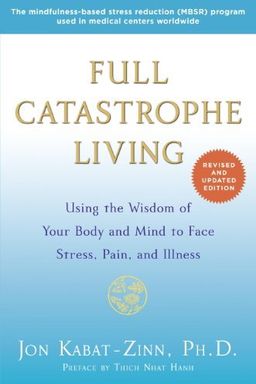
Full Catastrophe Living cover

Full Catastrophe Living

by Jon Kabat-Zinn

Full Catastrophe Living reveals how mindfulness can help you navigate life''s challenges. Learn to respond to stress with clarity, transform pain into growth, and find happiness in the present moment. Experience a balanced life through practical techniques that connect mind and body.

Mindfulness as a Way of Being

How can you meet stress, illness, and the unpredictability of life without being crushed or constantly reacting? In Full Catastrophe Living, Jon Kabat-Zinn presents Mindfulness-Based Stress Reduction (MBSR) not merely as a relaxation technique but as a transformative way of being—living with full awareness of the present moment rather than being ruled by automatic reactions.

Kabat-Zinn developed MBSR at the University of Massachusetts Medical School in the late 1970s as a structured eight-week program combining meditation, yoga, and group inquiry. Its purpose is not to erase life's difficulties but to help you meet them with clear awareness, curiosity, and compassion. You learn to turn toward your experience—body, breath, emotions—without judgment and thereby reclaim agency over how you respond to stress, pain, and even disease.

The structure and intention of MBSR

The program typically includes weekly group sessions, daily formal practice of about 45 minutes, and one full day of mindfulness around Week 6. Practices range from sitting meditation to body-scanning, gentle yoga, and mindful walking. Each method trains attention while cultivating a set of inner attitudes—non-judging, patience, beginner’s mind, trust, non-striving, acceptance, and letting go—that form the soil for mindful living. Participants commit to practicing whether they feel like it or not, because the discipline itself becomes the path to freedom from reactivity.

Who it helps and how healing occurs

Hospital patients, firefighters, business owners, parents, and teachers have all come through the clinic with the “full catastrophe” of life—chronic pain, cancer, heart attacks, AIDS, depression, anxiety, and more. Kabat-Zinn insists that mindfulness is not a cure-all but a reframing of healing. Through mindful awareness, people discover that health is not merely the absence of disease but the restoration of wholeness—the integration of body, mind, and spirit within each lived moment. For instance, Edward, living with AIDS, learned to meet fear and illness with dignity and presence. Joyce, after massive surgeries, experienced moments of vast peace during practice that sustained her through years of medical crises. Healing here means orientation, not outcome.

The paradigm shift in medicine

This book argues for a new kind of medicine—participatory medicine—in which patients become partners in their own healing rather than passive recipients of treatment. The MBSR clinic treats people as active agents capable of cultivating self-regulation, attention, and emotional balance. Clinicians are encouraged to embody mindfulness themselves: caring is biological, not just ethical. The evidence supports this approach: neuroimaging shows changes in brain networks for emotion regulation; immune studies reveal reduced inflammation and improved vaccine responses; and telomere research connects presence to cellular resilience.

The broader cultural and human dimension

Kabat-Zinn’s message extends beyond hospitals. Mindfulness transforms how you inhabit time, work, relationships, and even engagement with social and ecological concerns. By practicing non-doing and moment-to-moment awareness, you rediscover the space in which choice replaces reflex—the pause that turns stress into insight. Eventually, mindfulness radiates into institutions, from schools and workplaces to governments, reshaping culture around presence and compassion. (Note: Congressman Tim Ryan, Google’s corporate programs, and the NHS endorsement of MBCT are examples of this ripple.)

In essence, Kabat-Zinn invites you to a revolution in consciousness. Healing unfolds not by escaping pain but by paying attention to it differently. Through mindfulness, you shift from living automatically to living deliberately, discovering that awareness itself is the ground of health and wholeness. The eight-week course is only the beginning—the real practice is how you live every moment afterward.


Cultivating the Attitudes That Heal

Mindfulness is less about technique and more about attitude. Jon Kabat-Zinn outlines seven central orientations—non-judging, patience, beginner’s mind, trust, non-striving, acceptance, and letting go. These aren’t ethical commandments but functional stances you practice toward your own experience. If mindfulness is a seed, these attitudes are its soil.

Non-judging and patience

Non-judging teaches you to notice the mind’s endless commentary—its stream of “good,” “bad,” “too slow,” “not enough”—and to let it float by without taking orders from it. Patience builds tolerance for the natural unfolding of inner change. Transformation cannot be rushed; insight matures like fruit in its own season.

Beginner’s mind and trust

Beginner’s mind asks you to see familiar things anew—like tasting one raisin as if it’s the first you’ve ever seen. Trust calls you back to your own body and inner wisdom rather than treating authority or external validation as ultimate truth. A heart patient named Peter in the clinic learned to trust his sensations and found peace even with persistent cardiac symptoms.

Non-striving, acceptance, and letting go

Non-striving might be the most paradoxical attitude: you practice without chasing results. You do the meditation not to “get calm” or “fix” yourself but to inhabit the moment honestly. Acceptance means acknowledging what is here—pain, fear, or joy—without denial. Letting go, its dynamic twin, trains you to release attachment to pleasant experiences and stop resisting unpleasant ones. Joy emerges not from control but from presence.

Kabat-Zinn’s example of the angry businessman after a heart attack illustrates this vividly: through patient acceptance he shifted from despair to calm responsiveness even though his illness remained. (Note: Such attitudinal training aligns closely with cognitive reframing in psychology but works experientially rather than through argument.)

Over time, these attitudes become your second nature. When stress rises or pain returns, they serve as stabilizers—gentle reminders that awareness, not reaction, is your most reliable medicine. Taken together, they rewire how you experience yourself and the world.


Working with Body, Breath, and Pain

MBSR trains attention through the body. The body-scan, mindful breathing, and gentle yoga invite you to inhabit sensation directly. These practices shift your relationship to discomfort from fear and resistance to curiosity and care.

The breath as an anchor

Breath practice is the simplest entry point. It’s always present, and its rhythm mirrors your emotional state. You watch the breath rather than force it. Gregg, a firefighter paralyzed by panic in his mask, learned that feeling his belly rise and fall rescued him from hyperventilation and restored confidence on the job. One breath becomes both medicine and teacher: when your mind wanders, return to the belly and the breath—it’s the pause that heals.

Body-scan and working with pain

In the body-scan, you lie down and illuminate each region of the body with awareness—from toes to head—without manipulating anything. Pain and sensation become teachers. Mary’s body-scan opened a long-buried trauma memory, which she then processed therapeutically, leading to improved sleep and reduced pain. Others found relief not through elimination but through changed meaning: pain stopped being the enemy. (Note: Clinical guidance is important for trauma-triggered material.)

Yoga and walking meditation

Gentle yoga introduces movement as meditation, balancing stillness with flow. Walking meditation adds kinesthetic awareness—lift, move, place—turning even trips across a parking lot into mindful practice. Each method cultivates embodiment, showing that awareness is not abstract but physical. For those with pain or agitation, movement often becomes the most accessible doorway to mindfulness.

These practices train new habits of attention and resilience. Instead of numbing or fleeing discomfort, you learn to meet bodily signals with compassion and precision. Symptoms then become feedback, guiding wise action instead of dictating reaction.


Responding Instead of Reacting

Stress physiology underlies much of the book’s teaching: mindfulness rewires the stress-reaction cycle into a conscious response system. In ordinary life, fight-or-flight reactions are triggered by thoughts as easily as real danger. The pause created by awareness allows your body and brain to recover choice.

Understanding reactivity

Acute stress mobilizes survival pathways—amygdala alarms, cortisol spikes, and sympathetic activation—adaptive for emergencies but toxic when chronic. Mindfulness interrupts this by activating prefrontal regions and calming the vagus nerve. You notice tension, breathe, and step back from reflex. Marsha, who wrecked her husband’s van skylight, turned automatic panic into laughter by catching the moment early—proof that awareness changes physiology in real time.

Stress and allostatic load

Biologically, chronic stress accelerates wear and tear (allostatic load), driving inflammation and cellular aging. Studies by Elissa Epel and others show that perceived stress shortens telomeres—the markers of biological age. Mindfulness, exercise, sleep, and social connection restore balance. You can’t eliminate stressors, but you can change how you meet them.

The practical skill of pausing

The book’s simplest instruction—“pause and take one mindful breath”—is neurologically potent. It shifts attention from alarm to awareness. Keith meditated in the dentist’s chair; Pat shoveled a long driveway by pacing mindfully. The power lies in repetition: every pause trains the brain to respond instead of react. (Note: This insight parallels Viktor Frankl’s idea that between stimulus and response lies freedom.)

This mindful response skill explains why participants often report lower anxiety, reduced pain, and improved decision-making. By reclaiming attention, you reclaim biology itself.


Healing Through Wholeness and Non-Doing

A deeper dimension of MBSR unfolds when you stop treating mindfulness as another achievement project. Kabat-Zinn calls this practice of non-doing—being fully present without striving for a particular outcome. Healing, he argues, arises from contact with your intrinsic wholeness, not from chasing relief.

Wholeness as the foundation

Wholeness doesn’t mean perfection. It means sensing the inherent completeness beneath pain or limitation. The Latin roots of “health,” “medicine,” and “meditation” all point to the idea of returning to one’s whole measure. For Phil, a truck driver injured in his back, glimpsing bodily wholeness during a body-scan—feeling breath everywhere—changed his view of pain. When he tried to replicate that experience, suffering returned. Letting go allowed deeper peace to emerge again naturally.

Non-doing and letting go of goals

Non-doing doesn’t mean indifference. It means practicing without coercion. Joyce’s luminous experience of “nothing and everything” during illness exemplifies what happens when practice stops trying to fix and simply attends. Imagery and lovingkindness can support healing only when grounded in non-striving; otherwise they become wishful tools. The paradox is that surrender is often the doorway to genuine transformation.

Compassion and lovingkindness

Later in the program, lovingkindness meditation expands your circle of compassion—from self to others, even adversaries. Softening judgment and reactivity breeds freedom and physiological calm. When you practice “May I be free from harm” without demanding results, you cooperate with natural healing rather than forcing it. Medicine can work on the body; mindfulness recollects the being that lives within it. (Parenthetical note: Thich Nhat Hanh similarly emphasizes “being peace” rather than “achieving peace.”)

Ultimately, MBSR’s radical leap is existential: you are not fixing yourself but remembering that nothing essential was ever broken. Wholeness is not achieved; it is realized through awareness.


Mindfulness in Everyday Life

Formal meditation is the training gym; daily life is the true field of practice. Kabat-Zinn insists mindfulness must infiltrate ordinary acts—eating, walking, talking—until attention becomes a living habit. Every moment is an opportunity to ‘fall awake.’

Turning chores and routines into practice

You can wash dishes while fully feeling water and motion instead of daydreaming. You can drive by noticing breath and grip rather than rehearsing problems. The clinic stories—Jackie learning solitude, George managing COPD through mindful walking, the physician discovering compassion—show mindfulness’ practicality. The rule is simple: start small and repeat often. Even three mindful breaths before stairs or one mindful meal per week changes perception.

Managing time and sleep

Time pressure itself becomes a stressor. Non-doing reclaims it: slow down, simplify, and let go of compulsive busyness. The judge who dropped two newspapers gained two hours of real living daily. Sleep follows the same principle—don’t force it. Practice the body-scan at night or use wakeful moments as opportunities to be present. Acceptance of wakefulness often brings sleep naturally.

Listening to the body

Body signals—pain, tension, fatigue—are messages. Fred, suffering from obesity and headaches, regained vitality and normal blood pressure by attending to his symptoms mindfully. Laurie learned to catch migraines early, practicing the “blowhole” breathing technique to release tension. Mindfulness doesn’t ignore medical care; it complements it by tuning you to real feedback before crisis hits.

Informal practice accumulates like compound interest: each moment of awareness builds stability. The great discovery is that happiness correlates with presence—multiple studies confirm that mind-wandering predicts unhappiness. You can reverse that trend by simply being here.


Relationships and Communication

Mindfulness touches how you relate to others. Communication and interpersonal tension often trigger the same stress reactions as physical threats. The program teaches conscious engagement—mindful speaking, listening, and presence—that transform conflict.

The aikido model of interaction

Clinic exercises inspired by aikido demonstrate four styles: submission, avoidance, resistance, and entering-and-blending. The mindful approach is the fourth—enter, pivot, and move with the other’s energy without attack or retreat. Rabbi Abe’s realization that he “never turned” reflected decades of interpersonal rigidity; learning to pivot physically revealed how he could shift emotionally.

Mindful communication

Assertiveness doesn’t mean aggression. It means clarity. Use “I” statements—“I feel hurt when…”—to own emotions without blame. Kabat-Zinn’s story of gently naming a supervisor’s hostility illustrates how simple awareness and calm honesty can dissolve aggression. Awareness prevents what Daniel Goleman calls the “amygdala hijack.”

Mindful relationships cultivate empathy and reduce reactivity. When applied consistently, they reshape not only personal interactions but professional and social fields—medicine, leadership, and teamwork. Presence itself becomes contagious.


Mindfulness, Science, and Participatory Medicine

Scientific research anchors MBSR’s credibility. Over four decades, studies have demonstrated that mindfulness changes both subjective well-being and biological markers. These findings underpin a larger shift toward participatory, holistic medicine.

Neuroplasticity and physiology

fMRI research by Lazar, Hölzel, and Davidson shows structural brain changes—thicker prefrontal regions, reduced amygdala activation—and leftward frontal asymmetry associated with emotional resilience. Physiology follows suit: mindfulness reduces cortisol, lowers blood pressure, and supports immune balance. Kabat-Zinn’s psoriasis study showed faster healing when patients practiced mindfulness during UV therapy.

Epigenetics and cellular aging

Epigenetic findings reveal that mental and lifestyle habits affect gene expression. Research by Epel and Blackburn links mindful states to longer telomeres and healthier cellular aging. Dean Ornish’s lifestyle programs, which integrate meditation and diet, actually reversed coronary artery disease and altered gene patterns.

Participatory medicine and clinician mindfulness

In modern healthcare, mindfulness invites partnership. Patients practice self-regulation; clinicians practice mindful communication. Programs for physicians (Krasner & Epstein) show reduced burnout and better patient-centered care, validating Peabody’s axiom that “the secret of the care of the patient is in caring for the patient.”

Taken together, the science makes mindfulness both credible and practical—a bridge between subjective healing and objective physiology. Yet Kabat-Zinn cautions: practice for its experiential value, not to chase biomarkers. The most reliable evidence is in your own lived transformation.


Sustaining Practice and Cultural Impact

The book closes by asking how mindfulness becomes a lifelong path rather than an eight-week event. Sustainability comes through daily practice, community, and wise integration into culture.

Long-term rhythm and reinforcement

After the eight-week course, you are urged to continue with daily sitting (20–45 minutes), periodic retreats, and informal mindfulness throughout the day. The curriculum’s gradual progression—body-scan, yoga, sitting—builds capacity for self-guided practice. Retreats and community support foster accountability and deeper insight.

Community and global spread

MBSR’s reach has expanded globally—hospital programs, school courses, prison rehabilitation, corporate wellness, and governmental advocacy. Institutions like Google, the NHS, and the Center for Mindfulness sustain the movement. Research collaborations such as the Mind & Life dialogues integrate contemplative traditions with neuroscience.

Mindfulness as cultural evolution

Kabat-Zinn envisions mindfulness as part of civilization’s self-correction. It restores sanity amid speed, technology, and distraction. To sustain it, fidelity matters—teachers and practitioners must preserve substance over trend. (Note: He warns against commodified “McMindfulness,” emphasizing depth rather than hype.)

The eight-week course, then, is a small beginning of a larger movement—a reminder that collective change starts in individual attention. Every mindful act participates in cultural healing. As you keep practicing, you contribute not only to your own wellness but to a more conscious world.

Dig Deeper

Get personalized prompts to apply these lessons to your life and deepen your understanding.

Go Deeper

Get the Full Experience

Download Insight Books for AI-powered reflections, quizzes, and more.