
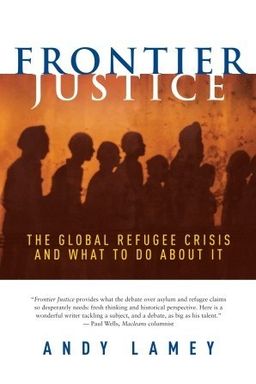
Frontier Justice cover

Frontier Justice

by Andy Lamey

Frontier Justice delves into the global refugee crisis, examining historical precedents and modern challenges. Andy Lamey provides insightful analysis and practical solutions, highlighting Canada''s refugee policies as a potential model for reform. This book is essential for understanding the complexities of refugee rights and inspiring action towards more humane policies.

The Politics of Refuge and the Right to Have Rights

What happens when humans lose their political home? The book argues that the modern refugee crisis exposes the limits of traditional human rights. Grounded in Hannah Arendt’s insight that rights require membership in a political community, the narrative follows thinkers, lawyers, and activists struggling to make rights enforceable for those outside state protection. The central question is not whether refugees deserve rights—they do—but how those rights can be guaranteed in a world organized around states and borders.

Arendt’s Philosophical Challenge

Hannah Arendt, herself a refugee from Nazi Germany, recognized a devastating truth: the 'Rights of Man' collapse once someone loses citizenship. After fleeing Berlin, being interned in France, and ultimately reaching the United States, Arendt saw first-hand that the supposed universality of rights depends on the existence of a state willing to enforce them. Refugees, as she wrote in The Origins of Totalitarianism, are living symbols of the contradiction between universalist ideals and state-based politics. When millions were displaced between the wars, 'human' rights offered no practical refuge.

That realization drives the book’s themes: refugees reveal the gap between moral declarations and enforceable protections. Lamey accepts Arendt’s critique but refuses despair. Instead, he asks: If rights depend on states, how can states be designed—or constrained—to ensure those rights are real?

Across Cases and Geographies

The book moves from Arendt’s personal exile to modern case studies that translate her abstract diagnosis into policy failures and potential remedies. In the 1990s 'Team Haiti' lawyers confronted U.S. policies that excluded Haitian refugees detained at Guantánamo, revealing how geography and procedure decide who counts as protected. The Supreme Court’s Sale decision sanctioned high-seas returns, effectively neutralizing the Refugee Convention. Australia’s 'Pacific Solution' mirrored the pattern—moving asylum processing offshore, excising islands from the migration zone, and turning desperate families into deterrent tools.

Europe’s story echoes this logic: Germany’s postwar constitutional right to asylum—meant to redeem the failures of the 1930s—was drastically curtailed in 1993 amid public backlash, inspiring similar 'Fortress Europe' tactics. In each theater, Arendt’s question repeats: what becomes of rights when political membership is denied?

From Theory to Practice

To respond to Arendt, philosophers like Giorgio Agamben and Jacques Derrida proposed different routes. Agamben warned of the 'state of exception'—zones like Guantánamo where law is suspended and people become 'bare life.' Derrida sought new forms of hospitality, imagining 'cities of asylum' and sanctuaries outside state control. Yet both models face limits: Agamben offers critique without construction, and Derrida’s civic experiments cannot scale or bind states legally. Historical counterexamples such as Shanghai’s shifting admission of Jewish refugees in 1938–39 reveal that sub-state entities can exclude as readily as they welcome.

What emerges is a philosophical tension between radical and pragmatic responses. Radical thinkers expose the moral failure of sovereignty; pragmatists seek procedural reforms within it. Figures like Samantha Power and Matthew Gibney bridge that gap by focusing on NGOs, shared resettlement agreements, and domestic reforms that make states more accountable. Their realism complements the book’s core idea: effective protection emerges not from abolishing states but from refining the procedures through which states exercise their power.

A Procedural Revolution

Lamey proposes a 'portable-procedural rights' model—constitutional guarantees that follow the person rather than remain fixed to geography. Drawing inspiration from Singh v. Minister of Employment and Immigration (1984), where Canada’s Supreme Court held that asylum seekers physically present in the country were entitled to oral hearings, the model centers three rights: an oral hearing, legal representation, and protection from arbitrary detention. These safeguards, if entrenched constitutionally or via binding agreements, make rights enforceable even when asylum processing crosses borders.

Compared to Europe’s onshore-only approach or Australia’s deterrence-first policy, proceduralism offers a middle path: it preserves sovereignty while constraining abuse. The goal is portability—allowing states to coordinate asylum adjudication without abandoning fair process. This design converts moral claims into legal commitments capable of surviving populist backlash or emergency politics.

History, Sovereignty, and the Possibility of Change

A final historical turn reminds you that sovereignty itself has evolved—from feudal loyalty to territorially bounded states, from absolute monarchy to shared international norms. Because sovereignty has changed before, it can change again. Britain’s abolition of the slave trade and the twentieth century’s human-rights revolutions show that moral pressure can reshape political order. The book’s optimism is measured but firm: reform is possible if pressure focuses on procedures and institutions rather than utopian abstraction.

Core Thesis

Refugee protection will work only when the 'right to have rights' is embedded in constitutional and procedural safeguards that states cannot casually revoke. Philosophy diagnoses the problem, but law and politics must build the cure.

Through Arendt’s insight, modern legal sagas, and a blueprint for reform, the book reframes human rights as institutional craftsmanship. It challenges you not to despair over sovereignty, but to rebuild it so that even the stateless may claim a place within the law.


Arendt’s Challenge to Human Rights

Hannah Arendt’s life as a refugee transformed philosophical reflection into political urgency. Having fled Nazi Germany, endured internment in France, and barely escaped to America, Arendt recognized that the abstract 'rights of man' collapse without national membership. For her, the refugee embodies the contradiction between humanity’s moral universality and the nation-state’s territorial enforcement.

The Right to Have Rights

Arendt’s phrase—'the right to have rights'—means that only participation in a political community makes rights effective. Citizenship, not bare humanity, determines whether the law will protect you. This diagnosis, born from twentieth‑century displacements, reorients your moral focus: the task isn’t to repeat moral rhetoric but to build political structures that can guarantee rights in practice.

Lamey uses Arendt not as a pessimist but as a starting point for inquiry. The danger she exposes—a gap between legal membership and moral entitlement—still defines contemporary refugee policy. When refugees are detained offshore, processed at sea, or excluded by geography, their 'humanness' is acknowledged rhetorically but denied legally.

Illustrating Arendt in Action

Case studies amplify her point. The Guantánamo Haitians were physically within U.S. control but outside its legal territory; the Sale decision rendered their rights suspended by geography. Germany’s 1993 asylum amendment revealed how even constitutional guarantees can dissolve under populist pressure. Australian and European deterrence policies show the same pattern: rights bend to political convenience when unanchored by firm legal procedure.

Arendt’s Continuing Warning

When the world treats refugees as anomalies, it reveals a deeper fragility: citizenship, not humanity, still defines who counts as a bearer of rights.

This insight sets the philosophical foundation for the rest of the book. Every subsequent reform—from constitutional hearings to procedural portability—attempts to fulfill Arendt’s demand: to make belonging possible for those whom politics has expelled.


From Guantánamo to Fortress Europe

After theory comes practice, and Lamey traces how procedural vacuum turns ideals into cruelty. From the U.S. interdiction of Haitians to the Pacific islands of Australian detention and the constitutional rollback in Europe, each case demonstrates how geography manipulates legality.

Guantánamo and the U.S. High Seas

The Yale Law School’s Team Haiti litigation exposed how U.S. policy turned refugees into rightless detainees. On Coast Guard decks, refugees were questioned publicly without lawyers. Even when lawyers won injunctions, the Supreme Court’s Sale v. Haitian Centers Council decision declared that the Refugee Convention’s prohibition on return applied only to U.S. territory. The result was a perverse geography of exclusion—a place under U.S. authority yet outside its law.

This episode teaches you a practical lesson: without legal access and procedural safeguards, human rights are slogans. Harold Koh, Michael Ratner, and their students embodied Arendt’s 'action' response—using litigation to force states to honor their own declarations. Yet even their success revealed institutional limits: courts can stop abuses temporarily, but durable reform demands structural change.

Australia and the Politics of Deterrence

Australia’s offshore system extended Guantánamo logic to an entire region. Under the 'Pacific Solution,' refugees like Mohammad Al Ghazzi, who fled Iraq’s torture only to lose his family at sea, were confined in remote camps under punitive conditions. Detention served symbolic politics—using suffering as deterrence. The moral tradeoff was explicit: innocent people were instrumentalized to dissuade others, a condition Julian Burnside condemned as morally bankrupt.

Empirical evidence revealed the policy’s futility—families kept risking the ocean, and over 90% of detainees were later recognized as legitimate refugees. Deterrence, marketed as control, magnified death and despair while eroding the nation’s ethical foundations.

Fortress Europe and Constitutional Retreat

Europe’s path shows how even strong constitutional traditions succumb to crisis. Germany’s Basic Law once enshrined the right to asylum; by 1993 it was amended to include 'safe third country' exclusions. Similar defensive architectures spread across Europe—carrier sanctions, airport detentions, and truncated appeals. Together they formed a continental 'Fortress Europe' that externalized responsibility and hollowed the asylum ideal.

Procedural Lesson

Rights reside not in texts or treaties but in the procedures and locations where decisions occur. Change the place, and you change the right.

Across these cases, Lamey illustrates how sovereignty manipulates geography to escape legal obligations. Reform, therefore, must focus on where and how asylum decisions are made—not just what principles states proclaim.


Radical vs Pragmatic Strategies for Refuge

The second half of the book juxtaposes two responses to Arendt’s dilemma. One is radical—questioning sovereignty itself. The other is pragmatic—reforming states through enforceable procedures. Understanding both positions helps you balance moral imagination with institutional realism.

Agamben’s State of Exception

Giorgio Agamben extends Arendt’s insight by describing how modern states create 'states of exception,' suspending law under the guise of protection. In these zones—the refugee camp, the detention center, the extraordinary rendition site—people are reduced to 'bare life.' The same legal order that promises rights authorizes their removal. Agamben’s power lies in diagnosis; yet he offers no institutional cure, leaving readers without a road back from exception to justice.

Derrida’s Cities of Asylum

Jacques Derrida counters Agamben with moral creativity. Instead of abolishing sovereignty, he experiments with decentralizing it—granting cities, churches, and civil society a share in hospitality. His 'cities of asylum' proposal imagines local refuges operating even when national governments close borders. Examples like the International Parliament of Writers project demonstrated that moral innovation is possible, but limited. As Shanghai’s 1939 reversal and church sanctuary raids in Canada and France show, sub-state actors can exclude as quickly as they protect.

Pragmatists in the Real World

Samantha Power and Matthew Gibney anchor the debate in institutional feasibility. Power highlights the leverage of NGOs and investigative networks to expose abuse and change policy; Gibney proposes realistic designs like quota-sharing and public education to reduce xenophobia. Their work acknowledges what Agamben and Derrida miss: states remain indispensable. The goal is not to abolish sovereignty but to discipline it.

Synthesis

Real progress blends radical imagination with procedural strategy—extra-state moral protest paired with enforceable legal commitments inside the state system.

This dual lens prepares you to appreciate the book’s culminating model: the procedural constitutionalization of the right to asylum. It turns political philosophy into institutional design.


Singh and the Birth of Enforceable Asylum Rights

If you want to see rights move from abstraction to enforcement, Canada’s Singh v. Minister of Employment and Immigration (1984) marks the turning point. Here, the Supreme Court declared that the Charter’s promise that 'everyone' has the right to life, liberty, and security applies to all persons physically present in Canada—citizens or not. It was Arendt’s 'right to have rights' translated into constitutional law.

Transforming Procedure

Before Singh, asylum claims were decided from transcripts without personal hearings. Refugees were denied the chance to appear before adjudicators. The Court’s ruling compelled the Canadian government to build an oral-hearing system, recognizing that credibility and fairness require face-to-face evaluation. By 1989, transcript-based denials were abolished.

Lawyer Barbara Jackman’s advocacy and NGO interventions reminded the Court that procedure is protection. Singh became an exportable model because it fuses parliamentary accountability with constitutional entrenchment—making refugee fairness both politically visible and legally binding.

Portable Lessons

The Singh precedent resonates beyond Canada. It resists the circumvention tactics visible in Germany’s constitutional amendment or Australia’s excised territories. When rights are constitutional, they cannot be downgraded by executive memo or territorial fiction. This makes Singh an institutional embodiment of Arendt’s insight: political membership can be created through law when the law itself extends voice to the unheard.

The Lesson

Constitutions can manufacture belonging. Fair hearings transform 'bare life' into legal personhood.

From Arendt’s despair, Singh retrieved a disciplined hope: rights work when the machinery of justice acknowledges everyone under its jurisdiction, not only those with national papers.


The Portable-Procedural Rights Model

Building on Singh, Lamey develops a transnational model of enforceable asylum—rights that follow people rather than remain tied to borders. The 'portable-procedural rights' framework offers realistic reform within the state system.

Three Core Safeguards

It defines three constitutional minimums: (1) the right to an oral hearing, (2) the right to legal representation, and (3) protection from arbitrary detention. Together, these rules ensure that asylum seekers are heard, assisted, and not indefinitely imprisoned without review. These rights are empirically grounded too: legal representation massively increases fair outcomes, and detention beyond necessity causes irreversible harm.

Making Rights Portable

Portability means the rights attach to the person, even if their claim is processed in another jurisdiction. If Canada sends an applicant to the U.S. or Australia refers one to Nauru, those receiving countries must guarantee the same procedural protections. This mobility prevents the endless chain-refoulement of 'safe third country' transfers that undermine fairness while preserving states’ interest in coordination.

Unlike the German model’s absolutism, portability avoids overwhelming local systems. Unlike ad hoc resettlement quotas, it creates individualized justice. The model is constitutional in spirit but pragmatic in form—it requires cooperation, not dissolution, of sovereignty.

Practical Ambition

Portable-procedural rights turn moral universality into enforceable minimums, spreading fairness across borders without demanding utopia.

By constitutionalizing procedure rather than outcomes, Lamey sketches an asylum regime that is both humane and politically feasible—a third way between boundless moralism and exclusionary realpolitik.


Myth, Evidence, and the Politics of Fear

No reform survives without confronting fear. After 9/11, political rhetoric weaponized the figure of the refugee as a security threat, epitomized in the distorted tale of Ahmed Ressam, the 'Millennium Bomber.'

The Ressam Legend

Ressam entered Canada in 1994 as a minor criminal and only radicalized years later after training in Afghanistan. Yet media retellings fused his refugee claim with terrorism, suggesting that the asylum system enabled his plot. Policymakers invoked the story to attack constitutional safeguards like Singh. Peter Showler, former Immigration and Refugee Board chair, documented that the legend was false—Ressam’s crimes were failures of passport control and deportation, not refugee law.

Empirical Reality

The book’s empirical appendix evaluates whether terrorists exploit asylum. Between 1988 and 2001, only 26 claimants with any link to political violence were identified among over 325,000 applications—and none carried out successful attacks. Refugee systems involve extensive interviews, biometrics, and background checks, making them poor cover for extremists. Statistically, asylum fraud poses infinitesimal risk compared to ordinary crimes or visa overstays.

Politics of Probability Neglect

Despite evidence, emotional amplification drives restrictive policy. Politicians seize on one anecdote to justify curtailing thousands of legitimate rights. The antidote is precision: fix security gaps—passport verification, removal logistics—without dismantling due process.

Empirical Insight

A transparent, well‑resourced asylum procedure enhances security; shortcuts increase chaos and injustice alike.

By confronting fear with data, the book restores proportion. Evidence, not panic, must guide refugee law—because dismantling procedural rights in the name of security solves nothing and undermines both justice and safety.


Sovereignty and the Possibility of Change

The journey ends with the institution most resistant to transformation: sovereignty. Yet sovereignty, Lamey argues, is not immutable. History shows how its forms have evolved and how moral revolutions can reshape its boundaries.

How Sovereignty Evolved

From feudal oaths of loyalty to the uniform nation-state, political authority has always been fluid. The rise of passports and border controls in the late nineteenth century created what Stephen Krasner calls 'interdependence sovereignty'—a recent phenomenon, not an eternal one. Because states constructed these controls, they can reform them.

Historical Precedents for Constraint

Sovereignty has yielded before to moral pressure. Britain’s navy shut down the slave trade despite foreign defiance; anti‑apartheid sanctions forced regime change in South Africa. These examples show that international cooperation and domestic activism can curb the worst abuses of state power without destroying the state itself.

A Goldilocks Strategy

The book’s closing vision is calibrated: neither utopian cosmopolitanism nor fatalistic isolationism. The pragmatic path is to constitutionalize core procedures—fair hearing, representation, judicial review—so that they integrate into state law yet transmit globally through legal precedent and agreements. This 'Goldilocks' balance keeps sovereignty functional while embedding enforceable rights within it.

Final Insight

Sovereignty has always adapted; its next evolution should make the protection of refugees part of the state’s core purpose, not its exception.

Optimism here is disciplined, not naïve. The book concludes that institutional imagination—rooted in historical precedent and guided by moral urgency—can produce a world where the 'right to have rights' is no longer rhetoric but reality.

Dig Deeper

Get personalized prompts to apply these lessons to your life and deepen your understanding.

Go Deeper

Get the Full Experience

Download Insight Books for AI-powered reflections, quizzes, and more.