
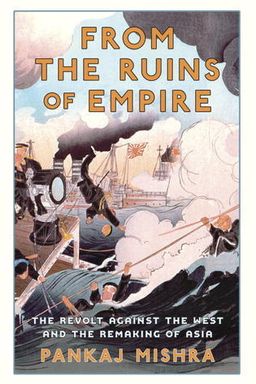
From the Ruins of Empire cover

From the Ruins of Empire

by Pankaj Mishra

From the Ruins of Empire delves into the Eastern perspective on 200 years of Western dominance, exploring how Asian nations countered imperialism with resilience and innovation. Through the stories of influential thinkers and artists, Pankaj Mishra reveals the complex interplay of tradition and modernity that reshaped Asia''s cultural and political landscapes.

Asia’s Long Reawakening

You are entering one of history’s most panoramic revolutions — the long reawakening of Asia from psychological subjugation to global influence. The book follows two centuries of confrontation between Western imperial dominance and Asian rediscovery. Its central argument is clear: Asia’s modern transformation is not merely a story of armies and industry but of imagination, dignity, and the struggle to redefine modernity itself.

The Shock of Subjugation

When Europe’s industrial empires reached Asia in the nineteenth century, their dominion was enforced by three interlocking levers — military conquest, economic penetration, and legal-cultural control. Opium wars, unequal treaties, and extraterritorial privileges reduced once-confident civilizations to dependencies. Asian thinkers from Cairo to Canton became painfully aware that this dominance was systemic, not accidental. (Note: the book emphasizes that Western supremacy was both technological and organizational, not merely militaristic.)

Responses and Experiments

Across the continent, you see three broad responses: revivalist reaction, selective borrowing, and radical transformation. Mystical resistance movements like the Mahdists and Boxers clung to faith and purity; reformers such as Sir Sayyid Ahmed Khan and Khayr al-Din imitated Western science; and revolutionaries like Liang Qichao and Mustafa Kemal broke away entirely to build secular or republican nations. These responses show Asia’s intellectual diversity — neither rejection nor imitation alone sufficed.

The Tsushima Turning Point

The 1905 Japanese victory over Russia at Tsushima explodes the myth of European invincibility. The impact is psychological: Gandhi in South Africa feels the tremor; Atatürk and Sun Yat-sen see proof that modernization and dignity can coexist. Across Asia, newborns are named after Japanese admirals, and crowds march in distant villages. Tsushima’s real power lies not in artillery but imagination — it teaches colonized peoples that reversal is possible.

Intellectual and Network Revolutions

Ideas travel faster than fleets. Jamal al-Din al-Afghani’s pan-Islamic agitation, Liang Qichao’s journalism, and print networks in Cairo, Paris, and Tokyo weave new solidarities. Newspapers, student societies, and exile hostels become the circuits of political awakening. You learn that modern change requires communication infrastructure as much as ideology: print culture and study networks knit fragmented Asian voices into a continental conversation.

From Reform to Revolution

These currents mature into mass politics — tobacco boycotts, constitutional agitations, and protests. Al-Afghani and Mirza Hasan Shirazi’s successful Persian boycott (1891) demonstrates that religion and activism can merge to force state retreat. By the early twentieth century, nationalism and pan-Islam evolve from elite projects into popular movements animated by print media and charismatic organizers.

Global Betrayals and Moral Reckonings

World War I and the Wilsonian promise deepen the confrontation between ideals and realities. Asian activists rally around the rhetoric of self-determination, only to face betrayal at the Paris Peace Conference. Wilson’s refusal to back racial equality and the Versailles transfer of Shandong to Japan spark China’s May Fourth Movement. Liberal internationalism collapses; Marxism and revolutionary nationalism arise as new moral alternatives.

The Search for Authentic Modernity

Tagore, Liang, and others debate what modernity should mean. Tagore urges Asians to integrate spiritual humanism with technology; Liang advocates state-led modernization after witnessing Western hypocrisy. Their conversation defines a question that runs through the century: can Asia forge progress without reproducing Western materialism? Their disagreement captures a tension between morality and power that endures today.

War, Liberation, and New Dominions

Japanese pan-Asianism, once a doctrine of solidarity, mutates into militarized imperialism in the 1930s. Yet its conquests inadvertently destroy European authority and catalyze postwar independence movements. By 1945, decolonization accelerates: India, Indonesia, and Vietnam emerge from empire. Asia’s irony is that its freedom was hastened by Japan’s own violent expansion.

New States and Their Dilemmas

Modern nation-states — Turkey, China, and later Iran — pursue self-assertion through centralized, authoritarian modernization. Atatürk’s secular reforms and Mao’s revolutionary mobilization reflect urgency over freedom. You see how state-led development promises sovereignty but breeds new tensions: repression, inequality, and loss of ethical compass. (Parenthetical comparison: the book honors their achievements but warns of spiritual voids reminiscent of the Western path they sought to transcend.)

Asia’s Ambiguous Revenge

The closing argument is sobering. Asia’s rise has shattered Western monopoly but not replaced it with a humane alternative. Economic success coexists with authoritarianism, inequality, and ecological peril. The reawakening teaches a moral truth: liberation from domination must also mean liberation from imitation. The future depends on whether Asia can pair strength with compassion — dignity with wisdom — and offer a model that speaks not only for itself but for all humanity.


Imperial Mechanics and Subjugation

You begin with how Western empires constructed their power: through disciplined systems that intertwined violence, commerce, and law. Napoleon’s Egypt campaign, Britain’s conquest of India, and the Opium Wars exemplify how technology and bureaucracy turned exploration into domination. Military victories were only the gateway; the true subjugation came through treaties, opium economies, and legal immunities that rewired entire societies for European advantage.

Guns, Debt, and Cultural Superiority

Armies intimidated, but debts enslaved. Egypt’s modernization loans placed European financiers inside its treasury; China’s indemnities reshaped its trade. Cultural control worked subtly: missionaries and newspapers portrayed local customs as backward. This mix of coercion and consent anchored a world order in which economic dependency reinforced psychological inferiority. (Note: the book compares this system to modern global capitalism — power persists through institutions, not just weapons.)

The System’s Self-Replication

You observe a pattern: military intervention opens markets, markets create debt, debt demands enforcement, and enforcement requires cultural justification. Burke’s famous image of company officials as “birds of prey” captures the moral rot that accompanied empire’s efficiency. This foundation explains why later Asian modernizers had to not only expel foreign armies but reinvent their economies and minds to escape dependency itself.


Responses and Reforms Across Asia

Under pressure, Asian societies explored three survival strategies: religious revivalism, selective modernization, and secular revolution. You see these overlapping modes from Mecca to Manchuria. The reactive movements — Wahhabism, the Boxer Uprising — asserted moral purity against foreign corruption. Their emotional appeal united peasants and clerics but often failed against industrial weaponry. Reformists like Rifa‘a al-Tahtawi and Sir Sayyid Ahmed Khan recognized that learning Western science could defend tradition better than blind resistance.

Selective Borrowing

Self-strengthening aimed to combine Western methods with local ethics: build arsenals, modern schools, and constitutional councils while retaining indigenous values. But partial adoption created elites estranged from the masses. You see this tension in China’s late Qing, where officials built railways but preserved autocracy. The lesson is enduring: technical reform alone cannot cure the political disequilibrium of empire.

Radical Overhaul

The most daring path came from figures like Liang Qichao and Mustafa Kemal, who concluded that salvation required total institutional renovation. Their projects — secular nationalism, constitutionalism, new education — created the prototypes of the modern Asian state. In this triad of responses, you find the genesis of later national movements, each balancing faith, science, and revolution in distinctive proportions.


Jamal al-Afghani and Pan-Islamic Activism

Al-Afghani embodies the itinerant intellectual who transforms theology into political energy. Moving across Persia, Egypt, India, and Europe, he preaches self-respect and solidarity. His method is as much organizational as theological: secret societies, journals, and mass petitions. Through him, Islam reappears not merely as faith but as a geopolitical framework capable of moral resistance.

Ideas into Action

The tobacco boycott in Persia shows his genius for converting abstract grievance into disciplined mass action. By fusing religious legitimacy (Shirazi’s fatwa) with political coordination, he demonstrates how oppressed societies can mobilize without state apparatus. His publication al-‘Urwa al-wuthqa in Paris connects Muslim readers across continents, defying colonial borders.

Contradictions and Legacy

Al-Afghani’s career exposes modern reform’s dilemma — cooperation with power versus confrontation with despotism. He alternates between courtly counsel and subversion. His influence survives in Abduh’s rationalist theology and Rashid Rida’s later activism. You see how one individual’s spiritual call turns into a prototype for twentieth-century political Islam and print-based reform networks.


Liang Qichao and China’s Modern Mind

Liang Qichao transforms Chinese political thought from imperial self-absorption to global realism. After 1895, Japan’s victory over China shocks him into urgency: Confucian confidence collapses, and superficial technological imitation is exposed as empty. Liang’s writings and exile in Japan help redefine China’s survival problem as institutional and civic — not merely military.

From Reform to Nationhood

His role in the Hundred-Day Reform teaches caution against top-down change. In Japan, he absorbs Social Darwinist metaphors, arguing that national competition demands educated citizens and moral cohesion. Liang’s journals circulate new concepts: democracy, patriotism, revolution. They train young Chinese readers to imagine themselves as members of a national organism, rather than subjects of a dynasty.

Authoritarian Modernization

Later, Liang concludes that democracy is premature. Witnessing racism and disorder abroad, he praises Meiji-style authoritarian reform and advocates state-backed capitalism. His pragmatic realism — freedom later, strength first — prefigures the developmental states of modern Asia. His shift mirrors a continental anxiety: survival before liberalism.


The Wilsonian Betrayal and the Radical Turn

The aftermath of World War I reveals the gulf between global rhetoric and colonial reality. Wilson’s promises of self-determination inspire hope from Cairo to Beijing. Yet Paris 1919 exposes the racial hierarchy still embedded in liberal internationalism. Japan’s proposal for racial equality is silenced; China’s claims to Shandong are dismissed. Liang Qichao’s reports from the conference crystallize a continental disappointment: Asia must depend on itself.

From Versailles to Revolution

The Chinese students’ May Fourth protests channel betrayal into new resolve. They reject old Confucian moralism and embrace science, democracy, and later Marxism. Across Asia, radicals turn to Lenin’s anti-imperialism and the Comintern’s offers of solidarity. You see how idealism’s collapse opens the way to revolutionary pragmatism — the shift from moral appeals to systemic transformation.


Tagore and the Moral Critique of Modernity

Tagore’s travels articulate a powerful but contested plea for moral regeneration. He warns Asia against mistaking imitation for progress, arguing that Western civilization’s material aggressiveness fractures the human spirit. His Santiniketan philosophy celebrates education, art, and village life as antidotes to industrial greed.

Asia’s Reaction

In China, May Fourth intellectuals reject his humanism as sentimental amid national crisis; in Japan, militarists distort his praise into nationalism before turning against him when he denounces imperial aggression. His experience exposes a recurring theme: moral critique thrives in peace but falters under threat. Still, his voice reminds you that spiritual autonomy is the ultimate form of decolonization — a counterpoint to both militarism and consumerism.


War, Pan-Asianism, and Decolonization

Pan-Asianism’s metamorphosis during Japan’s rise demonstrates the dangerous duality of liberation rhetoric. Initially inspired by solidarity, it becomes a justification for conquest. Okawa Shumei and Toyama Mitsuru present Japan as Asia’s savior, only to deliver occupation and exploitation. Yet paradoxically, Japanese victories against Western armies undermine colonial myths and empower nationalist leaders from Indonesia to Burma.

Acceleration of Independence

Despite brutality, the occupation’s disruption educates colonized peoples in administration and resistance. When Europeans return after 1945, they face mobilized societies unwilling to submit. Asia’s liberation, though tainted, becomes irreversible. You learn that domination can unintentionally sow the seeds of its own demise by teaching the oppressed how to rule themselves.


Religious Revival and Intellectual Decolonization

Postcolonial Asia’s thinkers confront another challenge: how to fill the moral vacuum left by failed secular ideologies. From al-Afghani’s reformism to Iqbal’s poetic calls for spiritual selfhood, Islamic modernism searches for dignity beyond Western materialism. Later figures — Mawdudi, Qutb, Shariati — turn this quest into movements, channeling disappointment with nationalist and socialist experiments into visions of divine order.

Iran’s Case

Iran’s intellectuals diagnose gharbzadegi, a “Westoxification” that uproots identity. Their efforts culminate in revolutionary Islam as both moral recovery and anti-imperial assertion. You see religion reemerge not as reaction but as comprehensive alternative — sometimes creative, sometimes destructive. (Note: the author connects this pattern to the twentieth century’s cycle of moral disappointment following secular nationalism’s collapse.)


Nation-States and Modern Dilemmas

Turkey and China, two contrasts in modern rebuilding, demonstrate the nation-state’s promise and peril. Atatürk constructs a secular republic that eradicates Ottoman traditionalism; Mao mobilizes peasants to topple feudal hierarchy. Both achieve independence through coercive modernization. Yet both confront backlashes — religious resurgence in Turkey, social upheaval in China — showing that enforced modernization cannot erase identity or inequality.

The Nation-State’s Double Edge

Centralization enables progress but suppresses pluralism. The author reminds you that sovereignty, while essential to dignity, is not the same as justice. Real liberation demands not just strong governance but continuous moral reform. These examples prepare you for the book’s closing meditation on Asia’s rise as both accomplishment and unresolved quest.


Asia’s Rise and Its Moral Limits

The book’s conclusion invites reflection on what victory truly means. Asia has reclaimed wealth, confidence, and geopolitical strength, but the pursuit of Western-style prosperity repeats many of the West’s follies — inequality, ecological crisis, and aggressive nationalism. Zhang Junmai’s warning about “prosperity without equality” captures this bittersweet triumph.

Beyond Revenge

Material success cannot replace ethical purpose. The author urges Asia’s thinkers to imagine a synthesis of spiritual insight and scientific mastery, a humane alternative to both colonial arrogance and authoritarian mimicry. Until such moral equilibrium is achieved, Asia’s rise remains ambiguous — a revenge without redemption. You end the journey aware that global balance now depends on whether Asia’s reawakening can serve not domination but wisdom.

Dig Deeper

Get personalized prompts to apply these lessons to your life and deepen your understanding.

Go Deeper

Get the Full Experience

Download Insight Books for AI-powered reflections, quizzes, and more.