
Idea 1
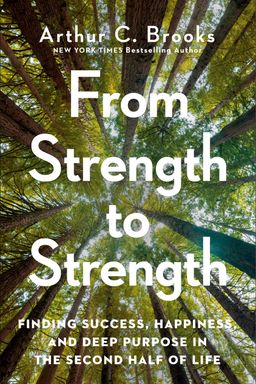
From Strength to Strength: Redefining Success, Happiness, and Purpose
What happens when the very abilities that made you successful begin to fade? That haunting question opens Arthur C. Brooks’s From Strength to Strength, a compassionate and illuminating book about what it means to thrive in the second half of life. He begins with a vivid conversation overheard on a plane: a beloved hero lamenting to his wife that “it would be better if I were dead.” This moment becomes a mirror for Brooks himself—a man at the height of his career but tormented by the suspicion that his success and sense of relevance are beginning to slip away.
For Brooks, that realization sparked a years-long journey through economics, social science, philosophy, theology, and the biographies of great achievers. His conclusion: the professional decline that terrifies high achievers isn’t a curse—it’s an opportunity. In fact, it can mark the beginning of a life richer in meaning, happiness, and love than any period that came before. Yet escaping the “striver’s curse”—the tendency to measure yourself only by past successes—requires learning new skills, building new relationships, and embracing a new way to define strength.
The Hidden Trap of Success
The “striver’s curse,” Brooks writes, afflicts anyone whose identity is built on achievement. From athletes to scholars, from entrepreneurs to musicians, success creates an addiction-like pattern. You chase the next high of accomplishment until your productivity starts to decline—and then you fight, deny, or despair. The moment you can no longer perform at your previous level, your self-worth crumbles. This desperate struggle, Brooks argues, is not a moral failure but a physiological and psychological one. Using data on cognitive decline, he shows that most people reach intellectual or creative peak productivity in their late 30s or early 40s—and that decline, though natural, hits hardest among those whose status depends on their brainpower or creativity.
Just as athletes must retire when their bodies age, “knowledge workers” suffer a mental slowdown they can neither prevent nor reverse. The secret, however, is not to resist but to pivot—to shift your focus from achievement to wisdom, from “strength” as mastery to “strength” as understanding. In this way, decline becomes transformation.
Two Types of Strength
One of the book’s most powerful revelations comes from psychologist Raymond Cattell’s theory of dual intelligence: fluid intelligence (quick, innovative reasoning) and crystallized intelligence (deep, synthesized understanding). The first fuels success in youth; the second grows with age. Brooks calls this discovery “the second curve”—the hidden mental capacity that blossoms after decline begins. If fluid intelligence drives your early professional triumphs, crystallized intelligence offers your later-life edge in teaching, mentoring, and synthesis. The goal, he suggests, is not to fight your decline but to “jump to the second curve”—turning experience into wisdom and contribution.
This idea reshapes traditional notions of success. Where society celebrates innovation and ambition, Brooks celebrates teaching, service, and compassion. J.S. Bach, who reinvented himself late in life as a master instructor after creative decline, becomes a model of joyful transformation. “He died beloved, respected, and fulfilled,” Brooks notes—to show that by embracing new strengths, we can all go from one type of greatness to another.
From Addiction to Aspiration
The book also dissects the psychology of those caught in “success addiction.” Brooks compares workaholism and status-chasing to substance dependence: chasing hits of achievement, enduring withdrawal when recognition fades, and prioritizing “being special” over being happy. Many people, he writes, claim they’d rather be admired than fulfilled. The second half of life offers the chance to break this addiction, not through failure but through deliberate reframing—by trading ambition for purpose, pride for humility, and accumulation for genuine joy. His key formula for sustained satisfaction—satisfaction = what you have ÷ what you want—shows that happiness lies not in acquiring more, but in desiring less.
Love, Death, and Renewal
Brooks structures his argument as both philosophy and life manual: he walks the reader through the inevitability of decline; the power of crystallized intelligence; the need to shed attachments (“chip away”); the courage to face mortality; the restoration of connection and love (“cultivate your aspen grove”); and the embrace of spiritual search (“start your vanaprastha”). He guides you through reinvention with humor and humility, using his own move from a high-profile Washington think-tank presidency to teaching at Harvard as a real-life example of jumping curves.
Ultimately, Brooks’s message is that life’s second act is not about diminishing returns but about transcendent growth. “Use things. Love people. Worship the divine,” he concludes, summarizing the book’s formula for lasting strength. For anyone uneasy about aging or feeling their success is slipping, From Strength to Strength offers both comfort and challenge: proof that the path to lifelong happiness is not resisting change, but embracing it with purpose, humility, and love.