
Idea 1
A Daughter Maps Love, Loss, and Legacy
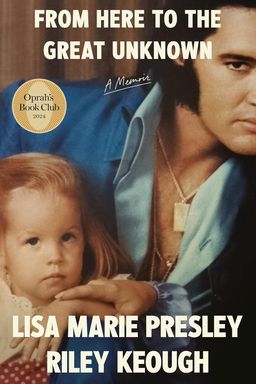
What does it take to tell the truth about someone the world thinks it already knows—and what changes in you when you try? In From Here to the Great Unknown, Lisa Marie Presley and her daughter Riley Keough argue—across time, tape, and memory—that a life lived under myth can still be rendered in three dimensions. Lisa contends that behind the bright glare of Elvis, and later Michael Jackson, lay a ferocious mother, a searching artist, and a woman shaped by early awe, sudden loss, late addiction, and love that never gave up. Riley, who finishes the book after Lisa’s death, insists that to understand Lisa you must hold opposites at once: glamour and grit, agency and abandonment, tenderness and volcanic temper, childlike wonder and adult reckoning.
This memoir is a duet—Lisa’s raw, spoken recollections (drawn from recorded interviews) interlaced with Riley’s witness and patchwork of the missing late chapters. The result isn’t a celebrity recap; it’s a map of intergenerational forces flowing from Graceland’s upstairs sanctuary to a Calabasas living room where a daughter changes a grandchild’s diaper as grief howls outside. The story asks you to consider how families transmit power and pain, and how you might metabolize both in your own life.
What the book claims
At its core, the book claims that legacies are living organisms. Lisa’s childhood—fueled by late-night golf carts, Pomeranians stealing bacon, and a father whose moods could make the weather—formed an unshakeable devotion and an early apprenticeship in charisma. Elvis’s death at her age nine became the primal wound and template for grief: public spectacle, private silence, and a lifelong sense that the center can vanish in an instant. From there, love and longing braided through rebellious years (Scientology, the Apple school, Ojai), harrowing abuse by a stepfather figure, two great romances (Danny Keough and Michael Jackson), the decade-long joy of raising Riley and Ben inside a buzzing Hidden Hills compound, a music career fought for on her own terms, and—arriving late—an opioid addiction that shadowed her final chapter. Riley argues the only way to tell it truly is to hold compassion, anger, and context in the same hand.
How the book is structured
You move through vivid set pieces: “Upstairs at Graceland” (Lisa’s private sanctuary with Elvis); “He’s Gone” (the day Elvis died and what public mourning does to a child); “The Wall” (teenage rebellion, boarding schools, Scientology’s pull and containment); “There’s a Bluebird in My Heart” (meeting Danny Keough, motherhood that saves her); “Mimi” (loving Michael Jackson for his unguarded, private self while fearing the machinery around him); “Ten Years” (the happiest period—motherhood, friends-as-family, tours, rituals); “The Bus from Nashville to L.A.” (late addiction, a heart in crisis, the attempt at reboot); “Ben Ben” (Riley’s shattering account of her brother’s suicide and the family’s grief pod); and “Meditation Garden” (Lisa’s grandmotherhood, last days, and burial beside Elvis and Ben).
Why this matters to you
If you’ve ever inherited a story—of greatness, addiction, anger, or grief—this book shows how to carry it without letting it crush you. Lisa and Riley model a kind of double-seeing you can practice: honor what was magical (the vortex at Graceland, the way Elvis sang her to sleep with a basset hound puppet) and confront what was devastating (finding him facedown in the bathroom, being groomed and hit by a mother’s boyfriend, the slow logic of pills). They also model how to love someone you’ve divorced (Lisa and Danny as lifelong allies) and how to mother when your heart is in shards (Lisa’s ritual lullabies, tours built around her kids, and—at the end—grief circles she ran for bereaved parents).
Guiding premise
A myth can be gorgeous and also incomplete; a person can be broken and also radiant. The work of a daughter is to finish the portrait—with tenderness and the whole truth.
What you’ll learn in this summary
You’ll see how upstairs rooms—literal and psychological—shape a life, and how fame’s perimeter (fans in trees, security at gates) trains children to scan for danger and adore spectacle. You’ll watch addiction arrive not in adolescence but after twins and a C-section, confirming what physicians like Gabor Maté note about painkillers as portals for old pain (context: In the Realm of Hungry Ghosts). You’ll learn why Lisa called Danny her “different kind” of soulmate, and how that pact protected Riley and Ben even through divorce. You’ll step into the moral fog around Michael Jackson—where Lisa insists on his innocence as she experienced it, yet names the secrecy, Demerol, and control that doomed their marriage (compare to Janice Erlbaum’s frankness in Girlbomb about loving flawed men while saving yourself).
Finally, you’ll sit with Riley in the rawest rooms: keeping Ben’s body at home on dry ice so their goodbyes weren’t rushed; getting matching tattoos in the very script he’d inked on his own skin; finding vocabulary for a grief that doesn’t lessen but changes shape (echoing Joan Didion’s The Year of Magical Thinking). Through all of it, you’ll see how a family crafts meaning from chaos—rituals, songs, jokes, fairy gardens—so you can consider your own.