
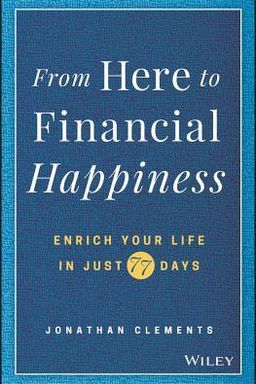
From Here to Financial Happiness cover

From Here to Financial Happiness

by Jonathan Clements

From Here to Financial Happiness offers a straightforward guide to achieving financial security in just 77 days. Author Jonathan Clements provides actionable insights to help you overcome financial anxiety, save effectively, and ensure a comfortable future. Discover simple strategies to boost your savings, optimize retirement plans, and make smarter financial decisions.

Building a Happy and Prosperous Financial Life

What if money wasn’t something you feared or resented—but something that actually made your life richer, happier, and more meaningful? In From Here to Financial Happiness, Jonathan Clements invites readers on a 77-day journey to transform how they think about money. His argument is simple yet profound: true prosperity isn’t measured by net worth alone—it’s about creating financial peace of mind and using money as a tool to build a fulfilling life.

Clements, a veteran personal finance columnist and founder of HumbleDollar.com, contends that most of us don’t need complicated investment schemes or grand acts of financial genius. What we need is a steady rhythm of small, intentional actions—each taken with purpose and humility. His plan is part financial guide, part behavioral workbook, and part life philosophy. Over those 77 days, he challenges you to save diligently, reduce stress, and cultivate a thoughtful relationship with money that supports happiness rather than obsessive pursuit of wealth.

Redefining Financial Success

Unlike traditional finance books obsessed with beating the market or maximizing returns, Clements reframes success entirely. He argues that the ultimate goal is not to be rich but to be secure—to have enough to live the life you want without fear or stress. Financial success, in his view, means crafting a plan that ensures comfort through life’s ups and downs, cultivating resilience against risk, and recognizing that chasing extraordinary returns usually leads to extraordinary mistakes.

This perspective places emotional wellbeing at the center of financial planning. Drawing on behavioral economics (similar to works by Daniel Kahneman and Richard Thaler), Clements explains that our instincts are often at odds with rational money management. We succumb to impulse purchases, favor immediate gratification, and overestimate our skill at investing. A sound financial life, therefore, requires not just spreadsheets and budgets but also self-awareness and humility.

The Human Side of Money

Clements insists that understanding money is inseparable from understanding ourselves. Every chapter in his 77-day plan combines practical steps—like paying down debt or automating savings—with introspective tasks that help you explore your beliefs and behaviors around money. Early sections ask you to dream freely about what you’d change if money were no object. Later ones confront your fears and past mistakes. It’s both a financial audit and psychological cleanse.

He encourages readers to examine how early life lessons—those learned from parents or peers—shape our current financial habits. By replacing unhelpful beliefs (like associating possessions with self-worth) with mindful ones (viewing money as a means to time, freedom, and relationships), you gradually align finances with values. This introspection makes Clements’ book feel deeply personal rather than prescriptive.

A Practical Blueprint for Everyday Life

While philosophy permeates every page, Clements’ advice is pragmatic. He walks readers through essentials: contribute to your 401(k) to capture the employer match, avoid credit card debt, build an emergency fund, and control what you can (like expenses, savings rate, and risk exposure). He teaches the compounding power of patience—illustrating that starting to save even five years earlier can mean hundreds of thousands more at retirement. Each lesson seeks balance: enjoying today without sabotaging tomorrow.

Along the way, Clements connects money decisions to happiness research. Drawing from decades of studies, he shows how wealth often fails to enhance joy beyond basic comfort. Once financial security is achieved, human connection, meaningful work, and experiences—not possessions—bring lasting satisfaction. The book’s recurring themes of gratitude and simplicity echo similar ideas found in Your Money or Your Life by Vicki Robin and Joe Dominguez, as well as The Psychology of Money by Morgan Housel.

Toward a Life of Financial Freedom

In the end, Clements’ central promise is transformation—both financial and emotional. By investing just five to ten minutes a day for 77 days, you’ll clarify your goals, design realistic plans, and move towards financial freedom. But that freedom is not the ability to buy whatever you want; it’s the knowledge that you already have what you need. Through reflection, saving, and conscious spending, you learn to use money not for competition or comparison, but for contentment. When you stop chasing more and start living intentionally, financial happiness becomes not a destination but a way of being.

Core Message

Money isn’t about proving status or beating markets—it’s about creating the freedom to live meaningfully. Jonathan Clements urges you to combine financial discipline with personal clarity, turning daily money decisions into a foundation for lifelong happiness.


Humility: The Secret to Financial Wisdom

Jonathan Clements emphasizes that humility may be the most underrated skill in money management. In day four, titled “Embrace Humility,” he unpacks five fundamental human failings that derail smart financial decisions: overconfidence, short-term thinking, unrealistic expectations, lack of discipline, and overestimation of investment skill. Each one reflects our tendency to believe we’re exceptional—until reality proves otherwise.

Why Overconfidence Hurts Most of Us

Most people assume financial intelligence means high returns or clever trading. Clements dismantles this illusion. He reminds us that the vast majority of investors—including professionals—underperform the market. Our belief that we can predict outcomes or pick winning stocks is seductive but statistically false. As he quips, “The meek may not inherit the earth, but they are far more likely to retire in comfort.” Humility means admitting you don’t know the future—and building strategies robust enough to survive uncertainty.

Learning from Mistakes and Luck

Clements argues that luck often masquerades as wisdom. If you bought stocks before a bull market, you weren’t clairvoyant—you were fortunate. True financial maturity means distinguishing between smart decisions and lucky timing. That’s why he encourages reflection on past successes and failures, urging readers to classify them honestly. Maybe that risky investment worked, but could it have easily gone the other way? Humility transforms these experiences into insight rather than ego.

Discipline over Genius

To Clements, wealth accumulation is less about brilliance than consistency. Saving steadily, avoiding debt, and sticking to basic investment vehicles—index funds, retirement accounts—beats any grand market-timing strategy. A humble investor focuses on process, not prediction. This echoes advice from John Bogle (founder of Vanguard), who favored low-cost indexing as the ultimate act of financial humility: accepting market returns instead of chasing mirages of superior performance.

Accepting Uncertainty as Strategy

Humility also means embracing uncertainty rather than fighting it. Clements helps us prepare for unpredictable life changes—job loss, illness, divorce—not with paranoia but prudence. Insuring intelligently, managing risk, and saving for emergencies demonstrate respect for life’s volatility. The humble approach to money isn’t timid; it’s strategic realism. Financial peace, he concludes, doesn’t come from conquering risk—it comes from accepting that we can’t.

Key Takeaway

Humility is a superpower in personal finance. When you admit what you don’t know, you invest simply, save consistently, and stop gambling on predictions. The result isn’t weakness—it’s lasting financial stability.


Habits that Make You Rich Slowly

In the section “Be Kind to Your Future Self,” Jonathan Clements outlines the behaviors that turn steady earners into millionaires—not through luck, but through patience. He lists five traits essential for lifelong wealth building: low fixed costs, self-control, aversion to stress, self-reflection, and a fondness for your future self. Together, they create the mindset that makes saving effortless and prosperity inevitable.

Low Fixed Costs: The Freedom to Save

Clements warns that most families don’t fail financially because of low income—they fail because of high recurring expenses. Mortgage payments, car loans, insurance premiums, and subscriptions eat away at potential savings. The first step toward wealth is flexibility. Keep your fixed costs below half of your pretax income, he urges, leaving plenty to save and adapt. Frugality isn’t deprivation; it’s optionality—the ability to redirect funds toward greater goals.

Self-Control and Stress Aversion

Saving money is emotionally demanding, not intellectually complex. Clements compares resisting spending impulses to resisting snacks or cigarettes—it’s about managing desire. Over time, those who truly grasp how painful debt feels begin to prefer the calm of solvency over the thrill of buying. This emotional evolution transforms saving from a task into relief.

Self-Reflection and Learning from Experience

The author encourages a psychological audit of purchases. Every item we once thought would bring joy but didn’t teaches us restraint. As disappointments accumulate, desires mature. When you learn that happiness doesn’t sit inside a car or designer bag, you begin to crave financial freedom instead. This mirrors themes from Your Money or Your Life, which emphasizes examining every expense for its real “life energy” value.

Loving Your Future Self

Finally, Clements suggests treating your future self as someone you deeply care about. Each dollar saved isn’t lost indulgence—it’s a gift. Paradoxically, concern for the future strengthens with age, when time shrinks but wisdom grows. To close the loop, he reminds us: every millionaire next door shares one trait—they’re cheap not because they must be, but because they choose to be. Frugality, far from stinginess, is compassion extended through time.

Key Insight

Wealth isn’t built by extraordinary earnings—it’s preserved by ordinary habits repeated relentlessly. The more you respect your future self, the sooner saving feels like self-care rather than sacrifice.


Decoding Happiness and Money

Clements dives into psychology in days 8 and 9—asking why Americans remain no happier despite higher incomes and better living conditions. He leans on data from the General Social Survey to reveal a paradox: even as inflation-adjusted earnings have doubled, our happiness levels haven’t budged. The culprit? We adapt. This “hedonic treadmill” keeps us chasing the next promotion, gadget, or vacation—only to end up at emotional square one.

The Trap of Hedonic Adaptation

The thrill of achievement fades quickly. A new job or car boosts happiness for weeks, then normalcy returns. Clements calls this realization both discouraging and liberating. Happiness isn’t sustained by possessions—it’s sustained by purpose. But there’s good news: while the destination (new house, raise, cruise) might disappoint, the pursuit itself—the anticipation, planning, and effort—often delivers genuine pleasure. The journey, not the reward, is what matters.

Reliving and Savoring Experiences

To counter hedonic adaptation, Clements recommends reliving joyful moments intentionally. Pause before entering your car to appreciate it, or revisit photographs from last year’s family trip. Reflective gratitude reignites happiness by reminding you of what once thrilled you. These small acts, echoed in positive psychology (notably by Martin Seligman), train the mind to notice blessings rather than chase replacements.

Lessons for Spending Wisely

Clements’ conclusion: to extract happiness from money, spend on experiences, not possessions, and anchor those experiences in relationships. When money buys moments of connection, it resists decay; when it buys objects, joy depreciates. He warns that humans always seek progress—but smart progress means pursuing richer lives, not richer budgets.

Essential Reminder

You can’t buy lasting happiness—but you can design it. Spend on meaning, reflection, and connection, and the treadmill finally slows down.


Simple Investing: Indexing and Balance

By the second half of the book, Clements turns to investing—the engine of wealth growth—and distills decades of market wisdom into radical simplicity. His advice: stop trying to beat the market, keep costs low, and stay the course. The chapters “Unbeatable,” “Matching the Market,” and “Keeping Your Balance” outline a minimalist approach proven to outperform most complex strategies.

Why You Can’t Outsmart Markets

Clements compares amateur investors to weekend athletes challenging professionals—no chance of winning. After fees, taxes, and trading friction, even experts trail the broad indexes. What’s better than competition? Participation. Through index funds and target-date funds, you buy the whole market at minimal cost and let capitalism work for you. He offers clear options—Vanguard, Schwab, Fidelity—each known for low-cost global diversification. (This philosophy echoes John Bogle’s work and the evidence presented in Burton Malkiel’s A Random Walk Down Wall Street.)

The Power of Balance and Rebalancing

Owning the right mix of stocks, bonds, and cash is crucial. Clements defines this as your “asset allocation”—the compass guiding your risk. You might hold 90% stocks when young, tapering toward 50% at retirement. Each year, you rebalance to restore this balance—selling some investments that rose and buying those that fell. This automatic discipline makes you buy low and sell high without guesswork. Even a single target-date fund does this for you, ensuring your risk level matches your timeline.

Costs, Taxes, and Simplicity

He reminds investors that costs compound negatively. Paying 2% in annual fees consumes a third of potential returns. Thus simplicity equals wealth: own total market index funds, automate contributions, and resist tinkering. Keep taxable accounts for tax-efficient holdings (like index funds or municipal bonds), and stash interest-heavy or high-turnover investments inside retirement accounts.

Staying Calm Through Chaos

Finally, Clements teaches emotional resilience. During market declines, remind yourself that you’re still buying at cheaper prices. Your human capital—earning ability—remains intact. By focusing on total assets and long timelines, market volatility becomes noise, not catastrophe. Investing isn’t about cleverness; it’s about patience and faith that markets reward discipline, not drama.

Investment Philosophy

Smart investing isn’t exciting—it’s simple, boring, and effective. Own the world through index funds, rebalance annually, and ignore the noise. In simplicity lies strength.


The Virtuous Cycle of Financial Growth

In the closing chapters, Clements describes the “virtuous cycle”—the self-reinforcing loop that accelerates wealth once you start managing money wisely. It’s the opposite of the debt spiral: each smart choice creates even greater capacity to make more of them. The result is compounded peace of mind, not just compounded returns.

From Discipline to Momentum

Initially, saving feels slow and unrewarding. Paying off a credit card or building an emergency fund might seem trivial. But over time, three forces converge. First, fewer fees and lower interest payments free up cash for savings. Second, lower debt reduces financial anxiety, improving focus and wellbeing. Third, investment growth begins to outpace contributions—meaning your money starts working harder than you. When your annual returns equal what you save, you’ve hit Clements’ “tipping point” toward lasting prosperity.

Homeownership and Stability

Owning a home is central to this cycle. Fixed-rate mortgages lock housing costs at today’s dollars, while inflation raises your income. As years pass, what once felt expensive becomes trivial, freeing up enormous savings potential. Clements views homeownership not just as shelter but as an automated wealth engine—one where living expenses decline in real terms and emotional comfort rises.

Compounding in Action

Think of this cycle as compound interest applied to behavior. Better habits yield lower costs; lower costs enable bigger savings; bigger savings generate more investment gains, which in turn boost confidence and improve decisions. This feedback loop transforms moderate earners into millionaires—slowly but surely. Like a snowball, it starts small and grows unstoppable once rolling.

Happiness as the End Game

Ultimately, the virtuous cycle doesn’t end in luxury—it ends in liberation. Freedom from debt, anxiety, and material obsession allows you to redirect energy toward experiences, relationships, and meaning. Happiness doesn’t lie at the finish line—it’s woven into the process of living intentionally with money. Clements gently concludes: getting rich overnight is rare, but getting rich over time is astonishingly achievable when behavior and patience align.

Final Thought

Financial happiness isn’t a windfall—it’s a virtuous habit loop. Each disciplined act feeds the next, until money ceases to be a struggle and becomes a quiet source of joy.

Dig Deeper

Get personalized prompts to apply these lessons to your life and deepen your understanding.

Go Deeper

Get the Full Experience

Download Insight Books for AI-powered reflections, quizzes, and more.