
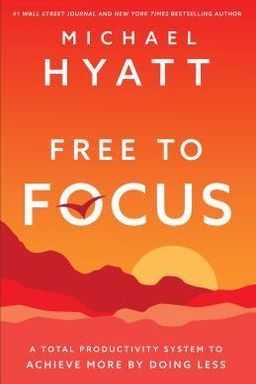
Free to Focus cover

Free to Focus

by Michael Hyatt

In ''Free to Focus,'' Michael Hyatt presents a revolutionary productivity system that defies conventional wisdom. By prioritizing essential tasks and minimizing distractions, readers can achieve more by doing less. Learn to harness the power of focus, rejuvenation, and strategic planning to enhance both personal and professional success.

Becoming Free to Focus: Redefining Productivity for a Distracted World

How often do you end your day exhausted but unclear about what you actually achieved? In Free to Focus, productivity expert Michael Hyatt argues that the modern obsession with busyness and efficiency is sabotaging our potential. Hyatt contends that true productivity isn’t about doing more—it’s about doing the right things in a way that allows you to live a more fulfilled and balanced life.

At its heart, this book is not just another time management manual. Hyatt designs a holistic system for achieving meaningful results while regaining freedom and energy. He calls this system “Free to Focus,” and it revolves around a three-step framework: Stop, Cut, and Act. This isn’t about squeezing more into your calendar; it’s about learning to slow down, clarify what matters, and rebound with purpose.

The Distraction Economy and the Myth of Busyness

Hyatt begins with a story of his own burnout—working endless hours as a publishing executive until stress nearly landed him in the hospital. The diagnosis? Stress, not heart failure. His doctor’s warning was clear: Unless he changed his approach to work, his health would deteriorate for real. In this, Hyatt mirrors the predicament many face in what he calls the Distraction Economy—where endless notifications, emails, and meetings consume our focus. He insists that the modern world confuses movement with progress, mistaking a packed schedule for productivity.

Drawing on research from Nobel laureate Herbert Simon—who wrote that “a wealth of information creates a poverty of attention”—Hyatt frames focus as the true currency of success. We live in an age where attention is our most valuable and besieged resource. Yet, most of us fail to protect it, scattering our energy across too many low-value activities. The cost? Lost creativity, constant overwhelm, and a haunting sense that we’re always falling behind.

The Three-Step Framework: Stop, Cut, Act

To counter these forces, Hyatt introduces the three-step “Free to Focus” system. It’s built to help you achieve more by doing less.

  • Stop – The first paradox: productivity starts with stopping. To regain control, you must clarify your purpose, assess where you are, and replenish your energy. Hyatt guides readers through exercises to formulate a vision (decide what truly matters), evaluate your course (using his signature tool, the Freedom Compass), and rejuvenate your energy (through intentional rest and self-care).
  • Cut – Once clear, you must eliminate. Learning to say “no”—to meetings, commitments, or even admirable tasks—is pivotal. Hyatt teaches how to eliminate the unnecessary, automate repetitive tasks, and delegate the rest. This is the pruning phase, where you remove the clutter from your work and life.
  • Act – Finally, reclaiming focus requires execution. Hyatt shows how to plan your week for peak performance, design your daily priorities, and protect your focus from interruptions and distractions. His step-by-step methods—like the Ideal Week, the Weekly Big 3, and the Daily Big 3—turn vision into action.

Why This Model Matters Today

Hyatt isn’t alone in sounding the alarm against overwork. Writers like Cal Newport (Deep Work) and Greg McKeown (Essentialism) have issued similar calls to focus on high-value work, but Hyatt’s contribution is distinctively comprehensive and behaviorally grounded. He doesn’t just tell you to “focus more”; he gives you the operational playbook for how to build structures around your focus. Through examples of clients like Rene, a private jet entrepreneur who cut her hours in half, or Matt, a business owner who rediscovered family time, Hyatt demonstrates that being focused isn’t about willpower—it’s about systems.

“Focus is the bridge between dreams and achievement,” Hyatt insists. “You can’t create lasting results if you are perpetually distracted, perpetually exhausted, or perpetually busy.”

Freedom as the Ultimate Aim

The ultimate goal is not just task success—it’s freedom: freedom to focus deeply, to be fully present with loved ones, to be spontaneous when opportunity strikes, and even freedom to do nothing. Hyatt reframes productivity not as squeezing out every ounce of time, but as earning the space to breathe, think, and choose. His philosophy offers a countercultural vision—one where effectiveness and joy go hand in hand.

In the chapters ahead, Hyatt distills decades of executive experience and neuroscience research into actionable strategies. You'll learn how to align your work with your strengths and passions, recover energy through rest, prune activities that drain you, and plan days that deliver tangible results without burnout. In essence, this book helps you trade busyness for balance—and become truly free to focus.


Stop: Clarity Before Hustle

If you feel like Lucy in the I Love Lucy chocolate factory episode—trying to keep up with an endless conveyor belt of tasks—Hyatt wants you to stop chasing chocolates and ask a deeper question: Why are you doing all this in the first place? The most common mistake, he explains, is that we equate productivity with acceleration. But working faster without knowing where you’re going just means you’re getting lost more efficiently.

Formulate: Define True Productivity

Hyatt identifies three false objectives—efficiency, success, and freedom—and argues that most people mistake the first two for progress. Efficiency, rooted in Taylorism and assembly-line culture, still dominates knowledge work—but today’s workers need creativity and value, not speed. Success, meanwhile, often turns into “the more myth”—more goals, more hours, more profits—but also more stress and burnout. The real objective, Hyatt argues, should be freedom. True productivity means creating margin: the freedom to focus on what matters most, to rest, and to thrive.

Evaluate: The Freedom Compass

Once you know your “why,” you need a compass to guide your daily choices. Hyatt’s Freedom Compass helps you categorize every task according to two criteria: passion and proficiency. Where these intersect is your Desire Zone—the place where you do work you love and excel at. The other zones are Drudgery (you dislike and are bad at it), Disinterest (you’re good but bored), and Distraction (you enjoy it but aren’t great). The goal: spend 80–90% of your time in your Desire Zone. Hyatt’s clients, like Rene and Mariel, used this simple grid to cut their weekly hours almost in half while improving results.

Rejuvenate: Rest as a Productivity Strategy

Most people sabotage their focus by working too much and resting too little. Hyatt challenges the hustle myth head-on: “Work longer, achieve less.” Instead, he highlights seven practices that recharge productivity—Sleep, Eat, Move, Connect, Play, Reflect, and Unplug. Through stories of executives cutting hours but improving output, Hyatt proves rest isn’t idleness—it’s strategic recovery. (This mirrors Alex Soojung-Kim Pang’s thesis in Rest, which shows high performers average only four to five hours of true deep work per day.)

In the Stop phase, the paradox becomes clear: slowing down is the necessary precondition for moving forward. You can’t fix a frenetic life by running faster. You must pause, recalibrate, and orient yourself toward meaningful work.


Cut: The Art of Saying No

Once you’ve identified what matters, the next step is courage—because clarity is useless if you’re still drowning in commitments. Hyatt’s second pillar, Cut, is about eliminating, automating, and delegating everything outside your Desire Zone. To do this well means confronting fear, guilt, and the ingrained habit of saying yes.

Eliminate: Mastering the Power of No

Time, Hyatt reminds us, is a zero-sum game: every yes is an unspoken no to something else. He encourages readers to see each decision as a trade-off: “If you say yes to a client dinner, you’re saying no to dinner with your spouse.” To help, he draws on Harvard professor William Ury’s “positive no” framework: state what you are saying yes to (your core priorities), say no clearly, then reaffirm respect by offering alternatives. This approach preserves relationships while protecting your boundaries.

The Not-To-Do List is Hyatt’s signature tool for pruning distractions. Like Michelangelo chiseling David from marble, productivity comes from subtraction. Eliminating gives shape to your best work.

Automate: Subtract Yourself from the Equation

Automation is any system that removes repetitive decision-making from your brain. Hyatt distinguishes four forms: self-automation (rituals like morning routines), template automation (reused email scripts), process automation (documented workflows), and tech automation (apps, macros, or task software). Each frees cognitive energy for higher-level work. For example, Hyatt’s team uses email templates and macros to handle hundreds of inquiries with personalized efficiency. The principle is simple: solve once, systemize forever.

Delegate: Clone Yourself—or Better

Delegation is buying back your time. Citing research by Harvard’s Ashley Whillans, Hyatt notes that people who pay to offload disliked tasks report greater happiness and productivity. His Delegation Hierarchy helps you prioritize what to pass off—starting with Drudgery Zone tasks, then Disinterest, and finally Distraction Zone items. His Five Levels of Delegation—from doing exactly as instructed to autonomous ownership—ensure trust develops gradually. Leaders who delegate effectively, like Hyatt’s client Caleb, end up doubling business results while cutting hours. The moral? You don’t lose control when you delegate—you multiply it.

“Innovation means saying no to a thousand things,” Hyatt quotes Steve Jobs. Focus demands the courage to cut—even good things—to protect the great.


Act: Turning Priorities into Execution

After stopping and cutting, you’re ready to move. The final phase, Act, translates focus into consistent results. But Hyatt warns: without structure, action collapses into chaos. The three disciplines—Consolidate, Designate, and Activate—form a playbook to execute without overwhelm.

Consolidate: Plan Your Ideal Week

Multitasking is a myth. Hyatt combines insights from Cal Newport and Annie Dillard to show that attention residue destroys effectiveness. His solution: MegaBatching—grouping similar tasks into focused days or time blocks. He also introduces the concept of stages: Front Stage (core work), Back Stage (preparation and maintenance), and Off Stage (rejuvenation). By mapping them onto your calendar, you build an Ideal Week—a proactive plan that allocates quality time for goals, meetings, and rest. Like budgeting money, you budget your time in advance.

Designate: Prioritize Your Week and Day

To prevent overload, Hyatt introduces the Weekly Preview system—review wins, lessons, and upcoming deadlines—and then define your Weekly Big 3: three high-value outcomes that move your big goals forward. Each day, you do the same for your Daily Big 3. This limits focus to what truly matters and ensures alignment. It’s an antidote to endless to-do lists and what Hyatt calls “loss of task separation.” The payoff: momentum, control, and peace at day’s end.

Activate: Beat Interruptions and Distractions

Finally, Hyatt confronts the twin enemies of execution: interruptions (external) and distractions (internal). His strategies include turning off notifications, creating office hours, and reframing restlessness as emotional discomfort to overcome. Citing cognitive science, he shows how switching tasks dings your IQ and shortens attention spans. His prescription: delayed communication, boundary-setting, and environment design. True focus, Hyatt insists, comes from intention, not isolation—no Isolator helmet required.

Together, these practices ensure work doesn’t spill into life. You work smarter, not harder—finishing the day satisfied rather than spent. The Act phase converts purpose into performance and restores mastery over your time.


Freedom as the New Productivity Paradigm

Throughout Free to Focus, Hyatt redefines productivity as an act of liberation. Most systems promise control over time; Hyatt promises freedom within it. He offers four dimensions of freedom that you can internalize as both goals and metrics of success.

1. Freedom to Focus

This is the foundation. True success requires sustained concentration—what Cal Newport calls “deep work.” Hyatt’s system ensures you protect cognitive energy for meaningful contributions. Techniques like MegaBatching, Focus@Will music sessions, and delayed communication act as digital detox tools to strengthen your focus muscle.

2. Freedom to Be Present

Many of Hyatt’s clients discover that success means nothing if they can’t enjoy it. The goal is not merely time management, but attention management—so you can fully engage with your spouse, children, or creative passions without mental noise from work. Hyatt compares this to the Italian idea of la dolce far niente—the sweetness of doing nothing. Being present is itself a form of productivity, because it replenishes your capacity to contribute.

3. Freedom to Be Spontaneous

Rigid schedules, Hyatt warns, suffocate joy. True productivity leaves margin—room to pivot when opportunity strikes, whether that’s taking an unplanned walk with your kids or brainstorming an unexpected idea. Spontaneity thrives on structure: when you manage the essentials, you can play with the rest.

4. Freedom to Do Nothing

Finally, Hyatt’s most radical proposal: that doing nothing is productive—because it fuels creativity and self-awareness. He cites Churchill’s painting habit and research showing nature and leisure time drastically improve problem-solving. Rest is how intuition catches up to intellect.

In Hyatt’s world, productivity’s new measure is freedom. If your system earns you more hours but steals your soul, it’s broken. To be free to focus means to have the space, strength, and serenity to pursue what matters most—without apology.

Dig Deeper

Get personalized prompts to apply these lessons to your life and deepen your understanding.

Go Deeper

Get the Full Experience

Download Insight Books for AI-powered reflections, quizzes, and more.