
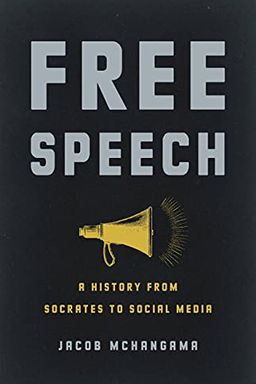
Free Speech cover

Free Speech

by Jacob Mchangama

Free Speech by Jacob Mchangama examines the evolution of this pivotal idea from ancient times to today. By highlighting key historical moments and their relevance to current debates, it underscores the importance of safeguarding free speech against rising global censorship and authoritarianism.

The Fragile Arc of Free Expression

What makes a society capable of tolerating dissent, and why does that tolerance so often erode? Throughout history, the freedom to speak, publish, and question authority has been one of civilization’s most precious—and precarious—achievements. This book traces that long arc from Athens to the age of social media, showing how free expression expands, contracts, and transforms across political orders, technologies, and crises.

The book’s core argument is that free speech is not a self-sustaining right but a fragile equilibrium maintained by institutions, civic norms, and public courage. From the agora of Athens and the forums of Rome to the presses of Reformation Europe and the anonymous crowds of the internet, periods of liberation are consistently followed by reactions that seek to contain or co-opt speech. Understanding that rhythm is crucial if you want to protect open inquiry in your lifetime.

Ancient Origins and Enduring Paradoxes

Athenian democracy introduced ideals like isēgoría (equal speech) and parrhēsía (frank speech), yet the very city that celebrated argument executed Socrates for his words. The Romans redefined liberty (libertas) as protection against domination, but their republic evolved into an empire where criticism could mean exile or death. These cases expose an enduring truth: free speech thrives on civic trust and collapses under fear, panic, or authoritarian ambition.

Across history, this cyclical drift toward new limits—what you might call “speech entropy”—reappears whenever crises make citizens trade openness for safety. Free expression’s meaning changes with circumstance, but its vulnerability remains constant.

Institutions, Inquisitions, and Technological Shocks

The medieval and early modern centuries illustrate how structure matters. Inquiry blossomed under the ʿAbbāsid caliphs’ decentralized intellectual networks and was crushed under the central bureaucracy of the Western Inquisition. Later, the printing press multiplied voices faster than authorities could suppress them, but it also provoked elite panic—from Reformation Europe to the censorship offices of monarchs and popes. New communication technologies, the section reminds you, always create both liberation and backlash.

When Martin Luther translated faith into mass pamphlets, he empowered individuals to read scripture but also unleashed radical conflict. Censorship evolved in tandem—licenses, indexes, monopolies—setting a pattern that would reappear with the internet five centuries later.

Enlightenment Promises and Contradictions

The Enlightenment reframed speech as an instrument of reason and civic progress. Yet its champions—Spinoza, Bayle, Voltaire, Diderot, Rousseau—remained ambivalent, preaching tolerance while courting power. Freedom advanced through practice, not purity: porous censorship, rival printing centers, and competing nations produced a de facto marketplace of ideas long before laws guaranteed it. The eighteenth-century debate set the foundations for modern civil liberty, even as colonial empires contradicted their own rhetoric abroad.

Modern Revolutions and Legal Frameworks

The American experiment, forged in pamphlets and public debate, institutionalized this culture into law. The First Amendment became a symbol of free-speech exceptionalism, but its endurance depended as much on habits of dissent and jury independence as on text. Later reforms, from the nineteenth-century press freedom movements to twentieth-century civil rights litigation, translated ideals into enforceable doctrine. The arc from Zenger to New York Times v. Sullivan and Brandenburg shows how dissenters transformed speech from privilege into right.

Repression, Totalitarianism, and Recovery

The book also confronts speech’s darkest defeats. The Soviet and fascist regimes of the twentieth century perfected censorship as a science, turning communication into propaganda and language itself into political weaponry. Bolshevik decrees defined freedom as party control; Goebbels’s media machine converted repetition and terror into public unity. Weimar’s well‐meant speech restrictions showed how democracies can undermine themselves by curbing liberty “temporarily.” Yet the postwar era, through the drafting of human rights instruments and the Helsinki dissident movements, reclaimed free expression as a universal value.

Digital Society and the New Battleground

Today’s battles over online platforms reprise ancient dilemmas in digital form. The internet decentralizes expression yet concentrates power in a few corporate moderators. Legal immunity (like Section 230) enables openness, while opaque algorithms decide visibility. States invoke disinformation and hate speech to justify restrictive laws; authoritarian governments cite Western precedents to defend their own controls. Meanwhile, civic innovators—from Taiwan’s g0v to investigative collectives like Bellingcat—demonstrate that transparency and participation can counter manipulation more effectively than blanket bans.

Core Message for You

Across epochs, free speech survives not merely through proclamation but through practice, institutional resilience, and cultural tolerance for discomfort. Every society invents moral and legal stories to justify repression—from protecting religion to preserving order—but the pattern remains: power fears speech that threatens its legitimacy. The book urges you to build and defend the civic habits, transparency, and pluralism that prevent fear from shrinking your public sphere. Freedoms, once lost, rarely return whole.


Ancient Origins and Civic Fragility

The story begins in classical antiquity because the origins of free speech are inseparable from the birth of democratic participation. Athens pioneered the principle that truth emerges from open contest, but its execution of Socrates reveals how easily majorities betray that ideal. You should see this paradox—courageous debate coexisting with lethal intolerance—as the enduring DNA of speech politics.

Greek Ideals and Collapse

In Athens, isēgoría gave every citizen voice in the assembly, while parrhēsía celebrated frank speech as civic duty. Pericles praised debate as democratic strength. Yet when fear gripped the city during wartime, conversation turned into accusation. Socrates, accused of corrupting youth, stood for the principle that inquiry may offend; his death signaled how fragile openness can be when moral panic meets political insecurity.

That early drama introduced the recurring theme of “speech entropy”: expansion followed by suppression under stress. A similar pattern appeared in Rome—vigorous senatorial jousts under the republic giving way to imperial censorship and the criminalization of “literary treason.” Tacitus’ praise of Aulus Cremutius Cordus, executed for praising Brutus, underlines how martyrdom often preserves memory when speech itself is outlawed.

Lessons for Modern Democracies

These early experiments expose two enduring mechanisms: crises prompt censorship, and elites justify it in the name of order or morality. When institutions weaken or civic trust erodes, even societies proud of tolerance revert to silencing dissenters. That reality makes ancient history more mirror than myth. If you value modern free expression, you must cultivate not only laws but also the civic habits that bear disagreement without retribution.


Faith, Inquiry, and the Medieval Balance

After the fall of Rome, faith and empire set the terms of permissible thought. The medieval world mixed inquisitorial control in Western Christendom with a surprising pluralism in parts of the Islamic world. This section asks you to reconsider stereotypes: the so‑called Dark Ages contained both darkness and light.

Curiosity and Decentralization in the Abbasid Era

Under the ʿAbbāsids, translators, physicians, and philosophers—Greek, Arab, Christian, Zoroastrian—flourished in Baghdad. Without centralized censorship, figures like al‑Rāzī and Avicenna debated religion and science with astonishing freedom. Even skeptics like Ibn al‑Rāwandī sometimes faced intellectual refutation rather than execution. Inquiry thrived because authority was diffused across courts, schools, and patrons.

Inquisitions and Systematic Repression

Contrast that with Latin Europe, where the Church transformed sporadic burnings into machinery. Manuals like Bernard Gui’s Practice of the Inquisition prescribed interrogation, secrecy, and punishment to preserve orthodoxy. The genius of the system was bureaucratic: by recording and institutionalizing suspicion, it made censorship self‑perpetuating. The archive replaced mob vengeance with administrative persecution.

Yet universities acted as escape valves. In Bologna, Paris, and Oxford, scholars debated banned texts and found sanctuary in corporate autonomy. Think of Thomas Aquinas reconciling Aristotle with Christianity while earlier bans still stood. These porous boundaries show that even tightly policed cultures host subversive curiosity.

The broader lesson is clear: intellectual life depends less on theological tolerance than on institutional pluralism. When power centralizes, dissent ossifies. When multiple authorities compete, ideas breathe.


Printing, Reform, and Modern Publics

The invention of movable type around 1450 was the single greatest acceleration in the history of speech. Gutenberg’s press democratized access to information but also exposed how every medium amplifies both truth and disorder. If you imagine Facebook in the sixteenth century, you glimpse the disruptive energy of cheap print.

Luther’s revolution and elite fear

Printing turned Martin Luther’s 1517 protest into a continental earthquake. His vernacular tracts, illustrated and inexpensive, reached artisans and merchants, and the Reformation became a media revolution. But empowerment came with upheaval: interpretation without hierarchy fueled peasant uprisings that Luther himself condemned. The same press that empowered conscience also spread chaos.

Adaptation of Control

Authorities responded inventively rather than ignorantly. The Index of Forbidden Books, printer monopolies, and licensing laws became the operating system of modern censorship. Islamic polities hesitated to adopt Arabic printing, partly for religious and guild reasons, illustrating how socio‑political context mediates technology’s impact. The pattern repeats with each wave of communication—from radio to the web—where elites invoke protection to retain control.

The enduring message: technology can spread knowledge, but liberty depends on who governs the choke points. Every new medium redistributes power and triggers both innovation and panic.


Enlightenment to Revolution

By the seventeenth and eighteenth centuries, Europe’s fragmented print culture formed the incubator of modern liberal speech. The Dutch Republic offered haven to banned authors; English dissenters pushed legal limits; and American revolutionaries fused theory with action. Freedom emerged from competition rather than consensus.

The Thinkers of Toleration

Spinoza’s call for freedom to philosophize, Bayle’s defense of conscience, and Milton’s Areopagitica argued that truth benefits from contest. Yet governments continued to prosecute sedition and heresy. Enlightenment rhetoric thus outpaced law, but practice made progress: underground editions, porous frontiers, and mercantile incentives diffused ideas faster than edicts could suppress them.

Revolutionary Transformations

Across the Atlantic, pamphlets like Paine’s Common Sense forged public opinion into revolutionary action. The U.S. First Amendment codified a principle that governments must tolerate criticism as part of sovereignty derived from the people. But even that new republic soon tested its ideals: the Sedition Act of 1798 criminalized dissent during fear of foreign subversion. The contradiction became enduring proof that liberty’s enemies often masquerade as its guardians.

The revolutionary legacy is twofold: free speech acts as democracy’s foundation and its first casualty under stress. Its survival depends on citizens habituated to argument, not on parchment alone.


Backlash, Reform, and Rights Expansion

The nineteenth and twentieth centuries saw global struggles to align law with ideals. Industrialization, empire, and new, literate publics collided with reactionary control. From Metternich’s Carlsbad Decrees to the working‑class press in Manchester, the period demonstrates how repression breeds resilience.

Economic Levers and Dissident Persistence

Governments taxed paper or licensing to stifle radicals; activists circumvented by creating unstamped presses. Trials of figures like Richard Carlile and the arguments of John Stuart Mill exposed moral hypocrisy and generated sympathy. Mill’s On Liberty crystalized the philosophical defense: silencing opinion robs mankind of truth or the clearer perception of error.

Empire, Race, and Unequal Speech

Meanwhile, liberal nations denied these principles in colonies and slave states. The “Slaver’s Veto” in the antebellum South outlawed abolitionist literature; British India rewrote sedition laws to silence independence movements. Frederick Douglass and the Grimké sisters used oratory to shame hypocrisy, while Gandhi’s trials revealed the moral power of refusing speech restrictions. The paradox of imperial liberalism gave universal rights their sharpest test.

Toward Equal Protection

Across abolitionism, suffrage, and civil rights, marginalized groups transformed freedom of speech into a liberation strategy. Their victories expanded the principle beyond property or race, making free expression synonymous with equality itself.


Democracy Under Siege

The twentieth century forced democracies to question whether absolute tolerance could survive totalitarian threat. From Bolshevik Russia to Weimar Germany and Nazi control, these experiments reveal how speech laws can defend or destroy liberty depending on design.

Weimar’s Lessons and Authoritarian Appropriation

Weimar’s constitution combined liberal guarantees with Article 48’s emergency powers—an opening Hitler later exploited. Press bans meant to contain extremism instead legitimized censorship and gifted Nazis with a centralized media system they quickly weaponized. This teaches a hard rule: temporary restrictions rarely remain temporary.

Totalitarian Engineering of Speech

Lenin’s “Decree on the Press” and Stalin’s Glavlit bureaucracy institutionalized control so absolute that language itself became an extension of the party. Tens of thousands of censors and laws like Article 58 turned private doubt into criminal propaganda. Fascist Italy and Nazi Germany mirrored this logic, fusing broadcasting, print, and education into synchronized monologue. Goebbels’s Editors Law and propaganda ministry exemplified how modern technology magnifies tyranny when independence vanishes.

These regimes remind you that propaganda is not merely falsehood but the elimination of alternatives. Freedom dies not in silence but in orchestrated chorus.


Rebuilding Freedom after Catastrophe

After 1945 the world faced twin imperatives: prevent fascism’s return and restrain new authoritarianism. Human rights law, Cold War rivalry, and civil movements together reimagined speech as both shield and weapon.

Universal Declarations and Disagreements

The United Nations debated whether free expression should be unconditional (as the U.S. urged) or limited to prevent incitement (as the Soviets and postcolonial states proposed). The compromise—UDHR Article 19 and ICCPR Article 20(2)—reflected this tension. Eleanor Roosevelt warned that vague hate‑speech bans could cloak repression; decolonized nations insisted protection from racist propaganda was essential. The contradiction remains unresolved, shaping current law.

From McCarthy to Civil Rights

Within the U.S., postwar fear spawned McCarthyism and the Smith Act, only to be corrected by civil rights litigation. The Supreme Court’s rulings in Sullivan and Brandenburg redefined limits with unprecedented breadth: speech may only be punished for intentional incitement of imminent lawless action. The NAACP’s battles over association and protest elevated expression into a tool for equality.

Paradoxically, protecting objectionable speech became essential to advancing justice. By defending the right of racists to march in Skokie, courts preserved the very framework that empowered the oppressed to dismantle segregation.

Helsinki and Global Resonance

The Helsinki Final Act of 1975 turned human‑rights language into leverage for Eastern bloc dissidents. Groups like Charter 77 and Poland’s Solidarity used speech rights as strategic instruments against totalitarian regimes. Combined with international publicity, these efforts demonstrated that open expression can erode repression from within—proof that words can outlast walls.


Speech in the Digital Age

In the twenty‑first century, the battlefield of free expression has migrated online. The internet promised universal voice but produced paradoxical concentration of power in corporate platforms. This final section argues that your generation faces an ancient problem armed with novel tools: how to secure open discourse when algorithms, governments, and mobs all compete to define acceptable speech.

Platform Power and Private Censorship

Section 230 of U.S. law enabled platforms to host user content without liability, catalyzing communication revolutions. Yet a handful of companies—Google, Meta, X, TikTok—became de facto gatekeepers of global conversation. Their opaque moderation rules mirror historical licensing systems, though justified by community standards instead of divine or royal authority. When elites panic over misinformation or hate speech, platform crackdowns spread worldwide, often imitated by authoritarian governments.

Disinformation, Regulation, and Civic Alternatives

Empirical studies show fake news is smaller but more influential than perception suggests; most harm arises where trust already collapses. Blanket removal rarely works and sometimes amplifies extremism (the modern “Streisand effect”). Instead, transparency, digital literacy, and counterspeech technologies—like Taiwan’s participatory platforms or investigative collectives such as Bellingcat—offer democratic correctives.

The emergent lesson parallels every era before: sustain a plural public sphere. Regulate concentration, demand procedural accountability, and favor openness over paternal protection. The tools change; the moral hazard of silencing remains.

Dig Deeper

Get personalized prompts to apply these lessons to your life and deepen your understanding.

Go Deeper

Get the Full Experience

Download Insight Books for AI-powered reflections, quizzes, and more.