
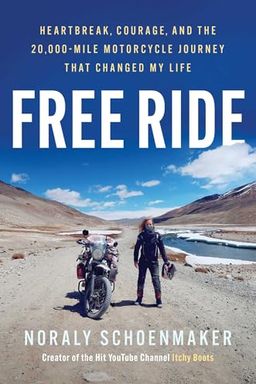
Free Ride cover

Free Ride

by Noraly Schoenmaker

The creator of the YouTube channel Itchy Boots recounts the transcontinental motorcycle ride she took after personal and professional changes.

Riding Into a New Life

When your life breaks in two, what kind of road could stitch it back together? In Free Ride, Noraly Schoenmaker (the creator of Itchy Boots) argues that freedom and identity aren’t discovered in a single bold leap but forged mile by mile—through motion, mishaps, hospitality, and the daily discipline of courage. She contends that the road can be a teacher as real as any mentor, that strangers can be your safety net, and that creative work—filming, writing, sharing—can turn raw experience into purpose.

Across twenty-five countries—from India’s Himalayan passes and Oman’s wadis to Iran’s deserts, the Pamirs of Tajikistan, the Kazakh steppe, and on to Europe—Schoenmaker rides a modest Royal Enfield Himalayan named Basanti. She leaves a life upended by betrayal and the loss of her home and career, and builds a new one in motion. Along the way, she burns out a clutch in Iran and is rescued by shepherds, braves frost and hypoxia on the Ak-Baital Pass at 15,272 feet, confronts the absurdities of Turkmen bureaucracy, and learns to separate people from regimes in places too easily caricatured by headlines.

What This Journey Is Really About

At its core, the book is a blueprint for reinvention: turn heartbreak into horsepower; trade certainty for skills and systems; and alchemize risk into stories that help others see the world differently. Schoenmaker shows you how to blend grit with grace: learn to wrench on your bike in Delhi’s Karol Bagh; swallow your pride after crashing on the Rohtang Pass; accept a TV interviewer’s broken-English welcome in Bafgh; and say no to a tantalizing Afghan detour when online threats escalate. It’s equal parts travel memoir, creative manifesto, and field guide to self-reliance.

Big Ideas You’ll Explore

  • Reinventing after rupture: From a shattered relationship and the sale of her house to a handshake deal at a Kashmiri wedding that gets her a bike and, eventually, a new career.
  • Letting the road train you: Skills stack in the wild—mechanics in Karol Bagh, off-road fundamentals in Oman, border playbooks across Central Asia, and judgment in deserts where a wrong line can sink you.
  • People vs. regimes: How Iran’s warmth can coexist with rules that frustrate and frighten; why Turkmenistan’s spotless marble capital feels dystopian while its border medics are kind.
  • Risk and logistics as freedom: Carnets, guides, transit visas, shipping crates, GPS checks, and the discipline that turns red tape into runways.
  • Solitude and storycraft: Managing fear and loneliness in the Kazakh emptiness, then transforming those feelings into films that connect millions.

Why This Matters to You

You don’t need to ride a motorcycle across continents to apply this playbook. The book models how to rebuild: get moving; learn visibly; create artifacts from your effort; trust people more than headlines; and use constraints (money, gear, visas, time) as design features, not excuses. If your life has hit a wall, you’ll find an approach to steer around it: small brave acts, repeated daily, compounding into competence and meaning (think Cheryl Strayed’s Wild for hikers or Ted Simon’s Jupiter’s Travels for riders, but filmed—in public).

Key Idea

Freedom isn’t the absence of limits; it’s the mastery of them—visas, weather, breakdowns, and fear—so you can keep going.

How the Story Unfolds

Part 1 covers India to Malaysia: the rented Himalayan baptism on the Rohtang Pass; learning to wrench with Satnam in Karol Bagh; starting a YouTube channel in Delhi; and riding east via Myanmar and Thailand to Kuala Lumpur. Part 2 jumps to Oman and Iran: off-road schooling with Peter Middleton, a desert rescue in the Lut, the love and contradictions of Yazd and Esfahan, and the hilarity and menace of Turkmenistan’s checkpoints before the stark beauty and danger of the Pamir Highway. Part 3 crosses the Kazakh steppe into Russia and on to Europe, where she sprints toward a new horizon: not back to India, but forward to the Netherlands—and a dotted line that soon stretches from Patagonia to Alaska.

Read Free Ride as a conversation between your future self and the part of you that’s scared to begin. The bike is the vehicle. The method is motion. The destination isn’t a point on a map—it’s a person you become by staying on the throttle.


From Ruin to Reinvention

Reinvention starts with a rupture. For Noraly Schoenmaker, it wasn’t a gentle nudge; it was an implosion—discovering her partner’s affair, losing the home she loved when the bank wouldn’t count her expat income, and facing a boss who hinted she might be grounded in the Netherlands. In the void, she defaulted to her lifelong pattern: motion. She quit her dredging job (after years in places like Brazil and Kazakhstan), sold her Ducati Monster, and flew to India with a backpack and a vague idea to blog.

The Turning Point at a Wedding

In Srinagar, Kashmir, during a three-day wazwan feast for a lavish wedding, she met Irfan—a distant relative of the bride—who casually solved her biggest barrier: “I can register a bike in my name for you.” Within days she owned a Royal Enfield Himalayan. She named it Basanti (after the heroine in the Indian classic Sholay), because if she couldn’t always be the heroine, her motorcycle could represent that courage in metal. One handshake became a life route: ride from Delhi to Malaysia. The blog wasn’t catching fire, so she pivoted to video—Itchy Boots—filming with a helmet camera and learning to edit as she went. (Compare this maker’s arc to Austin Kleon’s Show Your Work: she embraced messy public learning.)

Micro-Steps, Not Master Plans

Her plan was deliberately small. She scoped the map: Pakistan felt risky on an Indian plate; China would require an expensive guided convoy; so she went east. Bureaucracy forced her pace: a required guide for Myanmar meant a hard date at the border. She raced Delhi smog, learned street survival in Lucknow, and inched through hairpins to Darjeeling, stalling, dropping the bike, and bracing under the stares that greet a blond woman on a big motorcycle in India. Each day-end video became proof-of-progress to herself and an invitation to strangers to ride along.

Building the Creative Engine

The YouTube grind became her new job: ride–film–edit, repeat. She hit 1,000 subscribers and 4,000 watch-hours in Malaysia, unlocking monetization—a tiny revenue tap but a huge psychological milestone. Meanwhile, she learned the paperwork game: a Carnet de Passage (collateralized at roughly US$4,500 with the WIAA’s Mr. Dossa—picture a cash-stuffed jacket pocket and lassis at the Vega restaurant). She practiced saying “geologist” at borders to avoid jobless stigma. This was entrepreneurship in riding gear: shipping quotes, gear hacks (mesh jacket for Thai heat; hydration pack; top box), and audience-building, all while crossing continents.

A New Identity, Mile by Mile

What did reinvention feel like from the saddle? Part grief-extraction—crying into a helmet to Rag’n’Bone Man’s “Skin” through Ladakh; part competence compounding—fixing small things, like a kill-switch “reset,” and then bigger ones. In Kuala Lumpur, a shipment delay forced patience; in Muscat, she found Peter from Oryx Adventures and finally took real off-road lessons. She stopped backpacking and became a rider-filmmaker with a viable flywheel: story fuels subscribers; subscribers fund more days on the road; more days deliver deeper stories.

Key Idea

You don’t reinvent with a master plan—you reinvent by making the next true move visible, then stacking a hundred more.

Try It Yourself

  • Name your vehicle—literal or metaphorical. It externalizes courage (as Basanti did) so you can borrow it on hard days.
  • Trade “someday goals” for a border date. A fixed constraint (like Myanmar’s guide schedule) mobilizes action.
  • Publish in public. Messy, frequent output attracts allies and turns fear into fuel. (See also Ewan McGregor & Charley Boorman in Long Way Round.)

Let the Road Train You

Schoenmaker’s competence wasn’t declared; it was earned in ditches, workshops, and hairpins. If you’ve ever sworn that you’ll get “ready” before you begin, her field curriculum will challenge you: begin, then get ready as you go. She learns in concentric circles—from Karol Bagh’s chaos, to Himalayan gravel, to Omani wadis, to the Pamir’s thin air—and each circle adds a skill that rescues her later.

Mechanics as a Literacy

In Delhi’s Naiwala Street, Satnam teaches her to change clutch cables, oil, filters, brake pads, and tires; to grease chains; and to decipher the Himalayan’s guts. She photographs each step because she knows mastery will lag the lesson. These basics matter when Iranian mountain mud burns her clutch plates into blackened art and a village mechanic (Hamed) and bystanders help swap in the full spare clutch she had insisted on carrying—against all advice. It becomes the single most consequential weight in her pannier.

Off-Road Body English

In Muscat, Brit expat Peter Middleton puts her on a light CCM 450 and drills sand braking, steep descents with clutch–brake balance, and river fording. Those drills pay dividends on the Pamir’s corrugations and Tajik creek crossings, where the wrong line or speed buckles you into a boulder. She doesn’t become a rally ace; she becomes a rider who can keep moving. (Think of it as the difference Robert Pirsig makes in Zen and the Art of Motorcycle Maintenance: care + technique = quality of experience.)

Judgment in Deserts and Passes

Deep in Iran’s Dasht-e Lut, seduced by picture-perfect trees, she rides off the road and sinks into a sabkha—a salt flat masquerading as crust. Three men appear and push her out. Minutes later, at the mouth of a remote desert trail that promises the Rig-e Yalan dunes and Snake Tongue Canyon, she looks at the light, the wind, the temperature, and her near-miss and turns back. It’s not cowardice; it’s wisdom upgraded by experience. Similarly, at 15,272 feet on the Ak-Baital Pass, she manages throttle with numb fingers inside perforated “summer” gloves—a gear mistake she owns—and salvages the day with heat from strangers’ stoves.

Learning Loop: Fear → Skill → Story

Each scare becomes a segment in a bigger loop. She crashes on India’s Rohtang Pass, learns to lift a loaded bike alone, then films more confidently. She cooks a clutch in Iran, carries critical spares thereafter, and teaches those tradeoffs on camera. She misjudges no-man’s-land mud toward Kyrgyzstan, and codifies a pre-pass checklist. The viewer sees not performance but growth—and growth is stickier than bravado.

  • Actionable takeaways: carry a full clutch pack; use mesh for tropics but protect hands for altitude; practice U-turns and uphill hairpins loaded; photograph your own maintenance; pre-plan fuel in Murghab and carry clean oil for the Pamir.
  • Mindset: competence is cumulative. If you keep moving, the road will apprentice you.

People, Not Regimes

Free Ride refuses to flatten countries into headlines. Instead, it separates citizens from systems and lets you feel both at once—how you can be escorted by kind police in Iran in the morning and harassed by bored men in Esfahan by afternoon; how you can marvel at Turkmenistan’s white-marble Ashgabat while side-eyeing its rules about car colors and beards.

Iran’s Generosity—And Its Frictions

In the Alborz, after a bridge washout strands her mid-mountain, an elderly couple (Shams Ali and Sakineh) and their grandsons feed her, give her a room, and help shepard Basanti home. In Bafgh, a TV crew finds her at a traffic circle and insists she shout “Welcome to Bafgh!” into their camera. Mechanics like Hamed open their workshops on a Friday to resurrect her charred clutch. Yet in Esfahan, walking alone without the aura of a motorcycle, catcalls and hissing drive her back to the hostel. And the hijab—worn dutifully for weeks—is both a shield and a suffocation until she crosses into Turkmenistan and breathes.

Turkmen Theater

Border doctors shine lights in her eyes and take forehead temps; soldiers ask, deadpan, if she carries grenades. In a small office, officials insist she return a mysterious GPS tracker “given in Iran.” She never received one. After a phone call, they wave her off. It’s farce with a whiff of menace, contrasted by simple human kindness—like the men who guide her to the flaming Darvaza crater at sunset.

Central Asia’s Quiet Kindness

In the Pamirs, truck drivers pull her into a heated cab so she can thaw her hands; a Tajik border guard gently peels off her frozen gloves and warms her boots by the stove; Kyrgyz roadside vendors hand her kurut (fermented milk balls) with pride—she chokes on them and they laugh with her. In Murghab, fuel appears in a repurposed water jug. In dozens of villages, kids run to greet her, ask her name, and introduce themselves in rehearsed English.

Key Idea

Travel ethically by honoring people over narratives. Systems can be ridiculous or repressive; humans are the reason you’ll keep believing in the road.

(Context: Ted Simon’s Jupiter’s Travels also emphasizes this citizen-over-system lens; Schoenmaker updates it for a YouTube era, where a camera can amplify dignity or caricature—she chooses the former.)


Risk, Bureaucracy, and Flow

If freedom is movement, bureaucracy is often the price of admission. Schoenmaker turns paperwork into ritual—then into momentum. Her approach is a portable framework you can adapt to any high-friction project: learn the rules; assemble the kit; negotiate with grace; build buffers; know when to turn around.

The Border Playbook

She learns a reliable sequence: park in single file; remove helmet and smile; present the Carnet (where applicable), registration, passport, and—if asked—license; buy local liability insurance; trade cash with border changers; and get a SIM if you can. She writes “geologist” on forms because “unemployed” raises eyebrows. In Myanmar, a mandatory guide corrals all riders; Thailand threatens the same but at a small crossing waves her through. Turkmenistan wants a straight-line transit plan; a gruff officer jabs at a map, lines out the “no-go” zones, and sends her off.

Shipping and Crating

To leap from Malaysia to Oman, she builds a crate from scratch with a freight company new to motorcycles. They scavenge plywood and nails after Chinese New Year closures; she drops the bars, removes the battery, and plays Tetris to shrink the billable volume. When Muscat customs can’t import a “motorcycle” because it doesn’t exist in the software (horses do!), her hotel owner says, “I own the airport,” makes a call, and customs releases Basanti. It’s ridiculous—and a reminder to grow a network, not just a toolkit.

Red Lines and Retreats

She defines personal lines: no sabkhas without company; no Afghan detours when troll threats escalate; no staying in Ashgabat longer than needed; no night riding on the Kazakh steppe. On the Lut trail and later in snowbound passes, she proves that turning back is a skill, not a failure. Flow returns once prudence holds the pen.

Field Logistics → Creative Freedom

Visas, fuel caches (Murghab), oil choices, and spares aren’t bureaucratic sidelines—they’re the scaffolding that makes story possible. The faster she gets through borders, the more daylight she reserves for the riding and filming that fund the next day. You can treat admin as drudgery or, like her, as choreography.

  • Adopt this kit: document pouch; cash in small bills; photocopies; pen; a short script for your job; and a mental checklist for each crossing.
  • Adopt this cadence: morning miles; midday snack; early arrival; film/edit before dark; sleep; repeat.

Solitude as a Discipline

Adventure literature glamorizes solitude, but Free Ride treats it as a muscle. Some days it’s a superpower—laser focus in tricky terrain; other days, it’s a tax—mind loops, grief flashbacks, and the ache for a shared glance. Schoenmaker learns to manage both the ups (“Pamir high”) and the flats (Kazakhstan’s endless steppe).

The Emotional Weather

In Tajikistan’s dark Anzob Tunnel, she’s blinded by exhaust haze and headlights, then exits into a snow-bright world that feels like magic. On the Pamir, three miles of washboard and near-frostbite drag a primal “I want to go home” from her throat—only to be replaced by euphoria when a paved ribbon appears before Karakul. Emotional amplitude is part of the calculus; she doesn’t try to flatten it anymore.

Loneliness on the Steppe

Crossing Kazakhstan, her mind cycles back to a framed photo of the affair—pain replayed in 100-mile loops. She speaks to Basanti out loud, plays childhood car games in her head, and negotiates with sugar cravings in roadside shops. The discipline isn’t denying feeling; it’s continuing anyway, and noticing the human ballast when it appears: a shopkeeper’s smile, a random “Welcome” in Russia, or pancakes in a Kyrgyz kiosk.

Strategic Togetherness

She chooses company when it helps her grow: riding with Austrians Peter and Claudia through Myanmar and Thailand; composing a track with French cyclist Valentin in Dushanbe; swapping origin stories with Ganesha, the Singaporean student hitching to Montreal. Then she goes solo again, because solitude is how she hears herself. (This echoes Cheryl Strayed’s solo hike in Wild: aloneness as a forge.)

  • Create reliable rhythms (pack–ride–film–edit). Routines are anchors when geography is a blur.
  • Seed serendipity: stop for tea, accept the interview, ask directions even when you know them. People are the antidote to psychic drift.

Key Idea

Solitude is not the absence of connection; it’s the choice to carry your own weather—and to notice the shelter others offer.


Making Meaning With a Camera

Schoenmaker doesn’t just ride; she narrates. The camera is both mirror and bridge, turning hardship into instruction and strangers into co-authors. If you’ve wondered how to transmute adventure into livelihood, this is your case study in building a creative engine on the move.

Process Over Polish

It starts scrappy: loud music over Delhi traffic, helmet-mounted shots, and jump-cut diaries. Over time, the cadence steadies, the sound improves (thanks, Valentin, for a custom soundtrack built on a keyboard strapped to a bicycle), and the narrative tilts toward what viewers love: honest stakes, cultural curiosity, and a rider figuring it out in public. She doesn’t imitate the glossy production of Long Way Round; she offers something humbler—and more attainable.

Ethics and Boundaries

When an extremist forum amplifies her ride in Tajikistan with violent fantasies, she decides not to cross briefly into Afghanistan—even though locals say it’s safe in that corridor. The content would be spectacular; the moral calculus (and risk to dignity and safety) is not. She keeps filming what matters most: hospitality, effort, the texture of ordinary days, and the small wins that make a colossal route human-sized.

From Story to Support

Reaching YouTube Partner Program milestones in Malaysia gives her first revenue drip. Every border stamp becomes a beat; every rescue, a scene. Audience trust compounds: they don’t follow an invincible expert; they root for a capable beginner becoming advanced—on camera. That honest arc is a moat.

  • Film for utility (how to lift a bike; what to carry in Central Asia), not just spectacle.
  • Name helpers and places. Specifics repay generosity with dignity.
  • Accept constraints as your “look.” Viewers aren’t buying gear—they’re buying you.

(Context: Compare to Casey Neistat’s daily vlogs—speed and candor beat perfection; or to Paul Theroux’s travelogues, which prize ground truth over brochure gloss.)


Freedom Is a Direction

By the time she reaches Kyrgyzstan and later Russia, Schoenmaker confronts a subtle dread: returning. She’s not riding toward a new continent; she’s riding back to Europe. Her answer is profound in its simplicity—freedom is not a place; it’s a vector. In Tbilisi, Armenia, Türkiye, and the Balkans, she keeps moving. In Vienna, she reunites with rider friends, then presses on. At the Dutch border, hugging her family, she knows this nine-month, 22,370-mile ride was not an ending—it was a prototype.

Home, Redefined

Home is no longer a mortgage or a postal code; it’s a routine she can pitch anywhere: pack–ride–film–edit. It’s the trust that people will help, that paperwork will (eventually) clear, and that Basanti will start again after a push. It’s also a sequel forming in her mind: a dotted line from Patagonia to Alaska. She hasn’t just ridden out pain; she’s built a compass.

Apply It to Your Life

You don’t need a world map. You need a direction you can move in today. Rename a constraint into a catalyst (visa → deadline; small budget → story style). Replace the fantasy of permanent readiness with a system that tolerates fear and failure. And if your old life calls you back with comfort, remember: you can respect where you came from without riding in circles.

Key Idea

Freedom is not the absence of obstacles; it’s confidence in your ability to keep choosing the next right road.

(Note: This resonates with Antoine de Saint‑Exupéry’s Wind, Sand and Stars: meaning emerges from engagement with the world, not escape from it.)

Dig Deeper

Get personalized prompts to apply these lessons to your life and deepen your understanding.

Go Deeper

Get the Full Experience

Download Insight Books for AI-powered reflections, quizzes, and more.