
Idea 1
Framing: The Hidden Power Behind Human Decision-Making
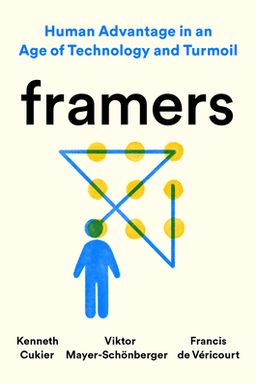
How do you actually make your most important decisions—what career to pursue, whom to trust, what issues truly matter? In Framers: Human Advantage in an Age of Technology and Turmoil, Kenneth Cukier, Viktor Mayer-Schönberger, and Francis de Véricourt argue that what distinguishes human intelligence isn’t our raw computing power or emotional depth—but our unique ability to “frame” the world through mental models. These frames—our internal blueprints for how things work—shape every judgment, innovation, and act of courage we make.
The authors contend that other species, and even artificial intelligence (AI), can collect data, follow patterns, and compute probabilities. But only humans can reinterpret situations, imagine what isn’t there, and ask “What if?” They call this ability framing—and they believe it’s both the secret of humanity’s success and its best hope in an age dominated by algorithms and polarization. As they put it, the challenge of our time is not developing more intelligent machines but becoming more deliberate framers ourselves.
The Power and Peril of Frames
Frames, they explain, are cognitive templates that simplify our complex world. You rely on them constantly—when choosing a route to work, judging a friend’s motives, or analyzing a financial opportunity. Like maps, frames sharpen some details while ignoring others, helping you navigate the overwhelming flood of information around you. But the same power that makes them useful also makes them dangerous. A misapplied frame can blind you to better solutions or reinforce bias. When Ben Bernanke used a historical model of the Great Depression to avert financial collapse in 2008, his framing saved the economy; when the Soviet Union used Marxist-Leninist ideology to guide agricultural policy under Lysenkoism, millions perished from famine.
The authors insist that frames aren’t inherently “good” or “bad.” What matters is whether they fit the context. Much of progress, they argue, comes not from better computing or more information but from people daring to shift perspective—Einstein reimagining time as relative, Mandela reframing power as reconciliation, or Alyssa Milano turning a simple tweet into the global #MeToo movement. Each breakthrough depended on reframing existing realities.
Why Framing Matters in an Age of AI and Extremes
Today, the authors argue, framing has become more urgent than ever. Society faces two temptations: the hyper-rationalists, who want to outsource judgment to AI and data, and the emotionalists, who claim instinct and passion are better guides than reason. Each group misses the uniquely human middle path—combining imagination and constraint, emotion and logic—to envision new possibilities responsibly. “Computers answer,” they write, “but humans frame questions never asked before.”
Framing gives humans agency. It lets you construct mental simulations, test options, and choose values under uncertainty—unlike AI, which merely calculates within the world it knows. It also allows societies to stay pluralistic and adaptable. When frames multiply and clash productively, innovation and democracy thrive. When a “single frame of truth” dominates—as in totalitarian regimes or ideological silos—societies stagnate or implode. The authors warn that today’s shrinking tolerance for alternative viewpoints, combined with overreliance on algorithmic decision-making, threatens to erase our cognitive freedom.
The Book’s Roadmap
To rediscover this human advantage, the authors structure Framers around nine central themes. They begin by showing how decisions always depend on frames, from Regina Barzilay’s AI-driven antibiotic discovery to Ben Bernanke’s rescue of the global banking system. They then unpack the cognitive ingredients that make framing possible—causality (how we understand cause and effect), counterfactuals (our ability to imagine what isn’t), and constraints (the boundaries that make imagination practical). Later chapters explore reframing—switching mental models entirely—and learning—how to cultivate a diverse set of frames through curiosity, education, and collaboration. The final chapters expand outward to pluralism and vigilance, arguing that societies survive not by converging on one worldview but by hosting many and defending the freedom to frame against machine or mob domination.
Why Framing Is Humanity’s True Edge
In an era when AI seems to outperform humans at complex tasks—from diagnosing disease to composing music—the authors turn the lens back on us. They show that intelligence alone doesn’t create meaning or progress. What sets humanity apart is cognitive agility: the power to frame, test, and reframe models consciously. As crises multiply—climate change, pandemics, political polarization—our survival won’t hinge on smarter technology but on cultivating the mental courage to see differently. The book closes by urging each reader to practice “agility of mind”: asking better questions, seeking diverse perspectives, entertaining tensions between frames, and deliberately shaping how we think.
Framing, then, isn’t just a clever cognitive trick—it’s the essence of human creativity, morality, and civilization itself. The authors remind us that “humans live not only in the world as it is but in worlds they imagine.” In learning to frame wisely, we reclaim the power to decide what kind of world that will be.