
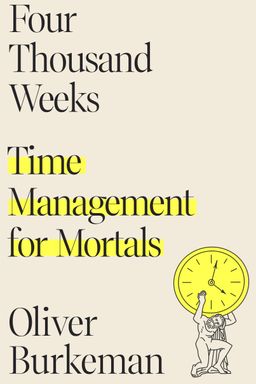
Four Thousand Weeks cover

Four Thousand Weeks

by Oliver Burkeman

Four Thousand Weeks challenges the relentless pursuit of productivity, encouraging readers to embrace their limitations and focus on what truly matters. By redefining our relationship with time, Oliver Burkeman offers a path to genuine fulfillment and happiness.

Making Peace with Our Finite Time

How can you truly make the most of your life when you have only about four thousand weeks to live? In Four Thousand Weeks: Time Management for Mortals, Oliver Burkeman turns the modern obsession with productivity inside out. Instead of teaching you how to cram more tasks into your day, he challenges the illusion that you can ever gain mastery over time. He argues that embracing finitude—not fighting it—is the key to meaning, productivity, and peace of mind.

Burkeman contends that all conventional time management systems fail because they start from the wrong premise: that with enough discipline, you can eventually control your schedule and reach some imagined state of balance. But the truth is more humbling and liberating. You will never get everything done. You will never achieve perfect equilibrium between work and life. The average human lifespan—about four thousand weeks—is insultingly short. Rather than despairing, Burkeman encourages you to embrace these limits as the doorway to a deeper appreciation of life itself.

The Essence of Finitude

The book begins by dismantling the myth of control. Since ancient times, philosophers from Seneca to Heidegger have wrestled with the strangeness of human existence—we have infinite mental capacity for planning but painfully little actual time to fulfill those plans. Modern productivity culture pretends this problem can be solved with apps, techniques, or early morning routines. Burkeman calls this “productivity as denial,” the modern attempt to overwrite mortality with spreadsheets.

He invites you instead to accept reality: life is terminal, unpredictable, and often overwhelming. Paradoxically, admitting defeat opens the possibility of freedom. When you stop struggling to fit infinite ambitions into finite hours, you begin to prioritize consciously instead of reactively. You can stop chasing a fantasy of mastery and face the beautiful mess of human life as it truly is.

Why It Matters Today

This approach matters because our collective relationship with time is broken. We live on a conveyor belt of endless tasks, fueled by digital distractions and capitalist pressures to stay “productive.” Busyness has become a badge of honor. Burkeman points out that technology meant to free our time—microwaves, email, smartphones—has only made us more impatient. He channels philosophers like Lewis Mumford and anthropologists like Edward T. Hall to show how society transformed time from the medium in which life unfolds into a resource to be optimized, bought, and sold. Once time became measurable and monetized, anxiety over its scarcity exploded.

During the pandemic, as routines disintegrated, many people experienced “the everlasting present”—days that dragged and raced simultaneously. Burkeman saw this confusion as an opportunity to reset our thinking: maybe we could stop trying to optimize and start paying attention. Life is not a dress rehearsal or a waiting line for efficiency. It’s happening right now, and the only sane response is to inhabit it fully.

Facing the Limit and Finding Meaning

Through vivid anecdotes—from medieval peasants who experienced time organically, to burnout-ridden millennials collapsing from “joyless urgency”—Burkeman traces humanity’s growing estrangement from time. His prescription is the “limit-embracing life”: a radical shift from seeing time as a possession to viewing it as something we are. You don’t have time; you are time. Once you grasp this, every choice becomes meaningful because every action represents a sacrifice of other possibilities.

Burkeman constructs his argument like a series of philosophical steps: first, acknowledge that efficiency is a trap; second, face the discomfort of mortality; third, let go of the fantasy of completion. Accept that missing out on things is inevitable—it’s what gives your choices meaning. By staying grounded in the present and working within your constraints, you gain not unlimited productivity but a life that feels full and real.

The Journey Ahead

Throughout the rest of the book, Burkeman unveils how to embody this philosophy in practical life. He explores why efficiency backfires, how procrastination can be an act of wisdom, how rest must be reclaimed from the tyranny of usefulness, and how cosmic insignificance can paradoxically be freeing. Drawing from writers like Heidegger, Jung, and Simone de Beauvoir, he connects timeless wisdom with our modern crisis of busyness. By confronting reality—the fact that life will never be mastered—you can make peace with impermanence and finally start living it.

Ultimately, Burkeman’s message isn’t about managing your four thousand weeks more efficiently—it’s about learning to use them meaningfully. He doesn’t offer tricks to stretch time. He teaches how to stop waging war against it. Once you embrace your limits, you discover that each finite moment can shimmer with enough beauty and presence to make the brevity of life not a curse but a gift.


The Efficiency Trap

Burkeman’s concept of “the efficiency trap” captures the paradox at the heart of modern productivity. You work harder and faster hoping to regain control of time, but every improvement only tightens the grip of busyness. He compares this endless cycle to an unstoppable conveyor belt: each task you complete simply makes room for more tasks, accelerating your life until exhaustion becomes inevitable.

Busyness as an Illusion of Importance

Burkeman traces this obsession back to early twentieth-century ideals of efficiency, from Arnold Bennett’s How to Live on 24 Hours a Day to the industrialist mindset inherited from factories. In Bennett’s world, time was a container too small for our ambitions. Yet, a century later, applying his advice still fails. If you fit more work into your schedule, new demands automatically expand to fill the space (C. Northcote Parkinson called this “Parkinson’s Law”). You feel busier, not freer.

Burkeman’s personal experiment with Inbox Zero offered proof. Clearing his email completely only produced more emails. He learned that being known as “efficient” is a curse—when you respond swiftly, people simply send more requests. The trap deepens when we mistake efficiency for virtue, believing that emptying our inbox will lead to the long-promised peace of mind. In reality, it just makes the conveyor belt run faster.

Existential Overwhelm

Efficiency isn’t limited to tasks—it infects life itself. Burkeman introduces the idea of “existential overwhelm,” the futile yearning to experience everything life has to offer. Modern progress convinces us that because the world is expanding, we must compress more into our fleeting existence. As sociologist Hartmut Rosa notes, we feel pressured to accelerate—not because we enjoy it but because we are haunted by the fear of missing out.

The travel addict ticking off bucket lists or the hyper-busy professional multitasking is caught in the same existential treadmill. The internet amplifies this by exposing infinite possibilities. Facebook lets you know there are dozens of events you could attend but never will. The root problem isn’t distraction—it’s denial of limits. Every click and calendar block is a rebellion against mortality.

Declining to Clear the Decks

Burkeman suggests an antidote: resist the urge to “clear the decks.” Most people tackle minor chores first to create space for meaningful work—but life quickly refills that space. True focus comes from tolerating the discomfort of unfinished tasks while attending to what matters most. Accepting that you’ll always have unresolved emails or chores frees you to engage in priority work with presence and patience.

Philosophically, this aligns with Nietzsche’s critique of modern haste—our avoidance of leisure and contemplation leads us to flee from ourselves. Slowness isn’t laziness; it’s sanity. In practice, this means deliberately limiting your projects, saying no to nonessential commitments, and resisting convenience that flattens meaningful experiences. Every “efficiency innovation,” from smartphone shortcuts to meal replacements like Soylent, removes texture from life. Convenience may save time but often steals meaning.

Choosing Limits Intentionally

The freedom Burkeman offers is paradoxical: liberation through limitation. True productivity comes not from doing more but from confronting what you cannot do. When you stop chasing total efficiency, you gain space for attention, wonder, and deeper human connection. Sylvia Keesmaat’s choice to live on a Canadian farm illustrates this beautifully—tending her fire and feeding animals every morning slowed her pace, yet filled her life with warmth and purpose. Sometimes, to live fully, you must build inefficiency into your day and defend it as sacred.


Facing Finitude

To embrace the limit-embracing life, Burkeman leads you into existential territory. Drawing on philosopher Martin Heidegger’s idea that humans are defined by their “Being-towards-death,” he argues that recognizing mortality isn’t morbid—it's essential. Finitude isn’t one problem among others; it’s the condition of being human.

We Are Time

Heidegger’s radical claim that “we are time” means your existence is inseparable from your unfolding moments. You don’t possess time as a resource; you are the finite interval between birth and death. Each choice you make sacrifices an infinite number of possible lives. Every decision is a “cutting off”—a Latin echo found in words like decidere (to decide) and suicide. Living authentically requires facing this reality instead of falling into what Heidegger calls “the everyday mode of falling,” a life of distraction and denial.

Bright Sadness

Burkeman explores modern thinkers who transform this awareness into joy. Philosopher Martin Hägglund argues that immortality would make life meaningless: if you lived forever, nothing would matter because there would be no urgency or scarcity. Only death makes priorities real. Similarly, artist Marion Coutts, writing after her husband’s terminal diagnosis, describes discovering an “absolute new law of perception”—that you will lose everything that catches your eye, so cherish the moment now. This “bright sadness” isn’t about happiness but about inhabiting reality completely.

The Joy of Missing Out

Facing finitude brings relief. As consultant Geoff Lye realized after his friend’s untimely death, even mundane frustrations like traffic can become sources of gratitude—what would the departed give to experience this moment? When you see every choice as a privilege of existence, missing out becomes liberation rather than loss. Burkeman calls this “the joy of missing out” (JOMO): the exhilarating realization that limitations make sense of life because meaning is found in choosing one thing and not another.

Finitude gives shape to meaning. When you stop demanding life guarantee fulfillment, you find it in small acts—a conversation, a sunset, your child’s laughter. To be alive in finite time is not to have less; it’s to finally recognize the miracle of having any time at all.


Becoming a Better Procrastinator

Contrary to popular wisdom, procrastination isn’t always a flaw—it can be strategic. Burkeman redefines it as the art of choosing what to neglect. Because you’ll never complete everything that could be done, wise living means deciding which tasks to defer or abandon with intention.

Pay Yourself First

Borrowing a metaphor from personal finance, illustrator Jessica Abel advises “pay yourself first” when it comes to time. Just as saving money requires putting funds aside before spending, meaningful work demands scheduling time for your priorities before handling obligations. Burkeman, inspired by this, suggests starting each day with the project closest to your heart—write, paint, play, or build—before everything else intrudes. Waiting for free time means waiting forever. You must protect a portion of each day for work that enlarges you.

Limit Your Work in Progress

Jim Benson and Tonianne DeMaria Barry’s Personal Kanban system, which caps active projects at three, inspired Burkeman’s next rule: never juggle more than a few priorities. If you’re working on everything, you finish nothing. Each new commitment must displace an old one. This limitation fosters deep engagement and forces you to confront what truly matters, echoing Seneca’s warning against wasting time on pursuits that don’t enrich your soul.

Resist Middling Priorities

Burkeman reinterprets an alleged Warren Buffett principle: list your top twenty-five goals, then focus on the top five and actively avoid the rest. The seductive middle ground—the “pretty good” friendships, projects, or ambitions—is what derails focus. Elizabeth Gilbert reminds us that you must learn to say no to things you actually want, because your finite weeks demand sacrifice. Mediocrity steals time more quietly than disaster.

Beyond Perfection

Burkeman illustrates perfectionism’s paralysis with Costica Bradatan’s fable of the architect from Shiraz, who burned his perfect plans rather than compromise with reality. Like Kafka—forever engaged yet never committed—we stall because we fear falling short. The solution isn’t mastery but acceptance: since real life will always fail to match imagination, you might as well start. Freedom lies not in control but in surrendering it.

To procrastinate well, then, is to choose consciously. You decide which ambitions to nourish and which to abandon. You trade the fantasy of limitless control for the peace of deliberate limitation—a trade that transforms procrastination from guilt into grace.


Rediscovering Rest

Rest is not a respite from work—it’s a vital expression of freedom. Burkeman argues that modern society, obsessed with productivity, has turned leisure into another form of labor. Even our relaxation must “pay off” in better performance. He traces this distortion back to the Industrial Revolution, when the clock replaced the sun as the ruler of daily life.

Leisure as Life’s Center

Aristotle saw leisure (schole) as humanity’s highest activity because it was done for its own sake. Labor was merely the interruption. Medieval peasants lived this truth unconsciously: their calendars brimmed with religious feasts and communal rest. By contrast, industrial capitalism made work the purpose of life and leisure merely recovery for more work. Burkeman calls this inversion tragic—we must reclaim rest as an end, not a means.

Philosopher Walter Kerr noted in 1962 that modern people are compelled to “party for contacts” and “read for profit.” Even vacations are justified as improving efficiency. As author John de Graaf’s Take Back Your Time campaign insists, we shouldn’t have to defend leisure in economic terms. Rest is valuable because it lets you inhabit pure existence.

The Sabbath Principle

To recover true rest, Burkeman looks to religious tradition. The Jewish and Christian Sabbath, he writes, is the original technology of rest—a communal interruption of striving. Everyone stops together, symbolizing trust that life will continue even when you cease hustling. Walter Brueggemann called Sabbath “resistance to the culture of now.” Its ancient rules—lighting no fires or even refraining from tearing paper—may seem absurd, but they reveal a truth: you need boundaries stronger than willpower to stop. In a society that never pauses, stopping requires structure, not spontaneity.

Idleness Aversion

Social psychologists term our inability to rest “idleness aversion.” Max Weber’s analysis of the Protestant work ethic links it to Calvinist anxiety—work became proof of salvation. Today, Danielle Steel’s twenty-hour workdays or the self-imposed pressure of gig culture reflect the same fear: that rest means inadequacy. Yet, as Zen teacher Charlotte Joko Beck observed, life becomes unbearable only when you believe the discomfort can be cured. True rest begins when you stop trying to fix existence.

Choosing Inconvenience

Rest therefore demands courage. You must face the anxiety of doing nothing and the guilt culture trains you to feel. Burkeman’s hikes through the Yorkshire Dales illustrate this release—a space where accomplishment disappears and simple presence remains. Rest isn’t laziness; it’s radical honesty about limitations. To stop striving is to discover that enough has always been enough.


Cosmic Insignificance Therapy

One of Burkeman’s most surprising remedies for time anxiety is “cosmic insignificance therapy.” Instead of trying to make your life monumental, he invites you to find relief in its smallness. Recognizing your irrelevance in the vastness of time is not depressing—it’s liberating.

The View from History

To illustrate scale, Burkeman uses philosopher Bryan Magee’s calculation that the entirety of human civilization—roughly six thousand years—spans only sixty centenarian lifetimes. The pharaohs ruled merely thirty-five lives ago; Henry VIII lived five. From this cosmic vantage, all human endeavors shrink to near-nothing. Yet seeing how little you matter brings peace: the universe doesn’t care if you reply to one more email or achieve greatness. You can finally put down the crushing expectation that your life must be extraordinary.

Freedom from Extraordinary Demands

Burkeman points out that most of us labor under an unrealistic standard of meaning, expecting our lives to “put a dent in the universe” like Steve Jobs or produce timeless art like Tolstoy. Philosopher Iddo Landau counters this delusion: you don’t criticize a chair for failing to make tea; why judge yourself by divine standards? Meaning doesn’t require global impact. Caring for your children, writing stories that touch a few readers, or helping one neighbor can be profound enough.

By confronting insignificance, you discover freedom from cosmic performance anxiety. The scale of the universe absolves you from perfectionism. Once relieved from the burden to be extraordinary, you can appreciate the miraculous ordinariness of being alive at all.

Living on a Human Scale

This shift in perspective turns attention toward present meaning. Preparing a meal, raising a child, or sharing laughter during a pandemic can matter as deeply as any grand accomplishment. After “The Great Pause” of lockdowns, many realized that care and community are ultimate measures of significance. Burkeman invites you to measure success by how fully you inhabit your finite weeks—not by what you leave behind.

Cosmic insignificance is not nihilism but acceptance. You are small, yet that smallness is what makes life beautiful and fleeting. To live meaningfully, you don’t have to transcend mortality—you must dwell inside it, fiercely aware that every moment, however tiny, is its own universe.

Dig Deeper

Get personalized prompts to apply these lessons to your life and deepen your understanding.

Go Deeper

Get the Full Experience

Download Insight Books for AI-powered reflections, quizzes, and more.