
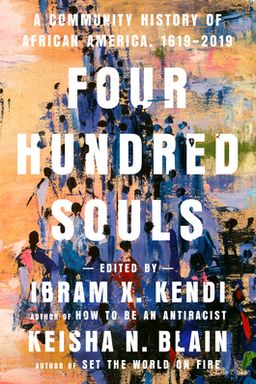
Four Hundred Souls cover

Four Hundred Souls

by Ibram X Kendi and Keisha N Blain

Four Hundred Souls is a groundbreaking history of African America from 1619 to 2019, told through the voices of 90 writers. This collective work explores the enduring struggle for freedom and equality, offering a nuanced perspective on America''s complex racial history.

Four Hundred Years of Survival and Resistance

How do you confront a history that was designed to erase you? In Four Hundred Souls: A Community History of African America, 1619–2019, Ibram X. Kendi and Keisha N. Blain invite readers into a radical project of memory. They argue that the story of African America is not a single narrative of suffering but a chorus of voices—each illuminating survival, resistance, creation, and community across four centuries. From the arrival of the first enslaved Africans on the White Lion to the rise of the Black Lives Matter movement, this book reveals how the fight for freedom has never ceased, only evolved.

The core of Kendi and Blain’s argument is simple yet profound: America was built not merely despite slavery but through it. The history of African Americans is the history of America itself—its structures, contradictions, and ongoing struggle to live up to its ideals. Each short essay and poem, written by ninety different contributors and organized chronologically, becomes a piece of a collective soul, each voice a window into a different era’s humanity. Through this structure, the book insists that no single person, policy, or rebellion can stand in isolation; they all form an interdependent mosaic of endurance.

The Human Cost of America’s Origins

Beginning in 1619, the book recounts the moment the first Africans were traded as cargo in Virginia. The story isn’t framed as a distant tragedy—it is personal, emotional, and political. You meet individuals like Go-Go, who cultivated tobacco and mourned the twin sister sold into slavery, and Anthony Johnson, who struggled between freedom and recapture. These early stories expose how slavery’s seeds were planted not through fate but calculated laws and social conditioning. The narrative dismantles the myth of inevitability—showing that enslavement was a series of decisions made to codify exploitation.

Law, Faith, and the Birth of Racism

As colonial laws developed, freedom became legally tied to whiteness. The Virginia Law on Baptism (1667) and Elizabeth Keye’s trial in 1659 reveal how the state and church combined forces to make racial hierarchy sacred. Christianity, once a universal religion, was weaponized to justify enslavement of nonwhite converts—illustrating how spiritual and civic power reinforced each other. This distortion of faith into racial doctrine lays the framework for centuries of systemic injustice. For readers today, it reminds you how ideology can masquerade as morality when power benefits from division.

Acts of Resistance and Identity

Throughout the book, rebellion and resistance emerge as recurring motifs. The Stono Rebellion in 1739, Maria Stewart’s early feminist voice in the 1830s, and Denmark Vesey’s plan for insurrection in 1822 each demonstrate courage against oppression—proof that Black freedom was not a gift but a creation. Even failed revolutions, such as the Louisiana Rebellion of 1811, are honored as manifestations of collective defiance. Kendi and Blain frame such resistance not as episodes of violence but moments of moral clarity in a world that refused humanity.

Culture as Liberation

The book transcends political history to embrace art, language, and spirituality as weapons of liberation. From Lucy Terry Prince’s poetry and the spirituals sung in 1720s plantations to the Harlem Renaissance’s brilliance and Hip-Hop’s rise, Black creativity becomes both survival and revolt. The contributors make clear that culture has always been a strategy—a way to remember what is erased, to turn pain into power. This transformative artistry echoes the traditions seen in other works like bell hooks’ Art on My Mind and Toni Morrison’s Beloved, where storytelling itself becomes resistance.

Reframing Modern Struggles

The final chapters move into the modern era—mass incarceration, the War on Drugs, Anita Hill’s testimony, and Black Lives Matter—connecting ongoing inequities to their historical roots. You see how policies, from the Fugitive Slave Act to the Crime Bill, repackaged oppression under new names. Yet alongside despair, there is resilience: Black women rebuilding after Hurricane Katrina, communities organizing for justice, and a new generation redefining activism through digital platforms. The book’s conclusion reminds you that freedom is not a static condition but a struggle requiring memory, strategy, and solidarity.

Why This History Matters Now

Kendi and Blain’s collaborative narrative matters because it refuses the simplification of history. You are not asked to memorize a timeline but to inhabit the emotions, contradictions, and perseverance of real people. In doing so, you confront how the past continues to inform justice movements today—from debates over voter suppression to reparations and cultural representation. The editors reveal that collective storytelling is not nostalgia; it’s survival. Four Hundred Souls asks every reader to consider: if history is a living community, what part of that community are you willing to build or protect?

Through its 400-year sweep, the book insists that freedom is never finished, progress never linear, and remembrance never optional. To engage with this history is to understand that the soul of America itself resides in those who were forced to create humanity under slavery’s shadow—and continue, generation after generation, to make liberation aloud.


Codifying Slavery and Race in Early America

One of the foundational ideas explored in Four Hundred Souls is how race became law. The transformation from human beings into property was not spontaneous—it was carefully constructed through policy, religion, and social hierarchy. Early chapters illuminate how English colonists in Virginia intentionally designed legislation to sustain control over the growing African population.

Law as a Weapon of Inequality

The 1662 law known as Act XII determined that children’s status followed that of their mothers—ensuring the perpetuation of slavery across generations. This legal innovation turned skin color into inherited economic bondage. The later Virginia Law on Baptism (1667) denied that Christianization freed enslaved people, demonstrating how spiritual redemption was subordinated to profit. These measures encoded racism within the DNA of American governance.

Religious Justification and Economic Control

By reframing faith, colonists rationalized enslavement as divine order. Ministers and planters argued that Africans could be enslaved as heathens—even after conversion. This fusion of theology and economics mirrors later systems, where morality was used to justify exploitation (as seen in missionary justifications during imperialism). By understanding this linkage, you see how systemic biases often hide behind ethical language even today.

Resistance and Humanity

Amid these legal oppressions, individuals like Elizabeth Keye challenged the system successfully—petitioning for her and her child’s freedom and winning. Her victory temporarily disrupted the illusion that the racial order was unchangeable, reminding you that even in eras of absolute control, resistance could emerge through intellect, law, and persistence. The book elevates Keye from obscurity, placing her alongside later figures such as Mumbet (Elizabeth Freeman) who used courts to claim justice.

Understanding these origins helps you grasp that racism was engineered to last. It teaches that injustice does not begin with hatred but through the bureaucracy that makes inequality appear natural. Recognizing this pattern empowers you to question modern systems—immigration law, incarceration, and health policy—that still echo the logic of ownership and hierarchy.


Resistance and Rebellion as Enduring Freedom

Resistance drives nearly every era in Four Hundred Souls. You see Africans rebelling in the Stono Rebellion, women defying norms through courtroom victories, and enslaved people escaping into maroon communities. These stories remind you that freedom is not granted—it is seized, even in failure.

The Courage to Defy Systems

The Stono Rebellion of 1739 demonstrates collective courage. Dozens of Africans stole weapons and marched toward freedom before being tragically defeated. Similarly, Denmark Vesey’s planned uprising in 1822 involved thousands but was betrayed from within. Such acts refute any claim that enslaved people accepted bondage passively. Their defiance established psychological freedom even where physical liberation was crushed.

Freedom Through the Mind and Word

Lucy Terry Prince, Maria Stewart, and Phillis Wheatley used intellect and art to fight enslavement. Prince’s oral poem about violence in her community became the first African American literary work; Stewart’s public speeches advocated feminist resistance decades before suffrage; Wheatley’s verse defied the boundaries of literacy and ownership. These figures show that liberation begins when one claims their voice.

Rebellion’s Legacy Today

These rebellions ripple through time. Whether in the 1811 Louisiana uprising or modern movements like Black Lives Matter, rebellion evolves into organization. As Kendi and Blain frame it, resistance becomes memory, and memory becomes institution—from freedom churches to civil rights groups. You begin to see that every protest, sit-in, or march builds upon centuries of Black defiance and creativity.

The practical lesson here: when systems seem immovable, look to history. These stories teach resilience as a strategy, showing how repeated resistance can reshape definitions of power itself.


The Role of Black Women in Rewriting History

Throughout its pages, Four Hundred Souls foregrounds Black women not as peripheral figures but as architects of American freedom. From enslaved laborers to modern activists, their presence reshapes the social, spiritual, and intellectual fabric of every chapter.

Early Defiance and Leadership

Stories of women like Elizabeth Keye, Go-Go, and Lucy Terry Prince illustrate how feminine strength challenged oppression even in colonial courts and fields. In the 1600s and 1700s, laws taxed Black women as men, stripping femininity away through forced labor. Yet Kendi and Blain highlight how this erasure became an unintended source of power—these women refused invisibility, asserting humanity despite institutional denial.

The Rise of Feminist Consciousness

In the 19th century, Maria Stewart emerged as the first Black feminist speaker who dared to address mixed-gender audiences, urging women to claim their rights. Her speeches parallel Sojourner Truth and later intersectional theorists like Audre Lorde (who argued that feminism must include race). Stewart’s advocacy created foundations for collective movements, leading up to groups like the Combahee River Collective in the 1970s.

Contemporary Invisibilities

Modern chapters, especially those on Hurricane Katrina and Anita Hill, reveal another form of marginalization—silencing Black women through neglect or disbelief. The response to Katrina showed how race and gender intersect to amplify vulnerability. Hill’s Senate testimony embodied courage despite attacks, prefiguring #MeToo’s rise decades later. Both moments mark the persistence of gendered racism.

In recognizing these women’s contributions, you see that America’s freedom narrative cannot exist without them. Their stories compel readers to expand activism to include all voices society tends to overlook.


Culture, Art, and the Creation of Freedom

Art in Four Hundred Souls operates as liberation in motion. Each century birthed a cultural revolution—from spirituals transforming grief into hope to Harlem’s creative explosion asserting racial pride. Culture is not a reaction to oppression but its counterspell.

From Song to Survival

Corey Walker’s essay on spirituals explains how enslaved Africans turned rhythm into memory. Songs like those created in the 1720s encoded resistance, functioning as emotional maps toward freedom. Music preserved African identities even as bodies were displaced, bridging generations in ways written history could not.

The Harlem Renaissance and Beyond

In Harlem’s 1920s renaissance, literature and art became acts of reclamation. Writers such as Jessie Fauset, Langston Hughes, and Zora Neale Hurston demonstrated cultural empowerment through creative authenticity. Hurston’s rejection of "proper" English mirrored how culture rebels against imposed norms. These innovations laid the foundation for modern hip-hop, where rhythm and rhyme became tools for political storytelling (similar to Rakim’s lyrical “science” reflecting identity and ideology).

Expression as Political Power

Cultural action transformed politics. Music, writing, and visual art provided safe spaces before political freedom existed. Harlem dance halls, poetry slams, and hip-hop performances allowed youth to protest creative censorship. As Kendi and Blain suggest, creation itself is liberation when institutions deny humanity.

The takeaway for you: artistic practices aren’t simply expression—they’re strategies for existence. To understand African American history fully, you must listen to its music, read its voices, and feel its rhythm. In these vibrations lies an enduring manifesto of freedom.


Modern Struggles and the Legacy of Systemic Injustice

Even after legal emancipation, Four Hundred Souls illustrates how new forms of systemic control emerged. The War on Drugs, voter suppression, and mass incarceration mimic earlier patterns of containment and exclusion, proving that history adapts to keep inequality alive.

Economic and Legal Continuities

The Fugitive Slave Act made helping runaways a crime; centuries later, the 1994 Crime Bill criminalized poverty. The mechanism remained identical—use law to separate, punish, and profit from Black bodies. Reagan’s War on Drugs redirected funds from treatment to policing, creating mass imprisonment that fractured families and echoed plantation control. These chapters serve as mirrors reflecting how control changes costumes but keeps its shape.

Invisible Barriers to Democracy

The Shelby Ruling and stories of voter suppression remind us that civil rights victories can be undone by policy. The tale of Otis Moss walking 18 miles to vote underscores how procedural obstacles replace overt bans. You realize democracy’s fragility lies not in law but in enforcement.

Rebirth Through Collective Action

The emergence of Black Lives Matter symbolizes the newest chapter in generational struggle. Founded after the deaths of Trayvon Martin and Michael Brown, it reframed resistance from individual outrage into organized activism. The movement connects centuries—from Anthony Johnson’s fight for land, through abolitionists, to modern street protests. It represents faith in collective renewal.

This section pushes you to see systemic injustice not merely as history’s residue but as an ongoing process requiring vigilance, empathy, and civic engagement. Awareness is the first act of resistance; action is the next.

Dig Deeper

Get personalized prompts to apply these lessons to your life and deepen your understanding.

Go Deeper

Get the Full Experience

Download Insight Books for AI-powered reflections, quizzes, and more.