
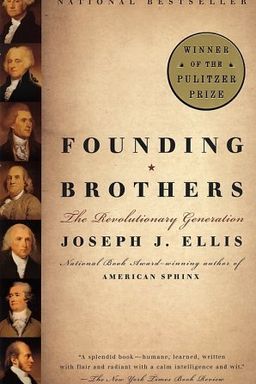
Founding Brothers cover

Founding Brothers

by Joseph J Ellis

Founding Brothers offers a compelling narrative of America''s formation, where the Founding Fathers grappled with uncertainties, alliances, and moral dilemmas. Joseph J. Ellis presents a rich tapestry of the revolutionary generation''s struggles and triumphs, providing fresh perspectives on historical events.

The Fragile Republic and the Politics of Character

How did a group of revolutionaries transform thirteen fractious states into a functioning republic? This book argues that the early American experiment rested as much on personality and honor as on institutions. The founders designed a system for liberty, but they also had to invent habits of governance amid regional rivalries, personal ambition, and unresolved moral contradictions. To understand the survival of the young republic, you must explore how principle, pragmatism, and ego collided.

Founding by Network

The founding generation formed a compact social web. George Washington, Alexander Hamilton, James Madison, Thomas Jefferson, John Adams, and others were not abstract theorists; they operated in a small, face‑to‑face political world. Trust came from dinners, correspondence, and shared combat experience. Decisions like the Compromise of 1790—the 'dinner deal' trading debt assumption for a capital on the Potomac—depended on personal chemistry as much as ideology. In modern terms, they governed through a dense network of relationships instead of partisan bureaucracy.

Principles and Pragmatism

The early leaders confronted two foundational questions: how strong should the federal government be, and how should morality guide policy? Jefferson and Hamilton embodied opposite poles. Jefferson imagined an agrarian republic of local virtue; Hamilton envisioned a commercial, centralized state powered by national credit. Madison oscillated between them, building a Constitution that could hold both visions in creative tension. Their compromises—like the bargain over assumption and residence—kept the nation alive but left ideological fissures that hardened into the first parties.

The Silence on Slavery

Even as the founders argued passionately about finance and federalism, they stepped delicately around slavery. Petitions in 1790 forced Congress to debate the issue, but Madison steered discussion toward procedural silence to prevent disunion. Washington quietly freed his slaves in his will yet avoided public advocacy; Jefferson drafted plans for gradual emancipation but never risked Virginia’s wrath. The choice to postpone confrontation was deliberate—a tactical deferral that preserved unity while planting seeds of future conflict. The moral cost of that silence echoes throughout the nation’s history.

Honor, Ego, and Political Virtue

In an age before stable parties or bureaucracy, personal character became political capital. Alexander Hamilton’s duel with Aaron Burr exposes the fragile culture of honor underpinning elite politics. When insults carried the weight of treason, private wounds could destabilize public trust. The duel was both a personal tragedy and a national warning—proof that ego, when unbridled by civic virtue, could endanger republican order. Yet it also revealed the founders’ shared anxiety: that the survival of self-government required moral discipline as much as institutional design.

Washington’s Example

George Washington’s career bookends the story. His presidency defined neutrality, unity, and voluntary restraint. His Farewell Address—edited iteratively by Madison, Hamilton, and himself—taught that partisanship and foreign entanglements would corrode republican virtue. His act of retiring solidified peaceful succession and the idea that no individual was indispensable. In omitting slavery from his Address, Washington modeled pragmatic silence but also left future leaders to face unfinished moral business. His legacy became the template for public duty balanced against human imperfection.

A key theme

The republic survived because individuals learned to translate private ambition into public compromise. The founders’ genius was not unanimity but their capacity to institutionalize disagreement and defer civil war into political argument. Their story reminds you that freedom’s first century began not with certainty, but with fragile balances between personality and principle.

Across the book’s episodes—from the dinner deal and the slavery debates to the Farewell Address and Jefferson-Adams reconciliation—you see one arc: the struggle to build legitimacy in a divided republic. Each compromise, duel, or letter exchange tested whether words could temper passion and whether moral restraint could sustain a republic of character.


Compromise and the Making of Union

The dinner of 1790 shows you that practical deal‑making, not ideology, first held the Union together. Hamilton’s plan to assume state debts met fierce southern opposition led by Madison and Jefferson. Virginia had already paid down its obligations and resented subsidizing speculators in northern states. Yet Hamilton believed assumption was vital to rebuild credit and cement national identity. Jefferson’s hospitality—what seemed a simple meal—became the stage for one of history’s most consequential bargains.

The Assumption‑Potomac Deal

At Jefferson’s house, the guests traded what each valued: support for Hamilton’s fiscal plan in exchange for placing the permanent capital on the Potomac, near Virginia. Behind the scenes, numbers were recalculated so that Virginia would be neither advantaged nor penalized, while Pennsylvania secured Philadelphia as a temporary seat of government. Congress soon passed both the Assumption and Residence bills. The result satisfied no one completely but confirmed that negotiation—anchored in trust—could prevent sectional rupture.

Meaning and Aftermath

The compromise created a new geography of governance. Political power moved toward the agrarian South in symbolism while economic power rose in the financial North. The dinner deal thus mirrored the national duality: Jefferson’s pastoral ideal alongside Hamilton’s modernity. The immediate crisis ended, but the deeper question—should America be a loose confederation or a centralized nation—remained unresolved. (Note: historians often see this as a prototype for later bargains like the Missouri Compromise and Compromise of 1850.)

For you, the lesson is that early American politics bought time rather than harmony. The dinner deal was a stopgap that gave the republic institutional breathing room to develop banks, credit, and legitimacy, even as it preserved competing regional myths that would later collide.


The Managed Silence on Slavery

Few issues reveal the founders’ pragmatism more starkly than the decision to move slavery off the federal agenda. When Quakers and the Pennsylvania Abolition Society petitioned Congress in 1790, urging national action against the slave trade, the response exposed the tension between moral conviction and political survival. Southern delegates warned that interference would violate the constitutional compromise protecting the trade until 1808. Madison, mindful of the fragility of the union, guided Congress toward silence.

Demographic and Political Arithmetic

The 1790 census made the scale of slavery unmistakable—around 700,000 enslaved across a four‑million population. With enslaved labor underpinning the southern economy, immediate emancipation seemed logistically and fiscally impossible. Even leaders who despised slavery, such as Franklin or Washington, recognized that abrupt abolition could destroy the new government. Thus pragmatism prevailed: a committee report confirmed Congress’s lack of authority to legislate emancipation within states, effectively ending national debate for a generation.

The Moral and Historical Cost

This deferral defined American politics for a century. It allowed the slave economy to expand westward while silencing moral discourse in the federal sphere. When Franklin died shortly after the debate, his symbolic mourning in Congress doubled as mourning for lost moral momentum. The founders’ silence was not ignorance but calculation—they believed union came first, even if justice came later. (Note: this logic of postponement parallels Madison’s belief that moral reform required prior institutional stability.)

For you, the scene teaches a paradox: preserving the republic sometimes meant perpetuating its contradictions. By choosing political survival over immediate emancipation, the founders created both a durable framework and an enduring stain that later generations would fight to remove.


Two Competing Blueprints for America

Jefferson and Hamilton personified two enduring American ideologies. Jefferson embodied the spirit of 1776—faith in local independence, agrarian virtue, and suspicion of centralized authority. Hamilton represented the logic of 1787—the need for national structure, fiscal power, and commercial ambition. Between them stood Madison, architect of the Constitution, toggling between idealisms. Their dispute crystallized in policy, geography, and temperament, creating the first durable political divide.

The Agrarian Ideal vs. the Financial State

Hamilton’s fiscal program—national debt, assumption, and a central bank—aimed to integrate elites into the federal project and make credit the lifeblood of nationhood. Jefferson feared exactly that: a debt‑based aristocracy that would erode republican simplicity. While Hamilton saw cities as engines of dynamism, Jefferson imagined corruption breeding in their alleys. Their worldviews produced parallel dreams: one of bustling commerce, the other of virtuous self‑sufficiency. Neither could destroy the other, so America learned to live in ideological dualism.

Institutionalizing Disagreement

Out of conflict came structure. The Federalists and the Democratic‑Republicans formalized these visions into party identities. Instead of civil war, the young nation adopted managed rivalry—a 'permanent argument' embedded in its politics. (Note: Alexis de Tocqueville later recognized this institutionalization of debate as a distinctive American strength.) By the time of the 1796 election, parties were inescapable, and even Washington’s warnings against faction could not reverse their growth.

You can see this rivalry as productive tension: Jefferson’s suspicion of power checked Hamilton’s ambition, and Hamilton’s energy pressed Jeffersonians to govern realistically. Out of their quarrel emerged the United States’ flexible capacity for self‑correction.


Madison’s Method and the Art of Balance

James Madison’s political craft reveals that survival sometimes outweighs purity. A theorist of constitutional checks, he also excelled as a parliamentary strategist. In crises—the debates on assumption, slavery, and later nullification—he relied on procedural control to keep disagreement inside institutional channels. His method turned explosive moral or sectional issues into manageable legislative outcomes. To him, keeping the republic functioning was itself a moral act.

The Diplomat of Discord

Madison bridged Jefferson’s republicanism and Hamilton’s structuralism. In 1790 he reshaped Hamilton’s plan by seeking a 'settlement before assumption,' softening its blow to Virginia. In the slavery petitions, he prevented rupture by drafting committee language that affirmed limited federal power. His genius lay in turning conflicts into precedents rather than crises—a temperament midway between philosopher and manager.

Legacy and Ambiguity

Madison’s preference for tactical moderation preserved the union but postponed confrontation with its deepest contradictions. He illustrates the cost of stability: postponement hardens problems even as it buys peace. His later role in authoring the Virginia Resolutions shows that even a moderation advocate could justify resistance under strain. He personifies the founder’s paradox—balancing enduring principles with immediate necessity.

For today’s reader, Madison teaches that institutional maintenance is moral labor. The republic endures not because solutions are found quickly, but because differences are given lawful space to breathe.


Washington’s Farewell and the Education of Citizenship

Washington’s Farewell Address served both as personal retirement and civic textbook. Crafted collaboratively—Madison’s early ideas, Hamilton’s phrasing, Washington’s final edits—it became the founding generation’s distilled wisdom. Washington dramatized the virtue of relinquishing power, teaching by act that republican leadership ends with voluntary withdrawal. He offered counsel structured around unity, morality, and cautious independence.

Three Central Lessons

  • First, nurture internal unity. Factions destroy the shared identity that sustains liberty.
  • Second, prioritize moral virtue; the Constitution alone cannot sustain a people lacking civic character.
  • Third, maintain neutrality abroad to gain time for national growth.

These points were grounded in recent turmoil—the Whiskey Rebellion, Jay’s Treaty, and partisan vitriol—that had tested his patience. By cautioning against permanent alliances and party rancor, Washington sought to embed prudence into the national psyche. Even his omission of slavery was strategic silence meant to preserve cohesion.

Symbolic power of retirement

Washington’s withdrawal proved the republic could survive beyond its founders—a civic gesture equal in importance to any battle he fought. Later presidents, from Adams to Obama, inherited this model of dignified exit as part of America’s constitutional DNA.

For you, the Address endures as a mirror: the health of democracy rests not in permanent victory for one faction, but in habitual restraint, self‑education, and rotation of power.


Parties, Crisis, and the 1800 Revolution

The presidential transitions from Washington to Adams to Jefferson tested whether the republic could survive political opposition within constitutional boundaries. By 1796, Adams and Jefferson embodied rival regimes in rhetoric and temperament. Adams governed with integrity but little tact; Jefferson orchestrated quiet resistance through Madison and state networks. The resulting polarization transformed personal disagreements into party warfare.

Adams’s Predicament

Adams sought peace amid the French Revolution’s global chaos. His decision to negotiate rather than fight—sending a new delegation after the XYZ Affair—saved America from war but alienated Federalist hardliners, particularly Hamilton. Meanwhile, his signature of the Alien and Sedition Acts, influenced by his circle’s fear of dissent, turned Republican editors into martyrs and tarnished his legacy. His presidency shows how virtue and vanity can coexist in one statesman: moral rigor paired with political inflexibility.

The Jefferson–Madison Counterrevolution

In opposition, Jefferson and Madison refined organized politics. Through the Virginia and Kentucky Resolutions, they argued that states could judge federal abuses, articulating philosophies that would echo in later nullification crises. Their coordination—the theorist and the tactician—converted scattered dissent into a coherent party. By 1800, disciplined organization and rhetoric of liberty defeated Federalists electorally without bloodshed. The transfer from Adams to Jefferson became the first peaceful regime change in modern history.

The era culminated with reconciliation, not revenge. In retirement, Adams and Jefferson renewed correspondence, recasting their rivalry as philosophical dialogue about the meaning of the Revolution. Their deaths on July 4, 1826 transformed politics into memory—a symbolic reconciliation of divided founders and the republic they had built.

Dig Deeper

Get personalized prompts to apply these lessons to your life and deepen your understanding.

Go Deeper

Get the Full Experience

Download Insight Books for AI-powered reflections, quizzes, and more.