
Idea 1
The Startup Mindset: Adapt, Persist, and Build What Matters
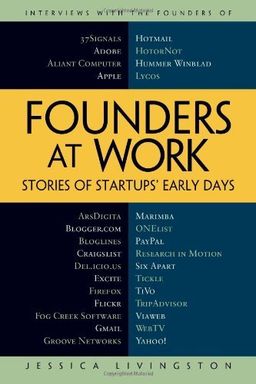
Why do some founders endure brutal uncertainty to build products that reshape industries, while others flame out despite talent and funding? This book traces the experiences of startup creators—from Steve Wozniak and Dan Bricklin to Max Levchin and Paul Buchheit—to show that real success comes not from genius or luck, but from an adaptive discipline: persistence guided by user empathy, resourceful engineering, and principled decision‑making.
The founders profiled faced impossible odds: PayPal was eaten alive by fraud, Hotmail grew faster than its servers could handle, and Basecamp had room for only one part-time developer. Yet across decades of technological shifts—from hardware to web to mobile to SaaS—they demonstrate a repeating pattern. Those who survive learn to balance perseverance with adaptability, build empathy into every decision, and treat constraints as a creative edge. The result is an enduring playbook for turning ideas into companies that last.
Perseverance with Adaptability
Founding stories often glamorize inevitability, but Max Levchin or Evan Williams began without a script. Levchin’s PayPal started as crypto-on-Palm before morphing into web payments; Williams’s Pyra became Blogger once he recognized users wanted publishing tools, not project management. These pivots were not random—they were fast responses to user signals. Perseverance meant refusing to quit on the mission even when tactics changed entirely.
The insight: commitment must attach to the problem you’re solving, not the plan you wrote. Founders who confuse persistence with stubbornness run out of resources before finding fit. Those who adjust tactics while protecting their mission—Levchin switching focus to anti‑fraud; Bhatia turning email frustration into Hotmail—convert chaos into progress.
User Empathy and Simplicity
Every major breakthrough here comes from seeing the world as users do. Wozniak’s Apple II used fewer chips so it was affordable and stable; Bricklin’s VisiCalc mirrored the human grid people already used on paper; Buchheit’s Gmail fixed the daily pain of finding old emails. You succeed by compressing technical complexity into tools simple enough that users forget the machinery underneath.
Empathy also drives distribution. Hotmail’s viral tagline worked because it fit users’ natural behavior: sending email. PayPal grew because its send-money flow invited non‑members automatically. These founders built sharing directly into everyday actions—a model of productized distribution that outperforms marketing budgets.
Engineering under Scarcity and Constraint
Constraints force clarity. Wozniak’s limited chips led to elegant design; DHH’s ten-hour Basecamp weeks forced ruthless priority; Bricklin’s 32KB memory limit birthed UX precision. Rather than curse constraints, these engineers embraced them to define what truly mattered. HotOrNot’s bandwidth crisis led to creative offloads to Yahoo and Ofoto, proving that operational hacks can buy time for strategic growth.
(Note: similar lessons appear in Clayton Christensen’s work on disruptive innovation—resource scarcity promotes focused invention.) When money or manpower are tight, each decision becomes a filter for value creation rather than vanity output.
Trust, Security, and Reliability
No startup survives without user trust. Levchin reframed PayPal as "a security company in disguise" and built human‑algorithm hybrids to detect fraud. RIM’s BlackBerry sold reliability wrapped in encryption. Gmail, TiVo, and Craigslist invested early in operational integrity—safe updates, data durability, or community moderation—because protection builds reputation faster than marketing does. Trust, engineered and sustained, is itself a product feature.
People, Governance, and Investors
As companies scale, technical excellence must be joined by cultural design and governance discipline. Wozniak needed Jobs; Levchin needed Thiel; Geschke needed Warnock. Complementary cofounders balance optimism with realism. When investor dynamics break that equilibrium—as in Greenspun’s ArsDigita—startups collapse from internal misalignment, not market failure. Contracts, board structures, and role definition are extensions of product architecture: they determine whether the system stays coherent as it grows.
From Research to Implementation
The bridge from lab idea to living startup demands translation skill. Lazaridis turned academic wireless protocols into commercial pagers; Geschke left Xerox PARC to ship PostScript. The move from prototype to product means translating technical proof into business context—packaging, framing, and timing. Innovators who fail this translation drown in “too early” brilliance; those who master it pioneer new categories.
The Central Message
The book’s collective argument is simple but strong: anyone can build enduring companies if they learn to adapt relentlessly, simplify obsessively, engineer elegantly under constraint, and protect trust as a core asset. Founders who internalize these principles—from garage inventors to intrapreneurs—convert volatility into unmatched advantage. What you build is less important than how you build: iterative, empathic, honest, and disciplined. Do that, and you not only survive; you redefine what’s possible.