
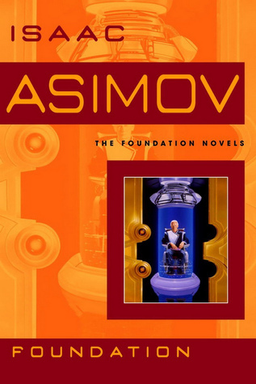
Foundation cover

Foundation

by Isaac Asimov

Isaac Asimov''s ''Foundation'' chronicles the strategic rise of a community at the galaxy''s edge, amid the collapse of a vast empire. Through psychohistory, atomic power, and economic savvy, the Foundation navigates political intrigue and cultural influence, offering timeless insights into power and survival.

The Power of Predicting the Future through Science and Civilization

Imagine if you could predict the rise and fall of empires—not by fortune-telling, but through mathematics. In Foundation, Isaac Asimov invites you into just such a world, one where science itself becomes destiny. His central argument is that civilization’s decay and renewal are not random but can be forecast and shaped through understanding the laws of human behavior, much like physics studies the movements of particles. Yet within that prediction lies another truth: progress depends as much on knowledge and adaptability as on foresight itself.

The Core of Psychohistory

Asimov’s legendary concept of psychohistory anchors the book—a fictional science combining mathematics, sociology, and history to anticipate large-scale human actions. Hari Seldon, the brilliant mathematician behind this theory, foresees the inevitable collapse of the millennia-old Galactic Empire and the ensuing dark age. His solution? To shorten thirty thousand years of chaos into just one thousand, by founding the Foundation: a small, remote colony devoted to preserving knowledge and guiding humanity back toward order. Throughout this first novel in the series, Seldon’s predictions form a structure—the “Seldon Plan”—around which humanity’s future unfolds, crisis by crisis.

Knowledge as Power and Survival

What happens when an empire’s strength turns brittle? Asimov suggests that while political and military might fade, intellectual resilience endures. The Foundation’s initial strategy is simple: gather and safeguard human knowledge. But soon, its leaders discover that ideas are more powerful than armies. The transformation from scientific community into political force rests on an audacious understanding—that beliefs and technology can both conquer hearts and nations. This evolution transforms the Foundation into a quasi-religious power, then an economic empire, and later, a blend of political pragmatism and advanced trade diplomacy. Each stage reveals how science, when mixed with psychology and cunning, shapes civilization itself.

Why Asimov’s Vision Still Matters

For you, the reader, Asimov’s world isn’t just a distant galactic fantasy—it’s a mirror. What happens to societies when their technology outpaces their ethics, or when information becomes both weapon and religion? His narrative resonates especially today, as we grapple with data, algorithms, and social influence—modern variants of psychohistory. The mathematician’s dream of prediction may be fiction, but it echoes in modern economics, political analytics, and AI forecasting (think of Nate Silver’s predictive modeling in politics, or Yuval Noah Harari’s reflections on data-driven civilizations in Sapiens).

From Individuals to Institutions

Unlike a typical hero’s tale, Foundation seldom centers on individuals. Its protagonists—Hari Seldon, Mayor Salvor Hardin, Trader Hober Mallow—serve more as instruments of history than romantic figures. Their personal ambitions bend under the weight of planetary destinies. This unusual narrative choice underscores Asimov’s claim that masses, not individuals, make history predictable. You can’t forecast a lone person’s whims, but you can model the average of billions. Thus, Foundation’s story unfolds as the chronicle of civilization learning to act in accordance with reason rather than superstition—a “scientific theology” of progress.

The Cycles of Crisis and Renewal

Each part of the book isolates a different stage in the Foundation’s survival—from its scholarly beginnings in the “Psychohistorians,” through political manipulation in “The Encyclopedists,” and economic control in “The Traders.” At every stage, a leader must solve what Asimov calls a “Seldon Crisis”: moments when history itself demands a shift in strategy. The crises serve as allegories for humanity’s own cycles—between faith and skepticism, science and dogma, hubris and humility. By navigating them, Asimov teaches that progress isn’t linear but adaptive. Civilization survives not by fighting the inevitable fall, but by preparing to rise again through knowledge, creativity, and courage.


Psychohistory and the Fall of Civilization

Hari Seldon’s theory of psychohistory embodies Asimov’s vision of science as destiny—a marriage of mathematics and sociology that transcends mere prediction. The idea rests on a paradox: you can forecast the future of billions but not of one person. This distinction between mass behavior and individual unpredictability shapes Foundation’s fate: history turns out to be neither random nor fully controllable, but statistically inevitable.

Mathematics as Prophecy

Seldon’s equations allow him to foresee the decline of the Galactic Empire centuries before anyone else notices. His prediction—a thirty-thousand-year age of anarchy—echoes Edward Gibbon’s Decline and Fall of the Roman Empire, which Asimov famously read twice before conceiving the story. In both cases, vast empires collapse not from external attack alone but from internal decay, bureaucratic stagnation, and loss of purpose. Psychohistory converts that historical intuition into science, making foresight a tool for salvation.

The Creation of the Foundation

Seldon’s answer to collapse is elegant yet audacious: create the Foundation at the galaxy’s edge, under the guise of compiling a universal encyclopedia. In reality, it is a seed for rebirth—a sanctuary for knowledge and the kernel of a Second Empire. The genius behind this move lies in its deception: even the dying Empire supports the project, unaware it’s funding its own replacement. You watch as Asimov turns strategy into science—a philosophical judo move that transforms weakness into long-term power.

Power Without Violence

From the first Seldon Crisis onward, the Foundation learns that strength doesn’t lie in weaponry but in understanding psychology and perception. Mayor Salvor Hardin, one of the early leaders, captures this perfectly when he declares: “Violence is the last refuge of the incompetent.” His diplomacy outmatches brute force through religious manipulation—convincing neighboring kingdoms that the Foundation’s technological miracles are divine gifts. The mastery of belief becomes more secure than any fleet.

Seeing Patterns in Chaos

For you, psychohistory offers a metaphor for foresight in life. Just as Seldon’s equations anticipate mass behavior, you can learn to recognize patterns—in markets, in social trends, in personal choices—and navigate rather than resist them. As psychologist Daniel Kahneman notes in Thinking, Fast and Slow, humans often mistake randomness for pattern; Asimov flips this, showing that on large scales, our collective irrationality becomes predictable. Wisdom, both personal and societal, lies in knowing when probabilities, not emotions, should guide action.


Faith, Science, and Psychological Power

What do you do when pure science loses its audience? For the citizens of the first Foundation, the answer is religion—or more precisely, a strategic use of religion. As technology becomes incomprehensible to common people, early leaders turn scientific advancement into divine miracle, building a theology that safeguards their power while spreading knowledge disguised as faith. It’s one of Asimov’s most provocative ideas: faith as a tool of science.

The Politics of Belief

Mayor Salvor Hardin’s era marks the shift from scholarly isolation to political manipulation. The Foundation’s neighbors—the Four Kingdoms—see technology as magic, so Hardin lets them believe exactly that. By elevating the Foundation’s scientists into priests who control “divine” power plants, he cements dominance without firing a shot. The neighboring rulers fear angering the “Galactic Spirit,” ensuring peace through superstition. As Asimov shows, ideas can enslave as effectively as weapons; propaganda becomes a peace treaty.

Science Cloaked in Ritual

The brilliant irony of Hardin’s success lies in its moral ambiguity. A rational institution founds a religion based on illusion. Priests tend nuclear generators they can’t understand; rituals replace reasoning. Yet Hidden beneath that deceit, the Foundation maintains intellectual integrity—its leaders know that “knowledge is power,” and faith is a temporary shield. Asimov, echoing Voltaire’s sarcasm toward blind belief, asks you to confront whether truth must always be pure—or whether progress sometimes requires illusion.

Manipulation versus Morality

At a personal level, you may experience similar dilemmas: should you tell the full truth when partial truth achieves better outcomes? In politics, science communication, or even leadership, Asimov suggests that influence often depends on presentation. Early Foundation leaders sacrifice purity for stability, teaching that pragmatic truth—truth in service of survival—can sometimes outweigh literal transparency. In comparing Hardin with Machiavelli, you see two minds that reject sentimentality for realism, proving that effective governance often means guiding belief even when belief is imperfect.


Trade as the New Religion

By the time the Foundation matures, religion wanes—but commerce rises. Asimov replaces miraculous faith with the economics of influence, revealing that wealth itself can become sacred. Traders, led by figures like Hober Mallow, transform money and technology into instruments of empire, spreading Foundation control through markets rather than missions.

Merchants as Missionaries

When military power and religious propaganda lose force, trade becomes the new frontier of persuasion. Asimov’s Merchants act as the Foundation’s ambassadors, selling nuclear gadgets to civilizations that mistake them for magic. Yet their success rests not on domination but addiction: once societies depend on these tools, they become economically and politically bound to Terminus. Mallow elevates this to strategy, preferring prosperity over conquest. “Trade without priests,” he declares, and Asimov transforms commerce into cosmic diplomacy.

The Economics of Freedom

Mallow’s genius lies in understanding systems rather than ideologies. He sees that material dependence can breed peace—that control through trade reduces war’s necessity. His policies echo Adam Smith’s invisible hand, where mutual self-interest becomes order’s foundation. When Korell, a hostile world, refuses Foundation missionaries, Mallow subverts resistance by tying its economy to imported technology. When the inevitable break comes, Korell collapses not by fleet but by market failure. Commerce, Asimov implies, outlasts faith.

A Lesson for Modern Power

You live in a world where soft power—trade, technology, culture—often triumphs over military threat. Asimov foresaw this decades before globalization. His merchants prefigure modern tech giants, whose innovations quietly create dependencies that shape nations. In that sense, Foundation reads like a prophecy of Silicon Valley diplomacy: whoever controls the tools controls the world. The challenge Asimov poses remains—can such power be wielded ethically, or will it, like religion before it, become another form of manipulation?


Crisis as Catalyst for Human Progress

In Foundation, history advances not through peace but through crisis. Each turning point—the “Seldon Crises”—forces evolution, compelling the Foundation to expand its strategy and values. Asimov teaches that progress often requires pressure; only when collapse looms do civilizations learn to adapt creatively. For you, it’s a reminder that crisis reveals capacity.

Predictable Chaos

Hari Seldon’s plan designs crises like tests. Every few generations, the Foundation faces existential dilemmas—religious threat, political intervention, economic collapse—and must find solutions consistent with historical probability. No one knows the outcome except that success is guaranteed if human nature follows its pattern. Readers witness the fascinating tension between free will and determinism: leaders act autonomously, yet their decisions always align with Seldon’s forecast. Fate and choice merge into one.

Opportunity in Adversity

Whether through Salvor Hardin’s diplomacy or Hober Mallow’s trade, every crisis reveals new layers of ingenuity. Hardin repels invasion by turning enemies’ faith against them—a masterstroke in psychological warfare. Mallow neutralizes aggression through economic dependence. Each finds power not in resistance but redirection. You learn that systems survive through flexibility: knowledge creates options; fear erases them. As psychologist Viktor Frankl wrote in Man’s Search for Meaning, “When we are no longer able to change a situation, we are challenged to change ourselves.” Asimov’s crises work the same way—forcing evolution through necessity.

Applying the Seldon Principle

In your own life, crises may feel random—but Asimov suggests they’re statistically inevitable outcomes of complex systems. The key is acceptance: the Foundation survives not by denying collapse but by designing for recovery. Build systems—personal, social, and technological—that absorb shocks and transform them into progress. That’s psychohistory’s wisdom distilled from mathematics into metaphor: anticipate evolution, not perfection.


Ethics of Control and the Limits of Prediction

Is it moral to manipulate an entire galaxy for its own good? Throughout Foundation, Asimov confronts the uneasy ethics of control. Hari Seldon’s Plan presumes that human beings can be guided unknowingly toward a predetermined destiny—an act both benevolent and authoritarian. The book challenges you to consider whether reason alone should rule civilization—or whether spontaneity, emotion, and freedom remain essential to progress.

Science as Salvation—or Tyranny

Asimov admired the intellect but feared dogma in any form. Psychohistory, though scientific, risks becoming its own priesthood. When hard data replace moral debate, leaders justify manipulation as necessity. Salvor Hardin’s creation of a religion to preserve order epitomizes this tension—brilliant yet deceptive. Hober Mallow’s economic empire, though less coercive, trades freedom for dependence. Thus, each method of control, whether faith or finance, ultimately limits choice. As philosopher Karl Popper warned, “The attempt to make heaven on earth invariably produces hell.”

The Fragility of Foresight

Seldon’s Plan works only for predictable masses. When deviations arise—the unforeseen appearance of individuals such as “The Mule” in later volumes—the entire system teeters. Asimov implies that complete mastery of fate is impossible: unpredictability is humanity’s counterweight against tyranny. For readers, this is liberating. Science can guide, but not replace, wisdom. Progress needs doubt.

Your Role in Modern Predictive Worlds

In a data-driven age, Asimov’s warning reverberates. Predictive algorithms—from marketing analytics to AI-driven social forecasting—mirror psychohistory’s ambition. Yet the more perfectly systems predict behavior, the less space remains for individuality. The lesson Asimov offers you is timeless: trust science, but guard freedom. Prediction should serve humanity, not remake it. Civilization’s strength lies in both its patterns and its surprises.

Dig Deeper

Get personalized prompts to apply these lessons to your life and deepen your understanding.

Go Deeper

Get the Full Experience

Download Insight Books for AI-powered reflections, quizzes, and more.