
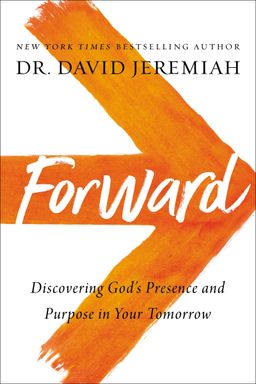
Forward cover

Forward

by David Jeremiah

In ''Forward,'' David Jeremiah reveals how integrating Biblical wisdom into everyday life can guide you to find God''s presence and purpose. Discover how to focus on your dreams, manage life''s challenges, and achieve personal fulfillment through faith and practical advice.

Moving Forward: Discovering God’s Presence and Purpose in Your Tomorrow

Have you ever felt as if your life is stuck in neutral—caught between yesterday’s regrets and tomorrow’s uncertainties? In Forward: Discovering God’s Presence and Purpose in Your Tomorrow, Dr. David Jeremiah argues that moving out of the past and into God’s plan requires more than wishful thinking: it requires spiritual momentum. He contends that your future is not defined by what you have lost or by what holds you back, but by your willingness to cooperate with God’s ongoing work in your life. The message of this study guide is clear: God isn’t done with you yet. As long as you have breath, He has a purpose.

Dr. Jeremiah structures the study around six dynamic actions—Dream, Focus, Risk, Pursue, Believe, and Finish. Each represents a step in what he calls a “faith-forward” lifestyle. Together, they form a roadmap to rediscovering spiritual direction and moving deliberately toward the life God has designed for you. Throughout the guide, participants are invited to reflect on Scripture, engage with study questions, and apply biblical truths through personal devotion and group discussion. These reflections turn abstract principles into concrete practices that transform thoughts into momentum.

Faith as Movement, Not Stillness

At its heart, Jeremiah’s message challenges the idea that faith is static. Progress in the Christian life, he writes, happens when you decide to “press on” like the apostle Paul, reaching forward toward what lies ahead (Philippians 3:13–14). The faith journey is not a flat road but a race requiring endurance and divine focus. The lessons in this study are built around Paul’s relentless pursuit of Christ—his pressing forward despite trials, imprisonment, or disappointment. Jeremiah’s core premise: you cannot move forward while constantly looking back.

Each of the six sessions explores a biblical principle using examples from Scripture—like Joseph’s perseverance, Mary’s humility, David’s determination, or Paul’s faith under pressure. These stories reveal that God’s call always involves preparation, progress, and perseverance. Jeremiah wants readers to see their own lives reflected in these prototypes of “faith in motion.”

The Six-Step Spiritual Roadmap

The first action, Dream, begins with recognizing that God places aspirations and callings within you—not for pride, but for His glory. The next, Focus, calls you to identify your “one thing,” the sacred priority that defines your direction. In Risk, Jeremiah dismantles the illusion of safety, arguing that spiritual growth always demands courage and obedience. Pursue highlights the discipline of chasing your purpose through service and surrender. With Believe, the focus shifts inward—to the renewal of a positive, biblical mindset grounded in trust and optimism. Finally, Finish brings everything full circle, urging believers to persevere to the end, maintaining faithfulness and joy until their race is complete.

Each phase corresponds not only to a cognitive change but also to a shift in spiritual posture—from dreaming with God to acting, from thinking rightly to living consistently. The guide’s design encourages progress through small but intentional steps: reflection, dialogue, and prayer. Each chapter concludes with personal exercises that challenge you to apply Scripture’s truths to your relationships, work, and spiritual habits. By the study’s close, the line between devotional reading and practical transformation blurs, creating a lived theology of advancement.

Why This Journey Matters

Why does moving forward matter so much? Jeremiah argues that spiritual stagnation is one of the greatest threats to Christian vitality. Many believers, he observes, are trapped by comfort or distracted by regret. But stagnation contradicts the example of Christ and His followers. Just as Abraham left home for an unknown land and Paul pressed toward his heavenly prize, so every believer must choose to move. Jeremiah insists that such motion does not come from self-help enthusiasm but divine empowerment. True forward motion begins when you surrender control, align your dreams with God’s will, and persevere through hardships with faith in His promises.

The study’s group-based format is intentional. Jeremiah emphasizes that faith-forward progress often happens in community—where believers encourage one another, exchange insights, and collectively practice accountability. In discussing Scripture together, participants learn that movement toward God is never a solo expedition but a shared pilgrimage.

Ultimately, the book’s power lies in its blend of pragmatism and hope. Jeremiah is not satisfied with vague idealism; he offers a clear theological blueprint grounded in Scripture and shaped by practical wisdom. Like Rick Warren’s The Purpose Driven Life or John Ortberg’s If You Want to Walk on Water, You’ve Got to Get Out of the Boat, this study invites you to make a decision: Will you remain stuck in your safe zone, or will you move forward into God’s unfolding tomorrow?


Dream: Seize Your Tomorrow Today

Dr. Jeremiah begins his journey with one key question: What is your God-given dream? Every believer, he explains, carries within them the seeds of divine purpose—a vision for how God intends to use their life. Yet these dreams must align with God’s heart, not with fleeting ambitions. Jeremiah frames a dream as “a picture of what you feel God wants you to do next.” It’s not fantasy; it’s divine foresight in motion.

Five Principles for Building a God-Given Dream

David’s dream to build a temple becomes Jeremiah’s central model. The king devoted his life to its preparation, even though it would ultimately be Solomon who built it. From that narrative, Jeremiah draws five practical principles for anyone chasing a dream with God.

  • Root your dream in history. Every significant dream grows from past foundations—faith, family, lessons from failure. David’s dream was rooted in his ancestors’ relationship with God. Likewise, your dream begins where your story intersects with His story.
  • Reproduce your dream in a picture. Faith without structure falters. God gave David blueprints through vision; you, too, must envision your dream tangibly through goals, notes, or even imagery. (Jeremiah echoes Proverbs 29:18: “Where there is no vision, the people perish.”)
  • Reinforce your dream with determination. Every calling meets opposition. Jeremiah notes that dreams with divine origins often provoke disbelief and delay. Yet perseverance distinguishes dreamers who serve God from those who quit when it hurts.
  • Reconcile your dream with its cost. Jesus’ parable of counting the cost reminds you to evaluate what sacrifice your dream might require. Pursuing a God-sized vision will demand time, humility, and patience.
  • Release your dream to your legacy. Every faith-filled dream is part of something eternal. Jeremiah insists that when your service outlives you, your influence continues beyond your lifetime—like David’s dream culminating in Solomon’s temple.

To dream God’s way, Jeremiah concludes, is to live for tomorrow with grounded faith today. Your dream may stretch you, frustrate you, and even pass beyond your lifetime, but it will always pull you forward toward God’s purpose.


Focus: Make Your One Thing the Main Thing

In a world full of distractions, Jeremiah calls focus “the art of spiritual alignment.” Many believers mistake busyness for faithfulness, scattering their energy in a dozen directions. But Paul’s declaration in Philippians 3:13–14—“One thing I do… I press toward the goal”—reminds you that success in spiritual growth requires narrowing your vision to what matters most.

Four Principles for Sharpening Focus

  • Focus on God’s purpose. Your ultimate goal is to be conformed to the image of Christ (Romans 8:29). Every decision should lead you one degree closer to Christlikeness.
  • Focus on God’s perspective. To move forward, you must “forget those things which are behind.” Jeremiah notes that constantly replaying past failures blinds you to present grace. Spiritual myopia—whether fixated on guilt or nostalgia—keeps you from seeing what God is doing now.
  • Focus on God’s plan. God’s blueprint for your life is unique. As Psalm 37:23 declares, “The steps of a good man are ordered by the Lord.” Your job is to walk in rhythm with His design, not imitate another’s path.
  • Focus on God’s prize. Your ultimate destination—the presence of Christ—should reorient every earthly pursuit. Hope of heaven gives present choices eternal weight.

This kind of focus requires both discipline and grace. Jeremiah compares it to adjusting spiritual lenses: when Jesus becomes your focal point, life’s blur sharpens into divine clarity.


Risk: Get Out of Your Safe Zone

Jeremiah devotes an entire session to demolishing the myth that faith is safe. He reminds readers that every biblical hero stepped into the unknown—Moses before Pharaoh, Esther before the king, Peter upon the waves. Playing it safe, he argues, often equals spiritual paralysis. He contrasts two types of living: the safe zone (driven by fear) and the faith zone (driven by trust).

Three Traps That Keep You Safe but Stuck

Drawing from Numbers 13, Jeremiah revisits the story of the twelve spies who surveyed Canaan. Ten played it safe, while only Joshua and Caleb dared to move forward. The ten fell into three traps:

  • They maximized the opposition—focusing on giants rather than God.
  • They minimized the opportunity—forgetting God’s past faithfulness.
  • They jeopardized the objective—forfeiting their future blessings through fear.

The Faith Zone Mindset

Joshua and Caleb, by contrast, show how believers in the “faith zone” view their challenges as invitations. They stay exuberant, enthusiastic, and energized about God’s promises. Jeremiah highlights that risk-takers remain excited about life’s future because they see obstacles as opportunities for trust. “When you follow God forward,” he writes, “you experience the joyful zest that keeps you young at heart.”

The author’s closing challenge echoes Hebrews 11’s Faith Hall of Fame: your name, too, could be written among those who dared to risk by faith. You will never see water hold you up until you step out of the boat.


Pursue: Chase Your Dream

Having inspired readers to dream, focus, and risk, Jeremiah now turns to the discipline of pursuit. Dreamers can envision, but pursuers act. He likens pursuit to running a race—steady, directional, and sustained by divine energy. The question becomes not just what you dream about but how you chase it.

Seven Steps to Pursuing Purpose

  • Present yourself totally to God. True pursuit starts with surrender. God can direct only what’s been placed on His altar.
  • Understand your uniqueness. God designs no duplicates. You fulfill His will by living the one-of-a-kind calling shaped by your gifts and personality.
  • Realize your responsibility. Every gift carries accountability. You are called not to bury your talents but to invest them (Matthew 25:14–30).
  • Pursue God’s plan, not self-promotion. Avoid imitation. Jeremiah cautions against comparing your calling to others—it breeds jealousy, not faith.
  • Obey orders from God’s Word. Scripture is your manual for staying on course when purposes seem unclear.
  • Serve others selflessly. Pursuing purpose always expands into serving people. Ministry, not ego, is the heartbeat of pursuit.
  • Experience eternal life now. The ultimate reward of pursuing your purpose is joy in the abundant life Jesus promised (John 10:10).

For Jeremiah, pursuit isn’t frantic striving but faithful following—an active alignment of passion, purpose, and persistence that turns calling into joy.


Believe: Get Your Mind Right

Optimism and faith, Jeremiah writes, are not luxuries; they are necessities. In an era saturated with anxiety, cynicism, and despair, the ability to “get your mind right” requires biblical confidence—believing that God’s truth outweighs your fears. Faith is an act of focus in itself, the lens that clarifies reality through the light of divine promise.

Four Pathways to Faith-Based Positivity

  • Be positive in your convictions. Convictions anchor your mind in certainty. Believe deeply in God’s love and His plan, allowing these truths to drive resilience. Jeremiah parallels this with Paul’s optimism in prison—faith made him free even behind bars.
  • Be positive in your conversations. What you speak shapes what you believe. Jeremiah encourages believers to “talk to themselves rather than listen to themselves,” echoing Dr. James Gills’ practice during grueling endurance races. Encouraging words reinforce truth when emotions falter.
  • Be positive in your crises. When storms come, optimism becomes a spiritual shield. Faith-based positivity doesn’t deny hardship; it reframes it through confident hope in God’s sovereignty.
  • Be positive in your countenance. Joy on your face reflects peace in your soul. Jeremiah connects outer expression to inner resilience: a cheerful heart is a testimony of trust.

True optimism, Jeremiah concludes, isn’t naïve—it’s theological. Belief in a good and powerful God transforms how you think, speak, and live. This mindset makes forward motion possible even when your circumstances stand still.


Finish: You’re Not Done Until You’re Done

In his final session, Jeremiah brings everything together with one unshakeable premise: finishing well is the real measure of success. Drawing again on Paul’s farewell words in 2 Timothy 4:7—“I have fought the good fight, I have finished the race, I have kept the faith”—he reminds you that spiritual vitality has no retirement age. As long as God gives you life, He calls you to keep running.

Five Challenges to Finishing Well

  • Stay focused until you’re finished. Like Solomon completing the temple, you must maintain discipline to complete what God starts in you.
  • Stay resilient about retirement. Retirement in the kingdom isn’t withdrawal but redirection—mentoring the next generation or serving in new ways.
  • Stay connected to your calling. The gifts and calls of God are “irrevocable” (Romans 11:29). Intentional disengagement often leads to dissatisfaction.
  • Stay vigilant after victories. Success can breed complacency. Jeremiah recalls how David, relaxed after triumph, fell into moral failure; vigilance is lifelong.
  • Stay ready for redeployment. Seasons change, but service doesn’t. God may reassign you to new fields of ministry rather than release you from the work entirely.

Finishing well means maintaining endurance, humility, and gratitude until your final breath. Jeremiah’s closing exhortation is both hopeful and urgent: don’t coast through the last mile—run it with joy. Because when you cross that finish line, your forward journey becomes forever.

Dig Deeper

Get personalized prompts to apply these lessons to your life and deepen your understanding.

Go Deeper

Get the Full Experience

Download Insight Books for AI-powered reflections, quizzes, and more.