
Idea 1
When Markets Behave Like Weather
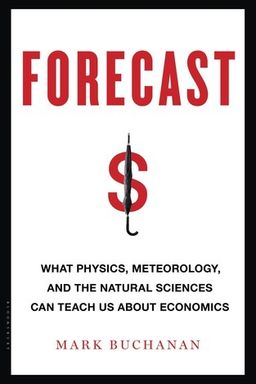
If the stock market sometimes feels like a tornado—sudden, chaotic, and completely unpredictable—what if that feeling is more accurate than economists ever admitted? In Forecast, physicist Mark Buchanan invites you to rethink everything you’ve been told about why markets move. He argues that economic systems aren’t calm and self-regulating machines at all. They’re turbulent natural ecosystems governed by feedback loops and instability—much like the planet’s weather.
For generations, Buchanan explains, economics has been trapped in an equilibrium delusion: the belief that markets naturally balance themselves, returning smoothly to normal after any disturbance. This comforting idea, born in the eighteenth century from Adam Smith’s famous ‘invisible hand,’ has shaped how governments regulate markets, how investors manage risk, and even how citizens think about fairness. But reality, says Buchanan, looks much closer to meteorology than to mathematics. Just as we can’t predict exactly when a thunderstorm will form, we can’t forecast a crash—but we can understand the conditions that make one more likely.
The Physics of Everyday Chaos
Buchanan takes the reader back to Overland Park, Kansas, where the book opens with a vivid image of tornadoes whipping across the plains. Tornadoes, he says, are not freak events—they’re inevitable consequences of how warm air interacts with cold air under rotation and gravity. In the same way, financial crises—like the ‘flash crash’ of 2010 or the meltdown of 2008—aren’t caused by one fat-fingered trader or rogue algorithm. They’re produced by the feedback loops built into the system itself. Each panic, each bubble, stems from the same physics of escalation: small fluctuations multiplying through mutual reactions until they explode.
Economists as Weather Forecasters
The heart of Buchanan’s indictment is simple: economists have been trying to forecast storms without understanding them. They design models that assume markets move toward stability instead of watching how real participants—people, firms, banks, and algorithms—interact dynamically. This worldview blinds them to the role of positive feedback, the process that makes small changes grow larger: a few traders selling stocks can trigger panic selling, just as one gust of wind can birth a storm.
For Buchanan, the failure is not just scientific but moral. Because economists convinced politicians that markets regulate themselves, governments tore down safeguards, deregulated financial systems, and let leverage spiral out of control. They used elegant mathematics to justify inequality and excess. And when those formulas failed, they claimed it was an ‘exception.’ As former Fed chairman Alan Greenspan famously said, market crises were ‘notably rare exceptions.’ Buchanan’s response: they are the rule.
Why Physics Teaches Us More than Finance
Physics, Buchanan reminds us, is the science of systems out of balance. Things move, collide, and evolve. Physicists learned centuries ago that equilibrium is the death of curiosity—you don’t study a cloud by pretending it’s frozen. So when physicists turned their tools toward life, biology, and the networks of human behavior, they found the same math behind earthquakes, evolution, and recessions: power laws, fractals, and self-organized criticality. These patterns reveal a world running on disequilibrium, where minor events—like Waddell and Reed’s $4 billion sell order—can release enormous forces just waiting for a trigger.
Buchanan argues that the heart of economic progress lies not in stability but in the continual churn of turbulence and adaptation. Understanding these rhythms requires abandoning old ideas like ‘market efficiency’ and embracing models of feedback, thresholds, and complexity. It means treating traders and algorithms not as perfect rational actors but as evolving creatures responding to one another, just as species compete for resources in nature. This isn’t fatalism—it’s realism.
The New Science of Financial Weather
Throughout the book, Buchanan chronicles how scientists from physics, ecology, and computer science have begun to map the patterns of economic turbulence. They’ve discovered power laws governing everything from earthquake magnitudes to price fluctuations, showing that extreme events are never truly rare—they’re part of the same fabric as ordinary days. He compares market spikes to the fractal geometry of coastlines, each ripple echoing the same underlying shape. This new science replaces dreams of perfect prediction with probabilistic forecasting—understanding what’s possible instead of pretending we can control what’s inevitable.
Ultimately, Buchanan’s message is unsettling but empowering: you can’t eliminate volatility, but you can learn its grammar. Economic storms aren’t mistakes; they’re the natural result of a complex, interacting system. It’s not a matter of if turbulence will strike but when—and whether we choose to design institutions able to withstand it.
Core Takeaway
Markets are not efficient, self-correcting machines—they’re chaotic ecosystems governed by feedback loops. To navigate them safely, you need to think more like a meteorologist than an accountant, studying instability instead of denying it. The future of economics, Buchanan shows, lies in embracing uncertainty and understanding the physics of change.