
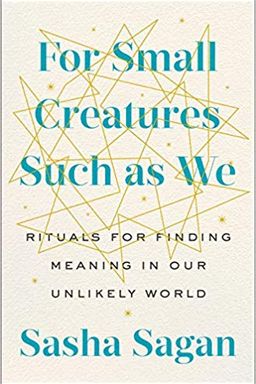
For Small Creatures Such as We cover

For Small Creatures Such as We

by Sasha Sagan

For Small Creatures Such as We guides readers in crafting personal rituals that celebrate life''s key moments with depth and wonder, all from a secular perspective. Sasha Sagan invites you to explore the universe''s magic through meaningful traditions.

Finding Meaning in a Secular Universe

How do you find meaning in a world that seems to run on randomness, without believing in anything supernatural? In For Small Creatures Such as We, Sasha Sagan asks and answers this deeply human question. Daughter of astronomer Carl Sagan and writer Ann Druyan, she grew up in a home where science and spirituality were not opposing forces but two faces of the same search for wonder. Through her memoir and philosophical reflection, she contends that rituals, awe, and celebration don't require religion—they require attention to the miraculous reality of being alive.

Sagan argues that you can live a profoundly meaningful life without believing in a deity or an afterlife. In her view, science itself reveals the sacred—in the patterns of the cosmos, the rhythms of biology, and even in our ordinary daily routines. Her mission is to take the inherited beauty of ritual and festivals, strip away dogma, and rebuild them on the foundation of evidence, gratitude, and love. This is a book about merging skepticism and awe, about teaching future generations—like her daughter Helena—that logic and wonder are not mutually exclusive.

A Framework Without Faith

From her father’s teaching—“It’s dangerous to believe things just because you want them to be true”—Sagan learned that truth must be demonstrated, not declared. Yet she also discovered that celebration is essential to survival. Throughout the book, she asks: if we have given up faith, must we give up the beauty of ceremony, of coming together, of marking time? Her answer is an emphatic no. We can craft secular rituals that affirm our connection to the cosmos, our ancestors, and each other.

She structures her meditations like a calendar and cycle of human life—birth, coming of age, love, death, and the seasons. Each chapter revisits ancient traditions, uncovering the scientific truths beneath them. For example, winter festivals are ways of coping with darkness and celebrating the slow return of sunlight; solstice and equinox rituals from every culture are, at heart, astronomy in disguise.

Why Ritual Matters

Ritual, she argues, is a way to cope with change and uncertainty. Her opening chapters recount how, after becoming a mother, she felt the absence of inherited ceremony around birth. In response, she invents secular approaches: instead of baptism, she might plant a tree, mirroring ancient customs that link new life and Earth. These rituals don’t promise miracles—they honor the real miracle of existence.

She believes rituals are essential for continuity and belonging. When she describes lighting a menorah though she no longer believes, she treats it as an act of remembrance rather than worship—a way of staying connected. You may recognize her line that echoes generations of free thinkers: “The only sin would be to pretend.” This honesty, she says, is at the heart of every authentic tradition.

Science as the New Sacred

Science, in Sagan’s philosophy, is not cold data—it’s revelation. Like her father, she embraces the cosmic perspective: we are tiny, fragile beings in a vast universe, yet our ability to love and wonder gives meaning to that smallness. She describes holding her infant daughter and realizing that Helena’s genetic material connects to billions of ancestors, all surviving chains of chance—that this, not heaven, is immortality. Biology and astronomy become rites of passage for the secular soul.

Through these reflections, she turns secularism into something celebratory. Instead of lamenting the absence of faith, she fills it with evidence-based awe. Why light candles? To see that, for a million years, humans have created light in the darkness. Why feast? To thank plants, animals, and sunlight for sustaining life. Every ritual can become a lesson in physics, chemistry, or cosmology.

Love as the Ultimate Meaning

Ultimately, Sagan echoes the sentiment that defined her parents’ work: “For small creatures such as we, the vastness is bearable only through love.” Love—romantic, familial, communal—is her answer to existential fear. In her moving postscript, acting as her grandmother on the set of Cosmos, she experiences a kind of time travel, realizing that ritual allows generations to overlap beyond death. Her daughter watches her cook, replicating gestures that will persist long after she’s gone.

The core idea, then, is that mortality does not negate meaning; it enhances it. To live is to celebrate being here, now, together, aware of how unlikely our existence is. Through this lens, Sagan turns science into spirituality—not faith in invisible gods, but reverence for visible truth. Her book teaches that the universe is sacred not because it was created for us, but because we get to be part of it for one brief, incredible moment.


Rituals of the Everyday

Sasha Sagan invites you to notice the rituals already embedded in daily life—the small gestures that make ordinary routines meaningful. She explains that even secular acts, like morning coffee or a bedtime story, can be infused with reverence. In her home, mornings begin with her husband Jon delivering coffee to bed, a ritual as simple as it is sacred. In the evening, she says goodnight to her daughter with small gestures of tenderness and gratitude. These moments are not religion, but they are devotion.

Making the Mundane Sacred

By redefining what “holy” means, Sagan transforms daily tasks into tokens of wonder. She asks, why should antibacterial hand gel or brewing coffee be any less enchanting than ancient miracles? Each involves transformation—biology, chemistry, sunlight turned into power. Seeing them this way turns home life into a laboratory of awe. As she writes, “Antibacterial gel is not usually the stuff of fables, but it could be.” You begin to see the science in the sacred.

Routine as Connection

Her memories of childhood show how repetition grounds us. Weekly art projects with her mother or singing the alphabet song with Jon aren’t trivial—they are human attempts to mark time. These rhythms, like prayer or meditation, connect the present to the past and future. Her “alphabet sacrament,” given by a singing cab driver she sees as a kind of earthly oracle, becomes the couple’s weekly ritual of unity.

This pattern mirrors the whole book’s thesis: you don’t need cosmic certainty to create meaning—you need consistency, gratitude, and the will to notice beauty. Every small ritual says: I was here. I experienced this moment.


Seasons of Life and the Cosmos

Throughout her book, Sasha Sagan uses the Earth’s orbit as a metaphor for the cycles of human life. Birth, growth, decay, and death align poetically with spring, summer, autumn, and winter. She demonstrates how ancient festivals celebrated not divine intervention, but astronomical events—the tilt of Earth, the solar rotation, the rhythm of darkness and light.

Spring and Renewal

To Sagan, springtime rituals reveal humanity’s hope for renewal. Passover, Easter, and Nowruz each symbolize freedom from darkness—an allegory echoed by biology itself. Even decorating eggs, she notes, predates Christianity; in every culture, eggs signified creation and fertility long before they became Easter icons. Her invented holiday, Blossom Day—a private tradition she and her mother observed upon seeing the first flowers bloom—models how anyone can claim new beginnings without worship.

Summer and the Sun

In summer, she celebrates the sun not as a god but as a giver of life. The solstice becomes an occasion to honor physics and light. Just as ancient people built temples like Stonehenge or Machu Picchu to trace the sun’s path, she sees modern stargazing as our version of worship. Standing under Leo Villareal’s Cosmos light installation at her wedding, she experiences reverence through art and astronomy, blending love and science as a single illumination.

Autumn and Mortality

Her meditation on autumn accepts decay as beauty. Halloween, she argues, is spiritually necessary—it lets us confront death with joy. Tracing its lineage to the Celtic Samhain, Mexico’s Día de los Muertos, and Japan’s Tsukimi, she shows how worldwide festivals use fear and light as antidotes to darkness. As leaves fall, she teaches her daughter that “death and life are one cycle”—a lesson both scientific and tender.

Winter and the Return of Light

Winter brings her work to its emotional crescendo. The solstice marks both her father’s death and the renewal of hope. Her chapters on Christmas and Hanukkah reveal how every culture has always used light to defeat despair. Even as an atheist, she lights candles—not as prayer, but as remembrance of continuity. As she tells her daughter, understanding the solstice teaches faith in the future without supernatural comfort. The longer nights will end, the world will warm again, and everything moves on.


Cycles of Identity and Family

Sagan’s meditations on ancestry and identity bind science and emotion. Her Jewish heritage and her marriage into a line of Protestant and Catholic believers create a microcosm of human history—beliefs, migrations, genetics, and contradictions intertwined. Yet she embraces the tension: identity, she says, is not a contradiction but a lineage of meaning. You can belong to a tradition without accepting its theology.

Genes as Sacred Texts

She looks at DNA as the modern Torah—a code that carries stories through time. Her descriptions of ancestry are vivid: her great-grandparents escaping pogroms, her grandmother Rachel surviving hardship, her father welcoming her into the world with the words “Welcome to the planet Earth.” Each act of survival becomes a secular blessing. In her daughter, she sees continuity stretching from shtetls to starfields.

Inventing Family Rituals

Rather than replicate old forms, she reimagines them. Her family’s dinners, solstice feasts, and candle lightings represent interfaith harmony grounded in science. When she lights birthday candles, she silently thanks the chemical reaction that creates flame, connecting physics to personal memory. Her reflections mirror Alain de Botton’s Religion for Atheists: ritual builds bonds even without shared belief.

Sagan’s family history is proof that skepticism and love can coexist. Her story of performing her grandmother’s role on the set of Cosmos becomes an almost mystical scene of generational overlap—a secular resurrection achieved through art, memory, and blood. In her view, the afterlife we crave is already inside us, encoded in our descendants.


Awe, Science, and Spirituality Reunited

At the book’s heart lies a reconciliation: science and spirituality do not conflict—they complete each other. Sasha Sagan insists that understanding the universe through evidence deepens, rather than diminishes, reverence. Observing a solar eclipse, welcoming a baby, or feeling grief—all are forms of worship if approached with awareness. She declares, “Logic, evidence, and proof do not detract from transcendence—they are the source of it.”

The Cosmos as Cathedral

Following Carl Sagan’s vision that “science is a candle in the dark,” she invites readers to see the universe itself as a sacred space. The museum dioramas she visited as a child become her temple of knowledge. In her father’s death, she finds not divine punishment but cosmic continuity: starlight and air molecules once breathed by him still circulate through her lungs. His recordings make his voice—like starlight—reach her long after his body is gone.

Faith in Unknowing

Sagan argues that embracing uncertainty is the most honest kind of faith. Like physicist Richard Feynman and philosopher Bertrand Russell, she welcomes mystery as motivation. Her Jewish great-grandfather’s mantra “The only sin would be to pretend” becomes her creed for intellectual humility. To say “I don’t know” is not despair—it’s reverence for possibility. For her, science’s willingness to be wrong is its spiritual integrity.

Purpose Without Providence

Without a higher power, what gives life meaning? For Sagan, the answer is clear: love, curiosity, and courage. These are empirical miracles, measurable yet transcendent. She calls for a new kind of religion—one rooted not in obedience but in observation. This echoes Karen Armstrong’s argument that myths and rituals help us “glimpse the core of reality.” In Sagan’s cosmos, myth and science merge, revealing what she calls “everywhen”—a timeless pattern connecting every living thing.


Facing Death and Finding Legacy

Sasha Sagan confronts mortality directly. Unlike comforting religious visions of reunion, she accepts death as an inevitable transformation. Yet her vision is not bleak—it is luminous. She sees death as the completion of the cosmic cycle, the moment when our atoms rejoin the universe. In this acceptance, she finds meaning and relief.

Death as Continuity

Visiting the graves of her father and ancestors, she imagines being buried nearby not because she believes in afterlife but because memory and place connect her to them. When her daughter Helena breathes, she breathes the same recycled air particles that her father once inhaled. This is immortality through chemistry—a scientific resurrection. Her approach recalls Carl Sagan’s own line from Cosmos: “We are star stuff contemplating the stars.”

Ritualizing Loss

She finds solace in secular mourning practices: lighting candles, leaving stones, telling stories. Borrowing from Jewish, Buddhist, and Taoist traditions, she suggests that grief must be felt, not denied. Her memory of taking medication to suppress emotion at her father’s funeral becomes a cautionary tale—pain, she insists, is sacred; to feel it is to love fully.

Legacy of Wonder

In the end, Sagan replaces hope for heaven with gratitude for existence. She encourages readers to create rituals not to promise eternal life but to honor the miracle of fleeting life. Looking at her sleeping child, she realizes that immortality may lie in memory, culture, and DNA—the continuation of small patterns that echo across generations. For small creatures such as we, the vastness is bearable because love endures when belief fades.

Dig Deeper

Get personalized prompts to apply these lessons to your life and deepen your understanding.

Go Deeper

Get the Full Experience

Download Insight Books for AI-powered reflections, quizzes, and more.