
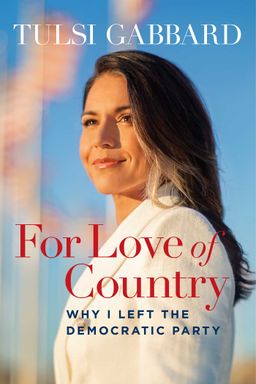
For Love Of Country cover

For Love Of Country

by Tulsi Gabbard

The Army Reserve officer, former member of Congress and 2020 presidential candidate explains why she left the Democratic Party.

A Republic at Risk: Power vs. Freedom

What would you do if your phone blared: “BALLISTIC MISSILE INBOUND—THIS IS NOT A DRILL”? Tulsi Gabbard opens For Love of Country with that very moment—a mistaken alert in Hawaii that nonetheless exposed how close ordinary people live to existential risk. She uses that visceral story to frame a broader warning: America’s constitutional order is being hollowed out by an interconnected elite—government officials, party leaders, media, and tech platforms—who justify extraordinary actions in the name of security, safety, or “saving democracy,” but end up eroding the very freedoms that make self-government possible.

Gabbard argues that today’s Democrat Party leadership (and many in “permanent Washington”) have come to see citizens as problems to be managed rather than as sovereigns to be served. This manifests, she contends, as the weaponization of the justice system against political opponents; the normalization of mass surveillance and financial snooping; a growing comfort with censoring speech; an antagonism toward faith in public life; a revival of Cold War brinkmanship and regime-change wars; the racialization of daily life; and a denial of objective truth about sex and biology that spills into policy—particularly in women’s sports and schools. While she criticizes leaders in both parties for war and surveillance, her strongest claims target the current Democratic establishment’s power plays and priorities.

What Gabbard Says Is Happening

At the core of the book is a claim about ends justifying means. Gabbard maintains that in recent years, elites have used state power and aligned influence to: (1) prosecute or procedurally sideline the candidates they fear (citing efforts to keep Donald Trump off ballots in Colorado and Maine, and multiple indictments); (2) punish dissenting speech via FBI and DHS “disinformation” partnerships with tech firms (the Twitter Files) and cultural gatekeepers (publishers protesting Amy Coney Barrett’s book deal, the ACLU’s pivot away from viewpoint-neutral defense); (3) surveil private life through elastic authorities (Patriot Act, FISA, FinCEN flags on “extremist indicators,” and her warning about central bank digital currencies); (4) pressure religious expression out of public spaces while greenlighting favored secular assemblies (COVID-era church vs. casino disparities; the Little Sisters of the Poor case; an FBI memo on “radical-traditionalist Catholics”).

Why It Matters to You

Gabbard’s message to you is profoundly practical: if unequal justice, ubiquitous surveillance, and selective censorship become normal, your vote, voice, and conscience shrink. Her own examples aim to show the slope isn’t theoretical: she describes Google freezing her presidential campaign’s ads account right after her breakout 2019 debate moment; the House’s party-line vote against the Protecting Speech from Government Interference Act; Intelligence leaders’ false “Russian disinfo” letter about the Hunter Biden laptop weeks before the 2020 election; and bipartisan rubber-stamping of post‑9/11 spying tools long after emergency faded.

The Book’s Main Arcs

You’ll see eight major arcs in this summary. First, the weaponization of law (double standards from Clinton emails to Biden documents vs Trump indictments; Pelosi’s “trial to prove innocence” tweet; Beria’s “show me the man…”). Second, the surveillance state’s creep (Patriot Act, FISA court rubber stamp rate, Snowden/Clapper’s denial, financial surveillance, CBDC risks). Third, free speech under pressure (Twitter Files, RFK Jr. hearing, ACLU’s 2017 shift, platform manipulation). Fourth, faith in public life (Little Sisters, Knights of Columbus hearings, FBI Latin Mass memo, contrasted with the grace-filled response after the Charleston church murders). Fifth, warmongering and a new Cold War (Hawaii alert, Biden’s “Armageddon” remark, Ukraine diplomacy spurned, Kennedy’s and Eisenhower’s warnings). Sixth, race and civic unity (Selma, King’s dream vs. contemporary race essentialism). Seventh, truth and women’s protections (Riley Gaines/Lia Thomas, Title IX reinterpretation). Eighth, families under fire (school choice battles, parental rights, pediatric medicalization, the Chloe Cole story).

A Frame of Aloha

Throughout, Gabbard offers aloha—love, respect, and shared dignity—as an organizing ethic. That’s not sentimental; she uses it as a standard for policy. Does a proposal honor free speech for adversaries? Does it protect a parent’s duty? Does it reduce the risk of nuclear war? Does it treat citizens as ends, not means? (Compare this values-first test to Martin Luther King Jr.’s “content of character” ideal or to John Stuart Mill’s marketplace of ideas.)

Where the Book Lands

In the Epilogue, she returns to Lincoln’s “we die by suicide” line. The antidote isn’t passivity but everyday civic action: defend speech, faith, due process, the right to bear arms, and a foreign policy that seeks peace first. You’re urged to vote for character and constitutional courage over party brand, and to practice the harder virtues—courage to speak, humility to listen, and love robust enough to forgive. Whether you agree with every claim, the throughline is clear: self-government survives only if citizens insist on equal justice, real privacy, open debate, and leaders restrained by the Constitution.


Weaponized Justice And Elections

Gabbard’s central charge is that law enforcement has been repurposed into a political tool. She points to attempts to bar Donald Trump from primary ballots (Colorado’s supreme court and Maine’s secretary of state), and the unprecedented stack of indictments during a campaign, as a blueprint future administrations can copy. For her, the danger isn’t just who you prefer in 2024—it’s the normalization of process as punishment.

A New Precedent: Keep Opponents Off the Ballot

When state actors move to disqualify a leading candidate, Gabbard argues, they signal that voters cannot be trusted. She cites Missouri’s secretary of state warning he could apply the same “new standard” to Joe Biden if courts upheld Trump removals, underscoring a tit‑for‑tat cycle. (Historical parallel: after Brazil’s “clean slate” law sidelined rivals, accusations of lawfare escalated across cycles.)

Selective Justice: Who’s Above the Law?

Gabbard walks through contrasts: James Comey’s decision not to charge Hillary Clinton after detailing “extremely careless” handling of classified emails; Special Counsel Robert Hur’s conclusion that Joe Biden “willfully retained and disclosed classified materials” yet declined prosecution; and the elevation of James Clapper and John Brennan after they misled Congress. Meanwhile, Trump faces 91 charges across jurisdictions. The pattern, she says, is not “no one above the law” but who is above the law.

Narrative Machinery: The Russia Hoax

Gabbard recounts the “Russia collusion” arc: the Clinton campaign’s Alfa Bank story fed to media and the FBI; the Steele dossier’s use to surveil Carter Page; and John Durham’s later findings on politicized investigations. She adds a personal anecdote: Hillary Clinton suggested in 2019 that Gabbard was “groomed by Russians,” a smear she says many still believe because it was repeated by media. The lesson she draws is chilling: manufactured claims can justify extraordinary state power.

Guilty Until Proven Innocent

Nancy Pelosi’s tweet that Trump would get “a trial to prove innocence,” Gabbard argues, flips the presumption of innocence. She links this mindset to Stalin’s police chief Lavrentiy Beria—“Show me the man and I’ll show you the crime”—and warns how easy it is to find an obscure statute to entangle any target. Add the federal bureaucracy’s ability to drown people in audits and investigations, and you get a climate of deterrence by fear.

Street-Level Tradeoffs

While elites “get Trump,” Gabbard says, ordinary people face rising urban crime as progressive prosecutors relax penalties. She spotlights Manhattan DA Alvin Bragg—who ran on “get Trump,” downgraded many violent offenses, and saw major crimes rise. You don’t need to share her policy preferences to consider the framing question she poses: are we prioritizing punitive process for political foes over basic public safety?

(Context: Scholars from different poles—like liberal law professor Jed Rubenfeld and conservative Paul Clement—have both warned about criminalizing politics. Gabbard’s unique contribution is to tie that legal drift to an everyday cost—trust in institutions and safety on the sidewalk.)


From Patriot Act To CBDC: Watching You

Gabbard traces how a legitimate post‑9/11 desire to prevent terrorism morphed into a standing architecture of mass surveillance—now stretching from your inbox to your bank account. The danger, she argues, isn’t any single program but the accumulation: secret courts, elastic definitions, and agency habit.

How the Emergency Became Normal

Passed six weeks after 9/11, the USA Patriot Act broadened surveillance, weakened probable cause standards, and relied on a secret FISA court that approved more than 99 percent of requests. Edward Snowden’s leaks then showed bulk phone record collection. When asked under oath in 2013 if the government collected “any type of data on millions of Americans,” DNI James Clapper said “Not wittingly”—a denial later shown false. Gabbard’s point: once ceded, extraordinary powers rarely roll back.

Financial Dragnet and ‘Extremist Indicators’

She highlights a 2024 Treasury letter confirming FinCEN encouraged banks to watch for “extremist” transactions after Jan. 6—signals that reportedly included purchases of Bibles or shopping at outdoor stores. Even if well‑intended, she argues, this blurs the line between policing crime and profiling beliefs.

Digital Dollars, Frozen Wallets

Gabbard warns that a U.S. central bank digital currency (CBDC), touted as efficient and inclusive, would centralize unprecedented visibility and control. She points to Canada’s freezing of truckers’ bank accounts during protests and EU proposals capping cash transactions as a preview of financial governance by emergency. “Once someone else controls your wallet,” she writes, “they control your freedom.”

A Founders’ Lens

Quoting Franklin’s “Those who would give up essential liberty…” and reminding you the Fourth Amendment guards “persons, houses, papers, and effects,” Gabbard calls for re‑balancing toward warranted, targeted surveillance with adversarial oversight—rather than blanket dragnets justified by amorphous threats. (Parallel concerns span ideologies: libertarians at Cato, progressives at EFF, and centrists on the PCLOB have all urged tighter guardrails.)

The personal upshot: your texts, donations, or purchases shouldn’t be reinterpreted tomorrow as red flags because a political wind shifted today. Self‑government needs zones of private life beyond the state’s predictive gaze.


Free Speech Under Pressure

“I may disagree with what you say, but I’ll defend your right to say it” once felt like American common sense. Gabbard argues that standard has been replaced by a managed-speech model: what you see online is filtered by government‑platform backchannels; what you write may be labeled “harmful”; and what you read is curated away.

Censoring by Proxy

The Twitter Files exposed emails from the FBI and DHS flagging posts and accounts for moderation, including ordinary citizens and elected officials. For Gabbard, that’s a constitutional end‑run: the state can’t directly ban speech, so it nudges platforms to do it. When a federal judge temporarily barred such coordination in 2023, the White House warned the ban would cause “great harm”—a frank admission, she says, that unfettered speech harms them, not you.

Gatekeepers Change the Rules

Gabbard notes the ACLU’s 2017 guidance to weigh cases against its values (a departure from its classic viewpoint‑neutral posture). She cites 600+ publishing staffers urging cancellation of Amy Coney Barrett’s book deal solely due to her jurisprudence. And at a 2023 House hearing on federal censorship, Democrats moved to silence lead witness Robert F. Kennedy Jr. before testimony began—“an attempt to censor a censorship hearing,” he quipped.

Big Tech’s Invisible Thumbs

After Gabbard’s strong 2019 debate, Google abruptly suspended her ads account (later restored without explanation), blocking voters from reaching her site at peak interest. She cites a study showing Gmail sent ~77% of Republican campaign emails to spam vs ~10% of Democratic emails during 2020. Even without malice, she argues, opaque curation is power over elections.

Congressional Choices

In 2023, the House passed the Protecting Speech from Government Interference Act—every Republican for, every Democrat against. Gabbard ties that vote to the 2020 “51 intelligence officials” letter branding the Hunter Biden laptop “Russian disinformation,” which Joe Biden then cited in a debate. In her view, the pattern is consistent: when truth is politically inconvenient, gate it.

(Compare: In The Constitution of Knowledge, Jonathan Rauch—no conservative—warns that social coercion and institutional capture can throttle open inquiry. Gabbard’s argument converges: pluralism needs robust free speech norms, not curated consensus.)

Key Idea

Open debate is not a luxury; it’s the operating system of a free society. Disable it for your opponent, and you’ve just installed the update that can disable yours.


Faith, Pluralism, And Public Life

Gabbard grounds her politics in a simple creed: love God, love people. She argues the Founders protected the “free exercise” of religion not to privatize faith, but to ensure conscience could flourish in public and private life. What alarms her today is a climate where faith is suspect while favored secular causes get deference.

Double Standards in a Crisis

During COVID, she notes, some jurisdictions shuttered churches (even drive‑in services) while allowing casinos, liquor stores, or mass protests. She contrasts the zeal to police worship with tolerance of political gatherings, concluding that the standard was which assembly the state preferred, not what health demanded.

Tests of Conscience

The Little Sisters of the Poor fought for years against a mandate to provide contraception coverage they opposed; enormous corporations won exemptions with ease. In 2018, Senators asked a judicial nominee to justify his membership in the Knights of Columbus, a Catholic fraternal charity. An FBI memo later flagged “Radical Traditionalist Catholics” and suggested recruiting sources in parishes. To Gabbard, these are canaries in the coal mine: no religious tests must mean just that.

Grace in Action

Her most moving story is Charleston, 2015. After a white supremacist murdered nine worshipers at Mother Emanuel AME Church, family members publicly forgave the killer. Gabbard stood at a memorial as thousands sang “Amazing Grace,” seeing in their courage a living testament to the power of faith to heal and unify. For her, this is the civic promise of religion: moral resources the state cannot manufacture.

(Context: Alexis de Tocqueville made a similar claim nearly two centuries ago—religion strengthens American freedom by shaping character, not commanding law. Gabbard’s chapter updates that for an age of suspicion.)


Warmongers, Cold Wars, And Real Costs

Having deployed to Iraq as a soldier, Gabbard treats foreign policy as a kitchen‑table issue: war shatters families, drains treasure, and—most dangerously in a nuclear age—can end civilization. She criticizes a bipartisan “war uniparty,” but argues today’s Democratic leadership and allied media have reignited a New Cold War to serve domestic narratives.

A Siren and a Spiral

The Hawaii missile alert changed how she experiences risk. Even a mistake made families stuff kids into manholes, dash for caves, and sob over impossible choices. Later, President Biden privately invoked the Cuban Missile Crisis and “Armageddon.” She asks: if leaders admit the peril, why aren’t diplomacy and de‑escalation visible priorities?

Narratives and Negotiations

Gabbard connects the post‑2016 “Russia puppet” frame to a posture that spurns negotiation as appeasement. She points to early 2022 talks among Ukraine, Russia, and Turkey that fizzled as Western leaders vowed to “weaken Russia.” When the Progressive Caucus briefly urged diplomacy, it retracted the letter within 24 hours under party pressure. Her takeaway: peace has no lobby.

Costs You Can Count

She invokes Eisenhower’s warning about the military–industrial complex and pegs nearly half of post‑9/11 Pentagon spending to contractors. Then she remembers Staff Sgt. Frank Tiai, killed a day before leave in 2005; the rifle stacked in his boots; the three‑volley salute. Numbers matter; names matter more.

A JFK Standard

Gabbard returns to President Kennedy’s 1963 American University address: “Not a Pax Americana… Peace is a process.” She pairs it with Reagan–Gorbachev’s line: “A nuclear war can never be won.” The policy test she offers you: does an action lower or raise the odds of great‑power war? If we can’t answer “lower,” she says, change course.


Race, Unity, And The Aloha Standard

Gabbard’s Hawaii upbringing taught her to see people first, labels second. She reveres the Civil Rights Movement’s method—nonviolence, appeal to equal rights, and an unshakeable belief that America could live up to its creed. Her pilgrimage across the Edmund Pettus Bridge with John Lewis becomes a moral compass for her critique of today’s race discourse.

Remembering What Worked

Bloody Sunday’s televised brutality catalyzed the Voting Rights Act because activists claimed America’s promises, not its overthrow. King’s “I Have a Dream” pledged judgment by character, not color. For Gabbard, that posture—anchored in dignity and shared destiny—built change that lasted.

Where We’re Drifting

She argues that today’s influential “anti‑racism” frameworks (Robin DiAngelo’s White Fragility; Ibram X. Kendi’s claim that the remedy for past discrimination is present discrimination) re‑essentialize race, promote permanent oppressor/victim identities, and license new forms of prejudice—particularly against whites. Even if intentions differ, the habit is the same: judge by color first.

Aloha, Not Animosity

Aloha, as she defines it, recognizes a spiritual connection that precedes categories. That doesn’t deny injustice; it supplies the fuel for reconciliation without erasing truth. (Analogous to King’s “beloved community” or Desmond Tutu’s Ubuntu.) She’s blunt: respond to hate with hate and you get more hate; respond with love and law, and you get change.

If you’re exhausted by whiplash moralizing, this chapter invites you to a steadier place: insist on equal protection; refuse race litmus tests; and treat neighbors as neighbors—first.


Truth, Women, And The Line In The Sand

This is Gabbard’s most combustible chapter. She argues that denying biological sex differences erases women in law and life. Her evidence runs from locker rooms to courtrooms to Title IX rewrites—and she names names so you can feel the stakes.

When Fairness Meets Fiction

NCAA swimmer Riley Gaines tied Lia Thomas—born male—for fifth in the 200‑yard freestyle; the lone trophy was handed to Thomas “for the photo,” Gaines was told. Women changed next to a naked biological male who sometimes appeared aroused; complaints were ignored. Surfer Bethany Hamilton lost longtime sponsorship and was excluded from an International Women’s Day jersey honor after objecting to male inclusion in women’s surfing. These are not abstractions; they are lost opportunities and dignity wounds.

Title IX, Redefined

Title IX’s 37 words guard opportunities “on the basis of sex.” Gabbard argues the Biden administration’s move to fold “gender identity” into Title IX, and to sanction schools that keep women’s categories female‑only, undermines the statute’s purpose. She introduced the Protect Women’s Sports Act to tether Title IX back to biological sex—and was branded a bigot for it.

Words Matter Because Reality Matters

When a Supreme Court nominee declined to define “woman,” saying “I’m not a biologist,” Gabbard saw a cultural tell: politics can now override the obvious. She also flags proposals abroad to criminalize “misgendering,” and U.S. federal guidance calling repeated pronoun dissent “actionable sex harassment.” Her point: coercing speech to conform to ideology is not inclusion; it’s compelled belief.

(Other authors—like Abigail Shrier in Irreversible Damage and Kathleen Stock in Material Girls—raise similar alarms from different angles: fairness for girls, the integrity of language, and safeguarding pluralism.)


Families, Schools, And Who Decides

Gabbard calls the family the bedrock of a free society. She argues the state increasingly asserts itself as the primary stakeholder in children—deciding what they learn, what parents may know, and even what medical pathways are “affirmed.” Her critique spans school choice fights, curriculum wars, and pediatric medicalization.

School Choice and a Political Earthquake

A 2023 poll showed ~71% of Americans support school choice. Yet when Virginia’s Terry McAuliffe said, “I don’t think parents should be telling schools what they should teach,” many parents bolted—to Glenn Youngkin. Gabbard frames the episode as a referendum on who owns the classroom: bureaucracies or families.

Secrecy and ‘Gender Support’ in Schools

She documents policies that bar teachers from informing parents when a child adopts a new gender identity, and cases where minors access blockers or referrals without parental consent. Even if you support social transition, she argues, parents are the most accountable guardians of a child’s long‑term good.

From Screens to Scalpels

The story of Chloe Cole—who identified as trans at 12, took blockers and testosterone, and had a double mastectomy by 15 before detransitioning—anchors Gabbard’s warning. She points to Boston Children’s Hospital videos marketing “gender‑affirming hysterectomies,” and an FDA warning that commonly used blockers may carry serious risks (e.g., brain swelling). She argues that experimentation should never be normalized as care, least of all on children who cannot consent to lifelong consequences.

Gabbard’s prescription is modest and radical at once: restore parents to the center; keep ideology out of K‑8 classrooms; and apply the Hippocratic Oath without exception—“first, do no harm.”

Dig Deeper

Get personalized prompts to apply these lessons to your life and deepen your understanding.

Go Deeper

Get the Full Experience

Download Insight Books for AI-powered reflections, quizzes, and more.