
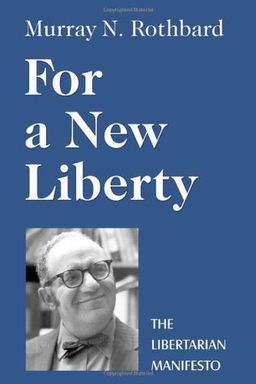
For a New Liberty cover

For a New Liberty

by Murray N Rothbard

For a New Liberty by Murray N Rothbard presents a compelling case for libertarianism, challenging the necessity of a central State. It critiques government overreach and inefficiencies, advocating for a society driven by individual rights and free markets.

Liberty, Power, and the Moral Logic of Freedom

Why do free societies flourish while coercive states stagnate? Murray Rothbard’s central claim is that liberty is both a moral imperative and a practical necessity. In his reconstruction of libertarianism, you discover that the same principles that justified the American Revolution—natural rights, voluntary exchange, and limits on power—form a coherent system that undercuts not only monarchy and feudalism but also modern welfare states and interventionist economies. Rothbard’s goal is not simply policy reform; it is a reorientation of political morality around the nonaggression principle.

He defines this principle simply: no one may initiate force or threat of force against another’s person or property. From that axiom flows his entire worldview—self-ownership, private property, free exchange, and peace. You can read the book as a fusion of moral philosophy, economic history, and political strategy designed to make liberty consistent, radical, and historically grounded.

From Classical Liberalism to Libertarianism

Rothbard begins with the libertarian heritage of classical liberalism and the American Revolution. From the English radicals Trenchard and Gordon (authors of *Cato’s Letters*) to Jefferson and the framers of the Bill of Rights, he traces a moral lineage that viewed power as inherently encroaching. The American founding, through its emphasis on natural rights and limited government, was a libertarian revolution—an attempt to institutionalize the suspicion of centralized control. Yet Rothbard argues these victories were partial: federalist elites reasserted central power through taxation, standing armies, and mercantilist programs that eroded the radical promise of 1776.

By recovering this historical radicalism, you learn why libertarianism is not a modern fad but a continuation of a centuries-long revolt against arbitrary authority. The loss of that revolutionary fervor—replaced by utilitarian compromise and state management—explains why Western liberalism collapsed into bureaucratic statism by the twentieth century.

The Moral Core: Nonaggression and Self-Ownership

For Rothbard, liberty stands or falls on moral coherence. The nonaggression principle forbids initiating force; self-ownership ensures every human being owns his or her body absolutely. From these two principles, private property follows: mixing one’s labor with unowned resources creates just ownership. That moral geometry explains the legitimacy of voluntary exchange and the injustice of theft, conscription, or taxation. While utilitarians defend freedom for its consequences, Rothbard insists liberty is an expression of human nature—something you respect because coercion is inherently wrong.

He contrasts self-ownership with two false alternatives. In slavery, one class claims ownership over another. In communal ownership, everyone supposedly owns everyone—an impossible setup leading to tyranny by administrators. Only individual ownership reconciles moral equality and practical autonomy.

The State as Persistent Aggressor

The next step in his logic is provocative: if aggression is wrong, then the State—defined as an institution claiming a monopoly of coercion—is immoral by design. It taxes by force, wages war without individual consent, and maintains privileges for a ruling class. Drawing on sociologists like Franz Oppenheimer and political theorists like Calhoun and Spooner, Rothbard classifies the State as the institutionalization of theft. Rulers ally with intellectuals to manufacture legitimacy—first priests, then professors and planners—to persuade people that taxation equals service and war equals virtue.

This critique turns conventional politics upside down. Instead of asking the State to solve problems, you must ask how State control causes them—through monopoly, subsidy, and moral exemption from the very laws that constrain individuals.

Economic Logic and Institutional Consequences

Rothbard’s historical chapters link moral philosophy to economics in vivid detail. By seizing the money supply (through fiat currency and central banking), governments create inflation—disguised taxation that transfers wealth to political and financial elites. His Austrian analysis of business cycles shows how central-bank manipulation of interest rates leads to malinvestment and inevitable busts. Similarly, welfare programs create dependency and political constituencies that perpetuate coercion. Inflation, welfare, and war are not policy errors but natural consequences of State privilege.

Where others see public services, Rothbard sees monopolies severed from performance: education that enforces obedience, public roads that invite congestion, and welfare policies that penalize productivity. Each example reveals the same pattern—disconnect service from voluntary payment, and you destroy accountability.

Reclaiming Society Through Voluntary Order

Against the charge that liberty leads to chaos, Rothbard builds a counterworld of voluntary arrangements. Private schools, private policing, private roads, and even competing arbitration courts have historical precedents—from merchant law to Irish *brehon* courts—and prove order does not require monopoly government. The key is property: whoever owns is responsible. When roads, neighborhoods, and businesses are privately owned, incentives align toward safety, efficiency, and mutual respect. Pollution, crime, and congestion become legal or pricing problems, not excuses for political control.

(Note: Rothbard’s approach draws inspiration from Mises, Hayek, Spooner, and classical liberals like Jefferson but diverges by rejecting any residual State—even a "night-watchman" government—as inconsistent with nonaggression.)

The Strategy of Liberty

Finally, Rothbard turns from theory to practice. A free society will not be granted by rulers; it must be educated into existence. He calls for an intellectual and cultural movement that weds pure principle to strategic realism: teach, publish, and persuade, but never trade fundamental rights for incremental privilege. Crises—economic collapse, war failures, or scandals—are moments when belief in authority falters. Those moments create openings for radical alternatives.

The book ultimately reads as both indictment and invitation. Understanding the moral structure of liberty equips you to see political life differently: coercion is not inevitable, hierarchy not sacred, and freedom not an abstraction but the default condition of a moral society. If you follow Rothbard’s reasoning, you begin to judge all policies by one question: does this action respect every person’s right to self-ownership and voluntary exchange—or does it rest, secretly or openly, on the threat of force?


The Moral Foundations of Property and Freedom

Rothbard grounds liberty in the triad of nonaggression, self-ownership, and property. These three ideas form a moral geometry that explains law, economics, and politics at once. You, as a moral agent, own your body and the products of your labor. Any interference with those is coercion, no matter how benevolent the rhetoric. By extending John Locke’s labor-mixing theory, Rothbard argues that property arises naturally when effort transforms unowned resources. That claim shields private commerce from political expropriation and makes markets moral institutions, not amoral systems of greed.

Natural Rights vs. Utilitarian Pragmatism

Libertarian ethics, he insists, cannot rest on expediency. Utilitarian justifications for freedom collapse when someone claims coercion yields good results. The natural-rights view, by contrast, affirms rights as universal and non-negotiable. This perspective connects political liberty to human nature rather than social outcomes. It is why the same principle that forbids theft forbids taxation and conscription: both violate the owner’s title to his body or labor.

Exchange as Extension of Rights

When you freely trade your labor or property, you simply transfer or share control that was already yours. Markets, therefore, are networks of voluntary consent. In that sense, economic freedom and civil liberty are the same principle applied in different spheres. Rothbard uses micro examples—a farmer homesteading land, an artisan selling work, an inheritor gifting wealth—to illustrate how consent and property mutually reinforce each other.

Core implication

Once you accept that individuals own themselves, it becomes impossible to justify forced taxation, military drafts, or welfare redistribution without violating first principles.

The insight here is radical but common-sense: human beings thrive when moral and economic life are voluntary, not commanded. Liberty is not merely efficient—it is right.


The State as Organized Aggression

Rothbard’s boldest claim is that the State is not a public service but an organized system of aggression. Governments differ from all other institutions because they claim the legal right to do what would be crimes if done privately: tax, conscript, imprison, and kill. This moral asymmetry, he argues, reveals the fraud behind social‑contract myths. No one truly consents to have wealth seized or wars fought in his name. The State survives not by logic but by ideology—the alliance of rulers and intellectuals who legitimize authority in exchange for rewards.

How Coercion Is Disguised as Order

Through history, the State has rebranded its aggression as guardianship. Monarchs invoked divine right; democracies appeal to "the public good." Modern technocrats use the language of science and expertise. In each era, ideology converts fear of chaos into obedience to power. Lysander Spooner’s quip that government’s threat—"your money or your life"—is still robbery, even when called taxation, encapsulates this logic.

The Fiscal Class Struggle

Every State divides society into two groups: tax‑payers and tax‑consumers. Bureaucrats, contractors, and subsidy recipients live by political appropriation of others’ labor. Calhoun and Oppenheimer called it the political means of livelihood—wealth obtained by coercion rather than production. This institutionalized plunder explains why government tends to expand over time: every dependent interest lobbies for more spending, while costs disperse among coerced payers.

Moral Consistency

If aggression is wrong for individuals, it is wrong for the State. Taxation is legalized theft; conscription is legalized slavery; war is legalized mass murder.

You are thus forced to choose: either moral principles apply universally or special exemptions for the State erase them altogether. For Rothbard, true justice leaves no room for double standards.


Money, Inflation, and Business Cycles

Rothbard’s economic analysis connects morality to monetary mechanics. He argues that inflation is not a mysterious social trend but a deliberate policy outcome of State control over money and banking. When paper money replaces commodity money like gold or silver, governments gain the power to create money ex nihilo. That privilege lets them finance wars, welfare, and debt without visible taxation—subsidizing political constituencies while eroding purchasing power.

How Central Banking Manufactures Inflation

The Federal Reserve and commercial banks operate on fractional reserves: they hold only a fraction of deposits in reserve and lend the rest, creating new money as credit. When the Fed buys bonds in open-market operations, it injects new reserves, which banks multiply through lending. This hidden printing press expands the money supply far beyond what physical currency suggests. The long-term consequence is chronic inflation and artificial credit booms.

Austrian Business Cycle Theory

Mises and Hayek explained why these booms inevitably end in busts. Artificially low interest rates signal false abundance of savings, luring entrepreneurs into long-term projects unsupported by real capital. When savings prove insufficient, projects fail and recession follows. In past gold-standard eras, deflation would clear bad investments quickly. In today’s fiat-money world, governments refuse to allow contraction, producing stagnation alongside rising consumer prices—stagflation. The 1970s crisis vindicated this analysis and discredited Keynesian fine‑tuning.

Policy Lesson

True stability requires stopping credit expansion, allowing markets to liquidate errors, and restoring a commodity‑based, non‑political money standard.

In other words, monetary freedom—like moral freedom—means withdrawing privilege from the State. Inflation is simply the moral problem of aggression expressed through economics.


The Welfare State and the Limits of Coercion

Rothbard devotes a sharp analysis to welfare and redistribution, exposing not compassion but coercion and dependency. He shows with data how U.S. social spending exploded from the 1930s to the 1970s independent of poverty levels. Public aid became a permanent, politically protected transfer system that rewarded non‑work and expanded bureaucracy. Behind moral rhetoric lies a simple transaction: taxpayers are conscripted into financing clients of the State.

Incentives and Culture

Because people respond to incentives, high welfare benefits relative to wages logically increase welfare dependence. Cultural factors matter too: where traditions stress self‑help and community support (as in Mormon welfare programs), dependency declines. This illustrates that moral expectations can outperform coercive aid. Rothbard cites the McCone Commission data showing welfare often paid near job-level income, turning compassion into moral hazard.

False Reforms

Even well‑intentioned proposals like the negative income tax or universal basic income worsen the problem by automating dependency. They make welfare stigma‑free, expanding claimants and costs. Rothbard’s remedy is not bureaucratic efficiency but moral reformation: voluntary, local charity based on rehabilitation and temporary support.

Central Insight

Welfare coercion corrodes both giver and receiver. The only humane system is voluntary aid rooted in community and dignity.

For Rothbard, social compassion and individual liberty are not opposites—they flourish together when help is freely chosen, not politically compelled.


Education and the Manufacture of Obedience

Public education, for Rothbard, is the State’s psychological fortress. Compulsory schooling arose from religious and political motives to homogenize citizens and train them in obedience. From Martin Luther’s call for state‑run schools to the Puritan statutes of Massachusetts, the model has always been coercive uniformity. The result is not enlightenment but conformity—children indoctrinated to equate authority with knowledge.

Uniformity and Hidden Discrimination

Because districts monopolize schooling by law and finance it through property taxes, local systems segregate by class and income while enforcing standardized curricula. Bureaucrats decide what counts as education, crowding out private or innovative alternatives. Even higher education suffers: accreditation and bond requirements bias the field toward large, subsidized, trustee‑run universities.

Freedom to Learn

Rothbard endorses parental rights affirmed in *Pierce v. Society of Sisters* (1925): the child is not the creature of the State. Vouchers may decentralize funding, but as long as the State certifies eligible schools, control persists. True reform requires full privatization—letting families and communities shape education as they see fit. Learning, like religion or commerce, thrives under freedom.

Moral Lesson

When you remove coercion from education, diversity and responsibility replace indoctrination.

Education thus reveals an enduring libertarian truth: knowledge imposed is propaganda, knowledge chosen is liberty in practice.


Private Provision and the Market for Order

Rothbard dismantles the myth that public services must be publicly run. Whether you examine roads, policing, or adjudication, he argues that private ownership and voluntary exchange outperform coercive monopoly. The logic is transparent: markets tie service to payment and reward efficiency; government severs that link and rewards failure with more funding.

Private Roads, Police, and Courts

Imagine every street privately owned by merchants and residents who have direct financial stakes in safety and cleanliness. Historical precedents—private turnpikes in eighteenth‑century England, railway police in early twentieth‑century America, and merchant arbitration courts—show that decentralized law and policing are not fantasies. Owners hire protection because crime hurts revenue; arbitrators decide disputes because customers demand reliable justice. Competition and reputation check abuse more effectively than political bureaucracy ever could.

Economic Calculation and Incentives

Government monopolies cannot price services rationally because they lack market signals. This is the calculation problem identified by Mises in socialism and verified daily in bureaucratic waste. When roads congest, officials blame users instead of pricing scarce capacity; when post offices lose money, they raise taxes instead of improving efficiency. Privatization reconnects cost, value, and responsibility.

Broader Lesson

Freedom is not chaos; it is order generated by ownership and choice. Coercion is not stability; it is compulsory chaos disguised as planning.

By inviting you to imagine private law and streets, Rothbard shifts the entire frame: the question is no longer whether markets can deliver public goods, but why coercive monopolies still rule where voluntary cooperation could excel.


Liberty, Environment, and Global Peace

Rothbard extends libertarian logic beyond economics to ecology and foreign policy. In both realms, he argues, coercion undercuts responsibility while property and voluntary relations create harmony. Environmental degradation and war stem not from freedom but from its absence—from unowned commons and politicized intervention.

Ownership as Conservation

When property is private, owners internalize costs and preserve value. Rising prices of scarce resources naturally prompt conservation, substitution, and innovation. By contrast, public ownership erodes accountability. The open range, leased forests, and unowned oceans produced depletion precisely because no one bore long‑term responsibility. Pollution, likewise, is aggression—an invasion of property through toxins or noise. Enforcing nuisance law, rather than inventing bureaucracy, aligns ecology with justice.

Foreign Policy and the Logic of Peace

Rothbard’s anti‑interventionism continues the same logic internationally. War is the State’s ultimate aggression, concentrating power at home while destroying liberty abroad. Military conscription, censorship, and economic regimentation accompany every major conflict. He calls for strict non‑intervention: withdraw troops, end foreign aid, and abolish intelligence empires. Major General Smedley Butler’s 1936 proposal for a constitutional ban on overseas forces embodies this radical peace.

Moral Parallel

Pollution violates property; war violates persons. In both, moral consistency demands prohibition of aggression regardless of scale or justification.

Peaceful cooperation—among individuals or nations—is not naïve idealism but the logical outcome of respecting rights. Liberty, properly understood, is environmental stewardship and foreign non‑intervention combined.


Reviving a Movement of Consistent Liberty

Rothbard closes with strategy. If coercion is the oldest political habit, how do you reverse it? He answers by urging an intellectual insurgency: educate, organize, and wait for crisis. Liberty advances not by compromise but by clarity. When ruling systems fail—through stagflation, scandal, or war—people seek transparent moral alternatives. A principled, prepared movement can then transform skepticism into reform.

Principle and Pragmatism

Activists must avoid both opportunism and dogmatism. Opportunists dilute principle for popularity; sectarians reject all progress short of utopia. The golden mean is uncompromised direction combined with flexible application. As F.A. Hayek advised, keep the liberal utopia visible so society knows what to aim for. Transitional steps—decontrol, privatization, monetary reform—are useful only if they reduce, not expand, coercion.

Education as Revolution

The true battlefield is intellectual. Journals, lectures, and campus organizations form the infrastructure of renewal. The libertarian revolution begins in the mind, restoring moral vocabulary eroded by pragmatism. Rothbard envisions alliances among youth, independent entrepreneurs, and taxpayers—the classes most harmed by State predation—to build momentum during crises like Watergate or inflation shocks.

Enduring Optimism

Because liberty accords with human nature and practical reason, it will re‑emerge whenever people rediscover moral consistency. Your task is to make that rediscovery visible.

In essence, Rothbard offers both a theory of justice and a handbook for persuasion. Freedom will endure not as a gift but as an idea too coherent to suppress.

Dig Deeper

Get personalized prompts to apply these lessons to your life and deepen your understanding.

Go Deeper

Get the Full Experience

Download Insight Books for AI-powered reflections, quizzes, and more.