
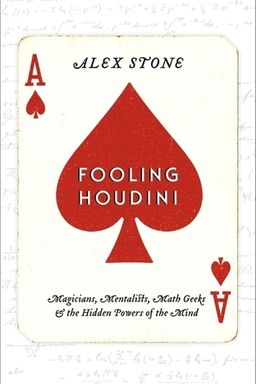
Fooling Houdini cover

Fooling Houdini

by Alex Stone

In Fooling Houdini, Alex Stone takes readers on an exhilarating journey into the world of magic, revealing its intricate ties to science and human perception. Through captivating stories and insights, Stone explores how magicians master deception, challenge reality, and inspire wonder, offering a fresh perspective on magic''s enduring allure.

The Magic of Perception and the Human Quest for Wonder

What happens in your mind during a moment of astonishment—when you see something that feels impossible? In Fooling Houdini, physicist-magician Alex Stone explores the strange intersection of science, psychology, and performance to answer that question. Blending memoir, cultural anthropology, and cognitive science, he argues that magic isn't just entertainment—it's a lens for understanding perception, deception, and human curiosity itself. Magic reveals the fragility of our senses, the malleability of memory, and the deep human desire to believe in mystery.

Stone contends that mastering illusion teaches us about more than sleight of hand—it teaches us how we see and think. His own humiliating failure at the 2006 World Championships of Magic becomes a catalyst for a journey through the subculture of magicians, con artists, and scientists who push the limits of human awareness. By tracing magic’s ties to physics, neuroscience, gambling, mentalism, and philosophy, Stone shows how deception and perception are bound together by the same laws that govern nature and cognition.

Magic as a Mirror to Science

Magic and science emerge in Stone’s narrative as sister disciplines—both rely on curiosity, observation, and the willingness to believe in underlying mysteries. As a physics PhD candidate at Columbia, Stone sees the same mathematical elegance in a card shuffle as in equations describing subatomic particles. Studying quantum mechanics and probability awakens in him an appreciation for the illusion behind reality itself—a magic trick on a cosmic scale. The book uses this insight to question how the mind constructs meaning from limited sensory data, much like how magicians construct illusions from subtle manipulations of attention.

Failure as a Catalyst for Insight

Stone’s journey begins with humiliation. After being disqualified mid-performance at the Magic Olympics, he spirals into self-doubt. Yet this failure compels him to reexamine magic through a scientific lens—seeking out master magicians, cognitive scientists, and gamblers to understand why illusions work. Each encounter—whether with the blind card mechanic Richard Turner, the eccentric mentor Wesley James, or psychologist Arien Mack—reveals a new dimension of the relationship between skill and perception. His narrative reminds you that breakdowns, whether on stage or in life, often create breakthroughs.

The Subculture of Obsession and Secrecy

Beneath the public glamour of magicians lies an intense, secretive world of obsessive practitioners. Stone portrays magic’s underground network as a society of outcasts and geniuses—the "island of misfit toys" where nerds and eccentrics reinvent reality. From pizza-parlor card hustlers in New York to elite gatherings of mentalists in Las Vegas, he explores how secrecy both empowers and isolates magicians. The tension between revelation and concealment mirrors our own desire for both understanding and mystery.

Magic Meets Neuroscience

Using experiments on attention blindness and misdirection, Stone connects magic to the latest findings in cognitive psychology. Collaborating with researchers like Arien Mack, he demonstrates how easily perception can be manipulated—a coin can vanish, a watch can disappear, even a gorilla can stroll unnoticed through a scene. Through magic, Stone translates complex neuroscience into intuitive insight: that reality isn't something we see but something we construct. The magician, like the scientist, plays with the boundaries of knowledge to reveal how fragile our sense of certainty truly is.

Why It Matters

Ultimately, Fooling Houdini argues that learning how magic works can deepen our sense of awe rather than diminish it. You begin to see illusion not as deception but as a fundamental feature of human experience, proof that wonder still thrives even in an age of explanation. Whether Stone is decoding the mathematics of card shuffling, examining the ethics of mentalists, or tracing the lineage of magicians from Houdini to street performers, his message is clear: to understand magic is to understand the marvelous limits of being human.


From Failure to Mastery

Stone’s journey begins in public humiliation. At the Magic Olympics in Stockholm, he drops a coin, loses his nerve, and is literally red-lighted offstage. This catastrophic failure, watched by thousands including his parents, becomes a turning point. Failure, he realizes, is the magician’s greatest teacher—and perhaps the scientist’s as well. Like Thomas Edison’s thousands of abandoned prototypes or Richard Feynman’s playful mistakes, failure reveals the fragile boundary between mastery and illusion.

Learning from the Red Light

Being publicly dismissed pushes Stone toward an obsessive self-reconstruction. He compares his perfectionist drive to scientific experimentation: iteration, feedback, and refinement. A magician’s rehearsal mirrors the lab cycle—test hypothesis, watch results, adjust variables. His pursuit of improvement—joining secret societies, studying physics, and rediscovering magic’s psychology—transforms shame into curiosity. By accepting error as inevitable, he reframes performance not as exposure but exploration.

Mentorship and Discipline

To recover, Stone seeks mentors who represent different aspects of mastery. Wesley James becomes his gruff guru in sleight of hand, teaching patience and precision in a dingy New York pizza parlor. Later, Eugene Burger and Jeff McBride guide him through the psychological and spiritual dimensions of performance. They remind him that genuine magic lies not in manipulation but in connection. Mastery demands both technique and personality—an insight common to athletes, artists, and scientists.

The Science of Practice

Stone’s obsession parallels the concept of deliberate practice championed by Anders Ericsson: focused repetition with immediate feedback. He learns that magicians strengthen muscles like pianists and cultivate attention like monks. He drills the classic pass and the faro shuffle until numbness becomes fluency. In these rituals of repetition, physics meets meditation. The lesson for you, whether or not you ever touch a deck of cards, is that mastery is born not of confidence—but of humility to start again after dropping the coin.


The Secret World of Magicians

Stone unveils magic’s true backstage—a subculture as rigorous and hierarchical as science or organized religion. Inside New York’s pizza parlors and veteran halls, magicians trade secrets like alchemists protecting formulas. They aren’t only entertainers; they’re keepers of an oral tradition where deception becomes art. Their motto—“Magic, Unity, Might”—captures a mix of camaraderie and rivalry that defines this secret brotherhood.

The Society of American Magicians

Joining the Society of American Magicians plunges Stone into a community governed by oaths and ceremonies. Houdini himself once led this fraternity. Its broken-wand ritual—a literal snapping of the wand when a magician dies—symbolizes the passage of mystery back to the ether. Through these traditions, Stone learns that magic resists commercialization precisely because it thrives on secrecy. The magician’s silence is not arrogance; it’s reverence for something ineffable.

Friends in Magic

The deeper he ventures, the more Stone discovers kinship among misfits. There’s Wesley James, the chain-smoking genius with a PhD, the mathematician Jack Diamond, and John Born, who views card mechanics as meditation. They bond through obsession, coding their lives around sleights and shuffles. Magic becomes a social language for outsiders—a refuge where intellectual thrill seekers find meaning through mastery. Much like scientists seeking truth, magicians seek mystery.

Secrecy as Identity

Stone learns that to be a magician is to live inside paradox: secrecy defines identity but also creates isolation. This tension mirrors the divided nature of modern information culture—where oversharing dominates yet true secrets are rare. For magicians, withholding isn’t deceit; it’s devotion. To keep a secret is to preserve wonder—a lesson applicable to all creativity, reminding you that not every truth needs explaining to hold its beauty.


Science of Deception and Perception

At the heart of Fooling Houdini is an inquiry into why illusions fool us. Collaborating with New School psychologist Arien Mack, Stone helps design experiments showing how misdirection reshapes perception. Their watch-stealing study illustrates inattentional blindness: when focused on one task, people miss even what happens on their skin. Magic thus becomes empirical evidence for the fallibility of attention, echoing Daniel Kahneman and Christopher Chabris’s work on cognitive illusion.

Attention as a Limited Resource

Stone explains that your attention acts like a spotlight, not a floodlight. When focused narrowly, you can miss glaring changes—a coin vanishing, a gorilla walking through a basketball game. Magicians exploit this constraint of the neural hardware. The inattentional blindness experiments show how easily the brain filters out unexpected stimuli, revealing that we don’t see reality—we assemble it. Each “trick” exposes cognitive shortcuts that normally help survival but invite illusion.

Touch, Memory, and the Brain’s Illusions

Magic also operates through tactile and memory distortions. Blind cardsharp Richard Turner, for instance, has developed superhuman touch allowing him to distinguish cards through friction and texture. Neuroscience confirms that loss of sight heightens other senses—proof that the brain continuously rewires itself. Stone’s collaboration with scientists transforms illusion into insight: every sleight exposes how sensory data and belief collide to generate experience.

The Embodied Mind of Magic

Magic’s lessons bleed into cognitive science’s frontier called embodied cognition—the idea that mind and body co-create understanding. Touch influences thought, warmth shapes emotion, and posture affects confidence. Magicians and neuroscientists alike learn that the hand, not only the brain, thinks. Through this realization, Stone reframes magic as a physical philosophy: to deceive the senses is to study the human condition itself.


Magic, Mathematics, and Meaning

Stone’s odyssey into the science of illusion reaches its most elegant point in the mathematics of card shuffling. Collaborating with Columbia mathematician David Bayer and inspired by Persi Diaconis’s research, Stone explores how chaos and order emerge through simple patterns. Their finding—that it takes seven perfect riffle shuffles to randomize a deck—becomes both metaphor and method. Mathematics, like magic, shows that randomness hides structure and that mystery itself obeys rules.

Order Hidden in Chaos

The seven shuffle discovery isn’t trivial. It reveals how all complex systems reach equilibrium through sudden phase transitions. From molecules to markets, disorder follows mathematical rhythm. When Stone visualizes the shuffle as entropy—the universe’s drift toward chaos—magic becomes a model for cosmic truth. Every trick, like every scientific theory, transforms uncertainty into pattern. (In comparison, Benoit Mandelbrot’s fractals show similar self-similarity hidden in randomness.)

Mentalism and Mathematical Wonder

By designing a new “Tossed-out Deck” using complex De Bruijn sequences, Stone creates an effect that seems supernatural yet stems from logic. This union of math and mystery evokes Diaconis’s insight that invention in magic and theorem-building share the same structure: solve constraints under uncertainty. For Stone, equations become magic spells—each revealing that behind randomness lies invisible design, much like human decisions concealed within chance.

Patterns of Reality

Ultimately, mathematics elevates magic from trickery to philosophy. If every shuffle mirrors entropy, then every act of understanding mirrors creation. Both magician and scientist pursue the same miracle: discovering order in an apparently random world. That realization invites you to see your own illusions—your memories, perceptions, and biases—not as flaws but as the necessary artistry of human thought.


The Ethics and Psychology of Secrecy

Magic’s code of secrecy sits at the core of its culture, yet Stone asks whether hiding knowledge truly preserves wonder. After publishing an article revealing certain techniques, he faces expulsion from the Society of American Magicians. The outrage reveals a paradox: while exposure seems destructive, transparency often deepens understanding. Through his trial, Stone explores the psychology of secrecy as both creative boundary and psychological burden.

The Cost of Concealment

Psychologists like James Pennebaker show that holding secrets triggers stress responses and mental fatigue. Stone experiences this firsthand. Magicians live between honesty and deceit—their job is to fool others ethically. His confrontation with the Society illustrates how secrecy can ossify tradition, creating a stagnant hierarchy rather than fostering innovation. By comparing his exposure scandal to scientific peer review, he suggests that controlled transparency could evolve magic the way data sharing drives science.

The Beauty of Shared Mystery

Stone learns that understanding a trick doesn’t spoil the experience; it amplifies it. When we grasp the complexity behind illusion—timing, psychology, muscle memory—our wonder transforms into respect. Magic mirrors the paradox of love or art: knowing the mechanism doesn’t erase emotion. In revealing secrets, Stone discovers that the biggest illusion isn’t the trick itself—it’s the belief that mystery vanishes once explained.

Honesty as a New Form of Magic

His censure by traditionalists parallels any innovation that threatens orthodoxy. Think of Galileo versus the Church or innovators like Penn & Teller, who expose methods not to ruin magic but to reinvent it. Stone’s conclusion is simple: transparency can coexist with wonder. By admitting the trick, you show trust in your audience’s curiosity—a reminder that authenticity itself may be the highest form of enchantment.


The Return to Wonder

After years of study, trial, and travel, Stone performs again—this time at the IBM Gold Cups competition before the same judge who once humiliated him. The red light of failure now transforms into affirmation. His new act, blending mathematics, magic, and storytelling, triumphs not through spectacle but sincerity. He learns that true magic isn’t about fooling others—it’s about awakening their capacity for awe.

Transformation Through Practice

Stone’s methodical preparation mirrors a pilot logging flight hours: endless repetition that turns instinct into art. Through collaboration with mentors and his girlfriend Kate’s stage guidance, he weaves science, emotion, and timing into an integrated performance. His victory lies not in winning a medal but in transcending his fear—what author Mihaly Csikszentmihalyi would call entering flow, the state where skill meets surrender.

A Philosophy of Play

Stone ends by invoking figures like Feynman and da Vinci, noting that creativity stems from play. Magic teaches adults to recover the curiosity of children—the joy of being fooled, the wonder of discovery. It’s the same spark that drives scientific breakthroughs: the thrill of not knowing. In an age obsessed with information, he reminds you that mystery itself is the oldest technology for keeping the mind young.

Living the Magic

The book closes in poetic symmetry: the man who once feared exposure embraces illumination. Standing before thousands, Stone finally experiences the magician’s truest illusion—the transformation of failure into wonder. In that moment, Fooling Houdini becomes less about sleights and secrets and more about the universal human drive to make sense of the inexplicable—and to find beauty in not quite succeeding.

Dig Deeper

Get personalized prompts to apply these lessons to your life and deepen your understanding.

Go Deeper

Get the Full Experience

Download Insight Books for AI-powered reflections, quizzes, and more.