
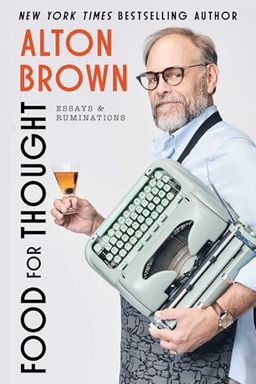
Food For Thought cover

Food For Thought

by Alton Brown

In a collection of essays, the Peabody Award- and James Beard Award-winning chef and TV host chronicles his career.

Food, Memory, and Meaning: Eating Your Life

What’s the one bite you can’t forget—the one that shaped how you taste, cook, or even love? In Food for Thought, Alton Brown argues that food is never just fuel or entertainment; it’s the most reliable lens for understanding a life. He contends that what we cook and how we eat form a running autobiography—stitched from memory, science, craft, culture, and community—that’s as revealing as any diary. But to read your own life through food, you have to notice three entwined forces: nourishment (how food actually works), identity (how it tells you who you are), and connectivity (how it binds you to others).

Brown builds this case through essays that are equal parts kitchen confessional, road memoir, and cultural criticism. A bowl of Cap’n Crunch spiked with buttermilk becomes a lesson in palate shock and curiosity; a French kitchen’s blistering service distills the line between good food and bad; a motel kadhi cooked by a stranger clarifies what hospitality really is. The cumulative argument is simple and subversive: your best education isn’t in restaurants or on streaming screens—it’s in remembered meals, honest cooking, and the people who feed you.

Why This Matters Now

We’re drowning in food images, short-form hacks, and AI-generated recipes, yet cooking at home is in decline and eating together is rare. Brown names the stakes: if food loses its meanings—its stories, scars, and skills—we don’t just eat worse; we live thinner lives. His essays push you to recover the long view: taste as memory, technique as inheritance, eating as relationship. (Compare Michael Pollan’s “cook more” throughlines with Samin Nosrat’s sensory-first practice in Salt, Fat, Acid, Heat.)

What You’ll Find in This Summary

You’ll learn how craft gets forged—not by flashy tools—but by repetition, humility, and a few scars (see the escargot-as-mortar incident under chef P). You’ll watch taste and trauma braid together: a disastrous s’more turns into a decades-later joke from beyond the grave; a cloud of shattered cumin seeds under a supermarket shelf becomes a time machine; a bowl of motel kadhi reframes belonging. You’ll get Brown’s practical playbook for home cooks: which tools to ditch, which hacks save your holiday (the laddered turkey derrick), and why the most expensive ingredient in cooking is time, not truffles.

Food as Culture, Not Costume

Across the book, Brown tackles the appropriation debate with uncommon nuance. Are you “stealing” when you mash miso into pot roast or open a Mongolian restaurant as a non-Mongolian? He lands on a hard-won distinction: appropriation erases and exploits; celebration learns, credits, and expands. His own DNA test—83 percent English with dashes of Sardinian, Portuguese, and French—frees him to cook where he’s from (hello, fish and chips by way of Sephardic cooks) and where he’s been (chicken tikka masala’s Britain-by-Delhi detour). (See also Diana Kennedy on Mexico or Julia Child on France; Brown places himself as a celebrant rather than a claimant.)

Screens, Spectacle, and the Lost Table

Brown’s media insider view—Good Eats, Iron Chef America, Cutthroat Kitchen—lets him explain how food TV and Instagram often turn cooking into “food porn,” a solitary, scrollable substitute for actually eating together. He also shows the counter-model: build a theme song (ten notes), borrow from Mr. Wizard and Monty Python, and teach by making brains laugh. When TV demanded the wrong kind of “pretty,” he fought to keep an ordinary motel kitchen kadhi scene—and lost. That loss becomes a thesis: don’t mistake aesthetics for authenticity; the best meals often wear fluorescent light.

A Life Cooked, Not Assembled

Finally, Brown threads personal change—weight loss gone too far, quitting octopus after a giant Pacific cephalopod remembered his pen, learning to share a kitchen with his designer wife, Elizabeth—into a simple vision of a good life: a roast chicken “Horcrux,” martinis stirred and civilized, a kitchen table large enough for arguments and grace. If you’re hungry for a book that moves from salted science to soul, from dumpster-resident dough to family forgiveness (Aunt Verna’s Ex-Lax coup), this is a voice that teaches by story, not sermon.

Guiding Claim

Food is the most portable form of memory—and the most ordinary form of meaning. Learn to taste your life and you’ll live it more fully.


Craft Over Tricks: How Cooks Are Made

Brown insists you don’t become a cook by buying gear or chasing trends; you become a cook by getting humbled, showing up, and learning to taste. His internship under the tyrannically precise chef P distills it. Saturday night. He’s in the weeds, nine steaks on the grill, three escargot pans under the salamander. A snail superheats, turns mortar, ricochets, brands his wrist. Chef P halts the kitchen and gives the only lesson that ever stuck: “There are two kinds of food: good food and bad food. And in twelve hours, they’re both shit.”

What the Beam Teaches

Chef P’s “beam”—that withering stare before the words land—forces Brown to separate performance from practice. The scar on his wrist outlives culinary school; it becomes a portable reminder: don’t cling to plates or praise. Cook because cooks cook. Pride follows persistence, not plating. (Compare this to Anthony Bourdain’s kitchen gospel: get crushed, come back.) Brown later repeats the mantra to cooks on his teams. No one asks him to explain it, which is fitting: the meaning is made in muscle, not in seminar.

From Actor to Explainer

He then rewires himself to teach on camera. Literally. To deliver Good Eats’ rapid-fire scripts, he trains his mouth to bypass his brain using an earpiece that feeds him his own recorded lines. He learns to talk while thinking something else—an airport-level act of cognitive juggling—and backs it with months of science reading (Harold McGee vibes) so the lines say something worth hearing. The formula—Julia Child’s real-world pragmatism + Mr. Wizard’s experiments + Monty Python’s absurdity—creates a show that makes “laughing brains more absorbent.”

Notes from Kitchen Stadium

On Iron Chef America, he upgrades again: nonstop commentary as white noise so chefs don’t freeze, research decks for each Iron Chef (Flay’s chiles; Morimoto’s mitsuba vs. yomogi), and purposeful on-air “mistakes” to keep discovery authentic. He admits the show supplied menus in advance; the real test wasn’t surprise but execution against a clock. His job: make viewers feel the surprise anyway and never stop translating—what the ingredient is, what it does, and how it tastes. (Think of John McPhee’s methodical voice, but with bonito flakes.)

The Dumpster, the Derrick, and the Discipline

Craft also means learning the physics the hard way. A trash-truck-rescued blob of yeast dough (“Son of Blob”) expands into an eight-yard dumpster, baking itself to the metal in July heat—a lesson in fermentation and heat transfer you don’t forget. So does a flaming-turkey-season: he shoves stuffing atop the hidden giblet bag; the oven becomes a flare stack. Out of that, he designs the “turkey derrick”—ladder + pulleys + cleat—to lower birds safely into oil. Firefighters thank him. (See also J. Kenji López-Alt’s empiricism; Brown’s bent is more boy-scout-engineer-meets-vaudeville.)

Why This Helps You Cook

Take the lesson: skill is less about talent than—

  • Reps: make biscuits a dozen ways, like he did shadowing Ma Mae, until you notice the detail you missed—her arthritic, straight-finger knead that made tenderness possible.
  • Restraint: brine a turkey not to show off but to build insurance; skip basting because water slows browning; salt smart, not loud.
  • Repair: when a luau dessert curdles (fresh pineapple enzymes annihilate gelatin), don’t grandstand—own the chemistry and leave before the piña-colada shrapnel hits the bride.

Craft Credo

Show up, get humble, learn the physics, tell the truth. Everything else—gear, glam, even glory—comes later, if at all.


Taste, Trauma, and the Stories Our Tongues Tell

Brown treats taste like a biography written in bites—some joyful, some scarring, all instructive. Three anchors carry the theme: a cereal catastrophe, a funerary s’more, and a cumin cloud that smells like time. Each shows how flavor fuses with feeling—and why you should mine your own palate history if you want to cook with meaning.

Cap’n Crunch and the Buttermilk Betrayal

North Hollywood, 1966: cartoons whisper, cereal sings, milk is missing. He grabs the green-topped bottle from the stoop—buttermilk—douses the Cap’n, and takes a bite. It’s shock and revulsion; “short-sheeted reality.” After the gag comes curiosity; he tastes again, slowly, and discovers that sweet scratches can negotiate with sour funk. Decades later he remixes the trauma into a savory breakfast: Cap’n Crunch with Pink Lady apples, grated Tillamook cheddar, and buttermilk—finished (maybe) with tamarind salt or garam masala. The point: palates grow; pain can be compost. (Harold McGee would approve of the acid-sugar-texture truce.)

S’mores, Grief, and a Final Prank

At five, he discovers s’mores over the neighbor’s grill—burnt, gooey, illicit magic. Soon after, an ill-timed home marshmallow drops into an ant mound; the ants do what ants do. That night, Aunt Verna (a stealth chocolate hoarder) arrives. After a party, Dad wakes him to ask where he found the chocolate—Verna’s stash. The bathroom scene that follows becomes myth: sounds and smells of gastrointestinal Armageddon; the solemn pact never to speak of it. Years later, after Verna’s funeral, he opens a gift bag—her old tea canister—still heavy. He eats the first five “chocolates” in the car, only to read their debossed truth: Ex-Lax. The road home is… long. A joke forged in love and memory. Eating makes families—even when it gets you.

The Smell of Time (a.k.a. Cumin)

Age fifteen: bag boy, aisle five, summer heat, glass jars fall. A dust-cloud forms under the spice rack. He crawls in to sweep and inhales an aroma his brain has no words for. His Wernicke’s area blurts the only label it can summon: “time.” Later he learns the powder was cumin—Cuminum cyminum—an Old and New Testament traveler perfumed with cuminaldehyde, pinene, cymene, myrcene. He orders whole seeds from a New York shop, toasts them carefully, and never treats cumin as “just” spice again. It becomes a portal. (This is Marcel Proust’s madeleine rerouted through a Kroger; compare to Molly Birnbaum’s Season to Taste on smell’s memory powers.)

The Motel Kadhi That Rewires Belonging

On a cross-country shoot for Feasting on Asphalt (2006), a roadside motor court manager and his wife (Mr. and Mrs. G) invite the crew to dinner. In a two-room apartment-kitchen, she toasts spices in ghee, plucks curry leaves from a potted shrub, stirs chickpea flour into homemade yogurt, and finishes with lime. They eat kadhi standing up, some in styrofoam cups. Willard-level simplicity; Michelin-level soul. Brown is stunned: “no Aunt Léonie in sight,” just a new grammar for comfort. When the network later cuts the scene as “too unattractive,” he names the wound: aspirational aesthetics can erase authentic hospitality. The memory becomes his north star.

Use Your Own Archive

Brown’s challenge to you: catalog your “Meals That Made Me.” What grossed you out then that you now love? Which sound or smell drops you into a year? And what was the kadhi moment—when a stranger’s food redrew your map of home? Write them, cook them, pass them along. The best recipes aren’t formats; they’re transmissions.

Palate Principle

To cook with heart, trace the fault lines where flavor meets feeling—then build bridges across them.


The Home Cook’s Playbook: Tools, Hacks, and Time

Brown strips home cooking to its essentials and gives you three gifts: a ruthless toolkit, a bag of hacks that actually solve problems, and a frank bill for what cooking really costs—time and attention. You don’t need a closet of gadgets; you need a few forgiving multitaskers, a kitchen table, and the courage to learn slow.

Tools: Multitaskers In, Unitaskers Out

He famously bans “unitaskers”—tools that do only one job poorly (garlic presses, banana slicers, countertop egg cookers). Exceptions: fire extinguisher. Instead, recruit multitaskers: spring-loaded tongs; foil; a well-cured 10" cast-iron skillet (roasts chicken, sears steaks, bakes cornbread); a brick wrapped in foil (a panini press, a chicken “under-a-brick,” a doorstop). The guiding rule: if a seventh grader can fix or repurpose it, it’s worthy. (This echoes Tamar Adler’s everlasting usefulness of a pot of water.)

Hacks That Save Holidays

Brown’s hacks arise from physics and humility, not novelty. A few greatest hits:

  • Turkey Derrick: an eight-foot ladder, two pulleys, a carabiner, a cleat, and sash cord let you lower a bird safely into boiling oil. Fewer fires; more feasts. Firefighters have thanked him.
  • Blow-Hard 5000: triple-stack furnace filters bungeed to a box fan dehydrate marinated flank-steak strips into jerky overnight. (Do it in the garage unless you want Buc-ee’s perfume for a week.)
  • Flowerpot Smoker & Liquid Smoke Still: clay pots + hot plate or a chiminea + Bundt pan rig prove you can smoke fish or capture smoke condensate without a thousand-dollar box—because chemistry.

The spirit isn’t “cleverness for likes”; it’s agency. Food engineering belongs at home as much as in labs—just with better manners and fewer conflagrations.

Signature Techniques That Travel

His turkey show (“Romancing the Bird,” 1999) democratized brining: salt-sugar solutions denature proteins, helping meat retain moisture through heat’s squeeze. He kills beloved but counterproductive rituals: basting (added water slows browning and cools the oven), stuffing in the cavity (forces the breast past 165°F). He protects skin with a foil “turkey triangle” and moves aromatics to the cavity microwave-softened, keeping stuffing (er, dressing) outside. He wins succession: countless first-timers become family turkey captains.

The Roast Chicken “Horcrux”

Brown’s private dish is his evolving roast chicken. He’s tried everything—fruit brines, jam under the skin (he asks forgiveness), clay shells. He ends with dry wisdom: truss to “lift and separate,” air-dry under a fan in the fridge, spritz with a saturated brine for even salt (no puddled blotches), then roast at 500°F in a preheated cast-iron skillet for one hour, no basting. Rest, then deglaze the fond with a quick white-wine–mustard–shallot jus. Serve at a table with knives and fingers, salad after. Simple theater, maximal flavor.

The Real Cost: Time (and Attention)

His hardest truth: cooking’s scarcest ingredient is time. You can’t outsource the reps. He calls out a culture that scrolls for “fast and easy” but logs four-plus hours daily on phones. If you can game for thirteen hours a week, you can peel, chop, sauté, clean. Start by reading a recipe twice, seated, with a pencil—no screens. Mise en place is attention embodied. (M.F.K. Fisher would approve; so would Cal Newport.)

Kitchen Math

Fewer tools + smarter hacks + more time = better food (and calmer cooks).


Hospitality, Heritage, and the Appropriation Tightrope

Where does celebration end and appropriation begin? Brown walks the line with stories, not slogans. A DNA test tells him he’s 83.1% English with sprinkles of French, Portuguese, Sardinian—and zero Ashkenazi (sorry, deli dreams). He resists tribal fatalism: identity is not a permission slip; it’s a starting point. He urges two postures when cooking “beyond your blood”: tell the truth about where dishes come from and practice philoxenia—Greek for generous hospitality toward strangers.

Food Is a Trade Route, Not a Fence

Brown shows how national dishes are often mash-ups, and that this hybridity doesn’t cheapen identity; it is identity. Chicken tikka masala is Britain appropriating Delhi’s butter chicken (murgh makhani) by way of empire and immigrant chefs. Fish and chips? Sephardic Jews fleeing the Inquisition brought “fried fish, Jewish fashion” to England; chips arrived later. Even the English table he inherits is part-colonial plunder, part-assimilation lab. (See Krishnendu Ray on immigrant cuisines climbing status ladders; Brown’s gallery of examples is accessible and sly.)

Appropriation vs. Celebration

He proposes a test you can apply: if you “Americanize” a dish, rename it as yours and erase its origin, you’re plagiarizing. If you study, credit, and uplift the source community, you’re celebrating. Would he open a Mongolian restaurant as a non-Mongolian? Only if he were accountable to the tradition, fluent in its flavors, and amplifying Mongolian voices. He cites Diana Kennedy (British) as the most influential English-language chronicler of Mexican cuisines—an outsider who embedded, cataloged faithful techniques, and redirected attention to Mexican cooks. Intent isn’t everything, but it isn’t nothing.

The Three Meanings of Food

In “Hunt and Gather,” he argues food carries three universal meanings: nourishment (chemistry that keeps bodies going), identity (what your grandmother’s burgoo or your family’s okra says you are), and connectivity (how breaking bread turns strangers into neighbors). For the last, philoxenia is the operating system. The motel kadhi embodies it; Instagram often erodes it by turning meals into solitary performance. (Compare Priya Parker’s The Art of Gathering: intention makes community; Brown adds soup.)

When Not Eating Is the Ethic

After an encounter with a giant Pacific octopus at the Monterey Bay Aquarium—tentacles tasting his wrist, stealing his pen, then remembering him months later—Brown stops eating octopus altogether. It’s not a universal law; it’s a personal line where connectivity (recognition, play) trumps culinary pleasure. Food ethics can be local and embodied, not performative.

Teach Kids With “Big-People Food”

He even offers a mischievous parenting tactic: when a child balks, don’t serve the hated thing. Eat it yourself, blissfully, calling it “big-people food.” Curiosity and ego do the rest. The lesson holds for grown-ups: taste is social, not just sensory. Make belonging part of the recipe.

Hospitality Rule

If your cooking honors the people who taught you—even if they never met you—you’re on firmer ground than any passport can offer.


Screens, Spectacle, and the Cost of Food Porn

Brown pulls back the curtain on how media reshapes what and how we eat—and what it erases. He has lit cheese pulls in cinematic slow motion, watched grill marks painted with electric starters, and fought to keep ugly rooms on TV. The throughline: the more our eyes eat alone, the less our bodies and communities do.

Good Eats: The Counter-Model

When he couldn’t stand “dump-and-stir” TV anymore, he built a new grammar: science you can see (why basting fails), comedy that sticks (Spanish Inquisition meets yeast), and a theme song you can hum (ten notes chosen so early ringtones could sing them). He avoids falsifying the food; what’s on the plate is what they cooked. The rule—“laughing brains are more absorbent”—becomes a teaching engine other shows later echo. (Think MythBusters meets Sesame Street with a sauté pan.)

Iron Chef America: Orchestrated Authenticity

He admits ICA wasn’t a pure surprise machine; chefs often had menu frameworks based on a shortlist of secret ingredients. His job wasn’t to fake it; it was to deliver discovery’s feeling faithfully—by researching relentlessly (PowerPoints for each chef), keeping a steady patter so chefs stayed in flow, and sometimes misdirecting on-air so the reveal landed. When Morimoto let marsh crabs skitter the station, Brown googled “sawagani,” grinned, and kept the spell. Authenticity, he suggests, isn’t lack of planning; it’s unforced curiosity with the camera rolling.

Food Porn vs. Communion

He names “food porn” without flinching: hyper-lit sliders, mechanized camera sliders, fog machines, algorithmically calibrated cheese stretches. It raises expectations while lowering participation. It’s also solitary. Like actual porn, it takes a communal act and moves it behind glass, swapping empathy for arousal. Instagram compounds it: some dishes get cooked to be photographed, not eaten; some restaurants light for iPhones, not faces. He isn’t puritan—he has made those shots—but he’s urgent: don’t let spectacle displace supper.

The AI Asparagus Paradox

In a wry test drive of ChatGPT, Brown requests recipes—from “Bobby Flay–inspired red pepper ice cream” to an ingredient grab bag (onion, mayo, three hot dogs, grape jelly). Results are edible-ish until the bot proposes “Butterscotch Dried Shrimp Asparagus Rolls with Pineapple-Lychee Gelatin.” Chemistry says no: raw pineapple enzymes nuke gelatin; crisp asparagus won’t roll around sticky shrimp; there’s no way to secure the bundle. The bot can “write” a recipe because it stitches language; it cannot cook because it has no body, no taste, no physics. Use AI for brainstorms; trust your tongue and stove for truth.

Choose the Table (and the Teacher)

Brown’s answer to spectacle is stubbornly analog: a kitchen table (rectangular, wooden, well-lit), where you can shell beans, do homework, or remove a tonsil in a pinch. Sit. Eat last. Talk. Later, during the pandemic, he and Elizabeth livestream a no-crew Tuesday dinner. Thousands watch—because the dishes are unvarnished, the pantry a mess, and the marriage real. The meta-lesson: if you must watch, watch people actually eat; then go make your own messy meal.

Media Mantra

Let screens teach and entice, but let tables feed and forgive.


From Stage Left to Kitchen Table: Teaching, Marriage, and Being Human

Brown frames cooking as a human art—learned like music, tempered like marriage, practiced like moral attention. Three arcs carry the idea: teaching that actually teaches, a relationship that learned to share the stove, and a civilized sip that measures a day.

What Teaching Is (and Isn’t)

An airport run-in with a veteran teacher, Mrs. Seabold, crystallizes his teaching philosophy. She bristles at Good Eats showing “puppets and props.” He quips; she holds her ground. Years later, he writes what he wished he’d said plainly: no one can make you learn. A teacher’s job is to entertain (hold attention), engage (interlock minds and matter), then empower (hand over the wrench). He quotes his flight instructor: “My job is to keep you alive while you teach yourself to fly.” That’s also how you teach sautéing, sauce, or sanitation.

Marriage, Ceded Territory, and Tuesday Night

When COVID hits, Elizabeth suggests streaming simple home cooking. He says yes—and cook-blocks her without meaning to. He nitpicks knife grips and heat choices, telegraphing the vibe: “This is my sandbox.” Viewers comment, “LET HER COOK.” He watches replays and recoils. Then he lets go. She cooks instinctively—sage where he’d never use it, soups better than his—breaking his rule worship with flavor. The kitchen becomes a duet: he handles meat; she does fish, salads, and soups. The meta: recipes are not the marriage; listening is.

Civilization, Poured and Stirred

Brown’s martini manifesto reads like etiquette with a jigger: London dry gin (Bombay Sapphire at the ready), Italian vermouths (Bordiga extra-dry plus a splash of bianco), Angostura orange bitters (two drops), stirred over good ice, strained into a small Nick & Nora. Garnish with a twist, Castelvetrano olive, or—his favorite—a caperberry. Bond was wrong about shaking; it over-dilutes. Hawkeye Pierce was right: “a very dry, arid, barren, desiccated, veritable dust bowl of a martini”—but only if you also love the table it presides over. The drink is a pause button: a call to taste on purpose.

Diets, Bodies, and Self-Recognition

After seeing a bloated double of himself on an edit bay monitor, he creates the “Diet of Four Lists”: daily (fruits, whole grains, dark leafy greens, nuts, carrots/sweet potatoes, green tea), thrice-weekly (oily fish, yogurt, broccoli, sweet potatoes, avocados), once-weekly (red meat, white starch, dessert, alcohol), and never (fast food, sodas, processed meals, anything labeled “diet”). He loses so much weight he doesn’t recognize himself—voice thins, body chills, life frays. He climbs back to a sustainable self: strong, martinis in moderation, tailored suits, a wife who likes him as he is. Health is not an algorithm; it’s a mirror you can bear.

Last Meal, First Principles

Asked his “last meal,” he resists contrivance. He wants caviar on chips with sake or potato vodka, Elizabeth’s soups, mint-chip “shakes” whisked with hemp milk, and a Lagavulin or Laphroaig by the lake. Maybe a cigar. The point isn’t ingredients; it’s with whom. Sinatra’s line—“Live every day like it’s your last, and one day you’ll be right”—becomes a culinary ethic: cook now, for someone you love, at a table that fits you both.

Human Practice

Teach by delight, love by sharing the stove, and mark the day with a well-stirred thing. That’s civilization, one Tuesday at a time.

Dig Deeper

Get personalized prompts to apply these lessons to your life and deepen your understanding.

Go Deeper

Get the Full Experience

Download Insight Books for AI-powered reflections, quizzes, and more.