
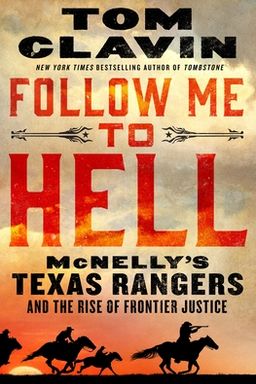
Follow Me To Hell cover

Follow Me To Hell

by Tom Clavin

A portrayal of a ranger named Leander McNelly and his men in 1870s Texas.

From Frontier Chaos to Enduring Institution

How do fragile communities under siege turn improvisation into a lasting institution? In this book, you watch Texas confront relentless frontier violence—Indian raids, lawlessness, and cross-border rustling—and answer not with a single hero but with a shifting blend of militia ingenuity, technology, leadership, and, eventually, professional bureaucracy. The core claim is simple and bracing: the Texas Rangers begin as a practical, ad hoc solution to immediate threats and evolve, through crises and controversy, into a permanent arm of state authority.

From need to name to nucleus

You first meet settlers in the 1820s facing Karankawa raids along the coast, including the bloody Skull Creek retaliation led by Robert Kuykendall. Mexican governance is distant, courts are weak, and property and lives are exposed. Stephen F. Austin’s 1823 call for “men to act as rangers for the common defence” puts a label on what locals already practice: small mounted parties that scout, warn, and strike. That one word—ranger—codifies a role distinct from regular troops and becomes the charter for a tradition (the note scrawled on the back of a land paper later feels like a Ranger Magna Carta).

Fighting a mobile enemy with mobile innovation

As you move into the 1830s–1840s, the Comanche showcase how hard the frontier fight will be: lightning raids, mastery of the horse, and deep terrain knowledge. Texans counter by going fully mounted and embracing technology—most famously the Colt Paterson and then the Walker Colt. Jack Hays and Sam Walker pair revolvers with tight, aggressive formations, turning fights like Walker’s Creek (1844) into demonstrations that repeating pistols can break mounted charges. This is warfare by feedback loop: raids spur adaptation; innovations bend strategy (a pattern you can trace across North American frontiers).

Leaders as force multipliers

Personalities matter. Hays experiments and teaches a generation to ride and shoot in motion. John “Rip” Ford pursues deep into Comancheria in 1858, Tonkawa allies in tow, showing how political mandate unleashes cross-border strikes. Mathew Caldwell and Ben McCulloch add steadiness and fieldcraft. Then, in the Civil War’s Sibley campaign, a young Leander McNelly absorbs hard lessons—logistics matter, reconnaissance saves lives, and small-unit discipline turns chaos into action (Valverde’s fleeting success contrasted with the supply disaster at Glorieta Pass).

Reconstruction crisis and institutional reset

After the war, Governor Edmund Davis tries to fix pervasive violence with a centralized State Police and Frontier Force. The idea is bold—protect freedmen and enforce law statewide—but legitimacy collapses under abuse (Jack Helm’s extrajudicial killings) and scandal (chief James Davidson’s $38,000 embezzlement and flight to New Zealand). Meanwhile feuds (Mason County Hoodoos; Sutton-Taylor) and outlaw celebrities (John Wesley Hardin) push counties to the brink. The response is structural: Governor Richard Coke’s Frontier Protection Act (1874) creates the Frontier Battalion under Major John B. Jones, marrying pay, supply, and command to frontier flexibility.

McNelly’s border crucible and the edge of the law

Within the battalion, McNelly becomes the stark embodiment of frontier authority. He builds spy networks, stages public theater (funerals and displays designed as deterrence), and uses brutal interrogation via Jesus “Old Casuse” Sandoval to pry loose intelligence. In the Nueces Strip—where 100,000 head vanish into Mexico between 1865 and 1873—he partners with rancher Richard King, curbs vigilantes with a pronunciamiento, and then crosses the Rio Grande at Las Cuevas in November 1875, sparking an international standoff. With the U.S. Army’s Gatling gun guarding the north bank, McNelly holds his ground and forces cattle returns, punctuating it all with the incendiary retort to Washington: “Tell him and his United States soldiers to go to hell.”

From heroics to housekeeping

The final turn is institutional. Arresting King Fisher shows the limit of force without trusted courts; local bondsmen and friendly judges undo hard-won captures. The legislature appoints Jesse Lee “Red” Hall to bring steadier administration, while McNelly—ill with tuberculosis and politically out of step—retires and dies at 33 in 1877. By then, the Rangers have transitioned from crisis improvisers to a standing arm of state power. Journalists and memoirists—Thomas C. “Pidge” Robinson, N. A. Jennings, George Durham—mythologize the journey, ensuring public memory admires audacity even as the institution embraces paperwork and regularity (note the historiographical caution in Walter Prescott Webb and Robert Utley).

The throughline

You witness a frontier society solve a hard problem: transform reactive militias into a durable, state-backed force. Technology, leadership, and legitimacy each have their hour; only together do they produce order that lasts.


Improvised Birth of Rangers

The Rangers begin as a grassroots answer to raids, rustling, and the weakness of distant authority. In the early 1820s, Anglo colonists living along Texas’s coast face the Karankawa and other tribes in a grim cycle of attack and reprisal—Skull Creek stands out as a settler retaliation under Robert Kuykendall that leaves scores dead. With Mexican officials far away and justice inconsistent, settlers do what frontier communities across North America do: form mounted militias to scout, warn, and fight.

Austin names and frames the role

Stephen F. Austin’s 1823 call for “men to act as rangers for the common defence” gives a distinct identity to these ad hoc patrols. The term suggests mobility, local knowledge, and rapid response rather than barracks-bound soldiery. Austin’s colonization framework (seeded by Moses Austin’s earlier grant and brokered with help from the Baron de Bastrop) positions Anglos as buffers—useful to Mexico in holding off hostile tribes and foreign encroachments. That political calculus keeps the militias semi-sanctioned even before formalization (compare to colonial-era rangers in the Northeast who guarded borders without full regular status).

From scattered patrols to recognized companies

In the 1820s–1830s, the word “ranger” covers a spectrum: ten-man outfits like Moses Morrison’s company, neighborhood levies that ride a few weeks at a time, and escorts for settlers and supply trains. The Permanent Council in 1835 begins electing Ranger officers explicitly to “range and guard the frontiers,” anticipating the more formal roles the Rangers will play in the Texas Revolution. These companies scout for armies, carry dispatches, and screen settlements—functions that blend military reconnaissance with policing. You can see a dual identity forming: a soldier-police hybrid capable of acting fast in any direction.

Tasks that define a culture

Early Rangers do what the job will always require: track raiders, read sign, use cover, and live in the saddle. They escort vulnerable parties through contested country and learn to make camp light and fight mounted. Because pay is unreliable, land and loot sometimes replace wages, and chits pile up waiting for legislative redemption. Hardship becomes part of the occupational identity, and so does community expectation—families rely on men they know rather than strangers sent from afar (a recurrent source of local legitimacy).

Political scaffolding follows practice

As the Republic forms and then gives way to statehood, the scaffolding grows. Muster rolls, contracts for supplies, and chains of command gradually harden. Even so, Ranger companies remain light and flexible, often raised for a campaign and disbanded after. The evolution is uneven: in moments of crisis—Comanche raids or Mexican incursions—Rangers surge; in lulls, the state pares back funding. That “on-demand” habit will haunt Texas during Reconstruction when episodic forces prove too brittle for systemic violence (a contrast that sets up the Frontier Battalion in 1874).

Continuity amid change

Despite new names and paperwork, core practices hold. Whether in the Revolution, the Republic, or early statehood, Rangers carry local intelligence into the field and translate it into speed. They ride where regular troops cannot and show up where courts cannot reach. The culture grows leader by leader—Caldwell teaches patience under fire; McCulloch models bushcraft; Hays introduces aggressive mounted pistol work—until the “Ranger way” is as much a set of shared habits as a formal doctrine.

The origin lesson

Institutions often emerge from what works on the ground. Naming, paying, and equipping catch up later; the practice of protection comes first.


Warfare and Tactical Shifts

Texas’s frontier wars are a duel of adaptations. The Comanche, masters of the southern plains, build their power on mobility, horses, and fast violence. Texans, initially outmatched, learn to ride and shoot in motion and adopt repeating pistols that radically increase short-range fire. That interplay—raid, response, innovation—drives the narrative from the Council House debacle through the Great Raid and into set-piece fights where technology narrows the gap.

Comanche methods, settler vulnerability

Comanche war parties favor speed and surprise. They strike settlements, seize horses and captives, and vanish into the grasslands. The 1840 Great Comanche Raid, led in part by Buffalo Hump, hits Victoria and Linnville, sacking the port and forcing civilians to flee by boat. Western-style infantry cannot catch mounted raiders; dismounted militia fare little better. Geography and horse culture are the Comanche’s advantages, and they wield them without sentiment.

Diplomacy fails, violence escalates

The Council House fight in San Antonio is a seminal cautionary tale. Texans and Comanches convene to negotiate, but mistrust, hostages, and miscommunication turn parley into massacre. The aftermath includes the Great Raid—proof that failed diplomacy can supercharge violence. For you, the lesson is durable: when talks collapse amid bad faith and cultural gaps, the next encounter is often on worse terms (a theme echoed in later border dealings).

Hays, Walker, and the Colt revolution

Jack Hays’s companies begin to carry Colt Paterson revolvers—five-shot pistols that, used in pairs, give a rider ten rapid shots without reloading. Sam Walker refines the concept with Samuel Colt, yielding the heavier, harder-hitting Walker Colt. At Walker’s Creek (June 8, 1844), Hays’s Rangers meet Yellow Wolf’s Comanches and use mounted volleys of pistol fire to disrupt charges. The result—dozens of Comanche casualties to minimal Ranger losses—signals a tactical shift. The pistol ceases to be a backup and becomes the main offensive tool.

From frontier to national war

When the U.S. invades Mexico in 1846, Ranger skills scale up. Hays and Sam Walker scout for Zachary Taylor and win reputations at Monterrey. The War Department buys Walker Colts—an institutional nod to frontier innovation (President Polk’s administration sees utility beyond Texas). Rangers show that irregular tactics—fast reconnaissance, snap ambush, and mounted marksmanship—translate into conventional theaters, foreshadowing later U.S. cavalry doctrine.

Limits and consequences

Technology and tactics chip away at Comanche dominance, but they do not erase the human cost. Raids, reprisals, and counter-raids leave settlements traumatized and tribal communities battered. Even victories like Plum Creek and Moore’s October 1840 chase recover property without resolving underlying conflicts. Over time, however, repeating firearms, more settlers, and constant Ranger pressure shrink Comanche room to maneuver (a pattern mirrored in other plains wars, as Robert Utley and others document).

Tactical takeaway

On a fast frontier, the side that marries mobility to firepower gains leverage. Repeating pistols on horseback are the hinge that swings Texas’s door toward control.


Captains and Culture

Personal leadership repeatedly sets the tone for how the Rangers fight and how Texans remember them. You track a line from Jack Hays’s innovation to Rip Ford’s ruthless offensives, from Mathew Caldwell’s patience to Ben McCulloch’s pragmatism, and then to Leander McNelly’s audacious, intelligence-driven policing. Each leader brings a different blend of courage, technique, and political reading that shapes the force’s culture.

Hays: practice outpaces doctrine

Hays exemplifies the learn-by-doing ethos. He arms men with twin Colts and insists they stay mounted in a fight—a departure from dismount-and-fire habits. By tying pistol volleys to aggressive maneuver, Hays builds confidence on contact and trains men to keep initiative (you can feel his imprint later when Rangers in the Nueces Strip close fast on rustlers rather than shadowing them).

Ford: mandate plus momentum

In 1858, Governor Hardin Runnels gives John “Rip” Ford a sweeping order to “follow any trail.” Ford recruits Tonkawa allies under Chief Placido and hit Comanche camps at Antelope Hills, carrying the fight deep into Comancheria. The operations push—some would say breach—treaty boundaries, showing how political backing enables commanders to expand the battlespace. Ford’s style is effective and fearsome, creating a template for punitive expeditions (and a shadow for later debates about cross-border chases).

Caldwell and McCulloch: temperament as tactic

Mathew “Old Paint” Caldwell’s steady patience at Salado Creek models how restraint under pressure wins fights. Ben McCulloch, admired for fieldcraft, puts scouting discipline at the center of operations. Their presence reminds you that leadership is not all dash; calm coordination and good eyes on the ground prevent ambushes and save lives.

Civil War crucible: Sibley’s lesson

The Sibley Brigade’s 1862 thrust into New Mexico is audacious and flawed. It wins at Valverde but falters at Glorieta Pass when Union forces burn Confederate supplies; logistics, disease, and Sibley’s alcoholism undo the campaign. Leander McNelly, a young private turned staffer under Tom Green, learns hard truths: bold plans die without beans and bullets; small units matter when armies stumble; and reconnaissance is oxygen. Those lessons travel with him into Reconstruction policing—he will organize tight, mobile squads that live off speed and information.

Leadership as a lever of memory

Because Rangers operate in small, visible companies, captains loom large in public memory. Their choices—whether to parley, pursue, or punish—become the force’s reputation. Later chroniclers (Jennings, Durham) cast these leaders as archetypes, amplifying virtues and blurring flaws. Hays becomes the innovator, Ford the avenger, Caldwell the rock, McCulloch the scout, McNelly the relentless hunter. The mosaic is powerful precisely because it’s personal.

Leadership lens

On a frontier where law travels on horseback, the captain’s habits become the institution’s habits—until bureaucracy finally catches up.


Reconstruction, Feuds, and Reform

After the Civil War, Texas confronts a domestic battlefield: racial violence, feuds, and organized rustling. Governor Edmund Davis’s solution is to centralize law enforcement with a State Police and Frontier Force—paid, statewide, and (in theory) professional. You see how good intentions crash into bad conduct, fiscal scandal, and public fury, and how that collapse sets the stage for a durable fix: the Frontier Battalion.

An ambitious but brittle State Police

Davis funds companies, appoints officers, and tasks them with protecting freedmen and enforcing the law in hostile counties. But legitimacy is the oxygen of policing, and it drains fast. Jack Helm’s extrajudicial killings (notably the Kelly brothers incident) make the force look like a terror squad; communities stop cooperating. Then comes the thunderclap: adjutant general and police chief James Davidson embezzles nearly $38,000 and vanishes—years later surfacing in New Zealand. The force, already despised, loses any moral shield and is abolished in 1873.

The Terrible Seventies: feuds as micro-wars

Local order craters in places like Mason County, where the Hoodoos hang prisoners and torch a courthouse in 1877, and in DeWitt County, where the Sutton-Taylor feud metastasizes. John Wesley Hardin, allied by marriage and friendship to Taylor kin, turns the feud lethal and mobile. He kills officer J. B. Morgan in Cuero and helps assassinate Jack Helm in Albuquerque (Texas) on July 18, 1873. After Hardin kills Deputy Charles Webb in Comanche in May 1874, lynchings follow, jails are breached, and the county descends into reprisal logic.

Pressure forces a structural fix

Governor Richard Coke reads the moment: episodic posses and tainted state police cannot stabilize systemic violence. In spring 1874, the Frontier Protection Act creates the Frontier Battalion under Major John B. Jones and Adjutant General William Steele. Pay is standardized ($40 for privates, $100 for captains), rifles and ammunition come from the state, and service terms allow scaling to local crises. Jones reports forty-plus contacts with Indian raiders in six months and leads men himself at Lost Valley (July 12, 1874)—a signal that this new force blends administration with field leadership.

Deploying personality within structure

Within the battalion framework, the state creates a special unit for DeWitt County: Washington County Volunteer Militia Company A, captained by Leander McNelly. He brings method—intelligence networks, decisive raids, and theater—to quell a feud that sheriffs and juries cannot. From there, he and his men pivot to the Nueces Strip to face cross-border rustling, carrying the battalion’s hybrid DNA: bureaucratic backbone plus frontier daring.

Institutional lesson

Reform works when it pairs clean administration with capable field leadership. Without both, either corruption or chaos returns.


McNelly’s Frontier Method

Leander H. McNelly is the paradox at the heart of this story: a frail, tubercular man who imposes order through audacity, intelligence work, and theatrical deterrence. If you want to understand how authority operates in a vacuum, study his command style: rapid decision, ruthless information extraction, alliances with local elites, and a practiced willingness to skate the edge of the law.

Command by spectacle and resolve

McNelly treats optics as a weapon. He parades through hot spots like Clinton during the Sutton-Taylor conflict, stages funerals that broadcast sacrifice, and sometimes arrays the bodies of slain rustlers where towns can see them. The message is simple: the state is present, deadly, and unafraid. His signature exhortation—“I may lead you into hell, but I’ll get you out if you do exactly as I tell you”—binds men through clarity and courage.

Intelligence first, always

Before he moves, McNelly listens. He plants informants inside hostile households—one lives with Joseph Tumlinson, another with Bolivar Pridgen—and sends trusted sergeants like George Hall and John Armstrong to infiltrate camps. He pairs human sources with speed: once a herd or gang is located, he rides at once, aiming to intercept before the border erases jurisdiction. In a world without modern communications, this network becomes his telegraph.

The dark art of interrogation

Results trump process in McNelly’s calculus, and the means are grim. Jesus “Old Casuse” Sandoval—a man with his own vendetta after bandits raped his family and burned his home—serves as interrogator. He hoists prisoners to choking point, lowers them, and repeats until names and routes spill out; sometimes men die. It shocks modern sensibilities and troubled contemporaries, too, but in the Nueces Strip’s violent arithmetic, information saves patrols and recovers cattle. The moral cost, however, lingers in the record (and in later historiography’s ambivalence about Ranger legend).

Legal ambiguity as operational space

McNelly drapes his moves in whatever legitimacy he can stitch together: deputations, a friendly civil officer along for arrests, or a nod from the adjutant general. But when he deems it necessary, he crosses the Rio Grande, a decision that antagonizes both the U.S. Army and the State Department. His famous response to a Secretary of War order to withdraw—“Tell him and his United States soldiers to go to hell”—is political theater and operational cover. It plays to Texans who crave protection and infuriates officials charged with avoiding international incidents.

Elite alliances and administrative blind spots

McNelly’s partnership with ranch baron Richard King is decisive: fresh remounts, fodder, and supplies extend Ranger reach. In return, King gets the only thing that will keep his vast herds intact—force credibly applied. The cost of McNelly’s tempo is paperwork; reports are late or thin, and political allies grow uneasy. That gap becomes a liability as the legislature pivots toward tighter oversight and steadier captains like Jesse Lee “Red” Hall.

Method distilled

Speed, spies, spectacle—and a cold willingness to push the law’s edge—let a small unit impose order where institutions are thin.


Border War and Aftermath

The Nueces Strip between the Nueces River and the Rio Grande is where the book’s themes converge: porous borders, private power, vigilante spirals, and a state trying to project authority. From mass raids to an international standoff at Las Cuevas, you see how close law enforcement rides to the line between policing and war—and how the Rangers inch from charisma to institution.

A corridor of theft and reprisal

Between 1865 and 1873, an estimated 100,000 cattle cross into Mexico as loot. Geography favors rustlers: long distances, sparse towns, and buyers just across the river. In March 1875, as many as 150 raiders cross near Eagle Pass and splinter into groups that kill, burn, and loot, striking as far as Nuecestown. Local “minute companies” strike back indiscriminately, harassing Tejanos and Mexican rancheros and escalating ethnic violence. Order collapses; the line between suspect and neighbor blurs in smoke.

McNelly’s intervention

Adjutant General William Steele orders McNelly to “subdue or destroy” armed bands. McNelly starts with a pronunciamiento telling vigilantes to stand down, then recruits spies, leans on Richard King for horses and stores, and rides to the river crossings. In June actions, the Rangers tangle with rustlers and suffer the death of “Sonny” Smith, the company’s youngest trooper; his June 16 funeral becomes a public ritual of resolve that rallies settlers to Ranger methods.

Las Cuevas: a border crossed

On November 19, 1875, fog cloaks a small Ranger force as it crosses into Mexico. They first hit the wrong ranch—Rancho Cachattus—killing several men before shifting to Rancho Las Cuevas, the suspected depot. Facing hundreds, McNelly digs in on the south bank and trades fire. U.S. Army officers Randlett and Clendenin refuse to cross but emplace a Gatling gun on the north bank, deterring a mass countercharge. Dr. Alexander Manford Headley rides under a flag to parley; McNelly refuses to withdraw. The press splashes his profanity toward the Secretary of War across the nation, making him a folk hero to Texans and a problem to diplomats.

Death Squad and recovery

Days later, McNelly forms an eleven-man “Death Squad,” crosses again to Camargo, and forces the Mexican commandant to open pens at gunpoint. Accounts vary on exact numbers recovered, but the symbolism dominates: the Rangers will violate custom and risk incident to get Texans’ cattle back. That message—state muscle in defense of property—is what frontier constituencies most crave.

Limits, transition, and legacy

Arresting the border’s princeling outlaw, John King Fisher, on June 4 shows both Ranger reach and judicial fragility. Fisher smiles, surrenders, posts bond, and walks; local courts bend under pressure. The legislature tightens oversight and brings in Jesse Lee “Red” Hall, a steadier hand who files reports, runs long sweeps (Goliad, Eagle Pass), and keeps politics calmer. McNelly, sick with tuberculosis, testifies in Washington, leaves service, and dies on September 4, 1877 at age thirty-three. In the epilogue arc, Hardin is captured by John Armstrong in 1877 and serves a long prison term; Fisher later turns lawman before dying violently in 1884. The institution outlives the men.

Myth and memory as force multipliers

Reporters and memoirists—Thomas C. “Pidge” Robinson in the Austin Statesman, N. A. Jennings in A Texas Ranger, and George Durham from King Ranch—turn these episodes into enduring legend. Their dispatches recruit, reassure, and sometimes exaggerate; they also pressure officials to tolerate extra-legal methods that “work.” Historians later cross-check their tales against telegrams and Army reports, mapping where heroics shaded into hype (note the cautions in Walter Prescott Webb’s classic synthesis and Robert Utley’s borderlands studies).

Enduring pattern

Frontier order arrives first through charismatic force and only lasts when institutions tame, channel, and standardize that force.

Dig Deeper

Get personalized prompts to apply these lessons to your life and deepen your understanding.

Go Deeper

Get the Full Experience

Download Insight Books for AI-powered reflections, quizzes, and more.